Advanced technology can help farmers get to the root of a growing problem ¾ overwatering in an era of increasing drought and water scarcity. A new UC Riverside system can map soil moisture tree by tree, so growers water only where and when it’s needed.
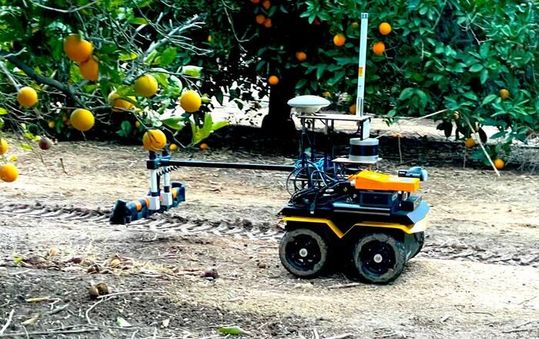
A robot designed to assist with precision irrigation in action, in a citrus orchard.
(Source: Elia Scudiero/ UCR)
Water management is one of the biggest challenges facing agriculture in California and other dry regions. Currently, some growers rely on soil moisture sensors buried in the ground to determine when to irrigate. These sensors are expensive and typically installed in only a few locations, leaving growers to guess how conditions vary across hundreds or thousands of trees.
“The information those sensors provide is very limited,” said Elia Scudiero, associate professor of precision agriculture and the Director of UCR’s Center for Agriculture, Food, and the Environment (Cafe)..“It really only tells you what’s happening in the immediate areas where they’re placed.”
Even when sprinkler systems deliver the same amount of water throughout an orchard, the soil moisture and its availability to trees can vary greatly from spot to spot within a single field.
One reason is soil texture. Fine soils packed with tiny particles hold water tightly because they have more surface area where water can cling. Sandy soils contain larger particles and fewer small ones, which allows water to drain more quickly. These differences can leave neighboring trees experiencing very different conditions.
The new system replaces limited sensor data and guesswork with detailed maps. A robot moves through an orchard measuring a property of the soil called electrical conductivity. These readings, combined with data from the fixed moisture sensors already in the ground, allow researchers to build a statistical model that predicts water content across the entire field.
Electrical conductivity indicates how easily electricity moves through the soil and is influenced by factors including moisture as well as salt and clay content. By pairing those measurements with direct water readings from buried sensors, the system can translate conductivity into accurate estimates of soil moisture. The result is a tree-by-tree picture of water distribution. “Using this method, growers will finally know how much water they have, and how much they need, and can water specific trees if they’re dry,” Scudiero said.
Maintaining the right moisture level is important for plant health. Trees that receive too little water become stressed, and more vulnerable to pests and disease. Too much water, however, can deprive roots of oxygen as soil pores fill with water rather than air. “There’s a sweet spot,” he said.
Enhanced precision could also keep orchards from folding. Growers already face tightening regulations on groundwater use while water costs continue to rise. “If water becomes limited, farmers have two choices,” Scudiero said. “They can retire orchards, or they can find ways to produce the same crops using less water.”
The technology may also reduce fertilizer pollution. When fields are overwatered, nutrients applied to crops can wash below the root zone and into groundwater, polluting it. “If you apply only the amount of water the plants actually need, you reduce the risk of washing those nutrients away from the roots of the crops and into the environment,” Scudiero said.
This project has been years in the making. Researchers began developing it in 2019 through collaborations between agricultural scientists and engineers at “Cafe”. For Scudiero, it represents the realization of a long-standing goal. He has studied soil conductivity technology for about 15 years and had hoped to someday pair it with autonomous vehicles capable of surveying entire fields.
The team has already filed a patent related to how the robot interacts with sensors without disturbing their measurements. This research was conducted at the UCR Citrus Research Center & Agricultural Experiment Station. Future work will focus on testing the system with commercial growers beyond the university’s research orchards.
Moving from research plots to real farms will require rugged machines capable of operating in all weather conditions and across different crop systems. Private industry partners may eventually adapt the technology into commercial products. The work is part of broader efforts at UCR to further the field of precision agriculture, where researchers are developing technologies that combine robotics, sensors, and data science to help farmers manage resources more efficiently.
Date: 08.12.2025
Naturally, we always handle your personal data responsibly. Any personal data we receive from you is processed in accordance with applicable data protection legislation. For detailed information please see our privacy policy.
Consent to the use of data for promotional purposes
I hereby consent to Vogel Communications Group GmbH & Co. KG, Max-Planck-Str. 7-9, 97082 Würzburg including any affiliated companies according to §§ 15 et seq. AktG (hereafter: Vogel Communications Group) using my e-mail address to send editorial newsletters. A list of all affiliated companies can be found here
Newsletter content may include all products and services of any companies mentioned above, including for example specialist journals and books, events and fairs as well as event-related products and services, print and digital media offers and services such as additional (editorial) newsletters, raffles, lead campaigns, market research both online and offline, specialist webportals and e-learning offers. In case my personal telephone number has also been collected, it may be used for offers of aforementioned products, for services of the companies mentioned above, and market research purposes.
Additionally, my consent also includes the processing of my email address and telephone number for data matching for marketing purposes with select advertising partners such as LinkedIn, Google, and Meta. For this, Vogel Communications Group may transmit said data in hashed form to the advertising partners who then use said data to determine whether I am also a member of the mentioned advertising partner portals. Vogel Communications Group uses this feature for the purposes of re-targeting (up-selling, cross-selling, and customer loyalty), generating so-called look-alike audiences for acquisition of new customers, and as basis for exclusion for on-going advertising campaigns. Further information can be found in section “data matching for marketing purposes”.
In case I access protected data on Internet portals of Vogel Communications Group including any affiliated companies according to §§ 15 et seq. AktG, I need to provide further data in order to register for the access to such content. In return for this free access to editorial content, my data may be used in accordance with this consent for the purposes stated here. This does not apply to data matching for marketing purposes.
Right of revocation
I understand that I can revoke my consent at will. My revocation does not change the lawfulness of data processing that was conducted based on my consent leading up to my revocation. One option to declare my revocation is to use the contact form found at https://contact.vogel.de. In case I no longer wish to receive certain newsletters, I have subscribed to, I can also click on the unsubscribe link included at the end of a newsletter. Further information regarding my right of revocation and the implementation of it as well as the consequences of my revocation can be found in the data protection declaration, section editorial newsletter.
For growing facing limited water supplies, the payoff for this research could be significant. “More crop per drop!” Scudiero said.
Original Article: Robotic mapping of soil volumetric water content with geospatial soil apparent electrical conductivity in micro-irrigated citrus orchards in California; Computers and Electronics in Agriculture; DOI:10.1016/j.compag.2026.111540




:quality(80)/p7i.vogel.de/wcms/5e/ae/5eae9dcbba6d172fac2b07b7aef05d3f/0130484643v2.jpeg "The chemical processes occurring when the light interacts with the plastic when it is dissolved causes the reaction to glow blue. (Source: University of Bath)")
:quality(80)/p7i.vogel.de/wcms/e5/9c/e59c5dd9fe4308acae7d5c6de8038c88/0130484607v1.jpeg "A close-up of a laser-directed energy deposition (LDED) system fabricating the novel AI-designed ultra-high strength steel, which achieves a rare balance of strength and ductility, excellent corrosion resistance, and requires only 6 hours of single-step heat treatment at low cost. (Source: Yating Luo et. al.)")
:quality(80)/p7i.vogel.de/wcms/5b/b6/5bb6c39a72c5852361fa904e2e9d8a49/0130484591v1.jpeg "Vehicle-to-grid (V2G) technology — software that allows charging stations to communicate with the grid — bridges both challenges, allowing EVs to both draw power and send it back when needed. (Source: free licensed)")
:quality(80)/p7i.vogel.de/wcms/6e/a8/6ea8f1ae8dd3d2bf84a941bae68e9a16/0130484528v1.jpeg "Highly porous biochar from spent coffee ground for fully green thermal insulating composites with thermal conductivity of 0.04 W m−1 K−1 (Source: Sung Jin Kim/ Seong Yun Kim)")
:quality(80)/p7i.vogel.de/wcms/6e/7c/6e7c762e933c938a92431a785df4690f/0130440213v2.jpeg "Biotech Fluidics' valving solutions offer low swept volume and eliminate reagent carryover concerns. (Source: Biotech Fluidics)")
:quality(80)/p7i.vogel.de/wcms/b0/0b/b00b237311ce4ceb03b2ba1136b6b074/0130440144v2.jpeg "Azenta Life Sciences offers a range of low binding consumables that deliver consistent performance from sensitive applications that require low DNA input such as Next Generation Sequencing and Molecular Biology. (Source: Azenta)")
:quality(80)/p7i.vogel.de/wcms/6c/ef/6cef060860810f12200fbd6d56884e9d/0130440127v2.jpeg "The Automated Plate Seal Remover from Azenta Life Sciences is a compact system for removing seals from a wide range of microplates at the single touch of a button, without damaging the plate or seal. (Source: Azenta )")
:quality(80)/p7i.vogel.de/wcms/14/ca/14ca189a5a6a5ac4c434039fc35af36c/0130440109v2.jpeg "Afys3G has launched the Information Marking System Lambda768. (Source: Afys3G)")
:quality(80)/p7i.vogel.de/wcms/f6/3d/f63d5aa4c99a79e3cfe9e1bf8c1595f3/0130484550v1.jpeg "A robot designed to assist with precision irrigation in action, in a citrus orchard. (Source: Elia Scudiero/ UCR)")
:quality(80)/p7i.vogel.de/wcms/5d/bb/5dbb962b09bae1c078a8ff996666bc8e/0130386229v2.jpeg "This image created using Gemini Pro, depicts an activated carbon fiber functionalized with amine groups (–NH2) at adjacent positions. This arrangement improves the energy efficacy of key interactions, enabling the desorption of captured carbon dioxide at lower temperatures. (Source: Gemini / Yasuhiro Yamada/ Chiba University / KI-generiert)")
:quality(80)/p7i.vogel.de/wcms/21/9b/219b000051ab1ea14ab5f92e4fd0f9bb/0130384937v2.jpeg "Deforestation in the Appalachian mountains. (Source: Alex Diaz on Unsplash)")
:quality(80)/p7i.vogel.de/wcms/e9/9c/e99cb19231197af70c489cb4acc2ead0/0130293444v2.jpeg "A new global study, led by researchers at Kaust in Saudi Arabia, shows that forests are most effective for climate regulation when conserved or restored in their natural or native locations. (Source: Kaust )")
:quality(80)/p7i.vogel.de/wcms/4c/df/4cdf172835be728c9ecb68ec309acca1/0130465673v2.jpeg "Peaches are climacteric fruits, which means they continue to ripen after being picked. The recommended storage temperature is 0°C, otherwise there is a risk of cold damage. (Source: Dall-e)")
:quality(80)/p7i.vogel.de/wcms/2a/07/2a0737995810d504b318f8a0f9ac2c3d/0130386209v1.jpeg "Simple, repeatable eating habits may help people stick to diets, see better results, study says (Source: free licensed)")
:quality(80)/p7i.vogel.de/wcms/6f/ba/6fba92196d0cbb1467334f8a2ecc520a/0130203021v2.jpeg "Low to moderate wine consumption shows lower risk compared with spirits, beer and cider (Source: free licensed)")
:quality(80)/p7i.vogel.de/wcms/a9/37/a9376f1d9a893570023d9aa97c085bc5/0129927485v2.jpeg "Examples of foods high in PUFAs include fatty fish and soybeans, while MUFAs include olive oil and avocadoes. (Source: free licensed)")
:quality(80)/p7i.vogel.de/wcms/40/c0/40c0c09c2bad7b925a069edbbac90621/0130385557v1.jpeg "When a stroke damages brain tissue (red) along an important movement pathway (yellow), the injured side of the brain may show faster aging (red), while parts of the opposite side may appear relatively “younger” (blue) as the brain tries to compensate. This pattern is linked to more severe movement problems and less recovery.
(Bild: Stevens INI)")
:quality(80)/p7i.vogel.de/wcms/32/14/3214c28a03f71ad067c5f27e5bd6772b/0130386218v1.jpeg "Antimicrobial-resistant Salmonella poses severe challenges to global food safety and public health. (Source: free licensed)")
:quality(80)/p7i.vogel.de/wcms/30/2e/302e195d532fc9aced73406b07642b57/0130384900v2.jpeg "Sleeping for 11 minutes more, doing an additional 4.5 minutes of moderate-to-vigorous physical activity, and eating additional quarter of a cup of vegetables were associated with a 10 % reduction in major cardiovascular events. (Source: Pixabay)")
:quality(80)/p7i.vogel.de/wcms/47/41/4741ee3c589369a09ab0e3a26b7143f0/0130384858v2.jpeg "A female, Aedes aegypti mosquito, after taking her blood meal. (Source: Lauren Bishop CDC)")
:quality(80)/images.vogel.de/vogelonline/bdb/1710600/1710675/original.jpg "Discover how to set yourself up for success when performing balance-based density determination of solids such as jewelry and precious metals. (Mettler Toledo)")
:quality(80)/images.vogel.de/vogelonline/bdb/1682500/1682579/original.jpg "The new XPR Analytical balance redesigned to meet the needs of laboratory technicians of working fast and lean. (Mettler Toledo)")
:quality(80)/images.vogel.de/vogelonline/bdb/1677000/1677080/original.jpg "Enhance your weighing accuracy, comfort and productivity with the redesigned XPR Analytical balance. (Mettler Toledo)")
:fill(fff,0)/p7i.vogel.de/companies/5f/3f/5f3f63ceedc78/knf-logo.jpg "KNF_Logo.jpg (www.knf.com)")
:fill(fff,0)/p7i.vogel.de/companies/69/b7/69b7f63f311d9/logo-bimos-tif--2-.jpeg "logo-bimos-tif--2- (https://www.bimos.com/de-de/)")
:quality(80)/p7i.vogel.de/wcms/2d/45/2d45aba62f5042baa00f7fd4fa629839/0130036533v2.jpeg "The population of Pune, India, is expected to reach 11 million by 2050. (Source: free licensed)")
:quality(80)/p7i.vogel.de/wcms/3f/88/3f880e6ae4e489c7e34f542e63cc20c5/0128661583v2.jpeg "The research combined survey data from 365 cocoa-producing households with rainfall measured via satellites covering 44 villages across five major cocoa-growing regions in Ghana. (Source: Amanda Cooke)")
:quality(80)/p7i.vogel.de/wcms/85/42/85423f3382c25d1ae0ac5645e969cd36/0128898289v2.jpeg "Dr Arya Gopinath Madathil Pulikkal (left) and Asst Prof Andy Tay (right) in front of a small greenhouse containing Choy Sum plants. (Source: NUS)")