New research reveals that the sensitive inner layer of teeth, dentine, first evolved in the armor of ancient fish — not for chewing, but for sensing their environment. The discovery reshapes our understanding of how teeth developed and blurs the evolutionary line between vertebrates and invertebrates.
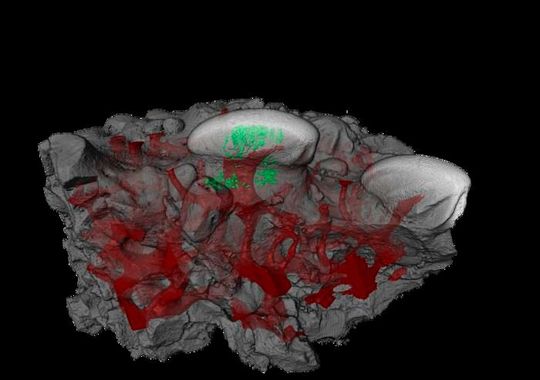
CT scan of the tooth-like-odontode structure from Astrapsis, an ancient jawless vertebrate fish. The tubules (shown in green) are filled with dentine, the same material that makes up the sensitive inner layer of modern teeth. In red is the vascular system which would have housed the nerves in life allowing for sensation to be transmitted.
(Source: Yara Haridy)
Anyone who has ever squirmed through a dental cleaning can tell you how sensitive teeth can be. This sensitivity gives important feedback about temperature, pressure — and yes, pain — as we bite and chew our food. However, the sensitive parts inside the hard enamel first evolved for something quite different.
New research from the University of Chicago shows that dentine, the inner layer of teeth that transmits sensory information to nerves inside the pulp, first evolved as sensory tissue in the armored exoskeletons of ancient fish.
Gallery
Paleontologists have long believed that teeth evolved from the bumpy structures on this armor, but their purpose wasn’t clear. The new study, published this week in Nature, confirms that these structures in an early vertebrate fish from the Ordovician period about 465 million years ago contained dentine, and likely helped the creature sense conditions in the water around it.
The research also showed that structures considered to be teeth in fossils from the Cambrian period (485-540 million years ago) were similar to features in the armor of fossil invertebrates, as well as the sensory organs in the shells of modern arthropods like crabs and shrimp. These similarities imply that sensory organs in the armor of diverse animals evolved separately in both vertebrates and invertebrates to help them sense the larger world around them.
“When you think about an early animal like this, swimming around with armor on it, it needs to sense the world. This was a pretty intense predatory environment and being able to sense the properties of the water around them would have been very important,” said Neil Shubin, PhD, Robert R. Bensley Distinguished Service Professor of Organismal Biology and Anatomy at UChicago and senior author of the new study. “So, here we see that invertebrates with armor like horseshoe crabs need to sense the world too, and it just so happens they hit on the same solution.”
Night at the Particle Accelerator
Yara Haridy, PhD, a postdoctoral researcher in Shubin’s lab who led the study, wasn’t looking for the origins of teeth when she started the project. Instead, she was hoping to answer another longstanding paleontological question: What is the earliest vertebrate in the fossil record? Haridy asked museums around the country for fossil specimens from the Cambrian period (485-540 million years ago) so she could CT scan them, looking for telltale signs of vertebrate features.
One of those signs, at least in later fish, is the presence of dentine inside the bumps on external armor, called odontodes. Haridy collected hundreds of specimens, some just tiny fragments that could fit on the end of a toothpick. She then took them to Argonne National Laboratory for an all-night scanning session using the Advanced Photon Source, which captured extremely high-resolution CT images of the fossils. “It was a night at the particle accelerator; that was fun,” Haridy said.
As they started seeing the images from the scans, one of the samples from a Cambrian fossil called Anatolepis looked like it showed the hallmarks of a vertebrate fish. It had a series of tubules, or pores underneath the odontodes, filled with material that bore the chemical signatures of dentine. If it truly was a vertebrate, this specimen would have extended the fossil record back by tens of millions of years.
“We were high fiving each other, like ‘oh my god, we finally did it,’” Haridy said. “That would have been the very first tooth-like structure in vertebrate tissues from the Cambrian. So, we were pretty excited when we saw the telltale signs of what looked like dentine.”
They had to confirm this, of course, so they began analyzing images of the other specimens Haridy scanned. This library of shells and skeletons included everything from other ancient fossils to modern crabs, snails, beetles, barnacles, sharks, and skates, plus miniature suckermouth catfish that Haridy raised herself in an aquarium.
Date: 08.12.2025
Naturally, we always handle your personal data responsibly. Any personal data we receive from you is processed in accordance with applicable data protection legislation. For detailed information please see our privacy policy.
Consent to the use of data for promotional purposes
I hereby consent to Vogel Communications Group GmbH & Co. KG, Max-Planck-Str. 7-9, 97082 Würzburg including any affiliated companies according to §§ 15 et seq. AktG (hereafter: Vogel Communications Group) using my e-mail address to send editorial newsletters. A list of all affiliated companies can be found here
Newsletter content may include all products and services of any companies mentioned above, including for example specialist journals and books, events and fairs as well as event-related products and services, print and digital media offers and services such as additional (editorial) newsletters, raffles, lead campaigns, market research both online and offline, specialist webportals and e-learning offers. In case my personal telephone number has also been collected, it may be used for offers of aforementioned products, for services of the companies mentioned above, and market research purposes.
Additionally, my consent also includes the processing of my email address and telephone number for data matching for marketing purposes with select advertising partners such as LinkedIn, Google, and Meta. For this, Vogel Communications Group may transmit said data in hashed form to the advertising partners who then use said data to determine whether I am also a member of the mentioned advertising partner portals. Vogel Communications Group uses this feature for the purposes of re-targeting (up-selling, cross-selling, and customer loyalty), generating so-called look-alike audiences for acquisition of new customers, and as basis for exclusion for on-going advertising campaigns. Further information can be found in section “data matching for marketing purposes”.
In case I access protected data on Internet portals of Vogel Communications Group including any affiliated companies according to §§ 15 et seq. AktG, I need to provide further data in order to register for the access to such content. In return for this free access to editorial content, my data may be used in accordance with this consent for the purposes stated here. This does not apply to data matching for marketing purposes.
Right of revocation
I understand that I can revoke my consent at will. My revocation does not change the lawfulness of data processing that was conducted based on my consent leading up to my revocation. One option to declare my revocation is to use the contact form found at https://contact.vogel.de. In case I no longer wish to receive certain newsletters, I have subscribed to, I can also click on the unsubscribe link included at the end of a newsletter. Further information regarding my right of revocation and the implementation of it as well as the consequences of my revocation can be found in the data protection declaration, section editorial newsletter.
Once they compared the possible vertebrate Anatolepis to a known arthropod fossil from the Milwaukee Public Museum, they realized that what looked like dentine-lined tubules of a vertebrate were more like the sensory organs on the shells of crabs, called sensilla. This means that Anatolepis, which was claimed to be a vertebrate in the pages of Nature in 1996, is an ancient invertebrate arthropod instead. The large tubules in another Ordovician vertebrate called Eriptychius were similar in structure to these sensilla, but did contain dentine.
“This shows us that ‘teeth’ can also be sensory even when they're not in the mouth,” Haridy said. “So, there's sensitive armor in these fish. There's sensitive armor in these arthropods. This explains the confusion with these early Cambrian animals. People thought that this was the earliest vertebrate, but it actually was an arthropod.”
Tooth-Like Structures Scattered Across the Fossil Record
Sharks, skates, and catfish also have tooth-like structures called denticles that make their skin feel like sandpaper. When Haridy studied the tissues of her catfish, she saw that the denticles were connected to nerves, just like a tooth would be. She said the similarities to teeth, the ancient odontodes of armored fish, and the sensilla of arthropods was striking.
“We think that the earliest vertebrates, these big, armored fish, had very similar structures, at least morphologically. They look the same in ancient and modern arthropods, because they're all making this mineralized layer that caps their soft tissue and helps them sense the environment,” she said.
There are two schools of thought about how these structures eventually became teeth. One, the “inside-out” hypothesis, says that teeth arose first, and were later adapted for exoskeletons. This paper would support the second, “outside-in” hypothesis, that says sensitive structures developed first on exoskeletons, and at some point, animals utilized the same genetic toolkit to produce sensitive teeth as well.
While they didn’t pin down the earliest vertebrate fish, Shubin said this discovery was more than worth the effort.
“For some of these fossils that were putative early vertebrates, we showed that they’re not. But that was a bit of misdirection,” Shubin said. “We didn’t find the earliest one, but in some ways, we found something way cooler.”
The study, “The Origin of Vertebrate Teeth and Evolution of Sensory Exoskeletons,” was supported by the National Science Foundation, the US Department of Energy, and the Brinson Family Foundation. Additional authors include Sam C.P. Norris, Matteo Fabbri, Neelima Sharma, Mark Rivers, Patrick La Riviere, and Phillip Vargas from the University of Chicago; Karma Nanglu and Javier Ortega-Hernández from Harvard University; and James F Miller from Missouri State University.




:quality(80)/p7i.vogel.de/wcms/fd/73/fd73fcb3ceda89d1419de1083fcab7b4/0130081520v2.jpeg "The fingers at the heart of this technology were inspired by the fin-ray effect — a design principle derived from the natural structure of fish fins. (Source: University of Texas at Austin )")
:quality(80)/p7i.vogel.de/wcms/fe/64/fe649767c802d53ac63ee2c2a40b7e0d/0130060830v2.jpeg "Sample tube with light-active substance (Source: Elvira Eberhardt / Ulm University)")
:quality(80)/p7i.vogel.de/wcms/db/e2/dbe2ae4e02f702b30153a882ef705089/0129978032v1.jpeg "Each of the isolated indium atoms (in gold color) can catalyse the synthesis of methanol (top right). (Source: Constance Ko/ ETH Zurich)")
:quality(80)/p7i.vogel.de/wcms/c1/e6/c1e6ac26eb18993236c100e7f01a78f2/0129937639v1.jpeg "Dogs evolved from highly social ancestors and have been shaped by thousands of years of interacting with humans. (Source: free licensed)")
:quality(80)/p7i.vogel.de/wcms/8f/b9/8fb98a958e4afe679865fbe52a473680/0129940982v2.jpeg "pH measurement in various nanoparticles using the Nine-Focus meter ensures precise stability and performance control. (Source: Mettler Toledo)")
:quality(80)/p7i.vogel.de/wcms/11/74/1174e5d4c8b07a64637dced8c9506b40/0129787561v2.jpeg "The Multicell Plus high-pressure reactor sets a new benchmark for operator safety, all-round accessibility and ease-of-use. (Source: Asynt)")
:quality(80)/p7i.vogel.de/wcms/ef/6e/ef6e96191183411973b77041fb6b1e16/0129785957v2.jpeg "Manufactured from high-quality crystal polystyrene - these new automation-ready plates are available in a choice of ANSI / SLAS standard (96-well and breakable 8-well strip) formats. (Source: Porvair Sciences)")
:quality(80)/p7i.vogel.de/wcms/ad/ca/adcaa20ef5ccaf7e3b325788b1e349c4/0129784872v2.jpeg "The high performance Degasi Flat Film in-line degasser. (Source: Biotech Fluidics)")
:quality(80)/p7i.vogel.de/wcms/2d/45/2d45aba62f5042baa00f7fd4fa629839/0130036533v2.jpeg "The population of Pune, India, is expected to reach 11 million by 2050. (Source: free licensed)")
:quality(80)/p7i.vogel.de/wcms/52/f8/52f8d5521fdab07ed0a865ec0d8919fd/0130009438v2.jpeg "Drylands support around half of global livestock production and sustain the livelihoods of close to a billion people, while also underpinning soil stability and carbon storage. (Source: Kaust )")
:quality(80)/p7i.vogel.de/wcms/fe/49/fe494ada322615b6e6f6ff0f5bb7c5cf/0129926008v2.jpeg "A mandrill eating fruit. (Source: University of Bristol )")
:quality(80)/p7i.vogel.de/wcms/af/4e/af4ea968647ee9cae82b39800c611819/0129865630v2.jpeg "Map of a simulated risk of water stress in 2050 where hydrogen is used in transport and industry. Baseline risk (regardless of hydrogen use) is represented by the background color in each area. Dashed areas show water use exceeding available resources due to hydrogen production. Blue dots show areas where the risk of water stress increases by more than 50 percent in the simulation. (Source: Chalmers University of Technology / Joel Löfving)")
:quality(80)/p7i.vogel.de/wcms/6f/ba/6fba92196d0cbb1467334f8a2ecc520a/0130203021v2.jpeg "Low to moderate wine consumption shows lower risk compared with spirits, beer and cider (Source: free licensed)")
:quality(80)/p7i.vogel.de/wcms/a9/37/a9376f1d9a893570023d9aa97c085bc5/0129927485v2.jpeg "Examples of foods high in PUFAs include fatty fish and soybeans, while MUFAs include olive oil and avocadoes. (Source: free licensed)")
:quality(80)/p7i.vogel.de/wcms/ea/88/ea88ef8810e21cdd9bb852c70f385ba1/0129797385v2.jpeg "A team of NUS food scientists consisting of Assoc Prof Liu Shao Quan (centre), Dr Lu Yuyun (right) and Ms Geng Chenhan (left) pioneered a co-fermentation method that improves both the nutrient and flavor profile of kombu. (Source: NUS)")
:quality(80)/p7i.vogel.de/wcms/84/2c/842c7c1678ceeec7147ea3a36e238e75/0129356324v2.jpeg "Kaust and Nadec have signed a MOU that establishes a framework for long-term cooperation across agricultural research, technology development, and professional training. (Source: Kaust )")
:quality(80)/p7i.vogel.de/wcms/ed/c0/edc0c1a86229b11efd17c5e3f94d14da/0130081211v2.jpeg "A new study finds that virtual visits did not make it easier for psychiatrists, psychologists and therapists to reach significantly more people in areas where access to care has long been limited. (Source: Pixabay)")
:quality(80)/p7i.vogel.de/wcms/9c/52/9c52318bc94be17e6662dfceffa4a0c0/0130060546v2.jpeg "Domestic cat ‘Lanni’ from co-author of the study, Latasha Ludwig, Assistant Clinical Professor at Cornell University, USA. (Source: © Latasha Ludwig)")
:quality(80)/p7i.vogel.de/wcms/4b/f4/4bf4cc9e28e65e11a27dd41da2d1a7f5/0130038185v2.jpeg "The biomarker p-tau217 could help identify women at elevated dementia risk decades before clinical symptoms begin. (Source: free licensed)")
:quality(80)/p7i.vogel.de/wcms/4f/29/4f292f402b157e2ab8c57e9f2a3e3199/0130036120v2.jpeg "The chemistry is powered by an LED lamp that triggers a self-sustaining chain reaction, forging new carbon–carbon bonds under mild conditions without toxic or expensive chemicals. (Source: Nordin Ćatić/ St John’s College, Cambridge)")
:quality(80)/images.vogel.de/vogelonline/bdb/1710600/1710675/original.jpg "Discover how to set yourself up for success when performing balance-based density determination of solids such as jewelry and precious metals. (Mettler Toledo)")
:quality(80)/images.vogel.de/vogelonline/bdb/1682500/1682579/original.jpg "The new XPR Analytical balance redesigned to meet the needs of laboratory technicians of working fast and lean. (Mettler Toledo)")
:quality(80)/images.vogel.de/vogelonline/bdb/1677000/1677080/original.jpg "Enhance your weighing accuracy, comfort and productivity with the redesigned XPR Analytical balance. (Mettler Toledo)")
:quality(80)/p7i.vogel.de/wcms/27/99/2799e4a43418b16f6e0d92b72956da24/0124879644v1.jpeg "CT scan of the tooth-like-odontode structure from Astrapsis, an ancient jawless vertebrate fish. The tubules (shown in green) are filled with dentine, the same material that makes up the sensitive inner layer of modern teeth. In red is the vascular system which would have housed the nerves in life allowing for sensation to be transmitted.(Source: Yara Haridy)")
:quality(80)/p7i.vogel.de/wcms/80/ed/80ed7ac4c53d7ae470ae31a8e52b6ce7/0124879641v1.jpeg "CT scan image of tooth like dermal denticles on a catshark. These tooth-like structures are connected to the nervous system, suggesting they create sensation.(Source: Yara Haridy)")
:quality(80)/p7i.vogel.de/wcms/53/48/5348dd09a258c764876aa08f27af2fb7/0124879643v1.jpeg "CT scan image of tooth like dermal denticles on a catshark. These tooth-like structures are connected to the nervous system, suggesting they create sensation.(Source: Yara Haridy)")
:quality(80)/p7i.vogel.de/wcms/9e/f8/9ef8894bb72c9e37fb5aff0b7e19052b/0124879642v1.jpeg "CT scan of the front of a skate, showing the hard, tooth-like denticles on its skin (shown in orange).(Source: Yara Haridy)")
:quality(80)/p7i.vogel.de/wcms/b6/79/b679d9fc74c03792eb434f115ce41a25/0124983990v2.jpeg "An illustration of Cretaceous Period birds with other dinosaurs from the same time period in the background. A paper in the journal Science documents the earliest-known example of birds nesting in the polar regions. (Source: Gabriel Ugueto)")
:quality(80)/p7i.vogel.de/wcms/e6/49/e649f8e8a4b990611fd1c1d8a1aa50a5/0129797212v2.jpeg "Case 6, photographed by Dr Jose de la Fuente. Amber now held in the KGJ Colección, Ciudad Real. (Source: Dr Jose de la Fuente)")