Social BehaviorTestosterone Promotes Not Just Aggression
Source:
Emory University
Testosterone can foster friendly, prosocial behavior in males, a new animal study finds. The work also revealed how testosterone influences the neural activity of oxytocin cells — the so-called “love hormone” associated with social bonding.
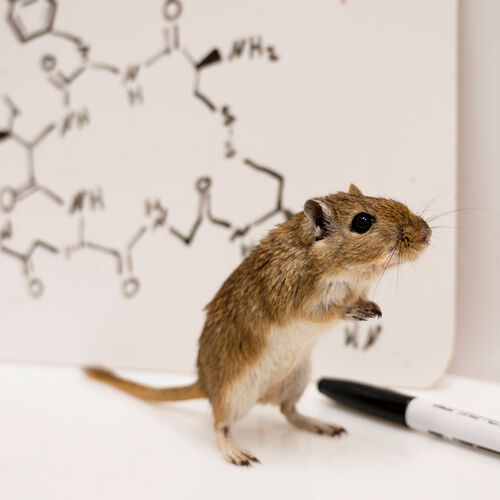
The research was conducted with Mongolian gerbils, rodents that form lasting pair bonds and raise their pups together. The work showed the nuanced effects of testosterone, depending on context. It also revealed how testosterone influences the neural activity of oxytocin cells, the so-called love hormone associated with social bonding.
(Source: Aubrey Kelly)
For what Emory researchers believe is the first time, they have demonstrated that testosterone can directly promote nonsexual, prosocial behavior, in addition to aggression, in the same individual. Aubrey Kelly, Emory assistant professor of psychology and first author of the study says: “It’s surprising because normally we think of testosterone as increasing sexual behaviors and aggression. But we’ve shown that it can have more nuanced effects, depending on the social context.”
Kelly’s lab has recently focused on the neural effects of oxytocin using rodent experimental models. Richmond Thompson, a neuroscientist at Oxford College of Emory University, is co-author of the study. His lab investigates the neural effects of steroids in fish. Both scientists are trying to get at the question of how hormones work in the brain to allow an animal to rapidly change its behavior, depending on the social context.
In addition to sharing this research interest, Kelly and Thompson share a home as a married couple. “The idea for this paper was borne out of us talking together over a glass of wine,” Kelly says. “It blends our two research worlds.”
The majority of human studies show that testosterone enhances aggressive behavior. Kelly and Thompson wondered if maybe testosterone might, in lockstep with being able to increase aggression toward intruders, also generally dampen prosocial behaviors. However, they also hypothesized that it might do something more radical — actually enhance positive social responses in contexts in which acting prosocially is appropriate.
To test this question, the Kelly lab conducted experiments on Mongolian gerbils, rodents that form lasting pair bonds and raise their pups together. While males can become aggressive during mating and in defense of their territory, they also exhibit cuddling behavior after a female becomes pregnant, and they demonstrate protective behavior toward their pups.
In one experiment, a male gerbil was introduced to a female gerbil. After they formed a pair bond and the female became pregnant, the males displayed the usual cuddling behaviors toward their partners. The researchers then gave the male subjects an injection of testosterone. They expected that the resulting acute rise in a male’s testosterone level would lessen his cuddling behaviors if testosterone generally acts as an antisocial molecule.
“Instead, we were surprised that a male gerbil became even more cuddly and prosocial with his partner,” Kelly says. “He became like ‘super partner.’”
It appears that testosterone enhances context-appropriate behavior.
Aubrey Kelly
In a follow-up experiment a week later, the researchers conducted a resident-intruder test. The females were removed from the cages so that each male gerbil that had previously received a testosterone injection was alone in his home cage. An unknown male was then introduced into the cage.
“Normally, a male would chase another male that came into its cage, or try to avoid it,” Kelly says. “Instead, the resident males that had previously been injected with testosterone were more friendly to the intruder.”
The friendly behavior abruptly changed, however, when the original male subjects were given another injection of testosterone. They then began exhibiting normal chasing and/or avoidance behaviors with the intruder. “It was like they suddenly woke up and realized they weren’t supposed to be friendly in that context,” Kelly says.
The researchers theorize that because the male subjects experienced a surge in testosterone while they were with their partners, it not only rapidly increased positive social responses toward them but also primed the males to act more prosocially in the future, even when the context changed and they were in the presence of another male. However, the second testosterone injection then rapidly prompted them to switch their behavior to become more aggressive, as appropriate to the context of a male intruder.
“It appears that testosterone enhances context-appropriate behavior,” Kelly says. “It seems to play a role in amplifying the tendency to be cuddly and protective or aggressive.”
Date: 08.12.2025
Naturally, we always handle your personal data responsibly. Any personal data we receive from you is processed in accordance with applicable data protection legislation. For detailed information please see our privacy policy.
Consent to the use of data for promotional purposes
I hereby consent to Vogel Communications Group GmbH & Co. KG, Max-Planck-Str. 7-9, 97082 Würzburg including any affiliated companies according to §§ 15 et seq. AktG (hereafter: Vogel Communications Group) using my e-mail address to send editorial newsletters. A list of all affiliated companies can be found here
Newsletter content may include all products and services of any companies mentioned above, including for example specialist journals and books, events and fairs as well as event-related products and services, print and digital media offers and services such as additional (editorial) newsletters, raffles, lead campaigns, market research both online and offline, specialist webportals and e-learning offers. In case my personal telephone number has also been collected, it may be used for offers of aforementioned products, for services of the companies mentioned above, and market research purposes.
Additionally, my consent also includes the processing of my email address and telephone number for data matching for marketing purposes with select advertising partners such as LinkedIn, Google, and Meta. For this, Vogel Communications Group may transmit said data in hashed form to the advertising partners who then use said data to determine whether I am also a member of the mentioned advertising partner portals. Vogel Communications Group uses this feature for the purposes of re-targeting (up-selling, cross-selling, and customer loyalty), generating so-called look-alike audiences for acquisition of new customers, and as basis for exclusion for on-going advertising campaigns. Further information can be found in section “data matching for marketing purposes”.
In case I access protected data on Internet portals of Vogel Communications Group including any affiliated companies according to §§ 15 et seq. AktG, I need to provide further data in order to register for the access to such content. In return for this free access to editorial content, my data may be used in accordance with this consent for the purposes stated here. This does not apply to data matching for marketing purposes.
Right of revocation
I understand that I can revoke my consent at will. My revocation does not change the lawfulness of data processing that was conducted based on my consent leading up to my revocation. One option to declare my revocation is to use the contact form found at https://contact.vogel.de. In case I no longer wish to receive certain newsletters, I have subscribed to, I can also click on the unsubscribe link included at the end of a newsletter. Further information regarding my right of revocation and the implementation of it as well as the consequences of my revocation can be found in the data protection declaration, section editorial newsletter.
The laboratory experiments, in a sense, slowed down what the males might experience almost simultaneously in the wild. In their natural habitat, Kelly explains, mating with a partner elevates testosterone, which primes them to act cuddly in the moment and in the near future while living with their partner, even if the testosterone levels decline.
If a rival entered its burrow the gerbil would likely experience another surge of testosterone that would immediately help adjust his behavior so he can fend off the rival and protect his pups. Testosterone, then appears to help animals rapidly pivot between prosocial and antisocial responses as the social world changes.
The current study also looked at how testosterone and oxytocin interact biologically. The results showed that the male subjects receiving injections of testosterone exhibited more oxytocin activity in their brains during interactions with a partner compared to males that did not receive the injections.
“We know that systems of oxytocin and testosterone overlap in the brain but we don’t really understand why,” Kelly says. “Taken together, our results suggest that one of the reasons for this overlap may be so they can work together to promote prosocial behavior.”
Rather than just flipping an “on” or “off” button to modulate behaviors, hormones seem to play a more nuanced role, Kelly says. “It‘s like a complicated dashboard where one dial may need to move up a bit while another one moves down.”
Human behaviors are far more complex than those of Mongolian gerbils, but the researchers hope that their findings provide a basis for complementary studies in other species, including humans.
“Our hormones are the same, and the parts of the brain they act upon are even the same,” Thompson says. “So, learning how hormones like testosterone help other animals adjust to rapidly changing social contexts will not only help us understand the biological nuts and bolts that affect their behavior, but also predict and ultimately understand how the same molecules in human brains help shape our own responses to the social world around us.”




:quality(80)/p7i.vogel.de/wcms/45/87/458714daead8bb6b83d5305ff764e8c1/0130386255v1.jpeg "Examples of drawings from each category, with the scores they received from humans, independent AI and the human-guided AI. (Source: Advanced Science)")
:quality(80)/p7i.vogel.de/wcms/66/7c/667c242f45cc06eb5bee090c7723ba0b/0130384415v2.jpeg "Inspired by arm-wrestling, the NUS team built a self-training platform (left) where two rings of muscle tissues continuously and autonomously pull against each other. Ostrabot (right), made from a single trained ring of muscle and two flexible tails, swims 3 times faster than counterparts with conventionally cultured muscle. (Source: National University of Singapore)")
:quality(80)/p7i.vogel.de/wcms/92/ad/92adbafb37924cea35ea3cf05b7a23e5/0130206318v2.jpeg "The world’s first fully functioning proof-of-concept quantum battery
(Source: Csiro)")
:quality(80)/p7i.vogel.de/wcms/9f/8b/9f8bc2b8491d7a514ca154e9588a07b7/0130205846v1.jpeg "The researchers’ new material, based on mineralised sawdust, is an excellent fire retardant. (Source: Dan Vivas Glaser / from Kürsteiner R et al. Chem Circularity 2026)")
:quality(80)/p7i.vogel.de/wcms/8f/b9/8fb98a958e4afe679865fbe52a473680/0129940982v2.jpeg "pH measurement in various nanoparticles using the Nine-Focus meter ensures precise stability and performance control. (Source: Mettler Toledo)")
:quality(80)/p7i.vogel.de/wcms/11/74/1174e5d4c8b07a64637dced8c9506b40/0129787561v2.jpeg "The Multicell Plus high-pressure reactor sets a new benchmark for operator safety, all-round accessibility and ease-of-use. (Source: Asynt)")
:quality(80)/p7i.vogel.de/wcms/ef/6e/ef6e96191183411973b77041fb6b1e16/0129785957v2.jpeg "Manufactured from high-quality crystal polystyrene - these new automation-ready plates are available in a choice of ANSI / SLAS standard (96-well and breakable 8-well strip) formats. (Source: Porvair Sciences)")
:quality(80)/p7i.vogel.de/wcms/ad/ca/adcaa20ef5ccaf7e3b325788b1e349c4/0129784872v2.jpeg "The high performance Degasi Flat Film in-line degasser. (Source: Biotech Fluidics)")
:quality(80)/p7i.vogel.de/wcms/5d/bb/5dbb962b09bae1c078a8ff996666bc8e/0130386229v2.jpeg "This image created using Gemini Pro, depicts an activated carbon fiber functionalized with amine groups (–NH2) at adjacent positions. This arrangement improves the energy efficacy of key interactions, enabling the desorption of captured carbon dioxide at lower temperatures. (Source: Gemini / Yasuhiro Yamada/ Chiba University / KI-generiert)")
:quality(80)/p7i.vogel.de/wcms/21/9b/219b000051ab1ea14ab5f92e4fd0f9bb/0130384937v2.jpeg "Deforestation in the Appalachian mountains. (Source: Alex Diaz on Unsplash)")
:quality(80)/p7i.vogel.de/wcms/e9/9c/e99cb19231197af70c489cb4acc2ead0/0130293444v2.jpeg "A new global study, led by researchers at Kaust in Saudi Arabia, shows that forests are most effective for climate regulation when conserved or restored in their natural or native locations. (Source: Kaust )")
:quality(80)/p7i.vogel.de/wcms/af/40/af40b535eb65c287fbd22ed5483d1d0e/0130206243v2.jpeg "The researchers dug soil pits in order to measure the carbon storage in soil
(Source: Johanna Asch)")
:quality(80)/p7i.vogel.de/wcms/2a/07/2a0737995810d504b318f8a0f9ac2c3d/0130386209v1.jpeg "Simple, repeatable eating habits may help people stick to diets, see better results, study says (Source: free licensed)")
:quality(80)/p7i.vogel.de/wcms/6f/ba/6fba92196d0cbb1467334f8a2ecc520a/0130203021v2.jpeg "Low to moderate wine consumption shows lower risk compared with spirits, beer and cider (Source: free licensed)")
:quality(80)/p7i.vogel.de/wcms/a9/37/a9376f1d9a893570023d9aa97c085bc5/0129927485v2.jpeg "Examples of foods high in PUFAs include fatty fish and soybeans, while MUFAs include olive oil and avocadoes. (Source: free licensed)")
:quality(80)/p7i.vogel.de/wcms/ea/88/ea88ef8810e21cdd9bb852c70f385ba1/0129797385v2.jpeg "A team of NUS food scientists consisting of Assoc Prof Liu Shao Quan (centre), Dr Lu Yuyun (right) and Ms Geng Chenhan (left) pioneered a co-fermentation method that improves both the nutrient and flavor profile of kombu. (Source: NUS)")
:quality(80)/p7i.vogel.de/wcms/40/c0/40c0c09c2bad7b925a069edbbac90621/0130385557v1.jpeg "When a stroke damages brain tissue (red) along an important movement pathway (yellow), the injured side of the brain may show faster aging (red), while parts of the opposite side may appear relatively “younger” (blue) as the brain tries to compensate. This pattern is linked to more severe movement problems and less recovery.
(Bild: Stevens INI)")
:quality(80)/p7i.vogel.de/wcms/32/14/3214c28a03f71ad067c5f27e5bd6772b/0130386218v1.jpeg "Antimicrobial-resistant Salmonella poses severe challenges to global food safety and public health. (Source: free licensed)")
:quality(80)/p7i.vogel.de/wcms/30/2e/302e195d532fc9aced73406b07642b57/0130384900v2.jpeg "Sleeping for 11 minutes more, doing an additional 4.5 minutes of moderate-to-vigorous physical activity, and eating additional quarter of a cup of vegetables were associated with a 10 % reduction in major cardiovascular events. (Source: Pixabay)")
:quality(80)/p7i.vogel.de/wcms/47/41/4741ee3c589369a09ab0e3a26b7143f0/0130384858v2.jpeg "A female, Aedes aegypti mosquito, after taking her blood meal. (Source: Lauren Bishop CDC)")
:quality(80)/images.vogel.de/vogelonline/bdb/1710600/1710675/original.jpg "Discover how to set yourself up for success when performing balance-based density determination of solids such as jewelry and precious metals. (Mettler Toledo)")
:quality(80)/images.vogel.de/vogelonline/bdb/1682500/1682579/original.jpg "The new XPR Analytical balance redesigned to meet the needs of laboratory technicians of working fast and lean. (Mettler Toledo)")
:quality(80)/images.vogel.de/vogelonline/bdb/1677000/1677080/original.jpg "Enhance your weighing accuracy, comfort and productivity with the redesigned XPR Analytical balance. (Mettler Toledo)")
:quality(80)/p7i.vogel.de/wcms/04/ec/04ece3e93ac0421d39367452e7dc7361/0105235582.jpeg "Changes to different genes, usually controlling hormones that influence social behaviour, have been implicated in the domestication of dogs. (Source: Public Domain)")
:quality(80)/p7i.vogel.de/wcms/0e/d0/0ed06c9af2fa36b99af1758f7f582cb6/0126402089v2.jpeg "Three female mountain gorillas in Bwindi Impenetrable National Park, Uganda. (Source: Martha M Robbins/ MPI-EVA)")
:quality(80)/p7i.vogel.de/wcms/51/b6/51b62047db1d0a629eb1a9cdd7fe0a0b/0123895438v1.jpeg "New research shows that it is very plausible that sexual desire in humans can be influenced by fasting. (Source: free licensed)")