Surplus heat from industry is a underused resource that can be used to purify some types of industry wastewater while providing heat to homes and businesses. Researchers at the Norwegian University of Science and Technology (NTNU) have been looking at the possibilities for doing something about this.
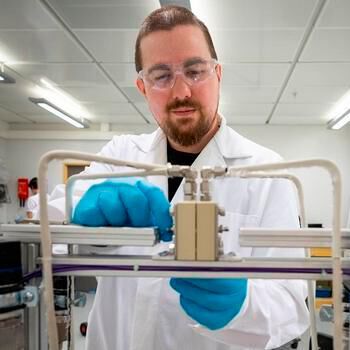
Kim Kristiansen has just received his doctorate from the Norwegian University of Science and Technology on a technology that can put to work some of the waste heat that today is simply wasted.
(Source: Aleksander Stokke Båtnes, NTNU)
“Surplus heat from industrial processes is a huge resource,” says Kim Kristiansen. He has just completed his PhD on a technology that can harness some of the surplus heat that currently goes to waste. Almost all the heat generated by industrial processes is currently released directly into the air or the ocean, and we are not talking about small amounts. In Norway alone, industry produces around 20 TWh of waste heat each year.
That number might not mean much to you, but according to the Norwegian Water Resources and Energy Directorate (NVE), this amount of energy corresponds to half of the electricity consumption of all Norwegian households combined. In other words, approximately the entire heating demand.
Kristiansen is part of the thermodynamics research group at Porelab in the Department of Chemistry. Academic supervisor Signe Kjelstrup and research group manager Øivind Wilhelmsen are co-authors of the articles in question.
Drinking Water as an Added Bonus
The technology also has another effect that may not be as relevant in Norway, but which might be a game changer in countries with limited drinking water. “The technology doesn’t just recycle the waste heat energy, it can also purify the waste water produced by industry,” says Kristiansen.
In many parts of the world, drinking water is becoming an increasingly scarce resource. “According to Unicef, four billion people are already experiencing severe drinking water shortages for at least one month of the year, and there is a high demand for technology that can meet these challenges,” says Kristiansen. A lack of drinking water is therefore a problem for approximately half of the world’s eight billion people.
So what is this new technology? “The waste water produced by industry is often contaminated. If we evaporate this impure water through small pores in a water-repellent membrane, the condensed water that emerges on the other side is drinkable,” says Kristiansen. This method is best suited for purifying water with so-called non-volatile impurities, such as salt. This is in contrast to alcohols and a number of other organic substances that can evaporate along with the water through the membrane.
“The most important area of application for this technology is therefore desalination of seawater. The treatment of process water is not being ruled out, but it involves additional challenges depending on its content,” says Kristiansen.
Exploiting Temperature Differences to Pump up Water
When water is heated on one side of the membrane, it evaporates and releases heat on the other side through condensation. A pressure difference may then arise between the two sides of the membrane.
“The temperature difference is used to pump the water up, and the pressure difference represents mechanical energy that can be used to power a turbine,” says Kristiansen. The phenomenon is called thermal osmosis. “We have investigated the interactions between water and the pores in the membrane, and what happens when the water evaporates, is transported through the pores, and condenses,” says Kristiansen about the doctoral research. He has designed theories on membrane properties and the effect they have on the entire process. He has also systematically measured this effect in the laboratory.
“The conclusion is that the technology has great potential. Through modification of the membranes, we can help address both the increasing challenges associated with energy efficiency requirements and the lack of clean drinking water,” says Kristiansen.
Kristin Syverud at the RISE PFI research institute is interested in improving the membranes used in this technology. “The starting point for the work was an idea that TNO in the Netherlands gets the credit for,” says Kristiansen’s academic supervisor Signe Kjelstrup. She is Professor Emerita and former Head Researcher at Porelab — Centre of Excellence. TNO is an independent institute that works to translate research findings into real-life applications.
TNO experimented with the concept called ‘Mempower’ (simultaneous production of water and power) and the prototype was made at their facilities. The researchers wanted to collaborate but had no funding. The solution was to continue the project as open research at NTNU. “Leen van der Ham from TU Delft got in touch with me and I introduced the idea to the group I then had at the Department of Chemistry, and later at Porelab.”
Date: 08.12.2025
Naturally, we always handle your personal data responsibly. Any personal data we receive from you is processed in accordance with applicable data protection legislation. For detailed information please see our privacy policy.
Consent to the use of data for promotional purposes
I hereby consent to Vogel Communications Group GmbH & Co. KG, Max-Planck-Str. 7-9, 97082 Würzburg including any affiliated companies according to §§ 15 et seq. AktG (hereafter: Vogel Communications Group) using my e-mail address to send editorial newsletters. A list of all affiliated companies can be found here
Newsletter content may include all products and services of any companies mentioned above, including for example specialist journals and books, events and fairs as well as event-related products and services, print and digital media offers and services such as additional (editorial) newsletters, raffles, lead campaigns, market research both online and offline, specialist webportals and e-learning offers. In case my personal telephone number has also been collected, it may be used for offers of aforementioned products, for services of the companies mentioned above, and market research purposes.
Additionally, my consent also includes the processing of my email address and telephone number for data matching for marketing purposes with select advertising partners such as LinkedIn, Google, and Meta. For this, Vogel Communications Group may transmit said data in hashed form to the advertising partners who then use said data to determine whether I am also a member of the mentioned advertising partner portals. Vogel Communications Group uses this feature for the purposes of re-targeting (up-selling, cross-selling, and customer loyalty), generating so-called look-alike audiences for acquisition of new customers, and as basis for exclusion for on-going advertising campaigns. Further information can be found in section “data matching for marketing purposes”.
In case I access protected data on Internet portals of Vogel Communications Group including any affiliated companies according to §§ 15 et seq. AktG, I need to provide further data in order to register for the access to such content. In return for this free access to editorial content, my data may be used in accordance with this consent for the purposes stated here. This does not apply to data matching for marketing purposes.
Right of revocation
I understand that I can revoke my consent at will. My revocation does not change the lawfulness of data processing that was conducted based on my consent leading up to my revocation. One option to declare my revocation is to use the contact form found at https://contact.vogel.de. In case I no longer wish to receive certain newsletters, I have subscribed to, I can also click on the unsubscribe link included at the end of a newsletter. Further information regarding my right of revocation and the implementation of it as well as the consequences of my revocation can be found in the data protection declaration, section editorial newsletter.
Van der Ham took his PhD in Chemistry at NTNU a few years ago, which shows just how important it is to have contacts. They worked with Luuk Keulen, a student at TU Delft, and the research was continued by Kristiansen and Michael Rauter from Porelab.
Practical Challenges
“Industry is showing interest in the concept of membrane distillation, but so far, there are only a few pilot plants worldwide,” says Kristiansen. The main reason industry is lagging behind academia is related to practical challenges associated with membrane technology, he explains. For example, this applies to the lifespan of membranes under harsh industrial conditions. “A lot of work is being done internationally in both academia and industry to meet these challenges and commercialise the technology,” says Kristiansen.
The Mempower concept involves converting waste heat into mechanical energy based on differences in temperature. “My impression is that industry is not yet fully aware of this concept and the opportunity it offers,” says Kristiansen. One of the conclusions in the latest article is that the potential for energy production is competitive in relation to more established membrane-based energy processes. He believes this could help increase commercial interest.
Reference: Kristiansen, Kim and Wilhelmsen, Oivind and Kjelstrup, Signe, Thermo-Osmotic Coefficients in Membrane Distillation experiments and Theory for Three Types of Membranes. Desalination, Volume 586, 2024, 117785, ISSN 0011-9164, https://doi.org/10.1016/j.desal.2024.117785




:quality(80)/p7i.vogel.de/wcms/fd/73/fd73fcb3ceda89d1419de1083fcab7b4/0130081520v2.jpeg "The fingers at the heart of this technology were inspired by the fin-ray effect — a design principle derived from the natural structure of fish fins. (Source: University of Texas at Austin )")
:quality(80)/p7i.vogel.de/wcms/fe/64/fe649767c802d53ac63ee2c2a40b7e0d/0130060830v2.jpeg "Sample tube with light-active substance (Source: Elvira Eberhardt / Ulm University)")
:quality(80)/p7i.vogel.de/wcms/db/e2/dbe2ae4e02f702b30153a882ef705089/0129978032v1.jpeg "Each of the isolated indium atoms (in gold color) can catalyse the synthesis of methanol (top right). (Source: Constance Ko/ ETH Zurich)")
:quality(80)/p7i.vogel.de/wcms/c1/e6/c1e6ac26eb18993236c100e7f01a78f2/0129937639v1.jpeg "Dogs evolved from highly social ancestors and have been shaped by thousands of years of interacting with humans. (Source: free licensed)")
:quality(80)/p7i.vogel.de/wcms/8f/b9/8fb98a958e4afe679865fbe52a473680/0129940982v2.jpeg "pH measurement in various nanoparticles using the Nine-Focus meter ensures precise stability and performance control. (Source: Mettler Toledo)")
:quality(80)/p7i.vogel.de/wcms/11/74/1174e5d4c8b07a64637dced8c9506b40/0129787561v2.jpeg "The Multicell Plus high-pressure reactor sets a new benchmark for operator safety, all-round accessibility and ease-of-use. (Source: Asynt)")
:quality(80)/p7i.vogel.de/wcms/ef/6e/ef6e96191183411973b77041fb6b1e16/0129785957v2.jpeg "Manufactured from high-quality crystal polystyrene - these new automation-ready plates are available in a choice of ANSI / SLAS standard (96-well and breakable 8-well strip) formats. (Source: Porvair Sciences)")
:quality(80)/p7i.vogel.de/wcms/ad/ca/adcaa20ef5ccaf7e3b325788b1e349c4/0129784872v2.jpeg "The high performance Degasi Flat Film in-line degasser. (Source: Biotech Fluidics)")
:quality(80)/p7i.vogel.de/wcms/2d/45/2d45aba62f5042baa00f7fd4fa629839/0130036533v2.jpeg "The population of Pune, India, is expected to reach 11 million by 2050. (Source: free licensed)")
:quality(80)/p7i.vogel.de/wcms/52/f8/52f8d5521fdab07ed0a865ec0d8919fd/0130009438v2.jpeg "Drylands support around half of global livestock production and sustain the livelihoods of close to a billion people, while also underpinning soil stability and carbon storage. (Source: Kaust )")
:quality(80)/p7i.vogel.de/wcms/fe/49/fe494ada322615b6e6f6ff0f5bb7c5cf/0129926008v2.jpeg "A mandrill eating fruit. (Source: University of Bristol )")
:quality(80)/p7i.vogel.de/wcms/af/4e/af4ea968647ee9cae82b39800c611819/0129865630v2.jpeg "Map of a simulated risk of water stress in 2050 where hydrogen is used in transport and industry. Baseline risk (regardless of hydrogen use) is represented by the background color in each area. Dashed areas show water use exceeding available resources due to hydrogen production. Blue dots show areas where the risk of water stress increases by more than 50 percent in the simulation. (Source: Chalmers University of Technology / Joel Löfving)")
:quality(80)/p7i.vogel.de/wcms/6f/ba/6fba92196d0cbb1467334f8a2ecc520a/0130203021v2.jpeg "Low to moderate wine consumption shows lower risk compared with spirits, beer and cider (Source: free licensed)")
:quality(80)/p7i.vogel.de/wcms/a9/37/a9376f1d9a893570023d9aa97c085bc5/0129927485v2.jpeg "Examples of foods high in PUFAs include fatty fish and soybeans, while MUFAs include olive oil and avocadoes. (Source: free licensed)")
:quality(80)/p7i.vogel.de/wcms/ea/88/ea88ef8810e21cdd9bb852c70f385ba1/0129797385v2.jpeg "A team of NUS food scientists consisting of Assoc Prof Liu Shao Quan (centre), Dr Lu Yuyun (right) and Ms Geng Chenhan (left) pioneered a co-fermentation method that improves both the nutrient and flavor profile of kombu. (Source: NUS)")
:quality(80)/p7i.vogel.de/wcms/84/2c/842c7c1678ceeec7147ea3a36e238e75/0129356324v2.jpeg "Kaust and Nadec have signed a MOU that establishes a framework for long-term cooperation across agricultural research, technology development, and professional training. (Source: Kaust )")
:quality(80)/p7i.vogel.de/wcms/ed/c0/edc0c1a86229b11efd17c5e3f94d14da/0130081211v2.jpeg "A new study finds that virtual visits did not make it easier for psychiatrists, psychologists and therapists to reach significantly more people in areas where access to care has long been limited. (Source: Pixabay)")
:quality(80)/p7i.vogel.de/wcms/9c/52/9c52318bc94be17e6662dfceffa4a0c0/0130060546v2.jpeg "Domestic cat ‘Lanni’ from co-author of the study, Latasha Ludwig, Assistant Clinical Professor at Cornell University, USA. (Source: © Latasha Ludwig)")
:quality(80)/p7i.vogel.de/wcms/4b/f4/4bf4cc9e28e65e11a27dd41da2d1a7f5/0130038185v2.jpeg "The biomarker p-tau217 could help identify women at elevated dementia risk decades before clinical symptoms begin. (Source: free licensed)")
:quality(80)/p7i.vogel.de/wcms/4f/29/4f292f402b157e2ab8c57e9f2a3e3199/0130036120v2.jpeg "The chemistry is powered by an LED lamp that triggers a self-sustaining chain reaction, forging new carbon–carbon bonds under mild conditions without toxic or expensive chemicals. (Source: Nordin Ćatić/ St John’s College, Cambridge)")
:quality(80)/images.vogel.de/vogelonline/bdb/1710600/1710675/original.jpg "Discover how to set yourself up for success when performing balance-based density determination of solids such as jewelry and precious metals. (Mettler Toledo)")
:quality(80)/images.vogel.de/vogelonline/bdb/1682500/1682579/original.jpg "The new XPR Analytical balance redesigned to meet the needs of laboratory technicians of working fast and lean. (Mettler Toledo)")
:quality(80)/images.vogel.de/vogelonline/bdb/1677000/1677080/original.jpg "Enhance your weighing accuracy, comfort and productivity with the redesigned XPR Analytical balance. (Mettler Toledo)")
:fill(fff,0)/p7i.vogel.de/companies/5f/3f/5f3f63ceedc78/knf-logo.jpg "KNF_Logo.jpg (www.knf.com)")
:quality(80)/p7i.vogel.de/wcms/23/20/2320cffae04398bc31236b15386cbf16/0125486023v2.jpeg "This isn’t a paper chain, it’s a 3D-printed material that soaks up seawater, purifying it into salt-free water. (Source: Adapted from ACS Energy Letters 2025, DOI: 10.1021/acsenergylett.5c01233)")
:quality(80)/p7i.vogel.de/wcms/f2/3e/f23ec06393aec19e8529a7d543f449fa/0127289278v1.jpeg "Ideally the microwave reactions can be driven by green energy, in which case the system could help reduce carbon dioxide by converting it into other useful chemicals. (Source: Kishimoto et al. CC-BY-ND)")