With some careful twisting and stacking, MIT physicists have revealed a new and exotic property in “magic-angle” graphene: superconductivity that can be turned on and off with an electric pulse, much like a light switch. The discovery could lead to ultrafast, energy-efficient superconducting transistors for neuromorphic devices — electronics designed to operate in a way similar to the rapid on/off firing of neurons in the human brain.
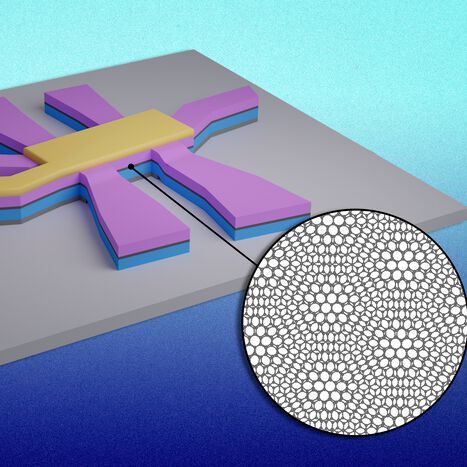
MIT physicists have found a new way to switch superconductivity on and off in magic-angle graphene. This figure shows a device with two graphene layers in the middle (in dark gray and in inset). The graphene layers are sandwiched in between boron nitride layers (in blue and purple). The angle and alignment of each layer enables the researchers to turn superconductivity on and off in graphene with a short electric pulse.
(Source: Pablo Jarillo-Herrero, Dahlia Klein, Li-Qiao Xia, and David MacNeill, et. al)
Magic-angle graphene refers to a very particular stacking of graphene — an atom-thin material made from carbon atoms that are linked in a hexagonal pattern resembling chicken wire. When one sheet of graphene is stacked atop a second sheet at a precise “magic” angle, the twisted structure creates a slightly offset “moiré” pattern, or superlattice, that is able to support a host of surprising electronic behaviors.
In 2018, Pablo Jarillo-Herrero and his group at MIT were the first to demonstrate magic-angle twisted bilayer graphene. They showed that the new bilayer structure could behave as an insulator, much like wood, when they applied a certain continuous electric field. When they upped the field, the insulator suddenly morphed into a superconductor, allowing electrons to flow, friction-free.
That discovery gave rise to “twistronics,” a field that explores how certain electronic properties emerge from the twisting and layering of two-dimensional materials. Researchers including Jarillo-Herrero have continued to reveal surprising properties in magic-angle graphene, including various ways to switch the material between different electronic states. So far, such “switches” have acted more like dimmers, in that researchers must continuously apply an electric or magnetic field to turn on superconductivity, and keep it on. Now Jarillo-Herrero and his team have shown that superconductivity in magic-angle graphene can be switched on, and kept on, with just a short pulse rather than a continuous electric field. The key, they found was a combination of twisting and stacking.
In a paper appearing today in Nature Nanotechnology, the team reports that, by stacking magic-angle graphene between two offset layers of boron nitride — a two-dimensional insulating material — the unique alignment of the sandwich structure enabled the researchers to turn graphene’s superconductivity on and off with a short electric pulse. “For the vast majority of materials, if you remove the electric field, zzzzip, the electric state is gone,” says Jarillo-Herrero, who is the Cecil and Ida Green Professor of Physics at MIT. “This is the first time that a superconducting material has been made that can be electrically switched on and off, abruptly. This could pave the way for a new generation of twisted, graphene-based superconducting electronics.” His MIT co-authors are lead author Dahlia Klein, Li-Qiao Xia, and David MacNeill, along with Kenji Watanabe and Takashi Taniguchi of the National Institute for Materials Science in Japan.
Flipping the Switch
In 2019, a team at Stanford University discovered that magic-angle graphene could be coerced into a ferromagnetic state. Ferromagnets are materials that retain their magnetic properties, even in the absence of an externally applied magnetic field.
The researchers found that magic-angle graphene could exhibit ferromagnetic properties in a way that could be tuned on and off. This happened when the graphene sheets were layered between two sheets of boron nitride such that the crystal structure of the graphene was aligned to one of the boron nitride layers. The arrangement resembled a cheese sandwich in which the top slice of bread and the cheese orientations are aligned, but the bottom slice of bread is rotated at a random angle with respect to the top slice. The result intrigued the MIT group.
“We were trying to get a stronger magnet by aligning both slices,” Jarillo-Herrero says. “Instead, we found something completely different.” In their current study, the team fabricated a sandwich of carefully angled and stacked materials. The “cheese” of the sandwich consisted of magic-angle graphene — two graphene sheets, the top rotated slightly at the “magic” angle of 1.1 degrees with respect to the bottom sheet. Above this structure, they placed a layer of boron nitride, exactly aligned with the top graphene sheet. Finally, they placed a second layer of boron nitride below the entire structure and offset it by 30 degrees with respect to the top layer of boron nitride.
The team then measured the electrical resistance of the graphene layers as they applied a gate voltage. They found, as others have, that the twisted bilayer graphene switched electronic states, changing between insulating, conducting, and superconducting states at certain known voltages.
Date: 08.12.2025
Naturally, we always handle your personal data responsibly. Any personal data we receive from you is processed in accordance with applicable data protection legislation. For detailed information please see our privacy policy.
Consent to the use of data for promotional purposes
I hereby consent to Vogel Communications Group GmbH & Co. KG, Max-Planck-Str. 7-9, 97082 Würzburg including any affiliated companies according to §§ 15 et seq. AktG (hereafter: Vogel Communications Group) using my e-mail address to send editorial newsletters. A list of all affiliated companies can be found here
Newsletter content may include all products and services of any companies mentioned above, including for example specialist journals and books, events and fairs as well as event-related products and services, print and digital media offers and services such as additional (editorial) newsletters, raffles, lead campaigns, market research both online and offline, specialist webportals and e-learning offers. In case my personal telephone number has also been collected, it may be used for offers of aforementioned products, for services of the companies mentioned above, and market research purposes.
Additionally, my consent also includes the processing of my email address and telephone number for data matching for marketing purposes with select advertising partners such as LinkedIn, Google, and Meta. For this, Vogel Communications Group may transmit said data in hashed form to the advertising partners who then use said data to determine whether I am also a member of the mentioned advertising partner portals. Vogel Communications Group uses this feature for the purposes of re-targeting (up-selling, cross-selling, and customer loyalty), generating so-called look-alike audiences for acquisition of new customers, and as basis for exclusion for on-going advertising campaigns. Further information can be found in section “data matching for marketing purposes”.
In case I access protected data on Internet portals of Vogel Communications Group including any affiliated companies according to §§ 15 et seq. AktG, I need to provide further data in order to register for the access to such content. In return for this free access to editorial content, my data may be used in accordance with this consent for the purposes stated here. This does not apply to data matching for marketing purposes.
Right of revocation
I understand that I can revoke my consent at will. My revocation does not change the lawfulness of data processing that was conducted based on my consent leading up to my revocation. One option to declare my revocation is to use the contact form found at https://contact.vogel.de. In case I no longer wish to receive certain newsletters, I have subscribed to, I can also click on the unsubscribe link included at the end of a newsletter. Further information regarding my right of revocation and the implementation of it as well as the consequences of my revocation can be found in the data protection declaration, section editorial newsletter.
What the group did not expect was that each electronic state persisted rather than immediately disappearing once the voltage was removed — a property known as bistability. They found that, at a particular voltage, the graphene layers turned into a superconductor, and remained superconducting, even as the researchers removed this voltage.
This bistable effect suggests that superconductivity can be turned on and off with short electric pulses rather than a continuous electric field, similar to flicking a light switch. It isn’t clear what enables this switchable superconductivity, though the researchers suspect it has something to do with the special alignment of the twisted graphene to both boron nitride layers, which enables a ferroelectric-like response of the system. (Ferroelectric materials display bistability in their electric properties.) “By paying attention to the stacking, you could add another tuning knob to the growing complexity of magic-angle, superconducting devices,” Klein says.
For now, the team sees the new superconducting switch as another tool researchers can consider as they develop materials for faster, smaller, more energy-efficient electronics. “People are trying to build electronic devices that do calculations in a way that’s inspired by the brain,” Jarillo-Herrero says. “In the brain, we have neurons that, beyond a certain threshold, they fire. Similarly, we now have found a way for magic-angle graphene to switch superconductivity abruptly, beyond a certain threshold. This is a key property in realizing neuromorphic computing.”
References: “Electrical switching of a bistable moiré superconductor”; Nature Nanotechnology; DOI: 10.1038/s41565-022-01314-x.




:quality(80)/p7i.vogel.de/wcms/fd/73/fd73fcb3ceda89d1419de1083fcab7b4/0130081520v2.jpeg "The fingers at the heart of this technology were inspired by the fin-ray effect — a design principle derived from the natural structure of fish fins. (Source: University of Texas at Austin )")
:quality(80)/p7i.vogel.de/wcms/fe/64/fe649767c802d53ac63ee2c2a40b7e0d/0130060830v2.jpeg "Sample tube with light-active substance (Source: Elvira Eberhardt / Ulm University)")
:quality(80)/p7i.vogel.de/wcms/db/e2/dbe2ae4e02f702b30153a882ef705089/0129978032v1.jpeg "Each of the isolated indium atoms (in gold color) can catalyse the synthesis of methanol (top right). (Source: Constance Ko/ ETH Zurich)")
:quality(80)/p7i.vogel.de/wcms/c1/e6/c1e6ac26eb18993236c100e7f01a78f2/0129937639v1.jpeg "Dogs evolved from highly social ancestors and have been shaped by thousands of years of interacting with humans. (Source: free licensed)")
:quality(80)/p7i.vogel.de/wcms/8f/b9/8fb98a958e4afe679865fbe52a473680/0129940982v2.jpeg "pH measurement in various nanoparticles using the Nine-Focus meter ensures precise stability and performance control. (Source: Mettler Toledo)")
:quality(80)/p7i.vogel.de/wcms/11/74/1174e5d4c8b07a64637dced8c9506b40/0129787561v2.jpeg "The Multicell Plus high-pressure reactor sets a new benchmark for operator safety, all-round accessibility and ease-of-use. (Source: Asynt)")
:quality(80)/p7i.vogel.de/wcms/ef/6e/ef6e96191183411973b77041fb6b1e16/0129785957v2.jpeg "Manufactured from high-quality crystal polystyrene - these new automation-ready plates are available in a choice of ANSI / SLAS standard (96-well and breakable 8-well strip) formats. (Source: Porvair Sciences)")
:quality(80)/p7i.vogel.de/wcms/ad/ca/adcaa20ef5ccaf7e3b325788b1e349c4/0129784872v2.jpeg "The high performance Degasi Flat Film in-line degasser. (Source: Biotech Fluidics)")
:quality(80)/p7i.vogel.de/wcms/2d/45/2d45aba62f5042baa00f7fd4fa629839/0130036533v2.jpeg "The population of Pune, India, is expected to reach 11 million by 2050. (Source: free licensed)")
:quality(80)/p7i.vogel.de/wcms/52/f8/52f8d5521fdab07ed0a865ec0d8919fd/0130009438v2.jpeg "Drylands support around half of global livestock production and sustain the livelihoods of close to a billion people, while also underpinning soil stability and carbon storage. (Source: Kaust )")
:quality(80)/p7i.vogel.de/wcms/fe/49/fe494ada322615b6e6f6ff0f5bb7c5cf/0129926008v2.jpeg "A mandrill eating fruit. (Source: University of Bristol )")
:quality(80)/p7i.vogel.de/wcms/af/4e/af4ea968647ee9cae82b39800c611819/0129865630v2.jpeg "Map of a simulated risk of water stress in 2050 where hydrogen is used in transport and industry. Baseline risk (regardless of hydrogen use) is represented by the background color in each area. Dashed areas show water use exceeding available resources due to hydrogen production. Blue dots show areas where the risk of water stress increases by more than 50 percent in the simulation. (Source: Chalmers University of Technology / Joel Löfving)")
:quality(80)/p7i.vogel.de/wcms/6f/ba/6fba92196d0cbb1467334f8a2ecc520a/0130203021v2.jpeg "Low to moderate wine consumption shows lower risk compared with spirits, beer and cider (Source: free licensed)")
:quality(80)/p7i.vogel.de/wcms/a9/37/a9376f1d9a893570023d9aa97c085bc5/0129927485v2.jpeg "Examples of foods high in PUFAs include fatty fish and soybeans, while MUFAs include olive oil and avocadoes. (Source: free licensed)")
:quality(80)/p7i.vogel.de/wcms/ea/88/ea88ef8810e21cdd9bb852c70f385ba1/0129797385v2.jpeg "A team of NUS food scientists consisting of Assoc Prof Liu Shao Quan (centre), Dr Lu Yuyun (right) and Ms Geng Chenhan (left) pioneered a co-fermentation method that improves both the nutrient and flavor profile of kombu. (Source: NUS)")
:quality(80)/p7i.vogel.de/wcms/84/2c/842c7c1678ceeec7147ea3a36e238e75/0129356324v2.jpeg "Kaust and Nadec have signed a MOU that establishes a framework for long-term cooperation across agricultural research, technology development, and professional training. (Source: Kaust )")
:quality(80)/p7i.vogel.de/wcms/ed/c0/edc0c1a86229b11efd17c5e3f94d14da/0130081211v2.jpeg "A new study finds that virtual visits did not make it easier for psychiatrists, psychologists and therapists to reach significantly more people in areas where access to care has long been limited. (Source: Pixabay)")
:quality(80)/p7i.vogel.de/wcms/9c/52/9c52318bc94be17e6662dfceffa4a0c0/0130060546v2.jpeg "Domestic cat ‘Lanni’ from co-author of the study, Latasha Ludwig, Assistant Clinical Professor at Cornell University, USA. (Source: © Latasha Ludwig)")
:quality(80)/p7i.vogel.de/wcms/4b/f4/4bf4cc9e28e65e11a27dd41da2d1a7f5/0130038185v2.jpeg "The biomarker p-tau217 could help identify women at elevated dementia risk decades before clinical symptoms begin. (Source: free licensed)")
:quality(80)/p7i.vogel.de/wcms/4f/29/4f292f402b157e2ab8c57e9f2a3e3199/0130036120v2.jpeg "The chemistry is powered by an LED lamp that triggers a self-sustaining chain reaction, forging new carbon–carbon bonds under mild conditions without toxic or expensive chemicals. (Source: Nordin Ćatić/ St John’s College, Cambridge)")
:quality(80)/images.vogel.de/vogelonline/bdb/1710600/1710675/original.jpg "Discover how to set yourself up for success when performing balance-based density determination of solids such as jewelry and precious metals. (Mettler Toledo)")
:quality(80)/images.vogel.de/vogelonline/bdb/1682500/1682579/original.jpg "The new XPR Analytical balance redesigned to meet the needs of laboratory technicians of working fast and lean. (Mettler Toledo)")
:quality(80)/images.vogel.de/vogelonline/bdb/1677000/1677080/original.jpg "Enhance your weighing accuracy, comfort and productivity with the redesigned XPR Analytical balance. (Mettler Toledo)")
:quality(80)/images.vogel.de/vogelonline/bdb/1896500/1896586/original.jpg "On the left panel, the copper-oxide planes of the material YBCO are presented in the strange metal phase, where the strong interaction between electrons, the 'quantum entanglement', is illustrated as lightning. On the right panel, the same planes are presented when the charge density waves appear. The symmetry of the system is reduced by the appearance of these local modulations of the conducting electrons, which cause the suppression of the strange metal phase. (Chalmers University of Technology/ Yen Strandqvist)")
:quality(80)/p7i.vogel.de/wcms/32/ae/32ae11ef4154e0a95f766875fd10ad47/0124884486v2.jpeg "An intercrystal formed by overlaying twisted graphene on hexagonal boron nitride. (Source: Andrei Lab/ Rutgers University)")
:quality(80)/p7i.vogel.de/wcms/e2/50/e25060efc5d415df36685fce9e64f047/0128496870v2.jpeg "SFG microscopy image of boron nitride monolayer flakes. (Source: FHI)")