A new solar co-electrolysis concept combines green hydrogen production with selective biomass upgrading, cutting energy demand and pushing hydrogen costs below fossil benchmarks.
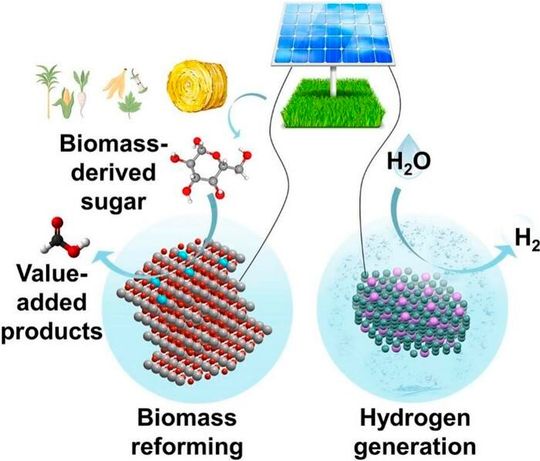
This schematic illustrates the solar-powered co-electrolysis strategy in which biomass-derived sugars undergo selective oxidation on a copper-doped cobalt oxyhydroxide catalyst to yield value-added products such as formate. Simultaneously, water is reduced at the cathode to generate high-purity hydrogen in a membrane-free reactor. The integrated process upgrades renewable biomass while reducing the energy demand of hydrogen production, offering a cost-effective pathway for green fuel generation.
(Source: H.S.S. et al.)
A recent study presents a highly efficient approach to solar hydrogen production by pairing water electrolysis with the selective oxidation of biomass-derived glucose. Central to this advance is a copper-doped cobalt oxyhydroxide catalyst that guides glucose through a finely tuned cascade of α–C–C bond cleavages, producing up to 80 % formate while simultaneously lowering the anodic potential by nearly 400 mV. This design enables hydrogen generation in a simple membrane-free reactor, achieving production rates that surpass 500 μmol h⁻¹ cm⁻². By converting low-cost sugars derived from non-food biomass cellulose into valuable chemicals during hydrogen generation, the method boosts energy efficiency and dramatically improves economic feasibility, pointing toward a more sustainable model for solar fuels.
As the world accelerates toward carbon-neutral energy systems, solar-driven water electrolysis has emerged as a cornerstone technology for producing clean hydrogen. Yet high operating costs — mostly tied to the energy-intensive oxygen evolution reaction — continue to hinder large-scale deployment. Biomass-derived sugars offer a compelling alternative reaction pathway: they oxidize more readily and create value-added chemical products. However, steering glucose away from over-oxidation and toward a single high-value product like formate has remained a fundamental challenge. Because of these challenges, there is a pressing need to explore catalysts capable of directing glucose along selective, energy-saving oxidation routes through carefully engineered reaction pathways.
A research team from China Agricultural University and Nanyang Technological University reported (DOI: 10.1016/j.esci.2025.100431) on May 26, 2025, in eScience that they have developed a copper-modified cobalt oxyhydroxide catalyst capable of cleanly converting glucose into formate while generating hydrogen at exceptionally high rates. Driven by an InGaP/GaAs/Ge triple-junction photovoltaic device, the membrane-free co-electrolysis system delivers over 500 μmol h⁻¹ cm⁻² of hydrogen. The work introduces a catalyst-guided cascade oxidation mechanism that substantially reduces energy input, opening new possibilities for integrating solar hydrogen production with sustainable biomass upgrading.
The researchers began by comparing earth-abundant metal oxyhydroxides and identified CoOOH as a promising starting point for glucose oxidation. They then systematically introduced various dopants and discovered that adding just 5 mol% copper transformed CoOOH into a far more selective and efficient electrocatalyst. With this modification, the yield of formate increased from 50% to 80%, and the onset potential for glucose oxidation dropped by about 400 mV, enabling highly energy-efficient co-electrolysis in alkaline conditions.
Copper Doping Reprograms Catalyst Chemistry
A suite of advanced characterization techniques, including X-ray photoelectron spectroscopy, Raman spectroscopy, electron microscopy, and in situ impedance analysis, revealed how copper reshapes the electronic landscape of the catalyst surface. Copper stabilizes reactive Co³⁺ sites while suppressing overly aggressive Co⁴⁺ species that typically lead to non-selective bond cleavage. Complementary DFT calculations showed that Cu doping disfavors side-on adsorption of glucose and suppresses β-cleavage pathways that form by-products. Instead, it promotes end-on binding at the aldehyde group, enabling a stepwise α-C–C cleavage sequence that releases formate from every carbon atom.
When paired with an earth-abundant Ni₄Mo cathode, the system produced pure hydrogen in a membrane-free cell with nearly 100% Faradaic efficiency. Under concentrated sunlight, the device achieved a hydrogen generation rate of 519.5 ± 0.4 μmol h⁻¹ cm⁻², maintaining stable performance across 24 hours of operation.
Date: 08.12.2025
Naturally, we always handle your personal data responsibly. Any personal data we receive from you is processed in accordance with applicable data protection legislation. For detailed information please see our privacy policy.
Consent to the use of data for promotional purposes
I hereby consent to Vogel Communications Group GmbH & Co. KG, Max-Planck-Str. 7-9, 97082 Würzburg including any affiliated companies according to §§ 15 et seq. AktG (hereafter: Vogel Communications Group) using my e-mail address to send editorial newsletters. A list of all affiliated companies can be found here
Newsletter content may include all products and services of any companies mentioned above, including for example specialist journals and books, events and fairs as well as event-related products and services, print and digital media offers and services such as additional (editorial) newsletters, raffles, lead campaigns, market research both online and offline, specialist webportals and e-learning offers. In case my personal telephone number has also been collected, it may be used for offers of aforementioned products, for services of the companies mentioned above, and market research purposes.
Additionally, my consent also includes the processing of my email address and telephone number for data matching for marketing purposes with select advertising partners such as LinkedIn, Google, and Meta. For this, Vogel Communications Group may transmit said data in hashed form to the advertising partners who then use said data to determine whether I am also a member of the mentioned advertising partner portals. Vogel Communications Group uses this feature for the purposes of re-targeting (up-selling, cross-selling, and customer loyalty), generating so-called look-alike audiences for acquisition of new customers, and as basis for exclusion for on-going advertising campaigns. Further information can be found in section “data matching for marketing purposes”.
In case I access protected data on Internet portals of Vogel Communications Group including any affiliated companies according to §§ 15 et seq. AktG, I need to provide further data in order to register for the access to such content. In return for this free access to editorial content, my data may be used in accordance with this consent for the purposes stated here. This does not apply to data matching for marketing purposes.
Right of revocation
I understand that I can revoke my consent at will. My revocation does not change the lawfulness of data processing that was conducted based on my consent leading up to my revocation. One option to declare my revocation is to use the contact form found at https://contact.vogel.de. In case I no longer wish to receive certain newsletters, I have subscribed to, I can also click on the unsubscribe link included at the end of a newsletter. Further information regarding my right of revocation and the implementation of it as well as the consequences of my revocation can be found in the data protection declaration, section editorial newsletter.
One of the study’s senior researchers noted that the findings illustrate how the catalyst design can reshape both the efficiency and economics of solar hydrogen production. By orchestrating glucose oxidation through a highly selective α-cleavage pathway, the catalyst not only reduces the electrical energy required but simultaneously upgrades biomass into a valuable chemical feedstock. This dual-function system, the expert emphasized, represents a pivotal shift toward more integrated and cost-effective renewable hydrogen technologies, demonstrating that sustainable chemistry and clean energy generation can be mutually reinforcing.
This co-electrolysis strategy offers a scalable and economically competitive route to green hydrogen by pairing energy-efficient operation with the sale of formate as a co-product. Economic modeling suggests that this approach could lower the levelized cost of hydrogen to $1.54 per kilogram, rivaling or undercutting hydrogen produced from fossil fuels. The membrane-free design also simplifies the system architecture and reduces capital costs, making industrial deployment more feasible. Importantly, the catalyst performs equally well on hydrolysates derived from agricultural waste, highlighting its compatibility with real-world biomass resources and its potential to support distributed hydrogen production in future circular bioeconomy systems.
Original Article: Steering the adsorption modes and oxidation state of Co oxyhydroxide active sites to unlock selective glucose oxidation to formate for efficient solar reforming of biomass to green hydrogen; eScience; DOI:10.1016/j.esci.2025.100431




:quality(80)/p7i.vogel.de/wcms/62/32/62327aaae1415beeed47db6201e79661/0133375912v2.jpeg "A cotton trailer outfitted with benches and a sunshade offers farmworkers a reprieve from the sun as they take a break from picking cantaloupe melons in Firebaugh, Calif.
(Source: Joe Proudman/ Regents of the University of California)")
:quality(80)/p7i.vogel.de/wcms/e6/c8/e6c8bd554776ee1ad2f1f0723fb243a7/0133369387v1.jpeg "Roman road (Source: Queen Mary University of London)")
:quality(80)/p7i.vogel.de/wcms/51/68/51687ac4cc19f2757c138498b877de57/0133167039v2.jpeg "CMFs are foams that consist of hollow spheres – made of materials such as stainless steel, nickel, or other metals and alloys – embedded in a metallic matrix. The resulting material is both lightweight and remarkably strong at absorbing compressive forces. (Source: Jie Sun/ NC State University)")
:quality(80)/p7i.vogel.de/wcms/cd/c0/cdc09efd1e5b3b8f83224e7729d66c10/0133105276v2.jpeg "From the data presented in this report, the authors show how TF3-MALS-RI is uniquely able to separate large polyacrylate molecules and provide precise molecular weight and Rg values. (Source: Postnova Analytics)")
:quality(80)/p7i.vogel.de/wcms/86/01/86014d3d2a28cefc852f65c8d68317e4/0133104231v2.jpeg "Single-handed tube reading using a Handheld 2. (Source: Azenta Life Sciences)")
:quality(80)/p7i.vogel.de/wcms/0b/0f/0b0f8ed042dfc91f32582e10d54c2c7e/0133087444v2.jpeg "Offering advanced automation to increase your throughput, the Intellixcap provides secure sealing – eliminating the need for manual intervention, while preserving vital sample integrity. (Source: Azenta Life Sciences)")
:quality(80)/p7i.vogel.de/wcms/13/d3/13d35105f74a1c2e22b9c7a270e8e9b3/0132611155v2.jpeg "Circulating cell free DNA. (Source: Amsbio)")
:quality(80)/p7i.vogel.de/wcms/bc/ed/bced6850297a04dbea471a66cb6bb6fe/0132611405v2.jpeg "The latest addition to the range is a peristaltic tubing stop adapter that eliminates the need for fixed stoppers and allows custom cut lengths of peristaltic tubing to be installed on any pump head size. (Source: Biotech Fluidics )")
:quality(80)/p7i.vogel.de/wcms/8d/5c/8d5c6c7f897f91d6784825eee20b5584/0133321225v1.jpeg "Empa researcher Christoph Hüglin collects samples of particles that are washed out of the air by rain and snow or settle due to gravity. (Source: Empa)")
:quality(80)/p7i.vogel.de/wcms/a1/af/a1afbc7c8a067bbe94749ec680b4bafd/0133163762v2.jpeg "The study found in murkier water, fish took longer to move towards the food than those in clear water, but individuals in larger groups responded more quickly overall. (Source: Christos Ioannou)")
:quality(80)/p7i.vogel.de/wcms/32/80/3280aa3d44708962943c96fe2d466744/0133088560v2.jpeg "A bumble bee in flight at the University of Bristol Botanic Garden. (Source: Phil Savoie)")
:quality(80)/p7i.vogel.de/wcms/7b/e5/7be5c735140cbe28f3af0ec3d88274b9/0133045403v2.jpeg "After being buried in the ground for two months and broken down by soil organisms, a new pair of cotton underwear (left) shows clear signs of decomposition (right). (Source: Nicolas Zonvi)")
:quality(80)/p7i.vogel.de/wcms/ef/68/ef68375729607984e5bb0c143afdae70/0133375119v2.jpeg "Printed Rice-Lentil 3D structures
(Source: SUTD)")
:quality(80)/p7i.vogel.de/wcms/bf/d0/bfd087349a85956a7aefad57ac1204c7/0133241961v2.jpeg "The Thermo Scientific Suretect Beverage Spoilage Multiplex PCR Assay provides a fast, broad-range molecular solution for detecting key spoilage microorganisms that threaten beverage quality. (Source: © OlegDoroshin - stock.adobe.com)")
:quality(80)/p7i.vogel.de/wcms/d4/61/d461ce0bd5743897993c6475f69e7ad6/0133067478v2.jpeg "In Harris County, 50 % of households with children reported food insecurity, compared with 33 % of households without children. (Source: Rice University)")
:quality(80)/p7i.vogel.de/wcms/79/76/7976d17b980bedfe35acaa532d690046/0132713841v2.jpeg "Observed rice yield losses from 1°C warming are more than twice as high as model estimates due to underestimated heat stress. (Source: AdobeStock/ducvien)")
:quality(80)/p7i.vogel.de/wcms/22/49/224964dd6850b62cccdbc4bde2d34693/0133372964v1.jpeg "Brain activity recorded during a video game helped researchers predict whether participants would take or avoid a risk half a second before they acted. (Source: free licensed)")
:quality(80)/p7i.vogel.de/wcms/48/a7/48a761934161543f70fef2403b44d714/0133372328v2.jpeg "The link between pollution and coughing persisted in the data, even when pollution levels were below the WHO’s recommended safe daily exposure limit. (Source: free licensed)")
:quality(80)/p7i.vogel.de/wcms/83/b4/83b4563a65c6036b61990931507428b4/0133363611v2.jpeg "Magnesium sulphate uptake and the north / south divide for the Precept program. (Source: University of Bristol )")
:quality(80)/p7i.vogel.de/wcms/bb/06/bb06c1c3c5d250f3f93016366c56525d/0133363201v2.jpeg "The team identified more than 1,200 associated genetic variants and found that these influences are remarkably consistent across countries, ages and methods of measuring personality. (Source: Pixabay - PublicDomainPictures)")
:quality(80)/images.vogel.de/vogelonline/bdb/1710600/1710675/original.jpg "Discover how to set yourself up for success when performing balance-based density determination of solids such as jewelry and precious metals. (Mettler Toledo)")
:quality(80)/images.vogel.de/vogelonline/bdb/1682500/1682579/original.jpg "The new XPR Analytical balance redesigned to meet the needs of laboratory technicians of working fast and lean. (Mettler Toledo)")
:quality(80)/images.vogel.de/vogelonline/bdb/1677000/1677080/original.jpg "Enhance your weighing accuracy, comfort and productivity with the redesigned XPR Analytical balance. (Mettler Toledo)")
:fill(fff,0)/images.vogel.de/vogelonline/companyimg/107800/107832/65.jpg "logoDueperthal.jpg ()")
:fill(fff,0)/images.vogel.de/vogelonline/companyimg/131900/131910/65.jpg "Xylem_tag_rgb.jpg ()")
:fill(fff,0)/p7i.vogel.de/companies/69/b7/69b7f63f311d9/logo-bimos-tif--2-.jpeg "logo-bimos-tif--2- (https://www.bimos.com/de-de/)")
:quality(80)/p7i.vogel.de/wcms/9a/d1/9ad1df3d2f9ea5c56596b632945359df/0125540498v1.jpeg "Oxygen is produced in a ‘Walden-like mechanism’ in which adsorption and desorption occur in a concerted manner, analogous to homogeneous variants. (Bild: UDE/ Muhammad Usama)")
:quality(80)/p7i.vogel.de/wcms/f1/71/f1711b934d493949c55d6e9b9ddcffe9/0131003077v1.jpeg "Plastics – rich in carbon and hydrogen – can be converted into a clean energy source, using sunlight. (Source: Adelaide University)")
:quality(80)/p7i.vogel.de/wcms/17/c0/17c0660deff66cc5f9b09a0e3b3286b5/0132714162v1.jpeg "Due to its unique properties, green hydrogen may be a promising tool to achieve a low-carbon economy. (Source: free licensed)")