Adaptive Material ResearchShifting Focus: Breakthrough in Adaptive Micro-Lens Technology
Source:
University of Nebraska-Lincoln
5 min Reading Time
Using flexible polymers and water-infused hydrogels, a team of chemists at the University of Nebraska could rapidly modify the optical properties of micro-lenses. Not only do these lenses promise dynamic imaging capabilities for soft robotics, but their compatibility with biological environments may revolutionize cell culturing in biomaterials.
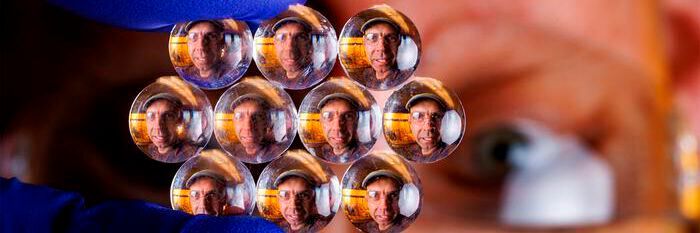
The visage of Stephen Morin, associate professor of chemistry, refracts through an array of lenses. Morin and his Nebraska colleagues have crafted much smaller lenses — some of them substantially narrower than a human hair — whose size and optical properties can be modified in seconds when subjected to certain stimuli.
(Source: Craig Chandler/ University of Nebraska–Lincoln)
A fly’s eye boasts roughly 4000 microscopic lenses, a honeybee’s up to twice that many. These lenses, though, belong not to a compound eye but to polydimethylsiloxane — a flexible polymer long ranking as a favored playground of Nebraska’s Stephen Morin and his band of fellow chemists.
With the aid of engineers Ruiguo Yang and Grayson Minnick, Morin’s team can now arrange and affix tiny gelatinous lenses to an elastic material that accommodates an even grander achievement. By carving the equivalent of aqueducts into the material, then running temperature-altering or water-gathering fluids through those channels, the researchers can also expand or contract the lenses in mere seconds — modifying their magnification, focal length and other optical properties in the process.
Whereas insects and crustaceans evolved their multifaceted eyes to draw in panoramas of ancient environments, Morin’s team is envisioning the future: projecting signals onto sensors embedded in soft robotic skins, for instance, via on-demand control.
“The artificial micro-lenses we have today are relatively static,” said Morin, associate professor of chemistry at the University of Nebraska–Lincoln. “They have a fixed focal length, a fixed size. They are made from materials that give you the lensing property you want, but they don’t really have any dynamic characteristics.”
To add that missing dynamism, Morin and his colleagues turned to hydrogels, the class of water-infused polymers that lend soft contact lenses their pliability. In the past, the team had physically adhered hydrogel islands to silicone materials, a deceptively difficult feat in its own right. But enough agitation, or the introduction of enough water, would inevitably detach the islands from their silicone base.
“The problem is that putting those together in a way that they function synergistically is not well-established,” Morin said. “There wasn’t really anything out there that was putting these two materials together in a robust, long-term platform.”
Overcoming the challenge, Morin knew, would mean supplementing the physical connection with a chemical one. Doctoral student John Kapitan and the team began by priming the transparent silicone with a patterned plasma treatment, coating it with strategic molecular groups and a lithium-based compound, depositing the hydrogel islands, then later applying just the right wavelengths of ultraviolet light. That light initiates the release of highly reactive free radicals that hopscotch across various molecular groups, essentially propagating chains that protrude both up from the silicone itself and across the emerging structure, stabilizing it.
“When it’s all said and done,” Morin said, “you have a somewhat monolithic structure. Now, in addition to that physical part, there’s this chemical element. And that was really the secret sauce.”
Morin and his colleagues would “aggressively” put the monolith through its paces. They threw water on it. They stretched the silicone, twisted it. They slapped on pieces of tape and peeled them off, trying to take the lenses with them. They even gave it an ultrasonic bath, peppering it with frequencies often used to clean jewelry, electronics and other grime-attracting products. The microscopic lenses hung tough through it all. When we were done, we were pretty satisfied that they were stuck on there pretty well,” Morin said.
Another series of experiments, led by doctoral student Brennan Watts, would soon test and demonstrate the lenses in action. In one, the team shone light on a Nebraska N, projecting it onto an array of hydrogel lenses and, beyond them, a microscope positioned to view the resulting images. When the researchers ran cold water through the material supporting those lenses, the Nebraska N appeared sharp, in focus. Just seconds after cranking that water up to 81°C, the lenses shrank and, on cue, the N blurred out of focus.
To its surprise, the team would later learn that the shift in focus stemmed not from the changing size or curvature of the lenses, but instead mostly from an alteration to their so-called refractive index. Light travels at different speeds when passing through different media — air, water, the human eye — and those changes in speed correspond to the light refracting, or bending, at different angles. As the hydrogel heated up and the lenses contracted, they actually expelled some of their water — upping their density, modifying their refractive index and, ultimately, blurring the image of the N.
Date: 08.12.2025
Naturally, we always handle your personal data responsibly. Any personal data we receive from you is processed in accordance with applicable data protection legislation. For detailed information please see our privacy policy.
Consent to the use of data for promotional purposes
I hereby consent to Vogel Communications Group GmbH & Co. KG, Max-Planck-Str. 7-9, 97082 Würzburg including any affiliated companies according to §§ 15 et seq. AktG (hereafter: Vogel Communications Group) using my e-mail address to send editorial newsletters. A list of all affiliated companies can be found here
Newsletter content may include all products and services of any companies mentioned above, including for example specialist journals and books, events and fairs as well as event-related products and services, print and digital media offers and services such as additional (editorial) newsletters, raffles, lead campaigns, market research both online and offline, specialist webportals and e-learning offers. In case my personal telephone number has also been collected, it may be used for offers of aforementioned products, for services of the companies mentioned above, and market research purposes.
Additionally, my consent also includes the processing of my email address and telephone number for data matching for marketing purposes with select advertising partners such as LinkedIn, Google, and Meta. For this, Vogel Communications Group may transmit said data in hashed form to the advertising partners who then use said data to determine whether I am also a member of the mentioned advertising partner portals. Vogel Communications Group uses this feature for the purposes of re-targeting (up-selling, cross-selling, and customer loyalty), generating so-called look-alike audiences for acquisition of new customers, and as basis for exclusion for on-going advertising campaigns. Further information can be found in section “data matching for marketing purposes”.
In case I access protected data on Internet portals of Vogel Communications Group including any affiliated companies according to §§ 15 et seq. AktG, I need to provide further data in order to register for the access to such content. In return for this free access to editorial content, my data may be used in accordance with this consent for the purposes stated here. This does not apply to data matching for marketing purposes.
Right of revocation
I understand that I can revoke my consent at will. My revocation does not change the lawfulness of data processing that was conducted based on my consent leading up to my revocation. One option to declare my revocation is to use the contact form found at https://contact.vogel.de. In case I no longer wish to receive certain newsletters, I have subscribed to, I can also click on the unsubscribe link included at the end of a newsletter. Further information regarding my right of revocation and the implementation of it as well as the consequences of my revocation can be found in the data protection declaration, section editorial newsletter.
While Morin said that on-the-fly adaptability bodes well for the design’s use in micro-projection systems, the chemist is also intrigued by its potential applications in biology. Because hydrogel generally mimics the gelatinous network residing between the cells of complex organisms, researchers often favor it when attempting to culture cells or tissues outside a biological environment.
A device designed by Yang, associate professor of mechanical and materials engineering, has granted Morin’s lab precise control over not just the size, patterning and composition of the hydrogel lenses it deposits, but the orientation and tension of the silicone they reside on, too. That precision, combined with the team’s ability to reversibly manipulate the lenses themselves, might expand the culturing options available to those working in biomaterials and biomedical engineering, Morin said.
“It would seem reasonable that these types of dynamic changes in size and stiffness and things of that nature would have a profound effect on the biology of anything contained in them,” he said. “We’re not there yet, but we certainly have interest in those problems.”
For Morin, who’s spent years experimenting with silicones and other polymers, the practical considerations of adaptable materials are informing, and informed by, the philosophical. There was, he said, a sensible reason for attaching the hydrogel lenses to silicone: Its elasticity relieves some of the stress imposed by the swelling and shrinking of the lenses, helping it maintain a longer-term grip than other, more brittle materials might.
But the chemist is also keen on reconsidering the physical and functional rigidity of what gets made — of viewing materials and structures through a new lens, give or take a few thousand. “There’s some confusion, I think, as to why we want materials that adapt,” he said. “And I think that’s built into the way that we’ve designed and manufactured materials … going all the way back to whenever we first started making things, I suppose. I always make the argument that it would be great if, 100 years from now, the materials we made were able to adapt as we grow and change, as opposed to just being designed to stay the same the whole way through. Of course, this work is just a microcosm of that. But that’s the idea. That’s what adaptive materials could give us.”
The team, which also included Nebraska’s Nengjian Huang and Mark Rose, reported its findings in the journal Advanced Functional Materials.




:quality(80)/p7i.vogel.de/wcms/aa/39/aa398d3e6667bdb43ad57abf38dc394c/0129347450v2.jpeg "An illustration shows a strand of engineered DNA passing through a nanoscale sensor, where its physical structure can be decoded as digital information. DNA nanostructures could one day serve as ultra-dense carriers of digital information and advance the field of data encryption. (Source: Jason Drees/ ASU)")
:quality(80)/p7i.vogel.de/wcms/06/a1/06a11f1d752afb35854aa9e1afb62e98/0129209625v2.jpeg "“Unsinkable\" metal tube made from chemically-etched aluminum floats in distilled water at the lab of University of Rochester professor Chunlei Guo. (Source: J. Adam Fenster / University of Rochester)")
:quality(80)/p7i.vogel.de/wcms/6d/df/6ddf023361ec7f8fbfb6c56521577960/0129056554v2.jpeg "The evolution of carburization (depicted by the spheres) under kinetic control (illustrated by the surface contours). The molecular beams represent gas evolution under synthesis conditions while the fiery sphere highlights the formation of the pure tungsten semi-carbide phase with additional molecular beams at the top to illustrate its catalytic performance. (Source: Sinhara M. H. D. Perera)")
:quality(80)/p7i.vogel.de/wcms/26/3d/263d97f8f2797267ecf2781b56882758/0129056451v1.jpeg "A study by the Complexity Science Hub finds that AI systems are already involved in nearly one-third of newly written software code, with rapid adoption in the United States and Europe and measurable productivity gains mainly for experienced developers. (Source: free licensed)")
:quality(80)/p7i.vogel.de/wcms/21/03/21030cc2541c455da0769decca8d1f82/0129146048v2.jpeg "Vyon porous plastics from Porvair Sciences are the perfect material for filtration applications in the healthcare and medical device market. (Source: Porvair Sciences)")
:quality(80)/p7i.vogel.de/wcms/bd/aa/bdaae5b9d381e2471ab37f479ad43d79/0129143884v2.jpeg "The Solvent Line Monitor from Testa Analytical is a true plug-and-play addition to any HPLC system designed to detect when one or more of its pump solvent reservoirs are empty and automatically shut-off the system. (Source: Testa Analytical)")
:quality(80)/p7i.vogel.de/wcms/8f/66/8f66b8acbb3037ca8e6b320bcad1c817/0129118043v2.jpeg "The Plasmaquant 9200 series is ideal for applications in research, trace analysis and quality control. (Source: Analytik Jena )")
:quality(80)/p7i.vogel.de/wcms/66/82/66825163ab842baded640db1a484e729/0129117548v2.jpeg "Biotech Fluidics has announced the Smartsaver solvent recycling unit which is designed to recover up to 90 % of your mobile phase by redirection of the pure solvent to the solvent reservoir during isocratic HPLC. (Source: Biotech Fluidics )")
:quality(80)/p7i.vogel.de/wcms/1a/4f/1a4fe7f8b5541716ba908251738beca1/0129349759v2.jpeg "Krict’s Syngas-to-Sustainable Aviation Fuel (SAF) Conversion Facility (Source: Korea Research Institute of Chemical Technology (Krict))")
:quality(80)/p7i.vogel.de/wcms/d4/29/d429a973c6f14ced3d2eb44931669a78/0129348927v1.jpeg "Cage-like ulva biochar confined synthesis of Fe₃O₄/ZnO heterojunction nanoparticles for synergistic adsorption and photocatalytic degradation of PFOA
(Source: Hua Jing et. al.)")
:quality(80)/p7i.vogel.de/wcms/86/90/8690b8154a552da13b37f289349b1db4/0129283446v2.jpeg "Lina Pérez-Ángel holds two sediment samples whose ages are separated by about a million years. (Source: Ellen Jorgensen)")
:quality(80)/p7i.vogel.de/wcms/90/f8/90f8c3152a59205a7cac1cc182eb186b/0129209634v2.jpeg "Nitrate in drinking water linked to increased dementia risk while nitrate from vegetables is linked to a lower risk, researchers find . (Source: free licensed)")
:quality(80)/p7i.vogel.de/wcms/84/2c/842c7c1678ceeec7147ea3a36e238e75/0129356324v2.jpeg "Kaust and Nadec have signed a MOU that establishes a framework for long-term cooperation across agricultural research, technology development, and professional training. (Source: Kaust )")
:quality(80)/p7i.vogel.de/wcms/d1/3c/d13c2ad34af600dbd360c0bb0990b922/0129045715v2.jpeg "Replacing animal products with plant-based foods helps reduce the risk of heart disease and type 2 diabetes, finds a new review by the Physicians Committee for Responsible Medicine. (Source: Pixabay)")
:quality(80)/p7i.vogel.de/wcms/e1/b3/e1b3e26d03101ba93b76b304da150c9a/0129025388v2.jpeg "The research reanalyzed data from a seminal clinical trial, led by US National Institutes of Health veteran Dr Kevin Hall, which first exposed how eating exclusively UPFs results in excessive calorie consumption and weight gain. (Source: Pixabay)")
:quality(80)/p7i.vogel.de/wcms/75/db/75db8afe45607bee750df705e22b60e9/0128938816v1.jpeg "A new academic review suggests that bamboo shoots could offer significant health benefits, including improved blood sugar control, gut health and antioxidant activity. (Source: free licensed)")
:quality(80)/p7i.vogel.de/wcms/14/24/14247b96901bfab6c75b7a3453ecfc6e/0129390600v2.jpeg "The US study, ‘Artificial-Intelligence-Enabled Digital Stethoscope Improves Point-of-Care Screening for Moderate to Severe Valvular Heart Disease’, was recently published on Thursday 5 February, 2026 in the European Heart Journal - Digital Health. (Source: Pixabay)")
:quality(80)/p7i.vogel.de/wcms/0d/9b/0d9bcd7e41846276db862456d619edd2/0129351002v2.jpeg "A Caltech-led team has developed a way of making bubble bots with simple protein shells that can be modified by enzymes or magnetic nanoparticles for efficient drug delivery. One version the researchers has made is \"smart\" enough to direct itself to direct itself to a tumor target. (Source: Gao Lab/ Caltech)")
:quality(80)/p7i.vogel.de/wcms/1a/ee/1aee2613e1a69c73ab568ee61d354ded/0129347044v1.jpeg "The Tonks lab studied PTP1B inhibition in a mouse model of Alzheimer’s disease. When PTP1B was deleted, as shown in the bottom row, the brain’s immune cells (green) were better at engulfing harmful amyloid-β plaques (grey), as shown in the left column. (Source: Nicholas Tonks/ CSHL)")
:quality(80)/p7i.vogel.de/wcms/fe/b7/feb7e0d151036b0c2be071e958dbce3b/0129341435v2.jpeg "As youth mental health challenges have risen alongside increased social media use, researchers and policymakers have questioned whether platforms contribute to emotional distress. (Source: Pixabay)")
:quality(80)/images.vogel.de/vogelonline/bdb/1710600/1710675/original.jpg "Discover how to set yourself up for success when performing balance-based density determination of solids such as jewelry and precious metals. (Mettler Toledo)")
:quality(80)/images.vogel.de/vogelonline/bdb/1682500/1682579/original.jpg "The new XPR Analytical balance redesigned to meet the needs of laboratory technicians of working fast and lean. (Mettler Toledo)")
:quality(80)/images.vogel.de/vogelonline/bdb/1677000/1677080/original.jpg "Enhance your weighing accuracy, comfort and productivity with the redesigned XPR Analytical balance. (Mettler Toledo)")
:quality(80)/p7i.vogel.de/wcms/16/cd/16cdd74e03f41e758270f88f9d917de8/0123513205v2.jpeg "Researchers in the Cox laboratory at Washington University in St. Louis used protoplasts — plant cells with their walls removed — to successfully adapt expansion microscopy for plant research. (Source: Cox laboratory, Washington University in St. Louis)")
:quality(80)/p7i.vogel.de/wcms/d0/2d/d02dee62d9d7043405db20308a530d29/0124884497v2.jpeg "Study participant putting contacts in (Source: Yuqian Ma, Yunuo Chen, Hang Zhao)")