Crafted from DNA, a tiny yet powerful motor is poised to revolutionize molecular factories and medical diagnostics. Powered by supercomputers, this innovation opens new frontiers in nanoscale machinery, echoing sci-fi visions and advancing real-world applications.
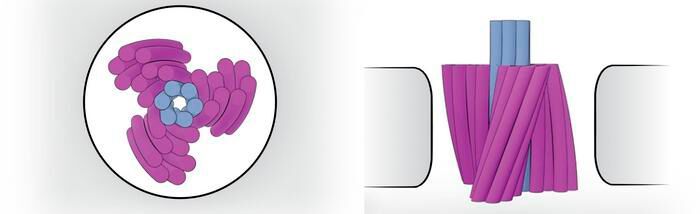
Scientists have created the world’s first working nanoscale electomotor. The science team designed a turbine engineered from DNA that is powered by hydrodynamic flow inside a nanopore, a nanometer-sized hole in a membrane of solid-state silicon nitride. The tiny motor could help spark research into future applications such as building molecular factories or even medical probes of molecules inside the bloodstream.
(Source: DOI: 10.1038/s41565-023-01527-8)
Scientists have created the world’s first working nanoscale electromotor, according to research published in the journal Nature Nanotechnology. The science team designed a turbine engineered from DNA that is powered by hydrodynamic flow inside a nanopore, a nanometer-sized hole in a membrane of solid-state silicon nitride.
The tiny motor could help spark research into future applications such as building molecular factories for useful chemicals or medical probes of molecules inside the bloodstream to detect diseases such as cancer.
“Common macroscopic machines become inefficient at the nanoscale,” said study co-author professor Aleksei Aksimentiev, a professor of physics at the University of Illinois at Urbana-Champagne. “We have to develop new principles and physical mechanisms to realize electromotors at the very, very small scales.”
The experimental work on the tiny motor was conducted by Cees Dekker of the Delft University of Technology and Hendrik Dietz of the Technical University of Munich.
Dietz is a world expert in DNA origami. His lab manipulated DNA molecules to make the tiny motor’s turbine, which consisted of 30 double-stranded DNA helices engineered into an axle and three blades of about 72 base pair length. Decker’s lab work demonstrated that the turbine can indeed rotate by applying an electric field. Aksimentiev’s lab carried out all-atom molecular dynamics simulations on a system of five million atoms to characterize the physical phenomena of how the motor works.
The system was the smallest representation that could yield meaningful results about the experiment; however, “it was one of the largest ever simulated from the DNA origami perspective,” Aksimentiev said.
Mission Impossible to Mission Possible
The Texas Advanced Computing Center (TACC) awarded Aksimentiev a Leadership Resource Allocation to aid his study of mesoscale biological systems on the National Science Foundation (NSF)-funded Frontera, the top academic supercomputer in the U.S.
“Frontera was instrumental in this DNA nanoturbine work,” Aksimentiev said. ”We obtained microsecond simulation trajectories in two to three weeks instead of waiting for a year or more on smaller computing systems. The big simulations were done on Frontera using about a quarter of the machine — over 2000 nodes,” Aksimentiev said. “However, it’s not just the hardware, but also the interaction with Tacc staff. It’s extremely important to make the best use of the resources once we have the opportunity.”
Aksimentiev was also awarded supercomputer allocations for this work by the NSF-funded Advanced Cyberinfrastructure Coordination Ecosystem: Services & Support (Access) on Expanse of the San Diego Supercomputer Center and Anvil of Purdue University.
“We had up to 100 different nanomotor systems to simulate. We had to run them for different conditions and in a speedy manner, which the ACCESS supercomputers assisted with perfectly,” Aksimentiev said. “Many thanks to the NSF for their support — we would not be able to do the science that we do without these systems.”
DNA as a Building Block
The success with the working DNA nanoturbine builds on a previous study that also used Frontera and ACCESS supercomputers. The study showed that a single DNA helix is the tiniest electromotor that one can build — it can rotate up to a billion revolutions per minute.
DNA has emerged as a building material at the nanoscale, according to Aksimentiev. “The way DNA base pair is a very powerful programming tool. We can program geometrical, three-dimensional objects from DNA using the Cadnano software just by programming the sequence of letters that make up the rungs of the double helix,” he explained.
Another reason for using DNA as the building block is that it carries a negative charge, an essential characteristic to make the electromotor.
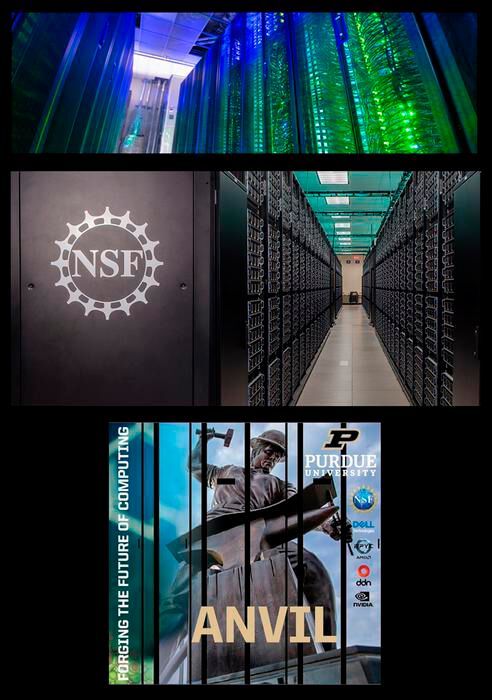
NSF-funded supercomputers: Expanse, San Diego Supercomputer Center (top); Frontera, Texas Advanced Computing Center (middle); Anvil, Perdue (bottom).
(Source: TACC, SDSC, Purdue)
“We wanted to reproduce one of the most spectacular biological machines — ATP synthase, which is driven by electric field. We chose to do our motor with DNA. This new work is the first nanoscale motor where we can control the rotational speed and direction,” he added. It’s done by adjusting the electric field across the solid state nanopore membrane and the salt concentrations of the fluid that surrounds the rotor. In the future, we might be able to synthetize a molecule using the new nanoscale electromotor, or we can use it to as an element of a bigger molecular factory, where things are moved around. Or we could imagine it as a vehicle for soft propulsion, where synthetic systems can go into a blood stream and probe molecules or cells one at a time,” Aksimentiev said.
Date: 08.12.2025
Naturally, we always handle your personal data responsibly. Any personal data we receive from you is processed in accordance with applicable data protection legislation. For detailed information please see our privacy policy.
Consent to the use of data for promotional purposes
I hereby consent to Vogel Communications Group GmbH & Co. KG, Max-Planck-Str. 7-9, 97082 Würzburg including any affiliated companies according to §§ 15 et seq. AktG (hereafter: Vogel Communications Group) using my e-mail address to send editorial newsletters. A list of all affiliated companies can be found here
Newsletter content may include all products and services of any companies mentioned above, including for example specialist journals and books, events and fairs as well as event-related products and services, print and digital media offers and services such as additional (editorial) newsletters, raffles, lead campaigns, market research both online and offline, specialist webportals and e-learning offers. In case my personal telephone number has also been collected, it may be used for offers of aforementioned products, for services of the companies mentioned above, and market research purposes.
Additionally, my consent also includes the processing of my email address and telephone number for data matching for marketing purposes with select advertising partners such as LinkedIn, Google, and Meta. For this, Vogel Communications Group may transmit said data in hashed form to the advertising partners who then use said data to determine whether I am also a member of the mentioned advertising partner portals. Vogel Communications Group uses this feature for the purposes of re-targeting (up-selling, cross-selling, and customer loyalty), generating so-called look-alike audiences for acquisition of new customers, and as basis for exclusion for on-going advertising campaigns. Further information can be found in section “data matching for marketing purposes”.
In case I access protected data on Internet portals of Vogel Communications Group including any affiliated companies according to §§ 15 et seq. AktG, I need to provide further data in order to register for the access to such content. In return for this free access to editorial content, my data may be used in accordance with this consent for the purposes stated here. This does not apply to data matching for marketing purposes.
Right of revocation
I understand that I can revoke my consent at will. My revocation does not change the lawfulness of data processing that was conducted based on my consent leading up to my revocation. One option to declare my revocation is to use the contact form found at https://contact.vogel.de. In case I no longer wish to receive certain newsletters, I have subscribed to, I can also click on the unsubscribe link included at the end of a newsletter. Further information regarding my right of revocation and the implementation of it as well as the consequences of my revocation can be found in the data protection declaration, section editorial newsletter.
If you think this sounds like something out of a 1960’s sci-fi movie, you are right. In the movie Fantastic Voyage, a team of Americans in a nuclear submarine is shrunk and injected into a scientist’s body to fix a blood clot and need to work quickly before the miniaturization wears off.
As far-fetched as this might sound, Aksimentiev says that the concept and the elements of the machines we are developing today could enable something like this to happen.
“We were able to accomplish this because of supercomputers,” Aksimentiev said. “Supercomputers are becoming more and more indispensable as the complexity of the systems that we build increases. They’re the computational microscopes, which at ultimate resolutions can see the motion of individual atoms and how that is coupled to a bigger system.”
Original Article: A DNA turbine powered by a transmembrane potential across a nanopore; Nature Nanotechnology; DOI:10.1038/s41565-023-01527-8




:quality(80)/p7i.vogel.de/wcms/fd/73/fd73fcb3ceda89d1419de1083fcab7b4/0130081520v2.jpeg "The fingers at the heart of this technology were inspired by the fin-ray effect — a design principle derived from the natural structure of fish fins. (Source: University of Texas at Austin )")
:quality(80)/p7i.vogel.de/wcms/fe/64/fe649767c802d53ac63ee2c2a40b7e0d/0130060830v2.jpeg "Sample tube with light-active substance (Source: Elvira Eberhardt / Ulm University)")
:quality(80)/p7i.vogel.de/wcms/db/e2/dbe2ae4e02f702b30153a882ef705089/0129978032v1.jpeg "Each of the isolated indium atoms (in gold color) can catalyse the synthesis of methanol (top right). (Source: Constance Ko/ ETH Zurich)")
:quality(80)/p7i.vogel.de/wcms/c1/e6/c1e6ac26eb18993236c100e7f01a78f2/0129937639v1.jpeg "Dogs evolved from highly social ancestors and have been shaped by thousands of years of interacting with humans. (Source: free licensed)")
:quality(80)/p7i.vogel.de/wcms/8f/b9/8fb98a958e4afe679865fbe52a473680/0129940982v2.jpeg "pH measurement in various nanoparticles using the Nine-Focus meter ensures precise stability and performance control. (Source: Mettler Toledo)")
:quality(80)/p7i.vogel.de/wcms/11/74/1174e5d4c8b07a64637dced8c9506b40/0129787561v2.jpeg "The Multicell Plus high-pressure reactor sets a new benchmark for operator safety, all-round accessibility and ease-of-use. (Source: Asynt)")
:quality(80)/p7i.vogel.de/wcms/ef/6e/ef6e96191183411973b77041fb6b1e16/0129785957v2.jpeg "Manufactured from high-quality crystal polystyrene - these new automation-ready plates are available in a choice of ANSI / SLAS standard (96-well and breakable 8-well strip) formats. (Source: Porvair Sciences)")
:quality(80)/p7i.vogel.de/wcms/ad/ca/adcaa20ef5ccaf7e3b325788b1e349c4/0129784872v2.jpeg "The high performance Degasi Flat Film in-line degasser. (Source: Biotech Fluidics)")
:quality(80)/p7i.vogel.de/wcms/2d/45/2d45aba62f5042baa00f7fd4fa629839/0130036533v2.jpeg "The population of Pune, India, is expected to reach 11 million by 2050. (Source: free licensed)")
:quality(80)/p7i.vogel.de/wcms/52/f8/52f8d5521fdab07ed0a865ec0d8919fd/0130009438v2.jpeg "Drylands support around half of global livestock production and sustain the livelihoods of close to a billion people, while also underpinning soil stability and carbon storage. (Source: Kaust )")
:quality(80)/p7i.vogel.de/wcms/fe/49/fe494ada322615b6e6f6ff0f5bb7c5cf/0129926008v2.jpeg "A mandrill eating fruit. (Source: University of Bristol )")
:quality(80)/p7i.vogel.de/wcms/af/4e/af4ea968647ee9cae82b39800c611819/0129865630v2.jpeg "Map of a simulated risk of water stress in 2050 where hydrogen is used in transport and industry. Baseline risk (regardless of hydrogen use) is represented by the background color in each area. Dashed areas show water use exceeding available resources due to hydrogen production. Blue dots show areas where the risk of water stress increases by more than 50 percent in the simulation. (Source: Chalmers University of Technology / Joel Löfving)")
:quality(80)/p7i.vogel.de/wcms/6f/ba/6fba92196d0cbb1467334f8a2ecc520a/0130203021v2.jpeg "Low to moderate wine consumption shows lower risk compared with spirits, beer and cider (Source: free licensed)")
:quality(80)/p7i.vogel.de/wcms/a9/37/a9376f1d9a893570023d9aa97c085bc5/0129927485v2.jpeg "Examples of foods high in PUFAs include fatty fish and soybeans, while MUFAs include olive oil and avocadoes. (Source: free licensed)")
:quality(80)/p7i.vogel.de/wcms/ea/88/ea88ef8810e21cdd9bb852c70f385ba1/0129797385v2.jpeg "A team of NUS food scientists consisting of Assoc Prof Liu Shao Quan (centre), Dr Lu Yuyun (right) and Ms Geng Chenhan (left) pioneered a co-fermentation method that improves both the nutrient and flavor profile of kombu. (Source: NUS)")
:quality(80)/p7i.vogel.de/wcms/84/2c/842c7c1678ceeec7147ea3a36e238e75/0129356324v2.jpeg "Kaust and Nadec have signed a MOU that establishes a framework for long-term cooperation across agricultural research, technology development, and professional training. (Source: Kaust )")
:quality(80)/p7i.vogel.de/wcms/ed/c0/edc0c1a86229b11efd17c5e3f94d14da/0130081211v2.jpeg "A new study finds that virtual visits did not make it easier for psychiatrists, psychologists and therapists to reach significantly more people in areas where access to care has long been limited. (Source: Pixabay)")
:quality(80)/p7i.vogel.de/wcms/9c/52/9c52318bc94be17e6662dfceffa4a0c0/0130060546v2.jpeg "Domestic cat ‘Lanni’ from co-author of the study, Latasha Ludwig, Assistant Clinical Professor at Cornell University, USA. (Source: © Latasha Ludwig)")
:quality(80)/p7i.vogel.de/wcms/4b/f4/4bf4cc9e28e65e11a27dd41da2d1a7f5/0130038185v2.jpeg "The biomarker p-tau217 could help identify women at elevated dementia risk decades before clinical symptoms begin. (Source: free licensed)")
:quality(80)/p7i.vogel.de/wcms/4f/29/4f292f402b157e2ab8c57e9f2a3e3199/0130036120v2.jpeg "The chemistry is powered by an LED lamp that triggers a self-sustaining chain reaction, forging new carbon–carbon bonds under mild conditions without toxic or expensive chemicals. (Source: Nordin Ćatić/ St John’s College, Cambridge)")
:quality(80)/images.vogel.de/vogelonline/bdb/1710600/1710675/original.jpg "Discover how to set yourself up for success when performing balance-based density determination of solids such as jewelry and precious metals. (Mettler Toledo)")
:quality(80)/images.vogel.de/vogelonline/bdb/1682500/1682579/original.jpg "The new XPR Analytical balance redesigned to meet the needs of laboratory technicians of working fast and lean. (Mettler Toledo)")
:quality(80)/images.vogel.de/vogelonline/bdb/1677000/1677080/original.jpg "Enhance your weighing accuracy, comfort and productivity with the redesigned XPR Analytical balance. (Mettler Toledo)")
:fill(fff,0)/p7i.vogel.de/companies/5f/3f/5f3f63ceedc78/knf-logo.jpg "KNF_Logo.jpg (www.knf.com)")
:quality(80)/p7i.vogel.de/wcms/b1/41/b141479779b11e0027969e746bd6c73b/0116181300.jpeg "Assistant professor Sourabh Saha and Jungho Choi (Ph.D. student) in front of their superluminescent light projection system at Georgia Tech. (Source: Georgia Institute of Technology)")
:quality(80)/p7i.vogel.de/wcms/aa/39/aa398d3e6667bdb43ad57abf38dc394c/0129347450v2.jpeg "An illustration shows a strand of engineered DNA passing through a nanoscale sensor, where its physical structure can be decoded as digital information. DNA nanostructures could one day serve as ultra-dense carriers of digital information and advance the field of data encryption. (Source: Jason Drees/ ASU)")
:quality(80)/p7i.vogel.de/wcms/6d/f3/6df31039a56e126d4f7988dd211759ff/0126110156v1.jpeg "Illustration of water trapped as molecular bridges at carbohydrate-clay interfaces. (Source: Aristilde Research Group/ Northwestern University)")