A new study in Nature Ecology & Evolution explores the challenges of scaling conservation efforts to reverse biodiversity loss. Researchers from Imperial College London reviewed global initiatives, offering five key lessons for expanding conservation programs effectively.
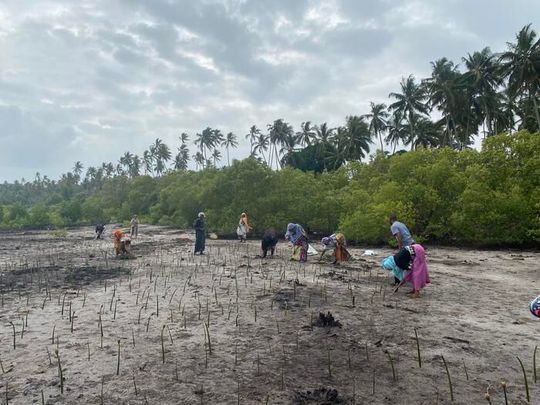
Mangrove planting in Zanzibar
(Source: Matthew Clark/ Imperial College London)
To reverse biodiversity loss and meet ambitious global targets, conservation programmes designed to preserve everything from forests to fish need to work ‘at scale’. Scaling can mean three things. Scaling ‘out’ means expanding a programme to new people and places, while scaling ‘up’ means bringing in higher-level institutions, such as governments introducing policies or incentives that make it easier for individuals and private companies to engage.
Scaling ‘deep’ means changing hearts and minds — what is socially acceptable. A particularly good example of scaling deep is the ‘Don’t Mess with Texas’ campaign in the 1980s, which successfully made littering a social no-no.
But not every attempt to expand pilot programmes in one or more of these directions works. Now, the Catalysing Conservation team led by Dr Morena Mills at Imperial College London researchers have reviewed conservation initiatives around the world with global experts and come up with five lessons to avoid the pitfalls of ineffective expansion.
The study is published today in Nature Ecology & Evolution, and we spoke to two of the authors on the paper, Dr Thomas Pienkowski and Dr Matthew Clark, both from the Centre for Environmental Policy at Imperial.
Before we dive in, Dr Clark says: “There’s no magic bullet — it’s not a case of ‘do these five things and you will succeed’ — but we hope these lessons will allow reflection on what hasn’t worked, and where we need to go from here.”
Lesson 1: There must be a balance between what is effective and what is scalable
Say you have a pilot programme that works with coastal communities to protect fish and other marine resources, aiming to improve the local ecology and economy. Then lots of neighbouring communities take up the programme. Great! This is scaling out, but has it actually been effective? Did it meet the stated goals of protecting marine life and improving local livelihoods? If the answer is no, it has scaled but it is not effective.
Conversely, something can be effective but not scalable. Dr Clark works with communities to support mangrove conservation, which can involve planting programmes. However, many of the seedlings die young. It’s possible to use specialised tools and know-how to increase survival rates, which makes the planting more effective, but it is an intensive process, and so not very scalable across rural communities.
The team say these trade-offs between what’s scalable and what’s effective must be balanced.
Good example: Community-based forestry management in Nepal has been adopted for more than 20,000 forests since the 1980s and appears to have reduced both poverty and deforestation, showing that some initiatives can be both highly scalable and effective.
A pilot project that is successful in one area may not work when moved out to a new area. This is common, say the researchers, and can be for a number of reasons: pilots may be in optimal locations and have lots of oversight and investment that expanded programmes won’t have, for example.
But it can also work the other way. For example, says Dr Clark: “Where the goal is to protect land for wildlife, larger animals that move over larger areas will only benefit once enough land is conserved, and enough patrols are in place to enforce the protection.”
Good example: Cacao agroforestry in Belize became much more effective at scale when a clear market for sustainable cacao emerged and more international companies wanted to promote their use of these products.
Lesson 3: The effects of conservation can change the conditions for further conservation
Sometimes, conservation expansion can backfire even when it’s effective. For example, a 10-year project in Mozambique introduced ‘no-take’ zones for fish and mangrove timber, which increased food security. However, once these areas had regained their value as sources of food and income, conservation support declined, leading to the abandonment of the zones in some areas.
These kinds of feedback loops between environmental change and human behaviour can be negative, as in Mozambique, or positive, where the impact of conservation schemes in one area can lead to neighbouring areas taking them up spontaneously, or where grassroots actions become national policy.
Good example: on the island of Pemba, Zanzibar, protected forest areas initially led to more harvesting on the edges of these zones; but this in turn led to neighbouring communities applying for their own forest protection, spontaneously expanding conversation.
Date: 08.12.2025
Naturally, we always handle your personal data responsibly. Any personal data we receive from you is processed in accordance with applicable data protection legislation. For detailed information please see our privacy policy.
Consent to the use of data for promotional purposes
I hereby consent to Vogel Communications Group GmbH & Co. KG, Max-Planck-Str. 7-9, 97082 Würzburg including any affiliated companies according to §§ 15 et seq. AktG (hereafter: Vogel Communications Group) using my e-mail address to send editorial newsletters. A list of all affiliated companies can be found here
Newsletter content may include all products and services of any companies mentioned above, including for example specialist journals and books, events and fairs as well as event-related products and services, print and digital media offers and services such as additional (editorial) newsletters, raffles, lead campaigns, market research both online and offline, specialist webportals and e-learning offers. In case my personal telephone number has also been collected, it may be used for offers of aforementioned products, for services of the companies mentioned above, and market research purposes.
Additionally, my consent also includes the processing of my email address and telephone number for data matching for marketing purposes with select advertising partners such as LinkedIn, Google, and Meta. For this, Vogel Communications Group may transmit said data in hashed form to the advertising partners who then use said data to determine whether I am also a member of the mentioned advertising partner portals. Vogel Communications Group uses this feature for the purposes of re-targeting (up-selling, cross-selling, and customer loyalty), generating so-called look-alike audiences for acquisition of new customers, and as basis for exclusion for on-going advertising campaigns. Further information can be found in section “data matching for marketing purposes”.
In case I access protected data on Internet portals of Vogel Communications Group including any affiliated companies according to §§ 15 et seq. AktG, I need to provide further data in order to register for the access to such content. In return for this free access to editorial content, my data may be used in accordance with this consent for the purposes stated here. This does not apply to data matching for marketing purposes.
Right of revocation
I understand that I can revoke my consent at will. My revocation does not change the lawfulness of data processing that was conducted based on my consent leading up to my revocation. One option to declare my revocation is to use the contact form found at https://contact.vogel.de. In case I no longer wish to receive certain newsletters, I have subscribed to, I can also click on the unsubscribe link included at the end of a newsletter. Further information regarding my right of revocation and the implementation of it as well as the consequences of my revocation can be found in the data protection declaration, section editorial newsletter.
Lesson 4: Pressures to scale can lead to bad practices that undermine long-term outcomes
Ambition is needed to meet ambitious goals, but ambition without care can be harmful. Dr Pienkowski explains one way this can happen: “NGOs [non-governmental organisations] play a really important role in scaling out, providing technical and financial support to local communities. But there can also be blurred boundaries between assistance and coercion.
“This can take the form, for example, of NGOs misleading communities of the benefits they might get from engaging in conservation programmes, or only engaging with people in the community who are most likely to benefit, leaving more vulnerable members behind and widening inequalities.”
For example, the REDD+ scheme is designed to help developing countries manage their forests and improve carbon stocks, but its implementation in parts of Tanzania was marred by promised payments not materialising, leading people to abandon conservation efforts and be suspicious of other schemes.
Larger NGOs are often needed to scale programmes, but this can be at the expense of local knowledge and grassroots organisations. For example, ‘slash and burn’ agriculture is considered bad practice in Europe, so European NGOs may lobby against it, but in communities in Africa it can be well used and an integral part of local ecosystem management.
Good example: Eco-tourism in Costa Rica started locally with support from NGOs, but has now become self-sustaining, meaning it no longer relies on direct aid or other structures that may undermine its long-term success.
Lesson 5: More evidence is needed
Dr Pienkowski explains: “This one is really an appeal from us researchers, who are struggling to develop the evidence base we need to inform more effective scaling strategies. It’s very difficult to know which initiatives have gone to scale or not — this information isn’t collected in a systematic or rigorous way.”
This is particularly true after programmes have ‘ended’ — few NGOs routinely review whether a scheme is still working years after their intervention has ended, or whether it has been abandoned.
Dr Pienkowski concludes: “For those calling for conservation scaling, this is a valuable moment to pause and reflect: with these examples and these lessons, what do we need to change? If we do this, we’re more likely to be able to deliver impact at scale and finally bend the curve on biodiversity loss.”
References: Five lessons for avoiding failure when scaling in conservation; Nature Ecology & Evolution; DOI:10.1038/s41559-024-02507-4




:quality(80)/p7i.vogel.de/wcms/92/ad/92adbafb37924cea35ea3cf05b7a23e5/0130206318v2.jpeg "The world’s first fully functioning proof-of-concept quantum battery
(Source: Csiro)")
:quality(80)/p7i.vogel.de/wcms/9f/8b/9f8bc2b8491d7a514ca154e9588a07b7/0130205846v1.jpeg "The researchers’ new material, based on mineralised sawdust, is an excellent fire retardant. (Source: Dan Vivas Glaser / from Kürsteiner R et al. Chem Circularity 2026)")
:quality(80)/p7i.vogel.de/wcms/fd/73/fd73fcb3ceda89d1419de1083fcab7b4/0130081520v2.jpeg "The fingers at the heart of this technology were inspired by the fin-ray effect — a design principle derived from the natural structure of fish fins. (Source: University of Texas at Austin )")
:quality(80)/p7i.vogel.de/wcms/fe/64/fe649767c802d53ac63ee2c2a40b7e0d/0130060830v2.jpeg "Sample tube with light-active substance (Source: Elvira Eberhardt / Ulm University)")
:quality(80)/p7i.vogel.de/wcms/8f/b9/8fb98a958e4afe679865fbe52a473680/0129940982v2.jpeg "pH measurement in various nanoparticles using the Nine-Focus meter ensures precise stability and performance control. (Source: Mettler Toledo)")
:quality(80)/p7i.vogel.de/wcms/11/74/1174e5d4c8b07a64637dced8c9506b40/0129787561v2.jpeg "The Multicell Plus high-pressure reactor sets a new benchmark for operator safety, all-round accessibility and ease-of-use. (Source: Asynt)")
:quality(80)/p7i.vogel.de/wcms/ef/6e/ef6e96191183411973b77041fb6b1e16/0129785957v2.jpeg "Manufactured from high-quality crystal polystyrene - these new automation-ready plates are available in a choice of ANSI / SLAS standard (96-well and breakable 8-well strip) formats. (Source: Porvair Sciences)")
:quality(80)/p7i.vogel.de/wcms/ad/ca/adcaa20ef5ccaf7e3b325788b1e349c4/0129784872v2.jpeg "The high performance Degasi Flat Film in-line degasser. (Source: Biotech Fluidics)")
:quality(80)/p7i.vogel.de/wcms/e9/9c/e99cb19231197af70c489cb4acc2ead0/0130293444v2.jpeg "A new global study, led by researchers at Kaust in Saudi Arabia, shows that forests are most effective for climate regulation when conserved or restored in their natural or native locations. (Source: Kaust )")
:quality(80)/p7i.vogel.de/wcms/af/40/af40b535eb65c287fbd22ed5483d1d0e/0130206243v2.jpeg "The researchers dug soil pits in order to measure the carbon storage in soil
(Source: Johanna Asch)")
:quality(80)/p7i.vogel.de/wcms/2d/45/2d45aba62f5042baa00f7fd4fa629839/0130036533v2.jpeg "The population of Pune, India, is expected to reach 11 million by 2050. (Source: free licensed)")
:quality(80)/p7i.vogel.de/wcms/52/f8/52f8d5521fdab07ed0a865ec0d8919fd/0130009438v2.jpeg "Drylands support around half of global livestock production and sustain the livelihoods of close to a billion people, while also underpinning soil stability and carbon storage. (Source: Kaust )")
:quality(80)/p7i.vogel.de/wcms/6f/ba/6fba92196d0cbb1467334f8a2ecc520a/0130203021v2.jpeg "Low to moderate wine consumption shows lower risk compared with spirits, beer and cider (Source: free licensed)")
:quality(80)/p7i.vogel.de/wcms/a9/37/a9376f1d9a893570023d9aa97c085bc5/0129927485v2.jpeg "Examples of foods high in PUFAs include fatty fish and soybeans, while MUFAs include olive oil and avocadoes. (Source: free licensed)")
:quality(80)/p7i.vogel.de/wcms/ea/88/ea88ef8810e21cdd9bb852c70f385ba1/0129797385v2.jpeg "A team of NUS food scientists consisting of Assoc Prof Liu Shao Quan (centre), Dr Lu Yuyun (right) and Ms Geng Chenhan (left) pioneered a co-fermentation method that improves both the nutrient and flavor profile of kombu. (Source: NUS)")
:quality(80)/p7i.vogel.de/wcms/84/2c/842c7c1678ceeec7147ea3a36e238e75/0129356324v2.jpeg "Kaust and Nadec have signed a MOU that establishes a framework for long-term cooperation across agricultural research, technology development, and professional training. (Source: Kaust )")
:quality(80)/p7i.vogel.de/wcms/66/a6/66a64c9dd7dbe84d2d7ea95a5e691bb1/0130361609v2.jpeg "Dr. Priya Freaney speaking to a patient at Bluhm Cardiovascular Institute at Northwestern Memorial Hospital in Chicago. (Source: Northwestern Medicine)")
:quality(80)/p7i.vogel.de/wcms/6e/d4/6ed479ad990b9ddc0f2eeadccccf62c7/0130359257v2.jpeg "Routine early measurement of neurofilament light chain could help improve prediction of cognitive impairment after out-of-hospital cardiac arrest, according to a study presented recently at ESC Acute Cardiovascular Care 2026. (Source: Pixabay)")
:quality(80)/p7i.vogel.de/wcms/6e/b9/6eb95805568aa78dc2ed57f829cf33d4/0130300421v2.jpeg "A 10-minute digital program co-developed by a University of Texas psychologist significantly reduced symptoms of depression four weeks after use, according to results from one of the largest randomized controlled trials of single-session mental health interventions. (Source: University of Texas at Austin )")
:quality(80)/p7i.vogel.de/wcms/6f/e9/6fe9d920eca2c0b3bdeb55cbe9f01908/0130299237v2.jpeg "Study authors Jason Miska and Leah Billingham reading out enzymatic activity of microglia in cell cultures. (Source: Northwestern University.)")
:quality(80)/images.vogel.de/vogelonline/bdb/1710600/1710675/original.jpg "Discover how to set yourself up for success when performing balance-based density determination of solids such as jewelry and precious metals. (Mettler Toledo)")
:quality(80)/images.vogel.de/vogelonline/bdb/1682500/1682579/original.jpg "The new XPR Analytical balance redesigned to meet the needs of laboratory technicians of working fast and lean. (Mettler Toledo)")
:quality(80)/images.vogel.de/vogelonline/bdb/1677000/1677080/original.jpg "Enhance your weighing accuracy, comfort and productivity with the redesigned XPR Analytical balance. (Mettler Toledo)")
:quality(80)/p7i.vogel.de/wcms/7e/dc/7edcd99f8f014e012c0b99bf76e6fba1/0115335272.jpeg "Red-base Jezebel (Delias pasithoe) (Source: Dr Shawan Chowdhury)")
:quality(80)/p7i.vogel.de/wcms/55/ef/55efab1b08587a4534a2a5f78cd39057/0125840372v1.jpeg "A side-by-side comparison of fishing vessel data detected via AIS and those detected by SAR techniques. (Source: Jennifer Raynor)")
:quality(80)/p7i.vogel.de/wcms/66/61/66614d42678d4d2fb009d842a6386744/0124969198v2.jpeg "Frog attempting to cross road in Monkton, Vermont. (Source: Joshua Brown/ University of Vermont)")