Imagine a future where a single drop of blood offers comprehensive health insights in minutes. This vision is nearing reality thanks to scientists from LMU and the Max Planck Institute, who, in collaboration with Helmholtz Zentrum München, have developed a groundbreaking health screening tool.
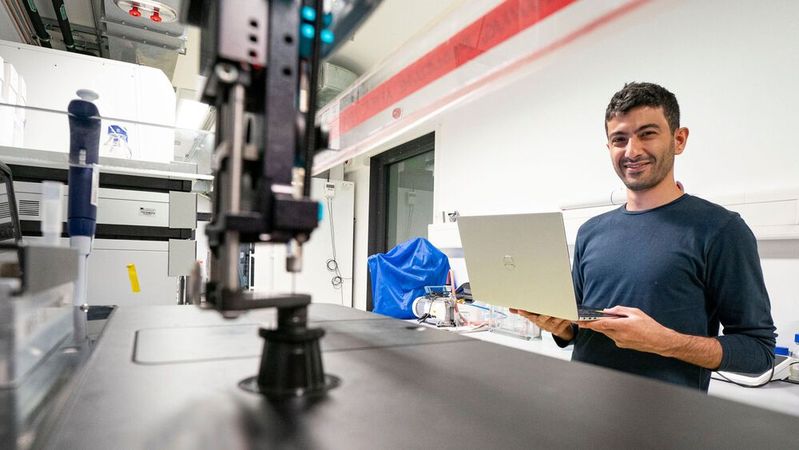
PhD student and first author Tarek Eissa has analyzed thousands of molecular fingerprints.
(Source: Thorsten Naeser / MPQ / Attoworld)
Scientists from the BIRD team led by Mihaela Žigman at Ludwig-Maximilians-Universität München (LMU) and the Max Planck Institute of Quantum Optics (MPQ), in collaboration with Helmholtz Zentrum München, have developed a health screening tool that uses infrared light and machine learning to detect multiple health conditions with just one measurement.
Infrared spectroscopy, a technique that employs infrared light to analyze the molecular composition of substances, has been a foundational tool in chemistry for decades. It’s like giving molecules a fingerprint that can be delivered by a specialized machine called a spectrometer. When applied to complex biofluids like blood plasma, this physico-chemical technique can reveal detailed information about molecular signals, making it a promising tool for medical diagnostics. Despite its long-standing use in chemistry and industry, infrared spectroscopy has not been established nor integrated into the canon of medical diagnostics.
Led by Mihaela Žigman, a team of scientists from the Bird group at LMU and MPQ initiated an effort to tackle this issue. Having previously established a method for measuring human plasma, they collaborated with Annette Peters' team from Helmholtz Munich to pioneer infrared molecular fingerprinting on a naturally diverse population. This involved measuring blood from thousands of individuals in the Kora study, a comprehensive health research project established in Augsburg, Germany. Randomly selected adults were chosen as a representative scenario for a naturally variable population and were recruited for medical examinations and blood donations.
Extensive Potential Applications
What is the value of the current work? The existing Kora study got a new value as it got tested from a fresh perspective and served a new purpose: More than 5000 blood plasma samples were measured using Fourier transform infrared (FTIR) spectroscopy. Tarek Eissa and Cristina Leonardo of the BIRD team at LMU analyzed the blood samples from the Kora study using infrared light to obtain molecular fingerprints. The team applied machine learning to analyze the molecular fingerprints and correlated them with medical data. They discovered that these fingerprints contain valuable information that enables rapid health screening. A multi-task computer algorithm that is now capable of distinguishing between various health states, including abnormal levels of blood lipids, various changes in blood pressure, seeing type-2 diabetes but also spotting even pre-diabetes, a precursor to diabetes often undetected.
Interestingly, the algorithm could also single out individuals who were healthy and remained healthy over the investigated years. This was very significant for two reasons: firstly, most people in any random population experience abnormal health changes and given that we are all different, as well as that we all change over time, it is all but trivial to find fully healthy individuals. Secondly, many individuals suffer from multiple conditions in various combinations. Traditionally, doctors would need a new test for each disease. However, this new approach doesn’t just pinpoint one condition at a time — it accurately identifies a range of health issues. This machine learning-powered system not only identifies healthy individuals but also detects complex conditions involving multiple illnesses simultaneously. Moreover, it can predict the development of metabolic syndrome years before symptoms appear, providing a window for interventions.
This study lays the groundwork for infrared molecular fingerprinting to become a routine part of health screening, enabling doctors to detect and manage conditions more efficiently, the researchers say. This is especially important for metabolic disorders like cholesterol abnormalities and diabetes, where timely and effective interventions can significantly improve outcomes. However, the potential applications of this technology extend even further. As researchers continue to refine the system and expand its capabilities, by means of technology development and the establishment of these in the context of clinical studies, there will be even more health conditions and their combinations added to the diagnostic repertoire, the researchers hope. This could lead to personalized health monitoring, where individuals regularly check their health status and catch potential issues long before they become serious.
Date: 08.12.2025
Naturally, we always handle your personal data responsibly. Any personal data we receive from you is processed in accordance with applicable data protection legislation. For detailed information please see our privacy policy.
Consent to the use of data for promotional purposes
I hereby consent to Vogel Communications Group GmbH & Co. KG, Max-Planck-Str. 7-9, 97082 Würzburg including any affiliated companies according to §§ 15 et seq. AktG (hereafter: Vogel Communications Group) using my e-mail address to send editorial newsletters. A list of all affiliated companies can be found here
Newsletter content may include all products and services of any companies mentioned above, including for example specialist journals and books, events and fairs as well as event-related products and services, print and digital media offers and services such as additional (editorial) newsletters, raffles, lead campaigns, market research both online and offline, specialist webportals and e-learning offers. In case my personal telephone number has also been collected, it may be used for offers of aforementioned products, for services of the companies mentioned above, and market research purposes.
Additionally, my consent also includes the processing of my email address and telephone number for data matching for marketing purposes with select advertising partners such as LinkedIn, Google, and Meta. For this, Vogel Communications Group may transmit said data in hashed form to the advertising partners who then use said data to determine whether I am also a member of the mentioned advertising partner portals. Vogel Communications Group uses this feature for the purposes of re-targeting (up-selling, cross-selling, and customer loyalty), generating so-called look-alike audiences for acquisition of new customers, and as basis for exclusion for on-going advertising campaigns. Further information can be found in section “data matching for marketing purposes”.
In case I access protected data on Internet portals of Vogel Communications Group including any affiliated companies according to §§ 15 et seq. AktG, I need to provide further data in order to register for the access to such content. In return for this free access to editorial content, my data may be used in accordance with this consent for the purposes stated here. This does not apply to data matching for marketing purposes.
Right of revocation
I understand that I can revoke my consent at will. My revocation does not change the lawfulness of data processing that was conducted based on my consent leading up to my revocation. One option to declare my revocation is to use the contact form found at https://contact.vogel.de. In case I no longer wish to receive certain newsletters, I have subscribed to, I can also click on the unsubscribe link included at the end of a newsletter. Further information regarding my right of revocation and the implementation of it as well as the consequences of my revocation can be found in the data protection declaration, section editorial newsletter.
In conclusion, the combination of infrared spectroscopy with machine learning is set to transform health diagnostics, the researchers believe. With a single drop of blood and infrared light, there will be a powerful new tool to keep tabs on our health, catching problems more efficiently and potentially improving healthcare globally.
Original Article: Plasma infrared fingerprinting with machine learning enables single-measurement multi-phenotype health screening; Cell Reports Medicine; DOI:10.1016/j.xcrm.2024.101625




:quality(80)/p7i.vogel.de/wcms/aa/39/aa398d3e6667bdb43ad57abf38dc394c/0129347450v2.jpeg "An illustration shows a strand of engineered DNA passing through a nanoscale sensor, where its physical structure can be decoded as digital information. DNA nanostructures could one day serve as ultra-dense carriers of digital information and advance the field of data encryption. (Source: Jason Drees/ ASU)")
:quality(80)/p7i.vogel.de/wcms/06/a1/06a11f1d752afb35854aa9e1afb62e98/0129209625v2.jpeg "“Unsinkable\" metal tube made from chemically-etched aluminum floats in distilled water at the lab of University of Rochester professor Chunlei Guo. (Source: J. Adam Fenster / University of Rochester)")
:quality(80)/p7i.vogel.de/wcms/6d/df/6ddf023361ec7f8fbfb6c56521577960/0129056554v2.jpeg "The evolution of carburization (depicted by the spheres) under kinetic control (illustrated by the surface contours). The molecular beams represent gas evolution under synthesis conditions while the fiery sphere highlights the formation of the pure tungsten semi-carbide phase with additional molecular beams at the top to illustrate its catalytic performance. (Source: Sinhara M. H. D. Perera)")
:quality(80)/p7i.vogel.de/wcms/26/3d/263d97f8f2797267ecf2781b56882758/0129056451v1.jpeg "A study by the Complexity Science Hub finds that AI systems are already involved in nearly one-third of newly written software code, with rapid adoption in the United States and Europe and measurable productivity gains mainly for experienced developers. (Source: free licensed)")
:quality(80)/p7i.vogel.de/wcms/21/03/21030cc2541c455da0769decca8d1f82/0129146048v2.jpeg "Vyon porous plastics from Porvair Sciences are the perfect material for filtration applications in the healthcare and medical device market. (Source: Porvair Sciences)")
:quality(80)/p7i.vogel.de/wcms/bd/aa/bdaae5b9d381e2471ab37f479ad43d79/0129143884v2.jpeg "The Solvent Line Monitor from Testa Analytical is a true plug-and-play addition to any HPLC system designed to detect when one or more of its pump solvent reservoirs are empty and automatically shut-off the system. (Source: Testa Analytical)")
:quality(80)/p7i.vogel.de/wcms/8f/66/8f66b8acbb3037ca8e6b320bcad1c817/0129118043v2.jpeg "The Plasmaquant 9200 series is ideal for applications in research, trace analysis and quality control. (Source: Analytik Jena )")
:quality(80)/p7i.vogel.de/wcms/66/82/66825163ab842baded640db1a484e729/0129117548v2.jpeg "Biotech Fluidics has announced the Smartsaver solvent recycling unit which is designed to recover up to 90 % of your mobile phase by redirection of the pure solvent to the solvent reservoir during isocratic HPLC. (Source: Biotech Fluidics )")
:quality(80)/p7i.vogel.de/wcms/c8/ad/c8ada88a48bc380a87b17fb820ca4721/0129504248v2.jpeg "A young star surrounded by a disk of gas and dust. New planets can form from this material. Whether they have the chemical conditions necessary for life depends on the correct oxygen content during core formation. (Source: Nasa-JPL)")
:quality(80)/p7i.vogel.de/wcms/1a/4f/1a4fe7f8b5541716ba908251738beca1/0129349759v2.jpeg "Krict’s Syngas-to-Sustainable Aviation Fuel (SAF) Conversion Facility (Source: Korea Research Institute of Chemical Technology (Krict))")
:quality(80)/p7i.vogel.de/wcms/d4/29/d429a973c6f14ced3d2eb44931669a78/0129348927v1.jpeg "Cage-like ulva biochar confined synthesis of Fe₃O₄/ZnO heterojunction nanoparticles for synergistic adsorption and photocatalytic degradation of PFOA
(Source: Hua Jing et. al.)")
:quality(80)/p7i.vogel.de/wcms/86/90/8690b8154a552da13b37f289349b1db4/0129283446v2.jpeg "Lina Pérez-Ángel holds two sediment samples whose ages are separated by about a million years. (Source: Ellen Jorgensen)")
:quality(80)/p7i.vogel.de/wcms/84/2c/842c7c1678ceeec7147ea3a36e238e75/0129356324v2.jpeg "Kaust and Nadec have signed a MOU that establishes a framework for long-term cooperation across agricultural research, technology development, and professional training. (Source: Kaust )")
:quality(80)/p7i.vogel.de/wcms/d1/3c/d13c2ad34af600dbd360c0bb0990b922/0129045715v2.jpeg "Replacing animal products with plant-based foods helps reduce the risk of heart disease and type 2 diabetes, finds a new review by the Physicians Committee for Responsible Medicine. (Source: Pixabay)")
:quality(80)/p7i.vogel.de/wcms/e1/b3/e1b3e26d03101ba93b76b304da150c9a/0129025388v2.jpeg "The research reanalyzed data from a seminal clinical trial, led by US National Institutes of Health veteran Dr Kevin Hall, which first exposed how eating exclusively UPFs results in excessive calorie consumption and weight gain. (Source: Pixabay)")
:quality(80)/p7i.vogel.de/wcms/75/db/75db8afe45607bee750df705e22b60e9/0128938816v1.jpeg "A new academic review suggests that bamboo shoots could offer significant health benefits, including improved blood sugar control, gut health and antioxidant activity. (Source: free licensed)")
:quality(80)/p7i.vogel.de/wcms/4f/b3/4fb3b146c4aedd40397a148c8322867f/0129504680v1.jpeg "Aerobic exercise, such as running, swimming, and dancing, may be most effective for relieving the symptoms of depression and anxiety. (Source: free licensed)")
:quality(80)/p7i.vogel.de/wcms/18/e6/18e6f3c86e5006f24237775af2a6124b/0129504632v1.jpeg "The Listeria lifecycle after it infects a mammalian host. Counterclockwise from upper left, the bacteria are quickly ingested by an immune system cell called a macrophage, where they end up in an organ called the phagosome for digestion. But they escape the phagosome and enlist a protein called actin to build a needle-like protrusion and push it through the cell wall into a neighboring cell, starting the cycle over again. The Listeria strain used for cancer therapy is unable to co-opt actin and thus cannot infect other cells to cause illness. (Source: American Society for Cell Biology)")
:quality(80)/p7i.vogel.de/wcms/bc/49/bc49ddee3b9194ee0589427d13610f11/0129504608v1.jpeg "The figure depicts associations between genetic variants and 921 different bacterial species in the Swedish cohorts (n = 16,017). Each point represents a genetic variant, and the higher the point, the stronger the association. Genetic regions that have not previously been identified in similar genetic studies are shown in purple. (Source: Tove Fall/ Uppsala University)")
:quality(80)/p7i.vogel.de/wcms/45/47/4547a006853506f31157fb435ce1449f/0129504589v1.jpeg "Elephant trunk whiskers shine (Source: MPI-IS/A. Posada)")
:quality(80)/images.vogel.de/vogelonline/bdb/1710600/1710675/original.jpg "Discover how to set yourself up for success when performing balance-based density determination of solids such as jewelry and precious metals. (Mettler Toledo)")
:quality(80)/images.vogel.de/vogelonline/bdb/1682500/1682579/original.jpg "The new XPR Analytical balance redesigned to meet the needs of laboratory technicians of working fast and lean. (Mettler Toledo)")
:quality(80)/images.vogel.de/vogelonline/bdb/1677000/1677080/original.jpg "Enhance your weighing accuracy, comfort and productivity with the redesigned XPR Analytical balance. (Mettler Toledo)")
:quality(80)/p7i.vogel.de/wcms/22/e4/22e4c22c5b1557edd11e2ac20ff88d4e/0129056428v1.jpeg "Researchers at Helmholtz Munich and the Technical University of Munich have developed “fast-RSOM”, a non-invasive imaging technology that detects early signs of cardiovascular disease through the skin. (Source: free licensed)")
:quality(80)/p7i.vogel.de/wcms/7f/75/7f7588857d84065177747494c48b89c6/0128725945v1.jpeg "Exposure to daylight helps synchronise the body clock during sleep — and may improve blood glucose control and metabolic health in people with type 2 diabetes. (Source: AI-generated (OpenAI / DALL·E))")