The Northwestern University Feinberg School of Medicine has launched a new Center for Bedside Medicine which aims to revitalize patient interactions by combining traditional elements of the bedside interaction with cutting-edge technology, such as artificial intelligence and point-of-care devices like digital stethoscopes and handheld ultrasound machines.
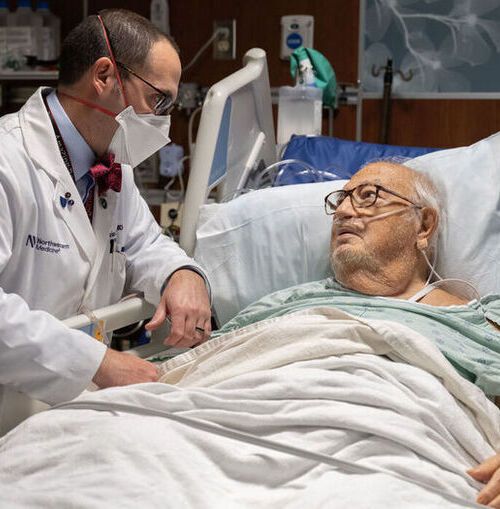
Dr. Brian Garibaldi talks with a patient at Northwestern Medicine.
Chicago/USA – The field of medicine is at a crossroads.
On one hand, artificial intelligence and advanced diagnostics are revolutionizing patient care. On the other, research has found that physicians — spread thin from electronic health recordkeeping and managing alerts — spend only 13 % of their time in direct contact with patients, which translates to just six minutes per patient per day in the hospital. This often results in physician burnout and frustrated patients.
To combat this, Northwestern University Feinberg School of Medicine has launched a new Center for Bedside Medicine, which will aim to revitalize patient interactions by combining traditional elements of the bedside interaction — history taking, physical exam, clinical reasoning and more — with cutting-edge technology, such as artificial intelligence and point-of-care devices like digital stethoscopes and handheld ultrasound machines.
“We've lost sight of the importance of some of the traditional skills that still have value, like talking to and building a rapport with patients, doing a targeted physical exam,” said the center’s inaugural director Dr. Brian Garibaldi, a nationally recognized leader in innovative bedside teaching methods. “The most common error that's made in the physical exam is simply that the exam was never performed. Part of this is the false belief that if it's done through technology, it's somehow better than what we can see, hear, feel and smell.”
“We need to figure out how to layer on technology not to replace our time with patients but to make the most of the time we have with them,” said Garibaldi, also a professor of medicine in the division of pulmonary and critical care medicine at Feinberg and a Northwestern Medicine physician.
For instance, AI-trained ambient listening technologies can jot down notes during a physician-patient conversation, freeing up the doctor to focus on the patient and notice body language and other nonverbal cues.
“Part of what we’ll be doing at the center is reimagining what the clinical encounter looks like now that we have these emerging technologies while, at the same time, using traditional methods that still provide value,” Garibaldi said.
Garibaldi is a distinguished physician-scientist with expertise in clinical skills assessment, high-consequence pathogens, pandemic preparedness and Covid-19. He serves on the board of directors of, co-founded and was the inaugural co-president of the Society of Bedside Medicine.
The power of touch with real volunteer patients
Diagnostic errors are estimated to affect millions annually. They often stem from lapses in basic examination skills, which are hard to practice without hands-on patient contact.
“There are many times where patients will say, ‘No one's ever examined me in that way before,’ and it may be simply taking down someone's gown and listening to their chest or their back on their bare skin with the stethoscope and not through their clothes,” Garibaldi said. “When you listen through clothes, you are more likely to miss something.”
In the U.S., graduating medical trainees have not participated in real-patient assessments since the 1970s, which is different from elsewhere in the world (e.g. the United Kingdom), Garibaldi said. Instead, the U.S. medical system relies on multiple-choice examinations to test clinical knowledge. Medical schools assess physical exam skills in undergraduates by hiring actors who have been trained to mimic having a certain disease or set of symptoms. But there are limits to simulating a condition someone doesn’t really have. Direct observation of clinical skills with real patients is a rare event once doctors graduate from medical school.
To address this, the center is building up a volunteer-patient program called APECS (Assessment of Physical Examination and Communication Skills), which will fall under the center’s clinical teaching and assessment arm. This will allow real patients to come to the center to take part in clinical exams with trainees and share authentic results.
Date: 08.12.2025
Naturally, we always handle your personal data responsibly. Any personal data we receive from you is processed in accordance with applicable data protection legislation. For detailed information please see our privacy policy.
Consent to the use of data for promotional purposes
I hereby consent to Vogel Communications Group GmbH & Co. KG, Max-Planck-Str. 7-9, 97082 Würzburg including any affiliated companies according to §§ 15 et seq. AktG (hereafter: Vogel Communications Group) using my e-mail address to send editorial newsletters. A list of all affiliated companies can be found here
Newsletter content may include all products and services of any companies mentioned above, including for example specialist journals and books, events and fairs as well as event-related products and services, print and digital media offers and services such as additional (editorial) newsletters, raffles, lead campaigns, market research both online and offline, specialist webportals and e-learning offers. In case my personal telephone number has also been collected, it may be used for offers of aforementioned products, for services of the companies mentioned above, and market research purposes.
Additionally, my consent also includes the processing of my email address and telephone number for data matching for marketing purposes with select advertising partners such as LinkedIn, Google, and Meta. For this, Vogel Communications Group may transmit said data in hashed form to the advertising partners who then use said data to determine whether I am also a member of the mentioned advertising partner portals. Vogel Communications Group uses this feature for the purposes of re-targeting (up-selling, cross-selling, and customer loyalty), generating so-called look-alike audiences for acquisition of new customers, and as basis for exclusion for on-going advertising campaigns. Further information can be found in section “data matching for marketing purposes”.
In case I access protected data on Internet portals of Vogel Communications Group including any affiliated companies according to §§ 15 et seq. AktG, I need to provide further data in order to register for the access to such content. In return for this free access to editorial content, my data may be used in accordance with this consent for the purposes stated here. This does not apply to data matching for marketing purposes.
Right of revocation
I understand that I can revoke my consent at will. My revocation does not change the lawfulness of data processing that was conducted based on my consent leading up to my revocation. One option to declare my revocation is to use the contact form found at https://contact.vogel.de. In case I no longer wish to receive certain newsletters, I have subscribed to, I can also click on the unsubscribe link included at the end of a newsletter. Further information regarding my right of revocation and the implementation of it as well as the consequences of my revocation can be found in the data protection declaration, section editorial newsletter.
“In my own career, I've never had a directly observed assessment of my clinical skills,” Garibaldi said. “If we want to improve our clinical skills and see how technology can augment them, we need to assess those skills. With APECS, we can evaluate trainees’ skills and give them real-time, hands-on feedback.”
The center’s second arm will focus on research and innovation to help physicians and trainees keep up on what technology is available to supplement traditional methods. For instance, AI algorithms can use data from digital recordings of heart sounds, EKGs and ultrasounds to aid in diagnosing specific conditions, Garibaldi said. In the not-too-distant future, AI might even be able to use video recordings to make observations about specific diseases (e.g. spotting an abnormal gait as part of a neurologic illness). AI can already use video recordings from operating rooms to spot if someone in non-sterile gear has entered a sterile space.
Improving bedside manner and physician burnout
It's estimated residents and trainees are interrupted every few minutes by an electronic communication or by some alert, Garibaldi said. These interruptions keep physicians from thinking deeply about a particular issue and can make the patient feel ignored.
The center will aim to implement evidence-based methods to help physicians make the most of the limited time they have with patients. One way is getting trainees to feel more comfortable dealing with uncertainty during patient interactions.
“There’s a lot of uncertainty in medicine,” Garibaldi said. “When we're uncomfortable with uncertainty, we also tend to be less empathetic, more guarded. By observing trainees during interactions with real patients, we can help physicians navigate uncertainty, be more present during an encounter and develop meaningful connections with their patients.”




:quality(80)/p7i.vogel.de/wcms/92/ad/92adbafb37924cea35ea3cf05b7a23e5/0130206318v2.jpeg "The world’s first fully functioning proof-of-concept quantum battery
(Source: Csiro)")
:quality(80)/p7i.vogel.de/wcms/9f/8b/9f8bc2b8491d7a514ca154e9588a07b7/0130205846v1.jpeg "The researchers’ new material, based on mineralised sawdust, is an excellent fire retardant. (Source: Dan Vivas Glaser / from Kürsteiner R et al. Chem Circularity 2026)")
:quality(80)/p7i.vogel.de/wcms/fd/73/fd73fcb3ceda89d1419de1083fcab7b4/0130081520v2.jpeg "The fingers at the heart of this technology were inspired by the fin-ray effect — a design principle derived from the natural structure of fish fins. (Source: University of Texas at Austin )")
:quality(80)/p7i.vogel.de/wcms/fe/64/fe649767c802d53ac63ee2c2a40b7e0d/0130060830v2.jpeg "Sample tube with light-active substance (Source: Elvira Eberhardt / Ulm University)")
:quality(80)/p7i.vogel.de/wcms/8f/b9/8fb98a958e4afe679865fbe52a473680/0129940982v2.jpeg "pH measurement in various nanoparticles using the Nine-Focus meter ensures precise stability and performance control. (Source: Mettler Toledo)")
:quality(80)/p7i.vogel.de/wcms/11/74/1174e5d4c8b07a64637dced8c9506b40/0129787561v2.jpeg "The Multicell Plus high-pressure reactor sets a new benchmark for operator safety, all-round accessibility and ease-of-use. (Source: Asynt)")
:quality(80)/p7i.vogel.de/wcms/ef/6e/ef6e96191183411973b77041fb6b1e16/0129785957v2.jpeg "Manufactured from high-quality crystal polystyrene - these new automation-ready plates are available in a choice of ANSI / SLAS standard (96-well and breakable 8-well strip) formats. (Source: Porvair Sciences)")
:quality(80)/p7i.vogel.de/wcms/ad/ca/adcaa20ef5ccaf7e3b325788b1e349c4/0129784872v2.jpeg "The high performance Degasi Flat Film in-line degasser. (Source: Biotech Fluidics)")
:quality(80)/p7i.vogel.de/wcms/e9/9c/e99cb19231197af70c489cb4acc2ead0/0130293444v2.jpeg "A new global study, led by researchers at Kaust in Saudi Arabia, shows that forests are most effective for climate regulation when conserved or restored in their natural or native locations. (Source: Kaust )")
:quality(80)/p7i.vogel.de/wcms/af/40/af40b535eb65c287fbd22ed5483d1d0e/0130206243v2.jpeg "The researchers dug soil pits in order to measure the carbon storage in soil
(Source: Johanna Asch)")
:quality(80)/p7i.vogel.de/wcms/2d/45/2d45aba62f5042baa00f7fd4fa629839/0130036533v2.jpeg "The population of Pune, India, is expected to reach 11 million by 2050. (Source: free licensed)")
:quality(80)/p7i.vogel.de/wcms/52/f8/52f8d5521fdab07ed0a865ec0d8919fd/0130009438v2.jpeg "Drylands support around half of global livestock production and sustain the livelihoods of close to a billion people, while also underpinning soil stability and carbon storage. (Source: Kaust )")
:quality(80)/p7i.vogel.de/wcms/6f/ba/6fba92196d0cbb1467334f8a2ecc520a/0130203021v2.jpeg "Low to moderate wine consumption shows lower risk compared with spirits, beer and cider (Source: free licensed)")
:quality(80)/p7i.vogel.de/wcms/a9/37/a9376f1d9a893570023d9aa97c085bc5/0129927485v2.jpeg "Examples of foods high in PUFAs include fatty fish and soybeans, while MUFAs include olive oil and avocadoes. (Source: free licensed)")
:quality(80)/p7i.vogel.de/wcms/ea/88/ea88ef8810e21cdd9bb852c70f385ba1/0129797385v2.jpeg "A team of NUS food scientists consisting of Assoc Prof Liu Shao Quan (centre), Dr Lu Yuyun (right) and Ms Geng Chenhan (left) pioneered a co-fermentation method that improves both the nutrient and flavor profile of kombu. (Source: NUS)")
:quality(80)/p7i.vogel.de/wcms/84/2c/842c7c1678ceeec7147ea3a36e238e75/0129356324v2.jpeg "Kaust and Nadec have signed a MOU that establishes a framework for long-term cooperation across agricultural research, technology development, and professional training. (Source: Kaust )")
:quality(80)/p7i.vogel.de/wcms/6e/b9/6eb95805568aa78dc2ed57f829cf33d4/0130300421v2.jpeg "A 10-minute digital program co-developed by a University of Texas psychologist significantly reduced symptoms of depression four weeks after use, according to results from one of the largest randomized controlled trials of single-session mental health interventions. (Source: University of Texas at Austin )")
:quality(80)/p7i.vogel.de/wcms/6f/e9/6fe9d920eca2c0b3bdeb55cbe9f01908/0130299237v2.jpeg "Study authors Jason Miska and Leah Billingham reading out enzymatic activity of microglia in cell cultures. (Source: Northwestern University.)")
:quality(80)/p7i.vogel.de/wcms/c4/54/c454661a9dd459cf7c5b632f79829358/0130284530v2.jpeg "The study shows that AI can be used to assess the build-up of calcium deposits in the arteries of the breast from the standard X-ray mammography scans that are currently used in routine breast cancer screening. (Source: ESC)")
:quality(80)/p7i.vogel.de/wcms/67/9b/679b140c164dbd7c4fe9eda4da91329b/0130281406v3.jpeg "This is the highest resolution molecular structure ever constructed of a key protein complex on the surface of the Andes virus, called the Gn-Gc tetramer, that enables it to infect cells. (Source: University of Texas at Austin)")
:quality(80)/images.vogel.de/vogelonline/bdb/1710600/1710675/original.jpg "Discover how to set yourself up for success when performing balance-based density determination of solids such as jewelry and precious metals. (Mettler Toledo)")
:quality(80)/images.vogel.de/vogelonline/bdb/1682500/1682579/original.jpg "The new XPR Analytical balance redesigned to meet the needs of laboratory technicians of working fast and lean. (Mettler Toledo)")
:quality(80)/images.vogel.de/vogelonline/bdb/1677000/1677080/original.jpg "Enhance your weighing accuracy, comfort and productivity with the redesigned XPR Analytical balance. (Mettler Toledo)")
:fill(fff,0)/p7i.vogel.de/companies/5f/3f/5f3f63ceedc78/knf-logo.jpg "KNF_Logo.jpg (www.knf.com)")
:quality(80)/p7i.vogel.de/wcms/14/24/14247b96901bfab6c75b7a3453ecfc6e/0129390600v2.jpeg "The US study, ‘Artificial-Intelligence-Enabled Digital Stethoscope Improves Point-of-Care Screening for Moderate to Severe Valvular Heart Disease’, was recently published on Thursday 5 February, 2026 in the European Heart Journal - Digital Health. (Source: Pixabay)")
:quality(80)/p7i.vogel.de/wcms/71/0b/710b65311648262eb99c8690377b73dd/0124237452v2.jpeg "Northwestern University researchers have developed the first wearable device for measuring gases emitted from and absorbed by the skin. (Source: John A. Rogers/Northwestern University)")