With the help of a study, researchers have revealed that resistant bacteria can regain susceptibility to antibiotics when the treatment is combined with a material equipped with antibacterial peptides. They further state that antibiotics can achieve a 64-fold increase in bactericidal effect when used together with the material, whose antibacterial properties are also greatly enhanced by this combination.
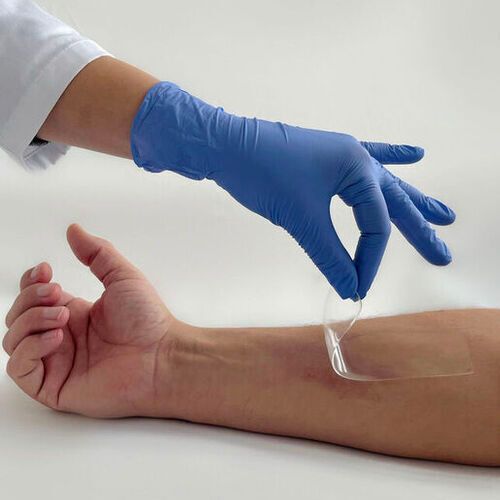
The antibacterial material is a proprietary hydrogel, which can be adapted to many medical applications.
(Source: Saba Atefyekta)
Gothenburg/Sweden – Research from Chalmers University of Technology, Sweden, shows that resistant bacteria can regain susceptibility to antibiotics when the treatment is combined with a material equipped with antibacterial peptides. The study, performed in a laboratory environment, shows that antibiotics can achieve a 64-fold increase in bactericidal effect when used together with the material, whose antibacterial properties are also greatly enhanced by this combination.
The bactericidal material has been developed for medical applications and has been studied by the researchers for many years. It has shown a strong ability to kill many different types of bacteria – including antibiotic-resistant ones. The material consists of a specially designed hydrogel that contains antibacterial peptides, which are molecules that also serve as the building blocks of proteins.
To enable clinical use for the peptide material, particularly in combination with standard treatments such as antibiotics, the researchers had to ensure that the material does not negatively impact the effectiveness of antibiotics when used concurrently. The study yielded surprisingly positive results: the antibiotics contrariwise became more effective in combination with the material. The researchers also discovered a synergistic effect against certain resistant bacteria, where the antibacterial effects of the peptide material and antibiotics were not only additive but greatly enhanced when used together. This has not been demonstrated before.
"When particles of the hydrogel came into close contact with the bacteria, they weakened and became more susceptible to the antibiotic treatment. In some cases, the antibiotics became effective again against bacteria that were previously resistant," says Annija Stepulane, doctoral student in applied chemistry at Chalmers and the first author of the scientific paper.
Resistant bacteria regained susceptibility
The peptide material was tested in bacterial cultures, in combination with two different antibiotics: oxacillin and vancomycin. The bacteria included in the experiments were two types of staphylococci (S. aureus), one of which is a strain resistant to several antibiotics (MRSA).
The most powerful effect observed in the study was with MRSA, especially when the material was combined with oxacillin – an antibiotic to which the bacteria are normally resistant. The combination lowered the effective concentration of oxacillin 64-fold compared to when the antibiotic was used alone. Consequently, the concentration of oxacillin fell below the threshold at which the bacteria are classified as resistant to the drug.
With vancomycin, the effective concentration was also lowered when the drug was combined with the hydrogel, though this effect was additive rather than synergistic.
Stable and active treatment over time
Researchers have tried to combine antimicrobial peptides with antibiotics previously, but so far only with peptides in solution. In this form, the peptides are highly sensitive and lose effectiveness when exposed to bodily fluids, such as blood. However, when the peptides are attached to a hydrogel, they become significantly more stable and can be active for a longer period.
The Chalmers researchers have previously measured bactericidal activity lasting for several days with the hydrogel, as opposed to a few hours with peptides in solution. They see numerous advantages with this formulation.
"The peptide-based material can be applied locally, on a limited part of the body, so that the entire body is not affected. The material is non-toxic and does not cause any adverse side effects," says Martin Andersson, research leader and professor of applied chemistry at Chalmers.
May curb infections and reduce the risk of complications
The hydrogel, which can also be formulated as particles in a spray, can increase the safety and efficacy of a course of antibiotics that the patient receives. One potential application of this discovery is in wound treatment.
"Often, you don't know whether the bacteria that caused a wound infection are resistant to a certain antibiotic when you start treatment. Applying the peptide material to the wound simultaneously increases the likelihood of the antibiotic being effective against the bacteria. Then you can cure the infection without having to use additional types of antibiotics," says Martin Andersson.
Date: 08.12.2025
Naturally, we always handle your personal data responsibly. Any personal data we receive from you is processed in accordance with applicable data protection legislation. For detailed information please see our privacy policy.
Consent to the use of data for promotional purposes
I hereby consent to Vogel Communications Group GmbH & Co. KG, Max-Planck-Str. 7-9, 97082 Würzburg including any affiliated companies according to §§ 15 et seq. AktG (hereafter: Vogel Communications Group) using my e-mail address to send editorial newsletters. A list of all affiliated companies can be found here
Newsletter content may include all products and services of any companies mentioned above, including for example specialist journals and books, events and fairs as well as event-related products and services, print and digital media offers and services such as additional (editorial) newsletters, raffles, lead campaigns, market research both online and offline, specialist webportals and e-learning offers. In case my personal telephone number has also been collected, it may be used for offers of aforementioned products, for services of the companies mentioned above, and market research purposes.
Additionally, my consent also includes the processing of my email address and telephone number for data matching for marketing purposes with select advertising partners such as LinkedIn, Google, and Meta. For this, Vogel Communications Group may transmit said data in hashed form to the advertising partners who then use said data to determine whether I am also a member of the mentioned advertising partner portals. Vogel Communications Group uses this feature for the purposes of re-targeting (up-selling, cross-selling, and customer loyalty), generating so-called look-alike audiences for acquisition of new customers, and as basis for exclusion for on-going advertising campaigns. Further information can be found in section “data matching for marketing purposes”.
In case I access protected data on Internet portals of Vogel Communications Group including any affiliated companies according to §§ 15 et seq. AktG, I need to provide further data in order to register for the access to such content. In return for this free access to editorial content, my data may be used in accordance with this consent for the purposes stated here. This does not apply to data matching for marketing purposes.
Right of revocation
I understand that I can revoke my consent at will. My revocation does not change the lawfulness of data processing that was conducted based on my consent leading up to my revocation. One option to declare my revocation is to use the contact form found at https://contact.vogel.de. In case I no longer wish to receive certain newsletters, I have subscribed to, I can also click on the unsubscribe link included at the end of a newsletter. Further information regarding my right of revocation and the implementation of it as well as the consequences of my revocation can be found in the data protection declaration, section editorial newsletter.
Since the peptide material only has a positive impact on the healing process, the researchers also see great advantages in using it as a standard treatment to prevent wound infections.
"The material could be used in healthcare settings, for example following surgeries – a possibility already available for veterinary care in some countries – and at home. It could function like a regular band-aid, especially for those concerned about infections. This can be particularly interesting in areas with a high prevalence of resistant infections, such as certain parts of Africa and Asia, where extra caution is needed with wound injuries," says Martin Andersson.
More about: the research results and the peptide material
Antimicrobial peptides exist naturally in our bodies and their strong bactericidal properties have been known for a long time. The bacterial cells die because the peptides damage their cell membranes, primarily through an interaction between positive charges in the peptides and negative charges in the bacterial membranes.
Synergistic effects between peptides and antibiotics have been shown previously, but only with free peptides in solution, which are challenging to work with clinically because they break down quickly. The current study is the first to show efficacy with peptides which are bound to a material, making them stable enough for clinical application.
The Chalmers researchers have previously shown that 99.99 percent of skin bacteria are killed by the material and that the bactericidal efficacy is active for more than two days. This enables using the material in many different products, such as wound care materials and coatings on medical devices that are used within the body.
The researchers have theories about the causes of the synergistic effect with antibiotics, but the molecular mechanisms remain to be explored.




:quality(80)/p7i.vogel.de/wcms/84/78/8478fcee08360056b226cb8d5032d50c/0130489771v2.jpeg "Saharsh Davuluri will assume the role of Chief Executive Officer and Managing Director, effective immediately, as the company moves into its next stage of CDMO growth. (Source: Neuland Laboratories)")
:quality(80)/p7i.vogel.de/wcms/5e/ae/5eae9dcbba6d172fac2b07b7aef05d3f/0130484643v2.jpeg "The chemical processes occurring when the light interacts with the plastic when it is dissolved causes the reaction to glow blue. (Source: University of Bath)")
:quality(80)/p7i.vogel.de/wcms/e5/9c/e59c5dd9fe4308acae7d5c6de8038c88/0130484607v1.jpeg "A close-up of a laser-directed energy deposition (LDED) system fabricating the novel AI-designed ultra-high strength steel, which achieves a rare balance of strength and ductility, excellent corrosion resistance, and requires only 6 hours of single-step heat treatment at low cost. (Source: Yating Luo et. al.)")
:quality(80)/p7i.vogel.de/wcms/5b/b6/5bb6c39a72c5852361fa904e2e9d8a49/0130484591v1.jpeg "Vehicle-to-grid (V2G) technology — software that allows charging stations to communicate with the grid — bridges both challenges, allowing EVs to both draw power and send it back when needed. (Source: free licensed)")
:quality(80)/p7i.vogel.de/wcms/6e/7c/6e7c762e933c938a92431a785df4690f/0130440213v2.jpeg "Biotech Fluidics' valving solutions offer low swept volume and eliminate reagent carryover concerns. (Source: Biotech Fluidics)")
:quality(80)/p7i.vogel.de/wcms/b0/0b/b00b237311ce4ceb03b2ba1136b6b074/0130440144v2.jpeg "Azenta Life Sciences offers a range of low binding consumables that deliver consistent performance from sensitive applications that require low DNA input such as Next Generation Sequencing and Molecular Biology. (Source: Azenta)")
:quality(80)/p7i.vogel.de/wcms/6c/ef/6cef060860810f12200fbd6d56884e9d/0130440127v2.jpeg "The Automated Plate Seal Remover from Azenta Life Sciences is a compact system for removing seals from a wide range of microplates at the single touch of a button, without damaging the plate or seal. (Source: Azenta )")
:quality(80)/p7i.vogel.de/wcms/14/ca/14ca189a5a6a5ac4c434039fc35af36c/0130440109v2.jpeg "Afys3G has launched the Information Marking System Lambda768. (Source: Afys3G)")
:quality(80)/p7i.vogel.de/wcms/f6/3d/f63d5aa4c99a79e3cfe9e1bf8c1595f3/0130484550v1.jpeg "A robot designed to assist with precision irrigation in action, in a citrus orchard. (Source: Elia Scudiero/ UCR)")
:quality(80)/p7i.vogel.de/wcms/5d/bb/5dbb962b09bae1c078a8ff996666bc8e/0130386229v2.jpeg "This image created using Gemini Pro, depicts an activated carbon fiber functionalized with amine groups (–NH2) at adjacent positions. This arrangement improves the energy efficacy of key interactions, enabling the desorption of captured carbon dioxide at lower temperatures. (Source: Gemini / Yasuhiro Yamada/ Chiba University / KI-generiert)")
:quality(80)/p7i.vogel.de/wcms/21/9b/219b000051ab1ea14ab5f92e4fd0f9bb/0130384937v2.jpeg "Deforestation in the Appalachian mountains. (Source: Alex Diaz on Unsplash)")
:quality(80)/p7i.vogel.de/wcms/e9/9c/e99cb19231197af70c489cb4acc2ead0/0130293444v2.jpeg "A new global study, led by researchers at Kaust in Saudi Arabia, shows that forests are most effective for climate regulation when conserved or restored in their natural or native locations. (Source: Kaust )")
:quality(80)/p7i.vogel.de/wcms/4c/df/4cdf172835be728c9ecb68ec309acca1/0130465673v2.jpeg "Peaches are climacteric fruits, which means they continue to ripen after being picked. The recommended storage temperature is 0°C, otherwise there is a risk of cold damage. (Source: Dall-e)")
:quality(80)/p7i.vogel.de/wcms/2a/07/2a0737995810d504b318f8a0f9ac2c3d/0130386209v1.jpeg "Simple, repeatable eating habits may help people stick to diets, see better results, study says (Source: free licensed)")
:quality(80)/p7i.vogel.de/wcms/6f/ba/6fba92196d0cbb1467334f8a2ecc520a/0130203021v2.jpeg "Low to moderate wine consumption shows lower risk compared with spirits, beer and cider (Source: free licensed)")
:quality(80)/p7i.vogel.de/wcms/a9/37/a9376f1d9a893570023d9aa97c085bc5/0129927485v2.jpeg "Examples of foods high in PUFAs include fatty fish and soybeans, while MUFAs include olive oil and avocadoes. (Source: free licensed)")
:quality(80)/p7i.vogel.de/wcms/a4/81/a48131e4ace9b91159e1d6f9f33da3a7/0130549685v2.jpeg "Although the number of participants was limited, the researchers note that the study's reliability is increased by its follow-up design and the rigorous imaging and laboratory tests conducted on the participants. (Source: Pixabay )")
:quality(80)/p7i.vogel.de/wcms/58/c9/58c99ae20ee71ab55c2bb16253d65297/0130486531v2.jpeg "Prof Ho Ghim Wei (third from left) and her team - (from left) Dr Pan Xinglong, Dr Tian Guo, and Dr Li Zhiwei - have developed a hydrogel sensor system that delivers seamless, real-time monitoring of mental wellbeing. (Source: NUS)")
:quality(80)/p7i.vogel.de/wcms/40/c0/40c0c09c2bad7b925a069edbbac90621/0130385557v1.jpeg "When a stroke damages brain tissue (red) along an important movement pathway (yellow), the injured side of the brain may show faster aging (red), while parts of the opposite side may appear relatively “younger” (blue) as the brain tries to compensate. This pattern is linked to more severe movement problems and less recovery.
(Bild: Stevens INI)")
:quality(80)/p7i.vogel.de/wcms/32/14/3214c28a03f71ad067c5f27e5bd6772b/0130386218v1.jpeg "Antimicrobial-resistant Salmonella poses severe challenges to global food safety and public health. (Source: free licensed)")
:quality(80)/images.vogel.de/vogelonline/bdb/1710600/1710675/original.jpg "Discover how to set yourself up for success when performing balance-based density determination of solids such as jewelry and precious metals. (Mettler Toledo)")
:quality(80)/images.vogel.de/vogelonline/bdb/1682500/1682579/original.jpg "The new XPR Analytical balance redesigned to meet the needs of laboratory technicians of working fast and lean. (Mettler Toledo)")
:quality(80)/images.vogel.de/vogelonline/bdb/1677000/1677080/original.jpg "Enhance your weighing accuracy, comfort and productivity with the redesigned XPR Analytical balance. (Mettler Toledo)")
:fill(fff,0)/p7i.vogel.de/companies/5f/3f/5f3f63ceedc78/knf-logo.jpg "KNF_Logo.jpg (www.knf.com)")
:fill(fff,0)/p7i.vogel.de/companies/69/b7/69b7f63f311d9/logo-bimos-tif--2-.jpeg "logo-bimos-tif--2- (https://www.bimos.com/de-de/)")
:quality(80)/p7i.vogel.de/wcms/32/14/3214c28a03f71ad067c5f27e5bd6772b/0130386218v1.jpeg "Antimicrobial-resistant Salmonella poses severe challenges to global food safety and public health. (Source: free licensed)")
:quality(80)/p7i.vogel.de/wcms/71/0b/710b65311648262eb99c8690377b73dd/0124237452v2.jpeg "Northwestern University researchers have developed the first wearable device for measuring gases emitted from and absorbed by the skin. (Source: John A. Rogers/Northwestern University)")