A computational analysis conducted at the Massachusetts Institute of Technology revealed that many repetitive sequences are shared across proteins and are similar in species from bacteria to humans. The new method can reveal the functions of these sequences and the proteins in which they are found.
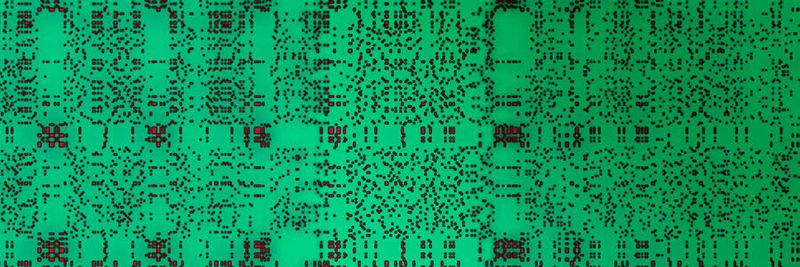
MIT researchers used a technique called dot-plot matrix, which is a way to visually represent amino acid sequences, to compare protein sequences known as “low-complexity regions” across many different species.
(Source: Courtesy of the researchers, and edited by MIT News)
About 70 percent of all human proteins include at least one sequence consisting of a single amino acid repeated many times, with a few other amino acids sprinkled in. These “low-complexity regions” are also found in most other organisms.
The proteins that contain these sequences have many different functions, but MIT biologists have now come up with a way to identify and study them as a unified group. Their technique allows them to analyze similarities and differences between LCRs from different species, and helps them to determine the functions of these sequences and the proteins in which they are found.
Using their technique, the researchers have analyzed all of the proteins found in eight different species, from bacteria to humans. They found that while LCRs can vary between proteins and species, they often share a similar role — helping the protein in which they’re found to join a larger-scale assembly such as the nucleolus, an organelle found in nearly all human cells.
“Instead of looking at specific LCRs and their functions, which might seem separate because they’re involved in different processes, our broader approach allows us to see similarities between their properties, suggesting that maybe the functions of LCRs aren’t so disparate after all,” says Byron Lee, an MIT graduate student.
The researchers also found some differences between LCRs of different species and showed that these species-specific LCR sequences correspond to species-specific functions, such as forming plant cell walls.
Lee and graduate student Nima Jaberi-Lashkari are the lead authors of the study, which appears today in eLife. Eliezer Calo, an assistant professor of biology at MIT, is the senior author of the paper.
Previous research has revealed that LCRs are involved in a variety of cellular processes, including cell adhesion and DNA binding. These LCRs are often rich in a single amino acid such as alanine, lysine, or glutamic acid.
Finding these sequences and then studying their functions individually is a time-consuming process, so the MIT team decided to use bioinformatics — an approach that uses computational methods to analyze large sets of biological data — to evaluate them as a larger group.
“What we wanted to do is take a step back and instead of looking at individual LCRs, to try to take a look at all of them and to see if we could observe some patterns on a larger scale that might help us figure out what the ones that have assigned functions are doing, and also help us learn a bit about what the ones that don't have assigned functions are doing,” Jaberi-Lashkari says.
To do that, the researchers used a technique called dotplot matrix, which is a way to visually represent amino acid sequences, to generate images of each protein under study. They then used computational image processing methods to compare thousands of these matrices at the same time.
Using this technique, the researchers were able to categorize LCRs based on which amino acids were most frequently repeated in the LCR. They also grouped LCR-containing proteins by the number of copies of each LCR type found in the protein. Analyzing these traits helped the researchers to learn more about the functions of these LCRs.
As one demonstration, the researchers picked out a human protein, known as RPA43, that has three lysine-rich LCRs. This protein is one of many subunits that make up an enzyme called RNA polymerase 1, which synthesizes ribosomal RNA. The researchers found that the copy number of lysine-rich LCRs is important for helping the protein integrate into the nucleolus, the organelle responsible for synthesizing ribosomes.
In a comparison of the proteins found in eight different species, the researchers found that some LCR types are highly conserved between species, meaning that the sequences have changed very little over evolutionary timescales. These sequences tend to be found in proteins and cell structures that are also highly conserved, such as the nucleolus.
“These sequences seem to be important for the assembly of certain parts of the nucleolus,” Lee says. “Some of the principles that are known to be important for higher order assembly seem to be at play because the copy number, which might control how many interactions a protein can make, is important for the protein to integrate into that compartment.”
Date: 08.12.2025
Naturally, we always handle your personal data responsibly. Any personal data we receive from you is processed in accordance with applicable data protection legislation. For detailed information please see our privacy policy.
Consent to the use of data for promotional purposes
I hereby consent to Vogel Communications Group GmbH & Co. KG, Max-Planck-Str. 7-9, 97082 Würzburg including any affiliated companies according to §§ 15 et seq. AktG (hereafter: Vogel Communications Group) using my e-mail address to send editorial newsletters. A list of all affiliated companies can be found here
Newsletter content may include all products and services of any companies mentioned above, including for example specialist journals and books, events and fairs as well as event-related products and services, print and digital media offers and services such as additional (editorial) newsletters, raffles, lead campaigns, market research both online and offline, specialist webportals and e-learning offers. In case my personal telephone number has also been collected, it may be used for offers of aforementioned products, for services of the companies mentioned above, and market research purposes.
Additionally, my consent also includes the processing of my email address and telephone number for data matching for marketing purposes with select advertising partners such as LinkedIn, Google, and Meta. For this, Vogel Communications Group may transmit said data in hashed form to the advertising partners who then use said data to determine whether I am also a member of the mentioned advertising partner portals. Vogel Communications Group uses this feature for the purposes of re-targeting (up-selling, cross-selling, and customer loyalty), generating so-called look-alike audiences for acquisition of new customers, and as basis for exclusion for on-going advertising campaigns. Further information can be found in section “data matching for marketing purposes”.
In case I access protected data on Internet portals of Vogel Communications Group including any affiliated companies according to §§ 15 et seq. AktG, I need to provide further data in order to register for the access to such content. In return for this free access to editorial content, my data may be used in accordance with this consent for the purposes stated here. This does not apply to data matching for marketing purposes.
Right of revocation
I understand that I can revoke my consent at will. My revocation does not change the lawfulness of data processing that was conducted based on my consent leading up to my revocation. One option to declare my revocation is to use the contact form found at https://contact.vogel.de. In case I no longer wish to receive certain newsletters, I have subscribed to, I can also click on the unsubscribe link included at the end of a newsletter. Further information regarding my right of revocation and the implementation of it as well as the consequences of my revocation can be found in the data protection declaration, section editorial newsletter.
The researchers also found differences between LCRs seen in two different types of proteins that are involved in nucleolus assembly. They discovered that a nucleolar protein known as TCOF contains many glutamine-rich LCRs that can help scaffold the formation of assemblies, while nucleolar proteins with only a few of these glutamic acid-rich LCRs could be recruited as clients (proteins that interact with the scaffold).
Another structure that appears to have many conserved LCRs is the nuclear speckle, which is found inside the cell nucleus. The researchers also found many similarities between LCRs that are involved in forming larger-scale assemblies such as the extracellular matrix, a network of molecules that provides structural support to cells in plants and animals.
The research team also found examples of structures with LCRs that seem to have diverged between species. For example, plants have distinctive LCR sequences in the proteins that they use to scaffold their cell walls, and these LCRs are not seen in other types of organisms.
The researchers now plan to expand their LCR analysis to additional species. “There’s so much to explore, because we can expand this map to essentially any species,” Lee says. “That gives us the opportunity and the framework to identify new biological assemblies.”




:quality(80)/p7i.vogel.de/wcms/92/ad/92adbafb37924cea35ea3cf05b7a23e5/0130206318v2.jpeg "The world’s first fully functioning proof-of-concept quantum battery
(Source: Csiro)")
:quality(80)/p7i.vogel.de/wcms/9f/8b/9f8bc2b8491d7a514ca154e9588a07b7/0130205846v1.jpeg "The researchers’ new material, based on mineralised sawdust, is an excellent fire retardant. (Source: Dan Vivas Glaser / from Kürsteiner R et al. Chem Circularity 2026)")
:quality(80)/p7i.vogel.de/wcms/fd/73/fd73fcb3ceda89d1419de1083fcab7b4/0130081520v2.jpeg "The fingers at the heart of this technology were inspired by the fin-ray effect — a design principle derived from the natural structure of fish fins. (Source: University of Texas at Austin )")
:quality(80)/p7i.vogel.de/wcms/fe/64/fe649767c802d53ac63ee2c2a40b7e0d/0130060830v2.jpeg "Sample tube with light-active substance (Source: Elvira Eberhardt / Ulm University)")
:quality(80)/p7i.vogel.de/wcms/8f/b9/8fb98a958e4afe679865fbe52a473680/0129940982v2.jpeg "pH measurement in various nanoparticles using the Nine-Focus meter ensures precise stability and performance control. (Source: Mettler Toledo)")
:quality(80)/p7i.vogel.de/wcms/11/74/1174e5d4c8b07a64637dced8c9506b40/0129787561v2.jpeg "The Multicell Plus high-pressure reactor sets a new benchmark for operator safety, all-round accessibility and ease-of-use. (Source: Asynt)")
:quality(80)/p7i.vogel.de/wcms/ef/6e/ef6e96191183411973b77041fb6b1e16/0129785957v2.jpeg "Manufactured from high-quality crystal polystyrene - these new automation-ready plates are available in a choice of ANSI / SLAS standard (96-well and breakable 8-well strip) formats. (Source: Porvair Sciences)")
:quality(80)/p7i.vogel.de/wcms/ad/ca/adcaa20ef5ccaf7e3b325788b1e349c4/0129784872v2.jpeg "The high performance Degasi Flat Film in-line degasser. (Source: Biotech Fluidics)")
:quality(80)/p7i.vogel.de/wcms/af/40/af40b535eb65c287fbd22ed5483d1d0e/0130206243v2.jpeg "The researchers dug soil pits in order to measure the carbon storage in soil
(Source: Johanna Asch)")
:quality(80)/p7i.vogel.de/wcms/2d/45/2d45aba62f5042baa00f7fd4fa629839/0130036533v2.jpeg "The population of Pune, India, is expected to reach 11 million by 2050. (Source: free licensed)")
:quality(80)/p7i.vogel.de/wcms/52/f8/52f8d5521fdab07ed0a865ec0d8919fd/0130009438v2.jpeg "Drylands support around half of global livestock production and sustain the livelihoods of close to a billion people, while also underpinning soil stability and carbon storage. (Source: Kaust )")
:quality(80)/p7i.vogel.de/wcms/fe/49/fe494ada322615b6e6f6ff0f5bb7c5cf/0129926008v2.jpeg "A mandrill eating fruit. (Source: University of Bristol )")
:quality(80)/p7i.vogel.de/wcms/6f/ba/6fba92196d0cbb1467334f8a2ecc520a/0130203021v2.jpeg "Low to moderate wine consumption shows lower risk compared with spirits, beer and cider (Source: free licensed)")
:quality(80)/p7i.vogel.de/wcms/a9/37/a9376f1d9a893570023d9aa97c085bc5/0129927485v2.jpeg "Examples of foods high in PUFAs include fatty fish and soybeans, while MUFAs include olive oil and avocadoes. (Source: free licensed)")
:quality(80)/p7i.vogel.de/wcms/ea/88/ea88ef8810e21cdd9bb852c70f385ba1/0129797385v2.jpeg "A team of NUS food scientists consisting of Assoc Prof Liu Shao Quan (centre), Dr Lu Yuyun (right) and Ms Geng Chenhan (left) pioneered a co-fermentation method that improves both the nutrient and flavor profile of kombu. (Source: NUS)")
:quality(80)/p7i.vogel.de/wcms/84/2c/842c7c1678ceeec7147ea3a36e238e75/0129356324v2.jpeg "Kaust and Nadec have signed a MOU that establishes a framework for long-term cooperation across agricultural research, technology development, and professional training. (Source: Kaust )")
:quality(80)/p7i.vogel.de/wcms/e9/73/e9732473361377610267347df55071a1/0130205830v2.jpeg "Sleep EEG signals may reveal whether the brain is aging faster than the body — and help identify elevated dementia risk earlier. (Source: free licensed)")
:quality(80)/p7i.vogel.de/wcms/ed/c0/edc0c1a86229b11efd17c5e3f94d14da/0130081211v2.jpeg "A new study finds that virtual visits did not make it easier for psychiatrists, psychologists and therapists to reach significantly more people in areas where access to care has long been limited. (Source: Pixabay)")
:quality(80)/p7i.vogel.de/wcms/9c/52/9c52318bc94be17e6662dfceffa4a0c0/0130060546v2.jpeg "Domestic cat ‘Lanni’ from co-author of the study, Latasha Ludwig, Assistant Clinical Professor at Cornell University, USA. (Source: © Latasha Ludwig)")
:quality(80)/p7i.vogel.de/wcms/4b/f4/4bf4cc9e28e65e11a27dd41da2d1a7f5/0130038185v2.jpeg "The biomarker p-tau217 could help identify women at elevated dementia risk decades before clinical symptoms begin. (Source: free licensed)")
:quality(80)/images.vogel.de/vogelonline/bdb/1710600/1710675/original.jpg "Discover how to set yourself up for success when performing balance-based density determination of solids such as jewelry and precious metals. (Mettler Toledo)")
:quality(80)/images.vogel.de/vogelonline/bdb/1682500/1682579/original.jpg "The new XPR Analytical balance redesigned to meet the needs of laboratory technicians of working fast and lean. (Mettler Toledo)")
:quality(80)/images.vogel.de/vogelonline/bdb/1677000/1677080/original.jpg "Enhance your weighing accuracy, comfort and productivity with the redesigned XPR Analytical balance. (Mettler Toledo)")
:quality(80)/p7i.vogel.de/wcms/a5/01/a501862c5303bc5543229cd5b826b536/0105298588.jpeg "Saccharomyces cerevisiae yeast. (Source: iStock)")
:quality(80)/p7i.vogel.de/wcms/b7/3c/b73c41e85851adc1e2be52f7eefa194f/0104868646.jpeg "A translucent fruit fly larvae glows where a green fluorescent protein (GFP) is being expressed by codons that are rare in the fly genome. Only two tissues, the brain (left) and testis (right) are capable of expressing this version of GFP. (Source: Fox Lab, Duke)")
:quality(80)/p7i.vogel.de/wcms/75/db/75db8afe45607bee750df705e22b60e9/0128938816v1.jpeg "A new academic review suggests that bamboo shoots could offer significant health benefits, including improved blood sugar control, gut health and antioxidant activity. (Source: free licensed)")
:quality(80)/p7i.vogel.de/wcms/4a/58/4a5873331e80f2644838805e5ee81670/0126458424v2.jpeg "A wild bumble bee (Bombus appositus) visiting a flower (Delphinium barbeyi) — both species were included in the study. (Source: Paul CaraDonna)")