As part of the Ice Memory initiative, researchers analysed ice cores drilled in 2018 and 2020 from the Corbassière glacier at Grand Combin in the canton of Valais. A comparison of the two sets of ice cores published in Nature Geoscience shows: Global warming has made at least this glacier unusable as a climate archive.
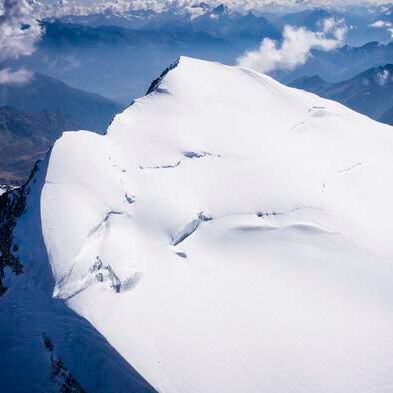
Even the “eternal ice” on the Grand Combin is not made to last forever. Visible at the upper right of the photo is the drilling camp of the 2020 Ice Memory expedition led by PSI researcher Theo Jenk.
Reliable information about the past climate and air pollution can no longer be obtained from the Corbassière glacier in the Grand Combin massif, because alpine glacier melting is progressing more rapidly than previously assumed. This sobering conclusion was reached by researchers led by Margit Schwikowski, head of the Laboratory for Environmental Chemistry at PSI, and Carla Huber, PhD student and first author of the study, when they compared the signatures of particulate matter locked in the annual layers of the ice. Glaciers are invaluable for climate research. The climatic conditions and atmospheric compositions of past ages are preserved in their ice. Therefore, they can serve, in much the same way as tree rings and ocean sediments, as a so-called climate archive for research.
Normally, the amount of particle-bound trace substances in ice fluctuates with the seasons. Substances such as ammonium, nitrate, and sulfate come from the air and are deposited on the glacier through snowfall: The concentrations are high in summer and low in winter, because lower amounts of polluted air can rise from the valley when the air is cold. The 2018 ice core, which was drilled from depths of up to 14 metres during a preliminary study and contains deposits dating back to 2011, shows these fluctuations as expected. But the core from 2020, from a depth of up to 18 metres — drilled under the leadership of PSI researcher Theo Jenk — shows those fluctuations only for the upper three or four annual layers. Deeper in the ice — that is, farther in the past — the curve indicating the concentration of trace substances becomes noticeably flatter, and the total amount is lower. Schwikowski’s team reports on this in the current issue of the journal Nature Geoscience.
Washed Away by Meltwater
Their explanation for the observed discrepancy: Between 2018 and 2020, the glacier melting must have been so strong that an especially large amount of water from the surface penetrated into the glacier and carried the trace substances it contained into the depths. “But apparently the water there did not freeze again, concentrating the trace substances,” the environmental chemist concludes, “but instead it drained off and literally washed them away.” Of course, that distorts the signatures of the layered inclusions. The climate archive is destroyed. It is as if someone had broken into a library and not only messed up all the shelves and books, but also stole a lot of books and mixed up the individual words in the remaining ones, making it impossible to reconstruct the original texts.
The researchers examined the meteorological data from 2018 through 2020: Since there is no weather station at the top of the Grand Combin, they combined data from the surrounding stations and extrapolated it for the study area on the mountain. According to this calculation, it was warm on the glacier in line with the general climatic trend, but these years were not extreme outliers. “From this we conclude that there was no singular trigger for this strong melting, but that it resulted from many warm years in the recent past,” Schwikowski says. “It seems a threshold has been crossed, which now has led to a comparatively strong effect.”
The bottom line is that the example of the Grand Combin shows that the melting of glaciers is progressing more dynamically than experts had assumed. “For a long time it has been clear that the glacier tongues are retreating. But we would not have thought that the areas feeding high alpine glaciers would also be so severely affected — that is, their highest part, where the ice replenishment is formed.” So far, the researchers have examined the distribution of oxygen isotopes in the ice, which can provide information about temperature developments, and of ionic trace compounds such as ammonium, nitrate, and sulfate. Next they want to analyse to what extent the signatures of organic substances in the ice are also affected.
Ice Memory: Ice Core Sanctuary in Antarctica
Another reason Schwikowski is interested in this is because, together with other ice core experts from around the world, she is involved in the initiative led by the Ice Memory Foundation. The aim of this research effort is to obtain ice cores from 20 endangered glaciers around the world in 20 years and collect them in a global climate archive. The cores, cut into rods around one metre long and eight centimetres in diameter, which were individually retrieved from the depths, are to be stored permanently and securely in an ice cave at the Italian-French research station Concordia in Antarctica — managed by an international governance on the long term. The reliable temperatures near the South Pole, averaging minus 50°C ensure that the cores will remain usable for studies in the future, even if global warming causes all alpine glaciers to melt at some point. This is important because analysis methods are constantly improving, and future generations of scientists could extract completely different information from the ice.
The Grand Combin ice core should be one of these 20 glacier samples. “But we already realised, on the mountain, that nothing would come of it,” Schwikowski says. “As I said, the test drilling in 2018 still looked good. But several times in 2020 we came across thick, solid layers of ice that had formed in the meantime as the water melted and froze again. We encountered one such particularly thick layer at a depth of 17 to 18 metres, which was underneath a very watery, soft layer. This transition caused us enormous problems. Especially when we were drilling deeper and then pulling it out, the drill got caught in the hard layer of ice. We nearly lost this expensive device.”
Date: 08.12.2025
Naturally, we always handle your personal data responsibly. Any personal data we receive from you is processed in accordance with applicable data protection legislation. For detailed information please see our privacy policy.
Consent to the use of data for promotional purposes
I hereby consent to Vogel Communications Group GmbH & Co. KG, Max-Planck-Str. 7-9, 97082 Würzburg including any affiliated companies according to §§ 15 et seq. AktG (hereafter: Vogel Communications Group) using my e-mail address to send editorial newsletters. A list of all affiliated companies can be found here
Newsletter content may include all products and services of any companies mentioned above, including for example specialist journals and books, events and fairs as well as event-related products and services, print and digital media offers and services such as additional (editorial) newsletters, raffles, lead campaigns, market research both online and offline, specialist webportals and e-learning offers. In case my personal telephone number has also been collected, it may be used for offers of aforementioned products, for services of the companies mentioned above, and market research purposes.
Additionally, my consent also includes the processing of my email address and telephone number for data matching for marketing purposes with select advertising partners such as LinkedIn, Google, and Meta. For this, Vogel Communications Group may transmit said data in hashed form to the advertising partners who then use said data to determine whether I am also a member of the mentioned advertising partner portals. Vogel Communications Group uses this feature for the purposes of re-targeting (up-selling, cross-selling, and customer loyalty), generating so-called look-alike audiences for acquisition of new customers, and as basis for exclusion for on-going advertising campaigns. Further information can be found in section “data matching for marketing purposes”.
In case I access protected data on Internet portals of Vogel Communications Group including any affiliated companies according to §§ 15 et seq. AktG, I need to provide further data in order to register for the access to such content. In return for this free access to editorial content, my data may be used in accordance with this consent for the purposes stated here. This does not apply to data matching for marketing purposes.
Right of revocation
I understand that I can revoke my consent at will. My revocation does not change the lawfulness of data processing that was conducted based on my consent leading up to my revocation. One option to declare my revocation is to use the contact form found at https://contact.vogel.de. In case I no longer wish to receive certain newsletters, I have subscribed to, I can also click on the unsubscribe link included at the end of a newsletter. Further information regarding my right of revocation and the implementation of it as well as the consequences of my revocation can be found in the data protection declaration, section editorial newsletter.
“Because further attempts at other parts of the glacier saddle encountered the same layer, and the same difficulties, the researchers had to abandon the expedition. They actually wanted to drill 80 metres deep, down to the bedrock, to record the entire archive of the glacier, which spans thousands of years. But this was not possible. “And our analyses have now confirmed it,”, Schwikowski says. “At the Grand Combin, we’re already too late.”
It is to be feared that this is also the case with other glaciers around the world that have yet to be sampled as part of Ice Memory. In the Alps, besides the Col du Dôme glacier on Mont Blanc at 4,250 metres, where the project team first drilled in 2016, there is only Colle Gnifetti on the Italian-Swiss border, which is even higher at 4,450 metres and therefore colder than the Grand Combin glacier. There the PSI team, together with the Ice Memory Foundation partners, was actually able to obtain an ice core with the signature still intact the following year. Cores from Illimani in the Bolivian Andes, from Belukha in the Russian Altai, and from Elbrus in the Caucasus have already been secured. Last year, there were also expeditions on Spitsbergen and the Col del Lys in Italy; their analyses are still pending. An expedition to Kilimanjaro, which has the only significant ice body in Africa, failed last year due to political and administrative issues.
The project is a race against time. It is by no means guaranteed to succeed. Setbacks like those at Grand Combin become more likely every year.
Original Publication: High-altitude glacier archives lost due to climate change-related melting; C.J. Huber, A. Eichler, E. Mattea, S. Brütsch, T.M. Jenk, J. Gabrieli, C. Barbante, M. Schwikowski. Nature Geoscience, 26.01.2024; DOI: 10.1038/s41561-023-01366-1




:quality(80)/p7i.vogel.de/wcms/fd/73/fd73fcb3ceda89d1419de1083fcab7b4/0130081520v2.jpeg "The fingers at the heart of this technology were inspired by the fin-ray effect — a design principle derived from the natural structure of fish fins. (Source: University of Texas at Austin )")
:quality(80)/p7i.vogel.de/wcms/fe/64/fe649767c802d53ac63ee2c2a40b7e0d/0130060830v2.jpeg "Sample tube with light-active substance (Source: Elvira Eberhardt / Ulm University)")
:quality(80)/p7i.vogel.de/wcms/db/e2/dbe2ae4e02f702b30153a882ef705089/0129978032v1.jpeg "Each of the isolated indium atoms (in gold color) can catalyse the synthesis of methanol (top right). (Source: Constance Ko/ ETH Zurich)")
:quality(80)/p7i.vogel.de/wcms/c1/e6/c1e6ac26eb18993236c100e7f01a78f2/0129937639v1.jpeg "Dogs evolved from highly social ancestors and have been shaped by thousands of years of interacting with humans. (Source: free licensed)")
:quality(80)/p7i.vogel.de/wcms/8f/b9/8fb98a958e4afe679865fbe52a473680/0129940982v2.jpeg "pH measurement in various nanoparticles using the Nine-Focus meter ensures precise stability and performance control. (Source: Mettler Toledo)")
:quality(80)/p7i.vogel.de/wcms/11/74/1174e5d4c8b07a64637dced8c9506b40/0129787561v2.jpeg "The Multicell Plus high-pressure reactor sets a new benchmark for operator safety, all-round accessibility and ease-of-use. (Source: Asynt)")
:quality(80)/p7i.vogel.de/wcms/ef/6e/ef6e96191183411973b77041fb6b1e16/0129785957v2.jpeg "Manufactured from high-quality crystal polystyrene - these new automation-ready plates are available in a choice of ANSI / SLAS standard (96-well and breakable 8-well strip) formats. (Source: Porvair Sciences)")
:quality(80)/p7i.vogel.de/wcms/ad/ca/adcaa20ef5ccaf7e3b325788b1e349c4/0129784872v2.jpeg "The high performance Degasi Flat Film in-line degasser. (Source: Biotech Fluidics)")
:quality(80)/p7i.vogel.de/wcms/2d/45/2d45aba62f5042baa00f7fd4fa629839/0130036533v2.jpeg "The population of Pune, India, is expected to reach 11 million by 2050. (Source: free licensed)")
:quality(80)/p7i.vogel.de/wcms/52/f8/52f8d5521fdab07ed0a865ec0d8919fd/0130009438v2.jpeg "Drylands support around half of global livestock production and sustain the livelihoods of close to a billion people, while also underpinning soil stability and carbon storage. (Source: Kaust )")
:quality(80)/p7i.vogel.de/wcms/fe/49/fe494ada322615b6e6f6ff0f5bb7c5cf/0129926008v2.jpeg "A mandrill eating fruit. (Source: University of Bristol )")
:quality(80)/p7i.vogel.de/wcms/af/4e/af4ea968647ee9cae82b39800c611819/0129865630v2.jpeg "Map of a simulated risk of water stress in 2050 where hydrogen is used in transport and industry. Baseline risk (regardless of hydrogen use) is represented by the background color in each area. Dashed areas show water use exceeding available resources due to hydrogen production. Blue dots show areas where the risk of water stress increases by more than 50 percent in the simulation. (Source: Chalmers University of Technology / Joel Löfving)")
:quality(80)/p7i.vogel.de/wcms/6f/ba/6fba92196d0cbb1467334f8a2ecc520a/0130203021v2.jpeg "Low to moderate wine consumption shows lower risk compared with spirits, beer and cider (Source: free licensed)")
:quality(80)/p7i.vogel.de/wcms/a9/37/a9376f1d9a893570023d9aa97c085bc5/0129927485v2.jpeg "Examples of foods high in PUFAs include fatty fish and soybeans, while MUFAs include olive oil and avocadoes. (Source: free licensed)")
:quality(80)/p7i.vogel.de/wcms/ea/88/ea88ef8810e21cdd9bb852c70f385ba1/0129797385v2.jpeg "A team of NUS food scientists consisting of Assoc Prof Liu Shao Quan (centre), Dr Lu Yuyun (right) and Ms Geng Chenhan (left) pioneered a co-fermentation method that improves both the nutrient and flavor profile of kombu. (Source: NUS)")
:quality(80)/p7i.vogel.de/wcms/84/2c/842c7c1678ceeec7147ea3a36e238e75/0129356324v2.jpeg "Kaust and Nadec have signed a MOU that establishes a framework for long-term cooperation across agricultural research, technology development, and professional training. (Source: Kaust )")
:quality(80)/p7i.vogel.de/wcms/ed/c0/edc0c1a86229b11efd17c5e3f94d14da/0130081211v2.jpeg "A new study finds that virtual visits did not make it easier for psychiatrists, psychologists and therapists to reach significantly more people in areas where access to care has long been limited. (Source: Pixabay)")
:quality(80)/p7i.vogel.de/wcms/9c/52/9c52318bc94be17e6662dfceffa4a0c0/0130060546v2.jpeg "Domestic cat ‘Lanni’ from co-author of the study, Latasha Ludwig, Assistant Clinical Professor at Cornell University, USA. (Source: © Latasha Ludwig)")
:quality(80)/p7i.vogel.de/wcms/4b/f4/4bf4cc9e28e65e11a27dd41da2d1a7f5/0130038185v2.jpeg "The biomarker p-tau217 could help identify women at elevated dementia risk decades before clinical symptoms begin. (Source: free licensed)")
:quality(80)/p7i.vogel.de/wcms/4f/29/4f292f402b157e2ab8c57e9f2a3e3199/0130036120v2.jpeg "The chemistry is powered by an LED lamp that triggers a self-sustaining chain reaction, forging new carbon–carbon bonds under mild conditions without toxic or expensive chemicals. (Source: Nordin Ćatić/ St John’s College, Cambridge)")
:quality(80)/images.vogel.de/vogelonline/bdb/1710600/1710675/original.jpg "Discover how to set yourself up for success when performing balance-based density determination of solids such as jewelry and precious metals. (Mettler Toledo)")
:quality(80)/images.vogel.de/vogelonline/bdb/1682500/1682579/original.jpg "The new XPR Analytical balance redesigned to meet the needs of laboratory technicians of working fast and lean. (Mettler Toledo)")
:quality(80)/images.vogel.de/vogelonline/bdb/1677000/1677080/original.jpg "Enhance your weighing accuracy, comfort and productivity with the redesigned XPR Analytical balance. (Mettler Toledo)")
:quality(80)/p7i.vogel.de/wcms/87/c4/87c401706a85593b914bafefc20adee2/0115215645.jpeg "Flyover photo of southern Greenland in 1932. (Source: Danish National Archives)")
:quality(80)/p7i.vogel.de/wcms/0e/03/0e032824d209ba21c39783ab54d4350a/0114062620.jpeg "Polygons and channel networks on the west side of Axel Heiberg Island near Expedition Fjord. (Source: Shawn Chartrand)")
:quality(80)/p7i.vogel.de/wcms/b9/06/b9069c414c1bc5c667d30f8fd5bb1c5d/0124805595v2.jpeg "Remaining of a glacier iceberg in Svalbard, Norway (Source: Fabien Maussion)")
:quality(80)/p7i.vogel.de/wcms/86/90/8690b8154a552da13b37f289349b1db4/0129283446v2.jpeg "Lina Pérez-Ángel holds two sediment samples whose ages are separated by about a million years. (Source: Ellen Jorgensen)")