Researchers have developed a new method which helps to fight the blockage of tiny coronary arteries after a heart attack. The new approach can be used to prevent the death of heart tissue after a heart attack.
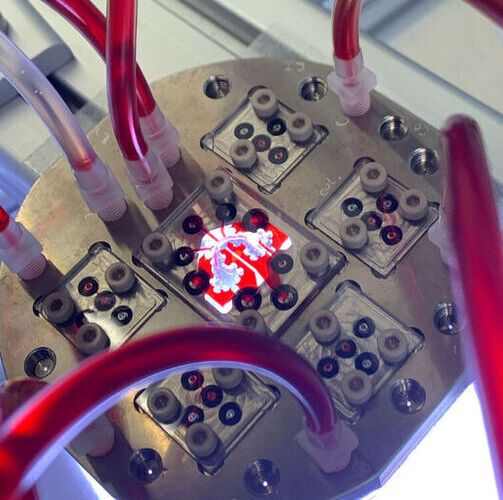
The microchip was designed at the Artorg Center and fabricated at the OST University of Applied Sciences. The team uses it to study the fluid mechanics within the smallest blood vessels.
Bern/Switzerland – In myocardial infarction (heart attack), the supply of the heart muscle with oxygen and nutrients is blocked by an obstruction of a major coronary artery. Even after recanalization of this artery via stent, secondary obstructions in the cardiac microcirculation (Microvascular Obstruction, MVO) occur in 40-60 % of all patients. This can lead to the death of heart tissue, with a negative impact on the long-term cardiovascular health of patients. Around 200,000 people are affected by this in Switzerland every year.
“MVO is an underdiagnosed condition because it cannot be easily detected during acute treatment in the catheter lab and to date there exists no established treatment for it,” says Dominik Obrist from the Artorg Center for Biomedical Engineering Research, University of Bern. So far, only the bigger clogged arteries have been considered for heart attack treatment – partly because current catheters cannot reach into smaller vessels. A catheter is a thin tube that is inserted into the body to examine and treat the blood vessels.
"Tackling blockages in larger vessels does not prevent cardiac tissue further down the arterial tree from dying because the blood flow no longer reaches it," says Obrist. In a longstanding collaboration with clinical partners and a medical technology start-up, his research group for Cardiovascular Engineering at the Artorg Center was able to develop a new technique that enables the diagnosis and treatment of MVO for the first time. The method is now being clinically tested and further refined.
Research at micrometer scale
To reach into the vessels, which are about as fine as a human hair (50 micrometers in diameter), the researchers first investigated the fluid mechanics of blood flow in the heart using a novel model mimicking vessels of the cardiac microcirculation. A first study with a newly designed balloon catheter demonstrated that MVO could be correctly diagnosed if the catheter was inflated at the site of the original obstructed artery. Measuring the pressure and resistance while infusing liquid with different flow rates into the arterial tree allowed to quantify hemodynamics and distinguish MVO from pressure relations present under healthy anatomic conditions.
In a second step, the scientists investigated how clot-dissolving drugs can be infused into these tiny branches. "When an artery is blocked, the blood will look for a different way to flow and avoid this congested branch. But this phenomenon makes it very hard to infuse dissolving medication into the blocked branch as it will directly be washed out into the healthy vessels beside it," explains Yannick Rösch, PostDoc at the Artorg Center. "We were able to show that inflating the balloon catheter, which also administers the medication, delivers sufficiently high concentrations of this medication to the blocked vessels. This allows us to reach the blockage, and the medication dosage could even be reduced because we do not have the wash-out effect."
Academia, clinic and industry partner up to bring solutions to the patient
“Our project is a prime example of networked interdisciplinary collaboration at the Bern Medical Hub - between researchers at the University of Bern, clinical experts of the Bern University Hospital, and local industry, together with the expertise of further Swiss partners to bring solutions to patients as quickly as possible,” says Obrist. This networked research into MVO led to the founding of the start-up Corflow Therapeutics. Its technology makes it possible to diagnose MVO during the initial treatment of heart attack patients in the catheter laboratory and to start MVO treatment immediately after stent placement. Academic partners include the ETH Zurich, the University of Zurich, the University of Applied Sciences OST in Buchs (SG) and the Cardiology Department at Inselspital Bern.
Along with in vivo testing of the new medical device as well as a first-in-human clinical trial, the research team refined their experimental model with biological expertise and recently investigated the effectiveness of clot-dissolving drugs on micro-blood clots in a microfluidic chip, which simulates the fluid mechanics within the smallest blood vessels. "The drugs used to dissolve blood clots have severe side effects in high doses. We have now been able to show that even the smallest amounts of these known and clinically used drugs are able to dissolve individual micro blood clots," says Anastasia Milusev, research associate at the Artorg Center. "This enables the targeted and low-dose dissolution of blood clots for the first time. Now, we need to put all the pieces of the puzzle together to make therapy for MVO available to patients.”
Date: 08.12.2025
Naturally, we always handle your personal data responsibly. Any personal data we receive from you is processed in accordance with applicable data protection legislation. For detailed information please see our privacy policy.
Consent to the use of data for promotional purposes
I hereby consent to Vogel Communications Group GmbH & Co. KG, Max-Planck-Str. 7-9, 97082 Würzburg including any affiliated companies according to §§ 15 et seq. AktG (hereafter: Vogel Communications Group) using my e-mail address to send editorial newsletters. A list of all affiliated companies can be found here
Newsletter content may include all products and services of any companies mentioned above, including for example specialist journals and books, events and fairs as well as event-related products and services, print and digital media offers and services such as additional (editorial) newsletters, raffles, lead campaigns, market research both online and offline, specialist webportals and e-learning offers. In case my personal telephone number has also been collected, it may be used for offers of aforementioned products, for services of the companies mentioned above, and market research purposes.
Additionally, my consent also includes the processing of my email address and telephone number for data matching for marketing purposes with select advertising partners such as LinkedIn, Google, and Meta. For this, Vogel Communications Group may transmit said data in hashed form to the advertising partners who then use said data to determine whether I am also a member of the mentioned advertising partner portals. Vogel Communications Group uses this feature for the purposes of re-targeting (up-selling, cross-selling, and customer loyalty), generating so-called look-alike audiences for acquisition of new customers, and as basis for exclusion for on-going advertising campaigns. Further information can be found in section “data matching for marketing purposes”.
In case I access protected data on Internet portals of Vogel Communications Group including any affiliated companies according to §§ 15 et seq. AktG, I need to provide further data in order to register for the access to such content. In return for this free access to editorial content, my data may be used in accordance with this consent for the purposes stated here. This does not apply to data matching for marketing purposes.
Right of revocation
I understand that I can revoke my consent at will. My revocation does not change the lawfulness of data processing that was conducted based on my consent leading up to my revocation. One option to declare my revocation is to use the contact form found at https://contact.vogel.de. In case I no longer wish to receive certain newsletters, I have subscribed to, I can also click on the unsubscribe link included at the end of a newsletter. Further information regarding my right of revocation and the implementation of it as well as the consequences of my revocation can be found in the data protection declaration, section editorial newsletter.




:quality(80)/p7i.vogel.de/wcms/92/ad/92adbafb37924cea35ea3cf05b7a23e5/0130206318v2.jpeg "The world’s first fully functioning proof-of-concept quantum battery
(Source: Csiro)")
:quality(80)/p7i.vogel.de/wcms/9f/8b/9f8bc2b8491d7a514ca154e9588a07b7/0130205846v1.jpeg "The researchers’ new material, based on mineralised sawdust, is an excellent fire retardant. (Source: Dan Vivas Glaser / from Kürsteiner R et al. Chem Circularity 2026)")
:quality(80)/p7i.vogel.de/wcms/fd/73/fd73fcb3ceda89d1419de1083fcab7b4/0130081520v2.jpeg "The fingers at the heart of this technology were inspired by the fin-ray effect — a design principle derived from the natural structure of fish fins. (Source: University of Texas at Austin )")
:quality(80)/p7i.vogel.de/wcms/fe/64/fe649767c802d53ac63ee2c2a40b7e0d/0130060830v2.jpeg "Sample tube with light-active substance (Source: Elvira Eberhardt / Ulm University)")
:quality(80)/p7i.vogel.de/wcms/8f/b9/8fb98a958e4afe679865fbe52a473680/0129940982v2.jpeg "pH measurement in various nanoparticles using the Nine-Focus meter ensures precise stability and performance control. (Source: Mettler Toledo)")
:quality(80)/p7i.vogel.de/wcms/11/74/1174e5d4c8b07a64637dced8c9506b40/0129787561v2.jpeg "The Multicell Plus high-pressure reactor sets a new benchmark for operator safety, all-round accessibility and ease-of-use. (Source: Asynt)")
:quality(80)/p7i.vogel.de/wcms/ef/6e/ef6e96191183411973b77041fb6b1e16/0129785957v2.jpeg "Manufactured from high-quality crystal polystyrene - these new automation-ready plates are available in a choice of ANSI / SLAS standard (96-well and breakable 8-well strip) formats. (Source: Porvair Sciences)")
:quality(80)/p7i.vogel.de/wcms/ad/ca/adcaa20ef5ccaf7e3b325788b1e349c4/0129784872v2.jpeg "The high performance Degasi Flat Film in-line degasser. (Source: Biotech Fluidics)")
:quality(80)/p7i.vogel.de/wcms/af/40/af40b535eb65c287fbd22ed5483d1d0e/0130206243v2.jpeg "The researchers dug soil pits in order to measure the carbon storage in soil
(Source: Johanna Asch)")
:quality(80)/p7i.vogel.de/wcms/2d/45/2d45aba62f5042baa00f7fd4fa629839/0130036533v2.jpeg "The population of Pune, India, is expected to reach 11 million by 2050. (Source: free licensed)")
:quality(80)/p7i.vogel.de/wcms/52/f8/52f8d5521fdab07ed0a865ec0d8919fd/0130009438v2.jpeg "Drylands support around half of global livestock production and sustain the livelihoods of close to a billion people, while also underpinning soil stability and carbon storage. (Source: Kaust )")
:quality(80)/p7i.vogel.de/wcms/fe/49/fe494ada322615b6e6f6ff0f5bb7c5cf/0129926008v2.jpeg "A mandrill eating fruit. (Source: University of Bristol )")
:quality(80)/p7i.vogel.de/wcms/6f/ba/6fba92196d0cbb1467334f8a2ecc520a/0130203021v2.jpeg "Low to moderate wine consumption shows lower risk compared with spirits, beer and cider (Source: free licensed)")
:quality(80)/p7i.vogel.de/wcms/a9/37/a9376f1d9a893570023d9aa97c085bc5/0129927485v2.jpeg "Examples of foods high in PUFAs include fatty fish and soybeans, while MUFAs include olive oil and avocadoes. (Source: free licensed)")
:quality(80)/p7i.vogel.de/wcms/ea/88/ea88ef8810e21cdd9bb852c70f385ba1/0129797385v2.jpeg "A team of NUS food scientists consisting of Assoc Prof Liu Shao Quan (centre), Dr Lu Yuyun (right) and Ms Geng Chenhan (left) pioneered a co-fermentation method that improves both the nutrient and flavor profile of kombu. (Source: NUS)")
:quality(80)/p7i.vogel.de/wcms/84/2c/842c7c1678ceeec7147ea3a36e238e75/0129356324v2.jpeg "Kaust and Nadec have signed a MOU that establishes a framework for long-term cooperation across agricultural research, technology development, and professional training. (Source: Kaust )")
:quality(80)/p7i.vogel.de/wcms/e9/73/e9732473361377610267347df55071a1/0130205830v2.jpeg "Sleep EEG signals may reveal whether the brain is aging faster than the body — and help identify elevated dementia risk earlier. (Source: free licensed)")
:quality(80)/p7i.vogel.de/wcms/ed/c0/edc0c1a86229b11efd17c5e3f94d14da/0130081211v2.jpeg "A new study finds that virtual visits did not make it easier for psychiatrists, psychologists and therapists to reach significantly more people in areas where access to care has long been limited. (Source: Pixabay)")
:quality(80)/p7i.vogel.de/wcms/9c/52/9c52318bc94be17e6662dfceffa4a0c0/0130060546v2.jpeg "Domestic cat ‘Lanni’ from co-author of the study, Latasha Ludwig, Assistant Clinical Professor at Cornell University, USA. (Source: © Latasha Ludwig)")
:quality(80)/p7i.vogel.de/wcms/4b/f4/4bf4cc9e28e65e11a27dd41da2d1a7f5/0130038185v2.jpeg "The biomarker p-tau217 could help identify women at elevated dementia risk decades before clinical symptoms begin. (Source: free licensed)")
:quality(80)/images.vogel.de/vogelonline/bdb/1710600/1710675/original.jpg "Discover how to set yourself up for success when performing balance-based density determination of solids such as jewelry and precious metals. (Mettler Toledo)")
:quality(80)/images.vogel.de/vogelonline/bdb/1682500/1682579/original.jpg "The new XPR Analytical balance redesigned to meet the needs of laboratory technicians of working fast and lean. (Mettler Toledo)")
:quality(80)/images.vogel.de/vogelonline/bdb/1677000/1677080/original.jpg "Enhance your weighing accuracy, comfort and productivity with the redesigned XPR Analytical balance. (Mettler Toledo)")
:quality(80)/p7i.vogel.de/wcms/a3/f6/a3f6f0610da43e69f13a4ab9cfa64d8a/0124072247v2.jpeg "According to autopsy reports, up to 30 percent of unexpected deaths of young athletes can be attributed to coronary artery anomalies. (Source: Pixabay)")
:quality(80)/p7i.vogel.de/wcms/68/1a/681a2e5e01ff30296e9bc9d2ba3bd7be/0125490738v2.jpeg "Using a new type of microscope and AI, the study shows how platelet clumping can be tracked in patients with coronary artery disease, opening the door to safer, more personalized treatment. (Source: University of Tokyo)")