Quantum mechanics tells us that particles like atoms should also be thought of as waves. As a result, we can build ‘atom lasers’ containing coherent waves of matter. But can we make these matter waves last, so that they may be used in applications?
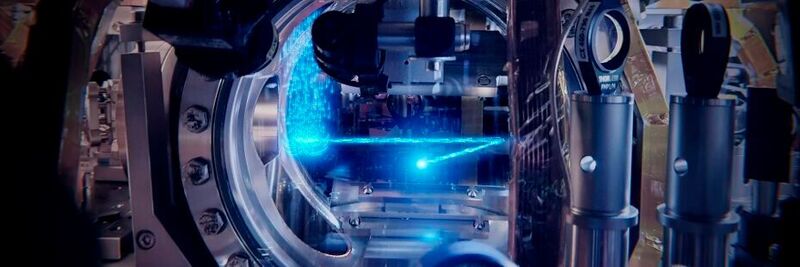
The central part of the experiment in which the coherent matter waves are created. Fresh atoms (blue) fall in and make their way to the Bose-Einstein Condensate in the center. In reality, the atoms are not visible to the naked eye. Image processing by Scixel.
(Source: University of Amsterdam)
Amsterdam/The Netherlands — The concept that underlies the atom laser is the so-called Bose-Einstein Condensate, or BEC for short. Elementary particles in nature occur in two types: fermions and bosons. Fermions are particles like electrons and quarks — the building blocks of the matter that we are made of. Bosons are very different in nature: they are not hard like fermions, but soft: for example, they can move through one another without a problem. The best-known example of a boson is the photon, the smallest possible quantity of light. But matter particles can also combine to form bosons — in fact, entire atoms can behave just like particles of light. What makes bosons so special is that they can all be in the exact same state at the exact same time, or phrased in more technical terms: they can ‘condense’ into a coherent wave. When this type of condensation happens for matter particles, physicists call the resulting substance a Bose-Einstein Condensate.
In everyday life, we are not at all familiar with these condensates. The reason: it is very difficult to get atoms to all behave as one. The culprit destroying the synchronicity is temperature: when a substance heats up, the constituent particles start to jiggle around, and it becomes virtually impossible to get them to behave as one. Only at extremely low temperatures, about a millionth of a degree above absolute zero (about -273°C), is there a chance of forming the coherent matter waves of a BEC.
Fleeting Bursts
A quarter of a century ago, the first Bose-Einstein Condensates were created in physics labs. This opened up the possibility to build atom lasers — devices that literally output beams of matter — but these devices were only able to function for a very short time. The lasers could produce pulses of matter waves, but after sending out such a pulse, a new BEC had to be created before the next pulse could be sent out. For a first step towards an atom laser, this was still not bad. In fact, ordinary, optical lasers were also made in a pulsed variant before physicists were able to create continuous lasers. But while the developments for optical lasers had gone very fast, the first continuous laser being produced within six months after its pulsed counterpart, for atom lasers the continuous version remained elusive for more than 25 years.
It was clear what the problem was: BECs are very fragile, and are rapidly destroyed when light falls on them. Yet the presence of light is crucial in forming the condensate: to cool a substance down to a millionth of a degree, one needs to cool down its atoms using laser light. As a result, BECs were restricted to fleeting bursts, with no way to coherently sustain them.
A Christmas Present
A team of physicists from the University of Amsterdam has now managed to solve the difficult problem of creating a continuous Bose-Einstein Condensate. Florian Schreck, the team leader, explains what the trick was. “In previous experiments, the gradual cooling of atoms was all done in one place. In our setup, we decided to spread the cooling steps not over time, but in space: we make the atoms move while they progress through consecutive cooling steps. In the end, ultracold atoms arrive at the heart of the experiment, where they can be used to form coherent matter waves in a BEC. But while these atoms are being used, new atoms are already on their way to replenish the BEC. In this way we can keep the process going — essentially forever.”
While the underlying idea was relatively simple, carrying it out was certainly not. Chun-Chia Chen, first author of the publication in Nature, recalls: “Already in 2012, the team — then still in Innsbruck — realized a technique that allowed a BEC to be protected from laser cooling light, enabling for the first time laser cooling all the way down to the degenerate state needed for coherent waves. While this was a critical first step towards the long-held challenge of constructing a continuous atom laser, it was also clear that a dedicated machine would be needed to take it further. On moving to Amsterdam in 2013, we began with a leap of faith, borrowed funds, an empty room and a team entirely funded by personal grants. Six years later, in the early hours of Christmas morning 2019, the experiment was finally on the verge of working. We had the idea of adding an extra laser beam to solve a last technical difficulty, and instantly every image we took showed a BEC, the first continuous-wave BEC.”
Date: 08.12.2025
Naturally, we always handle your personal data responsibly. Any personal data we receive from you is processed in accordance with applicable data protection legislation. For detailed information please see our privacy policy.
Consent to the use of data for promotional purposes
I hereby consent to Vogel Communications Group GmbH & Co. KG, Max-Planck-Str. 7-9, 97082 Würzburg including any affiliated companies according to §§ 15 et seq. AktG (hereafter: Vogel Communications Group) using my e-mail address to send editorial newsletters. A list of all affiliated companies can be found here
Newsletter content may include all products and services of any companies mentioned above, including for example specialist journals and books, events and fairs as well as event-related products and services, print and digital media offers and services such as additional (editorial) newsletters, raffles, lead campaigns, market research both online and offline, specialist webportals and e-learning offers. In case my personal telephone number has also been collected, it may be used for offers of aforementioned products, for services of the companies mentioned above, and market research purposes.
Additionally, my consent also includes the processing of my email address and telephone number for data matching for marketing purposes with select advertising partners such as LinkedIn, Google, and Meta. For this, Vogel Communications Group may transmit said data in hashed form to the advertising partners who then use said data to determine whether I am also a member of the mentioned advertising partner portals. Vogel Communications Group uses this feature for the purposes of re-targeting (up-selling, cross-selling, and customer loyalty), generating so-called look-alike audiences for acquisition of new customers, and as basis for exclusion for on-going advertising campaigns. Further information can be found in section “data matching for marketing purposes”.
In case I access protected data on Internet portals of Vogel Communications Group including any affiliated companies according to §§ 15 et seq. AktG, I need to provide further data in order to register for the access to such content. In return for this free access to editorial content, my data may be used in accordance with this consent for the purposes stated here. This does not apply to data matching for marketing purposes.
Right of revocation
I understand that I can revoke my consent at will. My revocation does not change the lawfulness of data processing that was conducted based on my consent leading up to my revocation. One option to declare my revocation is to use the contact form found at https://contact.vogel.de. In case I no longer wish to receive certain newsletters, I have subscribed to, I can also click on the unsubscribe link included at the end of a newsletter. Further information regarding my right of revocation and the implementation of it as well as the consequences of my revocation can be found in the data protection declaration, section editorial newsletter.
Having tackled the long-standing open problem of creating a continuous Bose-Einstein Condensate, the researchers have now set their minds on the next goal: using the laser to create a stable output beam of matter. Once their lasers can not only operate forever but can also produce stable beams, nothing stands in the way of technical applications anymore, and matter lasers may start to play an equally important role in technology as ordinary lasers currently do.




:quality(80)/p7i.vogel.de/wcms/92/ad/92adbafb37924cea35ea3cf05b7a23e5/0130206318v2.jpeg "The world’s first fully functioning proof-of-concept quantum battery
(Source: Csiro)")
:quality(80)/p7i.vogel.de/wcms/9f/8b/9f8bc2b8491d7a514ca154e9588a07b7/0130205846v1.jpeg "The researchers’ new material, based on mineralised sawdust, is an excellent fire retardant. (Source: Dan Vivas Glaser / from Kürsteiner R et al. Chem Circularity 2026)")
:quality(80)/p7i.vogel.de/wcms/fd/73/fd73fcb3ceda89d1419de1083fcab7b4/0130081520v2.jpeg "The fingers at the heart of this technology were inspired by the fin-ray effect — a design principle derived from the natural structure of fish fins. (Source: University of Texas at Austin )")
:quality(80)/p7i.vogel.de/wcms/fe/64/fe649767c802d53ac63ee2c2a40b7e0d/0130060830v2.jpeg "Sample tube with light-active substance (Source: Elvira Eberhardt / Ulm University)")
:quality(80)/p7i.vogel.de/wcms/8f/b9/8fb98a958e4afe679865fbe52a473680/0129940982v2.jpeg "pH measurement in various nanoparticles using the Nine-Focus meter ensures precise stability and performance control. (Source: Mettler Toledo)")
:quality(80)/p7i.vogel.de/wcms/11/74/1174e5d4c8b07a64637dced8c9506b40/0129787561v2.jpeg "The Multicell Plus high-pressure reactor sets a new benchmark for operator safety, all-round accessibility and ease-of-use. (Source: Asynt)")
:quality(80)/p7i.vogel.de/wcms/ef/6e/ef6e96191183411973b77041fb6b1e16/0129785957v2.jpeg "Manufactured from high-quality crystal polystyrene - these new automation-ready plates are available in a choice of ANSI / SLAS standard (96-well and breakable 8-well strip) formats. (Source: Porvair Sciences)")
:quality(80)/p7i.vogel.de/wcms/ad/ca/adcaa20ef5ccaf7e3b325788b1e349c4/0129784872v2.jpeg "The high performance Degasi Flat Film in-line degasser. (Source: Biotech Fluidics)")
:quality(80)/p7i.vogel.de/wcms/af/40/af40b535eb65c287fbd22ed5483d1d0e/0130206243v2.jpeg "The researchers dug soil pits in order to measure the carbon storage in soil
(Source: Johanna Asch)")
:quality(80)/p7i.vogel.de/wcms/2d/45/2d45aba62f5042baa00f7fd4fa629839/0130036533v2.jpeg "The population of Pune, India, is expected to reach 11 million by 2050. (Source: free licensed)")
:quality(80)/p7i.vogel.de/wcms/52/f8/52f8d5521fdab07ed0a865ec0d8919fd/0130009438v2.jpeg "Drylands support around half of global livestock production and sustain the livelihoods of close to a billion people, while also underpinning soil stability and carbon storage. (Source: Kaust )")
:quality(80)/p7i.vogel.de/wcms/fe/49/fe494ada322615b6e6f6ff0f5bb7c5cf/0129926008v2.jpeg "A mandrill eating fruit. (Source: University of Bristol )")
:quality(80)/p7i.vogel.de/wcms/6f/ba/6fba92196d0cbb1467334f8a2ecc520a/0130203021v2.jpeg "Low to moderate wine consumption shows lower risk compared with spirits, beer and cider (Source: free licensed)")
:quality(80)/p7i.vogel.de/wcms/a9/37/a9376f1d9a893570023d9aa97c085bc5/0129927485v2.jpeg "Examples of foods high in PUFAs include fatty fish and soybeans, while MUFAs include olive oil and avocadoes. (Source: free licensed)")
:quality(80)/p7i.vogel.de/wcms/ea/88/ea88ef8810e21cdd9bb852c70f385ba1/0129797385v2.jpeg "A team of NUS food scientists consisting of Assoc Prof Liu Shao Quan (centre), Dr Lu Yuyun (right) and Ms Geng Chenhan (left) pioneered a co-fermentation method that improves both the nutrient and flavor profile of kombu. (Source: NUS)")
:quality(80)/p7i.vogel.de/wcms/84/2c/842c7c1678ceeec7147ea3a36e238e75/0129356324v2.jpeg "Kaust and Nadec have signed a MOU that establishes a framework for long-term cooperation across agricultural research, technology development, and professional training. (Source: Kaust )")
:quality(80)/p7i.vogel.de/wcms/e9/73/e9732473361377610267347df55071a1/0130205830v2.jpeg "Sleep EEG signals may reveal whether the brain is aging faster than the body — and help identify elevated dementia risk earlier. (Source: free licensed)")
:quality(80)/p7i.vogel.de/wcms/ed/c0/edc0c1a86229b11efd17c5e3f94d14da/0130081211v2.jpeg "A new study finds that virtual visits did not make it easier for psychiatrists, psychologists and therapists to reach significantly more people in areas where access to care has long been limited. (Source: Pixabay)")
:quality(80)/p7i.vogel.de/wcms/9c/52/9c52318bc94be17e6662dfceffa4a0c0/0130060546v2.jpeg "Domestic cat ‘Lanni’ from co-author of the study, Latasha Ludwig, Assistant Clinical Professor at Cornell University, USA. (Source: © Latasha Ludwig)")
:quality(80)/p7i.vogel.de/wcms/4b/f4/4bf4cc9e28e65e11a27dd41da2d1a7f5/0130038185v2.jpeg "The biomarker p-tau217 could help identify women at elevated dementia risk decades before clinical symptoms begin. (Source: free licensed)")
:quality(80)/images.vogel.de/vogelonline/bdb/1710600/1710675/original.jpg "Discover how to set yourself up for success when performing balance-based density determination of solids such as jewelry and precious metals. (Mettler Toledo)")
:quality(80)/images.vogel.de/vogelonline/bdb/1682500/1682579/original.jpg "The new XPR Analytical balance redesigned to meet the needs of laboratory technicians of working fast and lean. (Mettler Toledo)")
:quality(80)/images.vogel.de/vogelonline/bdb/1677000/1677080/original.jpg "Enhance your weighing accuracy, comfort and productivity with the redesigned XPR Analytical balance. (Mettler Toledo)")
:quality(80)/images.vogel.de/vogelonline/bdb/1786800/1786867/original.jpg "Sketch representing the ion acceleration mechanism investigated within the framework of the project Ensure. (Politecnico di Milano)")
:quality(80)/p7i.vogel.de/wcms/58/81/588112c3e4163be0a78b5d16ec21aede/0124176493v1.jpeg "New observations could lead to more efficient catalysts for green hydrogen production. (Source: Northwestern University)")
:quality(80)/p7i.vogel.de/wcms/44/08/4408916bf7519041e6408e283744dd85/0127315781v2.jpeg "Sir Michael Berry has been awarded the Isaac Newton Medal and Lecture 2025 for his profound contributions across mathematics and physics. (Source: University of Bristol)")