Researchers have developed a new soft, flexible, battery-free implant that attaches to the bladder wall to sense filling. People suffering from paralysis, spina bifida, bladder cancer or end-stage bladder disease in which bladder function is often compromised, and bladder reconstruction surgery may be required will find the new implant useful.
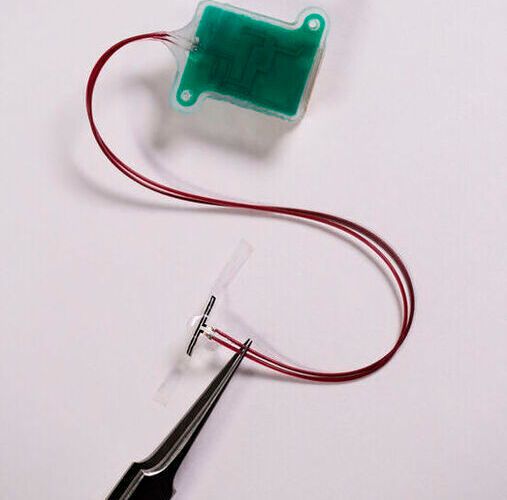
The elongated tab (near the tip of the tweezers) is the soft, stretchable sensor. The green box is the implantable "base station," which holds the electrical components to power the device and wirelessly transmit data.
(Source: Northwestern University)
Evanston/USA – Should you run to the bathroom now? Or can you hold it until you get home? A new implant and associated smartphone app may someday remove the guess work from the equation.
Northwestern University researchers have developed a new soft, flexible, battery-free implant that attaches to the bladder wall to sense filling. Then, it wirelessly — and simultaneously — transmits data to a smartphone app, so users can monitor their bladder fullness in real time.
The study will be published in the Proceedings of the National Academy of Sciences (PNAS). It marks the first example of a bioelectronic sensor that enables continuous monitoring of bladder function for a prolonged period.
While this new device is unnecessary for the average person, it could be a game-changer for people with paralysis, spina bifida, bladder cancer or end-stage bladder disease — where bladder function is often compromised, and bladder reconstruction surgery may be required. The sensor system also can enable clinicians to monitor their patients remotely and continuously to make more informed — and faster — treatment decisions.
“If bladder nerves are damaged from surgery or from a disease such as spina bifida, then a patient often loses sensation and is unaware that their bladder is full,” said Northwestern’s Guillermo A. Ameer, who co-led the work. “To empty the bladder, they often have to use catheters, which are uncomfortable and can lead to painful infections. We want to eliminate the use of catheters and bypass current bladder function monitoring procedures, which are highly invasive, very unpleasant and must be done in a hospital or clinical setting.”
An expert in regenerative engineering, Ameer is the Daniel Hale Williams Professor of Biomedical Engineering at Northwestern’s McCormick School of Engineering and professor of surgery at Northwestern University Feinberg School of Medicine. He also directs the Center for Advanced Regenerative Engineering and the predoctoral Regenerative Engineering Training Program, funded by the National Institutes of Health.
Ameer co-led the study with Northwestern’s John A. Rogers and Arun Sharma. A bioelectronics pioneer, Rogers is the Louis Simpson and Kimberly Querrey Professor of Materials Science and Engineering, Biomedical Engineering and Neurological Surgery at McCormick and Feinberg. He also directs the Querrey Simpson Institute for Bioelectronics. Sharma is a research associate professor of urology at Feinberg and of biomedical engineering at McCormick. He also is director of pediatric urological regenerative medicine at Stanley Manne Children’s Research Institute at Ann & Robert H. Lurie Children’s Hospital of Chicago.
How it works and initial results
Due to problems with nerves, brain or spinal cord, millions of Americans suffer from dysfunctional bladders. These issues can arise from congenital defects such as spina bifida — where a person is born with a damaged spine — or traumatic injuries sustained at any point in life. When left untreated, severe bladder dysfunction can cause routine infections and urination issues, eventually leading to kidney damage, which affects the entire body. Enabling physicians to remotely monitor their patients could enable faster interventions.
To monitor the bladder, the new device comprises multiple sensors, which work together to measure one simple parameter: strain. As the bladder fills, it expands. The fuller the bladder becomes, the more it stretches. This stretching pulls on the elastic-like device to signal strain. Likewise, when the bladder empties, it contracts, which then relieves strain. As the sensors detect various levels of strain, the device uses embedded Bluetooth technology to transmit this information to a smartphone or tablet.
“The key advance here is in the development of super soft, ultrathin, stretchable strain gauges that can gently wrap the outside surface of the bladder, without imposing any mechanical constraints on the natural filling and voiding behaviors,” Rogers said.
In small animal studies, the system successfully delivered real-time measurements of bladder filling and emptying for 30 days. Then, in a study using non-human primates, the system successfully delivered information for eight weeks. The researchers also demonstrated that the sensors are sensitive enough to detect strain from very low volumes of urine.
Date: 08.12.2025
Naturally, we always handle your personal data responsibly. Any personal data we receive from you is processed in accordance with applicable data protection legislation. For detailed information please see our privacy policy.
Consent to the use of data for promotional purposes
I hereby consent to Vogel Communications Group GmbH & Co. KG, Max-Planck-Str. 7-9, 97082 Würzburg including any affiliated companies according to §§ 15 et seq. AktG (hereafter: Vogel Communications Group) using my e-mail address to send editorial newsletters. A list of all affiliated companies can be found here
Newsletter content may include all products and services of any companies mentioned above, including for example specialist journals and books, events and fairs as well as event-related products and services, print and digital media offers and services such as additional (editorial) newsletters, raffles, lead campaigns, market research both online and offline, specialist webportals and e-learning offers. In case my personal telephone number has also been collected, it may be used for offers of aforementioned products, for services of the companies mentioned above, and market research purposes.
Additionally, my consent also includes the processing of my email address and telephone number for data matching for marketing purposes with select advertising partners such as LinkedIn, Google, and Meta. For this, Vogel Communications Group may transmit said data in hashed form to the advertising partners who then use said data to determine whether I am also a member of the mentioned advertising partner portals. Vogel Communications Group uses this feature for the purposes of re-targeting (up-selling, cross-selling, and customer loyalty), generating so-called look-alike audiences for acquisition of new customers, and as basis for exclusion for on-going advertising campaigns. Further information can be found in section “data matching for marketing purposes”.
In case I access protected data on Internet portals of Vogel Communications Group including any affiliated companies according to §§ 15 et seq. AktG, I need to provide further data in order to register for the access to such content. In return for this free access to editorial content, my data may be used in accordance with this consent for the purposes stated here. This does not apply to data matching for marketing purposes.
Right of revocation
I understand that I can revoke my consent at will. My revocation does not change the lawfulness of data processing that was conducted based on my consent leading up to my revocation. One option to declare my revocation is to use the contact form found at https://contact.vogel.de. In case I no longer wish to receive certain newsletters, I have subscribed to, I can also click on the unsubscribe link included at the end of a newsletter. Further information regarding my right of revocation and the implementation of it as well as the consequences of my revocation can be found in the data protection declaration, section editorial newsletter.
“This work is the first of its kind that is scaled for human use,” Ameer said. “We demonstrated the potential long-term function of the technology. Depending on the use case, we can design the technology to reside permanently inside the body or to harmlessly dissolve after the patient has made a full recovery.”
Bladder regeneration and function restoration
Although the new technology is useful on its own, Ameer envisions it as one component of a fully integrated system for bladder function restoration.
Just last month, Ameer and Sharma introduced a biodegradable synthetic, flexible “bladder patch,” which was published in PNAS Nexus. Seeded with the patient’s own stem cells, the citrate-based “patch” — referred to as a pro-regenerative scaffold (PRS) — enables the surgeon to reconstruct or rebuild the bladder without the need to harvest intestinal tissue, the current clinical standard for this surgery. The “patch,” which expands and contracts with the native bladder tissue, supports the migration and growth of bladder cells. Then it slowly dissolves, leaving behind new bladder tissue. The researchers demonstrated that the new tissue remained functional throughout the two-year study.
“We are working to integrate our bladder regeneration technology with this novel wireless bladder monitoring technology to restore bladder function and monitor the recovery process after surgery,” Ameer said. “This work brings us closer to the reality of smart regenerative systems, which are implantable pro-regenerative devices capable of probing their microenvironment, wirelessly reporting those findings outside the body (to the patient, caregiver or manufacturer) and enabling on-demand or programmed responses to change course and improve device performance or safety.”
“This technology represents a significant advancement, as there are currently no other tissue engineering-based approaches available to these patients,” Sharma said. “I am confident this will help improve the quality of life for many patients who will now be able to avoid the use of intestinal tissues and its myriad complications.”
Next: Urinating on demand
Ameer continues to work with Rogers and Sharma to build new functionalities into the system. They currently are exploring ways that the implant could stimulate the bladder to induce urination on demand.
“In addition to monitoring the filling, the app will be able to send warnings to the patient and then direct them to locations for the nearest restrooms,” Ameer said. “Also, one day, patients will be able to trigger urination, on demand, through their smartphone.”
Ameer, Sharma and Rogers are members of the Simpson Querrey Institute for Bionanotechnology. Ameer and Rogers are members of the International Institute for Nanotechnology. Ameer is a member of the Chemistry of Life Processes Institute, and Rogers is a member of the Robert H. Lurie Comprehensive Cancer Center of Northwestern University.
The study, “A wireless, implantable bioelectronic system for monitoring urinary bladder function following surgical recovery,” was supported by the National Institute of Diabetes and Digestive and Kidney Disease and the National Institute of Biomedical Imaging and Bioengineering.




:quality(80)/p7i.vogel.de/wcms/92/ad/92adbafb37924cea35ea3cf05b7a23e5/0130206318v2.jpeg "The world’s first fully functioning proof-of-concept quantum battery
(Source: Csiro)")
:quality(80)/p7i.vogel.de/wcms/9f/8b/9f8bc2b8491d7a514ca154e9588a07b7/0130205846v1.jpeg "The researchers’ new material, based on mineralised sawdust, is an excellent fire retardant. (Source: Dan Vivas Glaser / from Kürsteiner R et al. Chem Circularity 2026)")
:quality(80)/p7i.vogel.de/wcms/fd/73/fd73fcb3ceda89d1419de1083fcab7b4/0130081520v2.jpeg "The fingers at the heart of this technology were inspired by the fin-ray effect — a design principle derived from the natural structure of fish fins. (Source: University of Texas at Austin )")
:quality(80)/p7i.vogel.de/wcms/fe/64/fe649767c802d53ac63ee2c2a40b7e0d/0130060830v2.jpeg "Sample tube with light-active substance (Source: Elvira Eberhardt / Ulm University)")
:quality(80)/p7i.vogel.de/wcms/8f/b9/8fb98a958e4afe679865fbe52a473680/0129940982v2.jpeg "pH measurement in various nanoparticles using the Nine-Focus meter ensures precise stability and performance control. (Source: Mettler Toledo)")
:quality(80)/p7i.vogel.de/wcms/11/74/1174e5d4c8b07a64637dced8c9506b40/0129787561v2.jpeg "The Multicell Plus high-pressure reactor sets a new benchmark for operator safety, all-round accessibility and ease-of-use. (Source: Asynt)")
:quality(80)/p7i.vogel.de/wcms/ef/6e/ef6e96191183411973b77041fb6b1e16/0129785957v2.jpeg "Manufactured from high-quality crystal polystyrene - these new automation-ready plates are available in a choice of ANSI / SLAS standard (96-well and breakable 8-well strip) formats. (Source: Porvair Sciences)")
:quality(80)/p7i.vogel.de/wcms/ad/ca/adcaa20ef5ccaf7e3b325788b1e349c4/0129784872v2.jpeg "The high performance Degasi Flat Film in-line degasser. (Source: Biotech Fluidics)")
:quality(80)/p7i.vogel.de/wcms/af/40/af40b535eb65c287fbd22ed5483d1d0e/0130206243v2.jpeg "The researchers dug soil pits in order to measure the carbon storage in soil
(Source: Johanna Asch)")
:quality(80)/p7i.vogel.de/wcms/2d/45/2d45aba62f5042baa00f7fd4fa629839/0130036533v2.jpeg "The population of Pune, India, is expected to reach 11 million by 2050. (Source: free licensed)")
:quality(80)/p7i.vogel.de/wcms/52/f8/52f8d5521fdab07ed0a865ec0d8919fd/0130009438v2.jpeg "Drylands support around half of global livestock production and sustain the livelihoods of close to a billion people, while also underpinning soil stability and carbon storage. (Source: Kaust )")
:quality(80)/p7i.vogel.de/wcms/fe/49/fe494ada322615b6e6f6ff0f5bb7c5cf/0129926008v2.jpeg "A mandrill eating fruit. (Source: University of Bristol )")
:quality(80)/p7i.vogel.de/wcms/6f/ba/6fba92196d0cbb1467334f8a2ecc520a/0130203021v2.jpeg "Low to moderate wine consumption shows lower risk compared with spirits, beer and cider (Source: free licensed)")
:quality(80)/p7i.vogel.de/wcms/a9/37/a9376f1d9a893570023d9aa97c085bc5/0129927485v2.jpeg "Examples of foods high in PUFAs include fatty fish and soybeans, while MUFAs include olive oil and avocadoes. (Source: free licensed)")
:quality(80)/p7i.vogel.de/wcms/ea/88/ea88ef8810e21cdd9bb852c70f385ba1/0129797385v2.jpeg "A team of NUS food scientists consisting of Assoc Prof Liu Shao Quan (centre), Dr Lu Yuyun (right) and Ms Geng Chenhan (left) pioneered a co-fermentation method that improves both the nutrient and flavor profile of kombu. (Source: NUS)")
:quality(80)/p7i.vogel.de/wcms/84/2c/842c7c1678ceeec7147ea3a36e238e75/0129356324v2.jpeg "Kaust and Nadec have signed a MOU that establishes a framework for long-term cooperation across agricultural research, technology development, and professional training. (Source: Kaust )")
:quality(80)/p7i.vogel.de/wcms/e9/73/e9732473361377610267347df55071a1/0130205830v2.jpeg "Sleep EEG signals may reveal whether the brain is aging faster than the body — and help identify elevated dementia risk earlier. (Source: free licensed)")
:quality(80)/p7i.vogel.de/wcms/ed/c0/edc0c1a86229b11efd17c5e3f94d14da/0130081211v2.jpeg "A new study finds that virtual visits did not make it easier for psychiatrists, psychologists and therapists to reach significantly more people in areas where access to care has long been limited. (Source: Pixabay)")
:quality(80)/p7i.vogel.de/wcms/9c/52/9c52318bc94be17e6662dfceffa4a0c0/0130060546v2.jpeg "Domestic cat ‘Lanni’ from co-author of the study, Latasha Ludwig, Assistant Clinical Professor at Cornell University, USA. (Source: © Latasha Ludwig)")
:quality(80)/p7i.vogel.de/wcms/4b/f4/4bf4cc9e28e65e11a27dd41da2d1a7f5/0130038185v2.jpeg "The biomarker p-tau217 could help identify women at elevated dementia risk decades before clinical symptoms begin. (Source: free licensed)")
:quality(80)/images.vogel.de/vogelonline/bdb/1710600/1710675/original.jpg "Discover how to set yourself up for success when performing balance-based density determination of solids such as jewelry and precious metals. (Mettler Toledo)")
:quality(80)/images.vogel.de/vogelonline/bdb/1682500/1682579/original.jpg "The new XPR Analytical balance redesigned to meet the needs of laboratory technicians of working fast and lean. (Mettler Toledo)")
:quality(80)/images.vogel.de/vogelonline/bdb/1677000/1677080/original.jpg "Enhance your weighing accuracy, comfort and productivity with the redesigned XPR Analytical balance. (Mettler Toledo)")
:quality(80)/p7i.vogel.de/wcms/71/0b/710b65311648262eb99c8690377b73dd/0124237452v2.jpeg "Northwestern University researchers have developed the first wearable device for measuring gases emitted from and absorbed by the skin. (Source: John A. Rogers/Northwestern University)")
:quality(80)/p7i.vogel.de/wcms/15/d1/15d1ab97d1834050b8d828a4c0f9dabf/0124014294v2.jpeg "Tiny pacemaker on a fingertip, between a sesame seed and single grain of rice for scale. (Source: John A. Rogers/Northwestern University)")