Researchers have developed a novel material – Resurf that has the potential to significantly advance water quality monitoring and management. The new material, which can be prepared through a rapid micro-phase separation approach, autonomously self-heals and can be recycled.
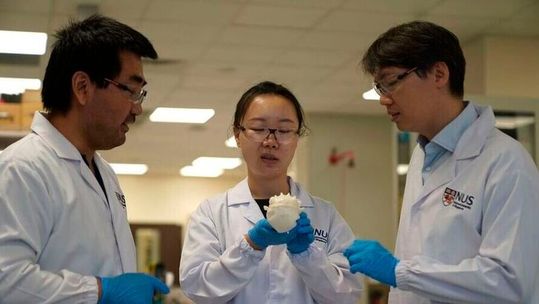
Assoc Prof Benjamin Tee (right), Liu Mengmeng (left), Ms Yu Kelu (centre) and their team from NUS have developed the Resurf sensor – an ultrafast, stretchable, self-healing and recyclable sensor for real-time water quality monitoring – and tested it on a pufferfish-like soft robot.
(Source: NUS)
Queenstown/Singapore – Clean, safe water is vital for human health and well-being. It also plays a critical role in our food security, supports high-tech industries, and enables sustainable urbanization. However, detecting contamination quickly and accurately remains a major challenge in many parts of the world. A groundbreaking new device developed by researchers at the National University of Singapore (NUS) has the potential to significantly advance water quality monitoring and management.
Taking inspiration from the biological function of the oily protective layer found on human skin, a team of researchers led by Associate Professor Benjamin Tee from the Department of Materials Science and Engineering in the College of Design and Engineering at NUS translated this concept into a versatile material, named Resurf, capable of spontaneously forming a water-repellent interface. This new material, which can be prepared through a rapid micro-phase separation approach, autonomously self-heals and can be recycled. The researchers incorporated the material into a device known as a triboelectric nanogenerator (Teng), which uses the energy from the movement of water droplets to create an electric charge. The resulting device (Resurf sensor) can be applied as a water quality monitor.
“The Resurf sensor can detect various pollutants, such as oils and fluorinated compounds, which are challenging for many existing sensors. This capability, together with unique features such as self-powered, self-healing, reusability and recyclability, positions Resurf as a sustainable solution for real-time, on-site, and sustainable water quality monitoring,” said Assoc Prof Tee.
The team’s design of the Resurf material and performance of the novel water quality sensor were published in the scientific journal Nature Communications on 1 July 2025.
Rapid and sustainable water quality sensing
Existing water quality monitoring technologies such as electrochemical sensors, optical detection systems, and biosensors are effective in certain specific applications, such as detecting heavy metals, phosphorus, and microbial pollution.
However, these technologies often face limitations including slow response, high costs, reliance on external reagents or power sources, limited reusability, and the need for bulky laboratory equipment or specialized instrumentation.
The Resurf sensor developed by the NUS team effectively overcomes these challenges, particularly in on-site real-time water quality sensing. The self-powered device has demonstrated the ability to detect water contaminants in approximately 6 milliseconds (i.e. around 40 times faster than a blink of the eye).
Additionally, the Resurf sensor is designed to be self-healing and recyclable, making it a sustainable and low-maintenance solution. Being stretchable and transparent, the material can be easily integrated into flexible platforms, including soft robotics and wearable electronics, setting it apart from conventional sensing materials.
Furthermore, the Resurf material applied as a sensor offers an environmentally friendly solution as it can be easily recycled due to its solubility in solvents, enabling it to be reused in new devices without suffering a loss in performance.
Resurf sensor: How it works
The Resurf sensor monitors water quality by analyzing the electrical signals generated when analytes — such as salts, oils, or pollutants — in the water droplets, contact its surface. When water droplets containing analytes strike the water-repellent surface of the sensor, they spread out and slide off quickly, generating electric charges within milliseconds. The magnitude and characteristics of the signal generated would vary according to the composition and concentration of the analytes present. By monitoring these signals in real time, the Resurf sensor can rapidly and accurately assess water quality without the need for external power sources.
To demonstrate its capabilities, the researchers tested the Resurf sensor on a pufferfish-like soft robot in detecting oil in water and perfluorooctanoic acid – a common contaminant found in water sources. The test produced promising results with both contaminants producing different voltage signals, providing a proof-of-concept that the Resurf sensor can be used in early surveillance of possible contamination.
Safeguarding water quality
The Resurf sensor offers broad application potential. It can be deployed in rivers, lakes, and reservoirs to enable early surveillance of pollutants, allowing for quick response to water contamination emergencies. In agriculture, it is capable of monitoring water safety in areas like rice fields. In industrial settings and sewage treatment plants, the Resurf sensor could provide valuable insights for wastewater management.
Date: 08.12.2025
Naturally, we always handle your personal data responsibly. Any personal data we receive from you is processed in accordance with applicable data protection legislation. For detailed information please see our privacy policy.
Consent to the use of data for promotional purposes
I hereby consent to Vogel Communications Group GmbH & Co. KG, Max-Planck-Str. 7-9, 97082 Würzburg including any affiliated companies according to §§ 15 et seq. AktG (hereafter: Vogel Communications Group) using my e-mail address to send editorial newsletters. A list of all affiliated companies can be found here
Newsletter content may include all products and services of any companies mentioned above, including for example specialist journals and books, events and fairs as well as event-related products and services, print and digital media offers and services such as additional (editorial) newsletters, raffles, lead campaigns, market research both online and offline, specialist webportals and e-learning offers. In case my personal telephone number has also been collected, it may be used for offers of aforementioned products, for services of the companies mentioned above, and market research purposes.
Additionally, my consent also includes the processing of my email address and telephone number for data matching for marketing purposes with select advertising partners such as LinkedIn, Google, and Meta. For this, Vogel Communications Group may transmit said data in hashed form to the advertising partners who then use said data to determine whether I am also a member of the mentioned advertising partner portals. Vogel Communications Group uses this feature for the purposes of re-targeting (up-selling, cross-selling, and customer loyalty), generating so-called look-alike audiences for acquisition of new customers, and as basis for exclusion for on-going advertising campaigns. Further information can be found in section “data matching for marketing purposes”.
In case I access protected data on Internet portals of Vogel Communications Group including any affiliated companies according to §§ 15 et seq. AktG, I need to provide further data in order to register for the access to such content. In return for this free access to editorial content, my data may be used in accordance with this consent for the purposes stated here. This does not apply to data matching for marketing purposes.
Right of revocation
I understand that I can revoke my consent at will. My revocation does not change the lawfulness of data processing that was conducted based on my consent leading up to my revocation. One option to declare my revocation is to use the contact form found at https://contact.vogel.de. In case I no longer wish to receive certain newsletters, I have subscribed to, I can also click on the unsubscribe link included at the end of a newsletter. Further information regarding my right of revocation and the implementation of it as well as the consequences of my revocation can be found in the data protection declaration, section editorial newsletter.
Next steps
The research team hopes to optimize the Resurf sensor by enhancing the specificity of pollutant detection, integrating wireless data transmission capabilities, and scaling the system for long-term or large-scale environmental monitoring. Additionally, the researchers plan to explore more eco-friendly material alternatives to enhance sustainability and align with evolving environmental regulations.
“Future iterations could integrate additional sensing modalities or machine learning–based signal analysis to enable more precise identification and classification of pollutants. We envision this platform as a foundation for the development of more intelligent and responsive water quality monitoring systems,” said Assoc Prof Tee.




:quality(80)/p7i.vogel.de/wcms/fd/73/fd73fcb3ceda89d1419de1083fcab7b4/0130081520v2.jpeg "The fingers at the heart of this technology were inspired by the fin-ray effect — a design principle derived from the natural structure of fish fins. (Source: University of Texas at Austin )")
:quality(80)/p7i.vogel.de/wcms/fe/64/fe649767c802d53ac63ee2c2a40b7e0d/0130060830v2.jpeg "Sample tube with light-active substance (Source: Elvira Eberhardt / Ulm University)")
:quality(80)/p7i.vogel.de/wcms/db/e2/dbe2ae4e02f702b30153a882ef705089/0129978032v1.jpeg "Each of the isolated indium atoms (in gold color) can catalyse the synthesis of methanol (top right). (Source: Constance Ko/ ETH Zurich)")
:quality(80)/p7i.vogel.de/wcms/c1/e6/c1e6ac26eb18993236c100e7f01a78f2/0129937639v1.jpeg "Dogs evolved from highly social ancestors and have been shaped by thousands of years of interacting with humans. (Source: free licensed)")
:quality(80)/p7i.vogel.de/wcms/8f/b9/8fb98a958e4afe679865fbe52a473680/0129940982v2.jpeg "pH measurement in various nanoparticles using the Nine-Focus meter ensures precise stability and performance control. (Source: Mettler Toledo)")
:quality(80)/p7i.vogel.de/wcms/11/74/1174e5d4c8b07a64637dced8c9506b40/0129787561v2.jpeg "The Multicell Plus high-pressure reactor sets a new benchmark for operator safety, all-round accessibility and ease-of-use. (Source: Asynt)")
:quality(80)/p7i.vogel.de/wcms/ef/6e/ef6e96191183411973b77041fb6b1e16/0129785957v2.jpeg "Manufactured from high-quality crystal polystyrene - these new automation-ready plates are available in a choice of ANSI / SLAS standard (96-well and breakable 8-well strip) formats. (Source: Porvair Sciences)")
:quality(80)/p7i.vogel.de/wcms/ad/ca/adcaa20ef5ccaf7e3b325788b1e349c4/0129784872v2.jpeg "The high performance Degasi Flat Film in-line degasser. (Source: Biotech Fluidics)")
:quality(80)/p7i.vogel.de/wcms/2d/45/2d45aba62f5042baa00f7fd4fa629839/0130036533v2.jpeg "The population of Pune, India, is expected to reach 11 million by 2050. (Source: free licensed)")
:quality(80)/p7i.vogel.de/wcms/52/f8/52f8d5521fdab07ed0a865ec0d8919fd/0130009438v2.jpeg "Drylands support around half of global livestock production and sustain the livelihoods of close to a billion people, while also underpinning soil stability and carbon storage. (Source: Kaust )")
:quality(80)/p7i.vogel.de/wcms/fe/49/fe494ada322615b6e6f6ff0f5bb7c5cf/0129926008v2.jpeg "A mandrill eating fruit. (Source: University of Bristol )")
:quality(80)/p7i.vogel.de/wcms/af/4e/af4ea968647ee9cae82b39800c611819/0129865630v2.jpeg "Map of a simulated risk of water stress in 2050 where hydrogen is used in transport and industry. Baseline risk (regardless of hydrogen use) is represented by the background color in each area. Dashed areas show water use exceeding available resources due to hydrogen production. Blue dots show areas where the risk of water stress increases by more than 50 percent in the simulation. (Source: Chalmers University of Technology / Joel Löfving)")
:quality(80)/p7i.vogel.de/wcms/a9/37/a9376f1d9a893570023d9aa97c085bc5/0129927485v2.jpeg "Examples of foods high in PUFAs include fatty fish and soybeans, while MUFAs include olive oil and avocadoes. (Source: free licensed)")
:quality(80)/p7i.vogel.de/wcms/ea/88/ea88ef8810e21cdd9bb852c70f385ba1/0129797385v2.jpeg "A team of NUS food scientists consisting of Assoc Prof Liu Shao Quan (centre), Dr Lu Yuyun (right) and Ms Geng Chenhan (left) pioneered a co-fermentation method that improves both the nutrient and flavor profile of kombu. (Source: NUS)")
:quality(80)/p7i.vogel.de/wcms/84/2c/842c7c1678ceeec7147ea3a36e238e75/0129356324v2.jpeg "Kaust and Nadec have signed a MOU that establishes a framework for long-term cooperation across agricultural research, technology development, and professional training. (Source: Kaust )")
:quality(80)/p7i.vogel.de/wcms/d1/3c/d13c2ad34af600dbd360c0bb0990b922/0129045715v2.jpeg "Replacing animal products with plant-based foods helps reduce the risk of heart disease and type 2 diabetes, finds a new review by the Physicians Committee for Responsible Medicine. (Source: Pixabay)")
:quality(80)/p7i.vogel.de/wcms/ed/c0/edc0c1a86229b11efd17c5e3f94d14da/0130081211v2.jpeg "A new study finds that virtual visits did not make it easier for psychiatrists, psychologists and therapists to reach significantly more people in areas where access to care has long been limited. (Source: Pixabay)")
:quality(80)/p7i.vogel.de/wcms/9c/52/9c52318bc94be17e6662dfceffa4a0c0/0130060546v2.jpeg "Domestic cat ‘Lanni’ from co-author of the study, Latasha Ludwig, Assistant Clinical Professor at Cornell University, USA. (Source: © Latasha Ludwig)")
:quality(80)/p7i.vogel.de/wcms/4b/f4/4bf4cc9e28e65e11a27dd41da2d1a7f5/0130038185v2.jpeg "The biomarker p-tau217 could help identify women at elevated dementia risk decades before clinical symptoms begin. (Source: free licensed)")
:quality(80)/p7i.vogel.de/wcms/4f/29/4f292f402b157e2ab8c57e9f2a3e3199/0130036120v2.jpeg "The chemistry is powered by an LED lamp that triggers a self-sustaining chain reaction, forging new carbon–carbon bonds under mild conditions without toxic or expensive chemicals. (Source: Nordin Ćatić/ St John’s College, Cambridge)")
:quality(80)/images.vogel.de/vogelonline/bdb/1710600/1710675/original.jpg "Discover how to set yourself up for success when performing balance-based density determination of solids such as jewelry and precious metals. (Mettler Toledo)")
:quality(80)/images.vogel.de/vogelonline/bdb/1682500/1682579/original.jpg "The new XPR Analytical balance redesigned to meet the needs of laboratory technicians of working fast and lean. (Mettler Toledo)")
:quality(80)/images.vogel.de/vogelonline/bdb/1677000/1677080/original.jpg "Enhance your weighing accuracy, comfort and productivity with the redesigned XPR Analytical balance. (Mettler Toledo)")
:quality(80)/p7i.vogel.de/wcms/41/ba/41bac71ed137c167d4a9337d5609319c/0127673053v2.jpeg "Measurement of conductivity for water quality insights with SevenGo. (Source: Mettler Toledo)")
:quality(80)/p7i.vogel.de/wcms/d8/42/d842014a015e22475805914990ad2fd6/0127562647v1.jpeg "Researchers at the University of Washington created a recyclable composite material made of tiny droplets of liquid metal infused into a stretchy polymer. The droplets, pictured in this microscope image, can be connected easily together to form an electrical circuit. (Source: Y. Han/ Advanced Functional Materials)")