Researchers at the University of Bern and Inselspital, Bern University Hospital made use of non-contact sensors to identify health problems in aging people such as old-age depression, risk of falls or cognitive impairment, at an early stage.
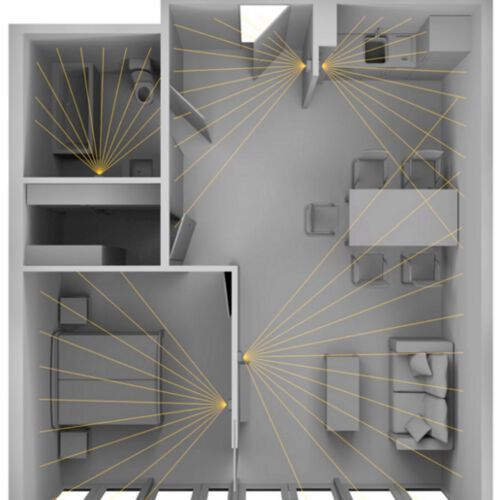
Exemplary apartment, highlighting the sensor system used in different rooms.
Bern/Switzerland – Specific changes in our movement patterns can be indicators of several health problems: For instance, decrease in strength often correlates with risk of falls, mild cognitive impairment, depression, sleep problems, respiratory problems, cardiac arrhythmias and increasing myocardial weakness or worsening of a Covid-19 infection. In older individuals, systematic detection of such changes could help identify chronic diseases such as dementia, Parkinson's disease, or heart disease at an early stage. These age-related health problems are often discovered late, and their progression is usually difficult to assess objectively.
An interdisciplinary research team led by Tobias Nef of the Artorg Center for Biomedical Engineering Research, and Professor Emeritus of Cardiology Hugo Saner of the University of Bern and Bern University Hospital, now shows how large-scale, sensor-based health monitoring could tackle these problems. The researchers combined a variety of everyday activity and behavior patterns measured by sensors in the homes of elderly study participants helping them to create a summary picture.
"We used non-contact sensors at home to create an extensive collection of digital measures that capture broad parts of daily life, behavior and physiology, in order to identify health risks of older people at an early stage," explains study first author and postdoctoral researcher Dr. Narayan Schütz. This may benefit early detection as well as foster development of personalized treatments and research into new therapeutic approaches and drugs. The study was published in npj Digital Medicine.
Reliable system accepted by seniors
The researchers initially collected 1,268 health parameters using non-interaction sensors particularly tailored to the senior demographic. The deployed system consists of simple, contactless motion sensors in each room, a bed sensor under the mattress, and door sensors on the front door and on the refrigerator. Connected to a base station, the system analyzes the registered motion signals and can inform relatives or an alarm center in the event of problems or emergencies – such as when a person does not return to bed at night. The researchers then evaluated the data collected in this way using machine learning approaches.
"We were able to show that such a systems approach – in contrast to the common use of a few health metrics – allows to detect age-relevant health problems such as cognitive impairment, fall risk or frailty surprisingly well," says Tobias Nef, Professor of Gerontechnology and Rehabilitation at the Artorg Center and co-last author of the study.
Compared to wearable devices, this sensor-based home monitoring approach was perceived well among seniors: As the interdisciplinary research group led by Tobias Nef and Hugo Saner was able to prove in a scientific collaboration of computer science, behavioral research and medicine spanning more than ten years, older test subjects in Switzerland found the daily operation of mobile devices rather cumbersome, and some were unable to handle them at all due to dexterity or cognitive problems. In particular, older adults above 80 years of age clearly preferred a zero-interaction system such as the one used in the study.
In addition, data protection and privacy are prioritized: “To ensure privacy and data protection on a technical level, the highest Swiss and European medical data security standards are applied”, Narayan Schütz points out. To secure privacy, the deployed sensors also do not record sound or video and their installation is entirely voluntary – both aspects that the study participants appreciated.
Great potential
The evaluation and combination of the large amount of everyday health data also offers the potential to identify possible new aging-relevant digital biomarkers: "For example, we found indications that fall risk could significantly depend on certain sleep parameters," explains Tobias Nef.
Prof. Hugo Saner, who was responsible for clinical data collection and is co-last author of the study, assesses the clinical relevance of the results: "Such a system marks a milestone in early detection of worsening health for seniors living alone into old age. We assume that it can make a significant contribution to enabling older people to live at home for as long as possible by delaying hospital admissions and transfers to nursing institutions or, in the best case, even avoiding them." According to the researchers, better early detection, and personalized treatment of typical diseases of old age would not only help older people achieve better health, but also reduce healthcare costs.
Date: 08.12.2025
Naturally, we always handle your personal data responsibly. Any personal data we receive from you is processed in accordance with applicable data protection legislation. For detailed information please see our privacy policy.
Consent to the use of data for promotional purposes
I hereby consent to Vogel Communications Group GmbH & Co. KG, Max-Planck-Str. 7-9, 97082 Würzburg including any affiliated companies according to §§ 15 et seq. AktG (hereafter: Vogel Communications Group) using my e-mail address to send editorial newsletters. A list of all affiliated companies can be found here
Newsletter content may include all products and services of any companies mentioned above, including for example specialist journals and books, events and fairs as well as event-related products and services, print and digital media offers and services such as additional (editorial) newsletters, raffles, lead campaigns, market research both online and offline, specialist webportals and e-learning offers. In case my personal telephone number has also been collected, it may be used for offers of aforementioned products, for services of the companies mentioned above, and market research purposes.
Additionally, my consent also includes the processing of my email address and telephone number for data matching for marketing purposes with select advertising partners such as LinkedIn, Google, and Meta. For this, Vogel Communications Group may transmit said data in hashed form to the advertising partners who then use said data to determine whether I am also a member of the mentioned advertising partner portals. Vogel Communications Group uses this feature for the purposes of re-targeting (up-selling, cross-selling, and customer loyalty), generating so-called look-alike audiences for acquisition of new customers, and as basis for exclusion for on-going advertising campaigns. Further information can be found in section “data matching for marketing purposes”.
In case I access protected data on Internet portals of Vogel Communications Group including any affiliated companies according to §§ 15 et seq. AktG, I need to provide further data in order to register for the access to such content. In return for this free access to editorial content, my data may be used in accordance with this consent for the purposes stated here. This does not apply to data matching for marketing purposes.
Right of revocation
I understand that I can revoke my consent at will. My revocation does not change the lawfulness of data processing that was conducted based on my consent leading up to my revocation. One option to declare my revocation is to use the contact form found at https://contact.vogel.de. In case I no longer wish to receive certain newsletters, I have subscribed to, I can also click on the unsubscribe link included at the end of a newsletter. Further information regarding my right of revocation and the implementation of it as well as the consequences of my revocation can be found in the data protection declaration, section editorial newsletter.




:quality(80)/p7i.vogel.de/wcms/92/ad/92adbafb37924cea35ea3cf05b7a23e5/0130206318v2.jpeg "The world’s first fully functioning proof-of-concept quantum battery
(Source: Csiro)")
:quality(80)/p7i.vogel.de/wcms/9f/8b/9f8bc2b8491d7a514ca154e9588a07b7/0130205846v1.jpeg "The researchers’ new material, based on mineralised sawdust, is an excellent fire retardant. (Source: Dan Vivas Glaser / from Kürsteiner R et al. Chem Circularity 2026)")
:quality(80)/p7i.vogel.de/wcms/fd/73/fd73fcb3ceda89d1419de1083fcab7b4/0130081520v2.jpeg "The fingers at the heart of this technology were inspired by the fin-ray effect — a design principle derived from the natural structure of fish fins. (Source: University of Texas at Austin )")
:quality(80)/p7i.vogel.de/wcms/fe/64/fe649767c802d53ac63ee2c2a40b7e0d/0130060830v2.jpeg "Sample tube with light-active substance (Source: Elvira Eberhardt / Ulm University)")
:quality(80)/p7i.vogel.de/wcms/8f/b9/8fb98a958e4afe679865fbe52a473680/0129940982v2.jpeg "pH measurement in various nanoparticles using the Nine-Focus meter ensures precise stability and performance control. (Source: Mettler Toledo)")
:quality(80)/p7i.vogel.de/wcms/11/74/1174e5d4c8b07a64637dced8c9506b40/0129787561v2.jpeg "The Multicell Plus high-pressure reactor sets a new benchmark for operator safety, all-round accessibility and ease-of-use. (Source: Asynt)")
:quality(80)/p7i.vogel.de/wcms/ef/6e/ef6e96191183411973b77041fb6b1e16/0129785957v2.jpeg "Manufactured from high-quality crystal polystyrene - these new automation-ready plates are available in a choice of ANSI / SLAS standard (96-well and breakable 8-well strip) formats. (Source: Porvair Sciences)")
:quality(80)/p7i.vogel.de/wcms/ad/ca/adcaa20ef5ccaf7e3b325788b1e349c4/0129784872v2.jpeg "The high performance Degasi Flat Film in-line degasser. (Source: Biotech Fluidics)")
:quality(80)/p7i.vogel.de/wcms/e9/9c/e99cb19231197af70c489cb4acc2ead0/0130293444v2.jpeg "A new global study, led by researchers at Kaust in Saudi Arabia, shows that forests are most effective for climate regulation when conserved or restored in their natural or native locations. (Source: Kaust )")
:quality(80)/p7i.vogel.de/wcms/af/40/af40b535eb65c287fbd22ed5483d1d0e/0130206243v2.jpeg "The researchers dug soil pits in order to measure the carbon storage in soil
(Source: Johanna Asch)")
:quality(80)/p7i.vogel.de/wcms/2d/45/2d45aba62f5042baa00f7fd4fa629839/0130036533v2.jpeg "The population of Pune, India, is expected to reach 11 million by 2050. (Source: free licensed)")
:quality(80)/p7i.vogel.de/wcms/52/f8/52f8d5521fdab07ed0a865ec0d8919fd/0130009438v2.jpeg "Drylands support around half of global livestock production and sustain the livelihoods of close to a billion people, while also underpinning soil stability and carbon storage. (Source: Kaust )")
:quality(80)/p7i.vogel.de/wcms/6f/ba/6fba92196d0cbb1467334f8a2ecc520a/0130203021v2.jpeg "Low to moderate wine consumption shows lower risk compared with spirits, beer and cider (Source: free licensed)")
:quality(80)/p7i.vogel.de/wcms/a9/37/a9376f1d9a893570023d9aa97c085bc5/0129927485v2.jpeg "Examples of foods high in PUFAs include fatty fish and soybeans, while MUFAs include olive oil and avocadoes. (Source: free licensed)")
:quality(80)/p7i.vogel.de/wcms/ea/88/ea88ef8810e21cdd9bb852c70f385ba1/0129797385v2.jpeg "A team of NUS food scientists consisting of Assoc Prof Liu Shao Quan (centre), Dr Lu Yuyun (right) and Ms Geng Chenhan (left) pioneered a co-fermentation method that improves both the nutrient and flavor profile of kombu. (Source: NUS)")
:quality(80)/p7i.vogel.de/wcms/84/2c/842c7c1678ceeec7147ea3a36e238e75/0129356324v2.jpeg "Kaust and Nadec have signed a MOU that establishes a framework for long-term cooperation across agricultural research, technology development, and professional training. (Source: Kaust )")
:quality(80)/p7i.vogel.de/wcms/66/a6/66a64c9dd7dbe84d2d7ea95a5e691bb1/0130361609v2.jpeg "Dr. Priya Freaney speaking to a patient at Bluhm Cardiovascular Institute at Northwestern Memorial Hospital in Chicago. (Source: Northwestern Medicine)")
:quality(80)/p7i.vogel.de/wcms/6e/d4/6ed479ad990b9ddc0f2eeadccccf62c7/0130359257v2.jpeg "Routine early measurement of neurofilament light chain could help improve prediction of cognitive impairment after out-of-hospital cardiac arrest, according to a study presented recently at ESC Acute Cardiovascular Care 2026. (Source: Pixabay)")
:quality(80)/p7i.vogel.de/wcms/6e/b9/6eb95805568aa78dc2ed57f829cf33d4/0130300421v2.jpeg "A 10-minute digital program co-developed by a University of Texas psychologist significantly reduced symptoms of depression four weeks after use, according to results from one of the largest randomized controlled trials of single-session mental health interventions. (Source: University of Texas at Austin )")
:quality(80)/p7i.vogel.de/wcms/6f/e9/6fe9d920eca2c0b3bdeb55cbe9f01908/0130299237v2.jpeg "Study authors Jason Miska and Leah Billingham reading out enzymatic activity of microglia in cell cultures. (Source: Northwestern University.)")
:quality(80)/images.vogel.de/vogelonline/bdb/1710600/1710675/original.jpg "Discover how to set yourself up for success when performing balance-based density determination of solids such as jewelry and precious metals. (Mettler Toledo)")
:quality(80)/images.vogel.de/vogelonline/bdb/1682500/1682579/original.jpg "The new XPR Analytical balance redesigned to meet the needs of laboratory technicians of working fast and lean. (Mettler Toledo)")
:quality(80)/images.vogel.de/vogelonline/bdb/1677000/1677080/original.jpg "Enhance your weighing accuracy, comfort and productivity with the redesigned XPR Analytical balance. (Mettler Toledo)")
:quality(80)/p7i.vogel.de/wcms/4b/f4/4bf4cc9e28e65e11a27dd41da2d1a7f5/0130038185v2.jpeg "The biomarker p-tau217 could help identify women at elevated dementia risk decades before clinical symptoms begin. (Source: free licensed)")
:quality(80)/p7i.vogel.de/wcms/8f/2d/8f2dafed79005bb26eadff740a014a54/0124446979v2.jpeg "Technology use among older adults appears to benefit cognitive health rather than harm it, according to a large-scale meta-analysis published in Nature Human Behaviour. (Source: SHOKO - stock.adobe.com)")