Researchers have developed a quick and accurate 3D printing method which can combine soft and hard properties into a single object by making use of different colors of light.
A new approach in 3D printing uses light in novel resins that provide flexibility, strength and complexity similar to what is found in nature.
(Source: University of Texas)
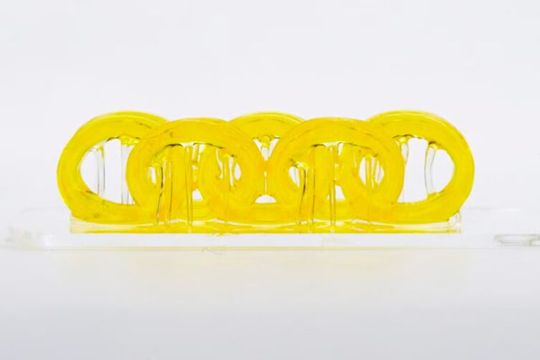
Texas/USA – Inspired by how nature blends toughness and flexibility, such as the rigid structure of bone surrounded by pliable cartilage, all with elegant and precise geometric properties, researchers at The University of Texas at Austin have developed a fast, precise new 3D printing method that seamlessly merges soft and hard properties into a single object using different colors of light.
This advance could pave the way for next-generation prosthetics, flexible medical devices and stretchable electronics that move naturally with the body, much like a human joint or ligament. The process is described in a paper in Nature Materials.
“What really motivated me and my research group is looking at materials in nature,” said Zak Page, an assistant professor of chemistry at UT Austin and corresponding author. “Nature does this in an organic way, combining hard and soft materials without failure at the interface. We wanted to replicate that.”
A related paper published on May 29 in ACS Central Science by Page and other authors describes adjacent work, which the journal’s editors praised in a “First Reactions” commentary, saying the work represents “the future of 3D printing” and showcases “how light — not merely as a tool for curing resin, but as a finely tuned sculptor — can drive the next generation of additive manufacturing.”
“This approach could make additive manufacturing more competitive for higher-volume production compared with traditional processes like injection molding. Just as important, it opens up new design possibilities,” said Keldy Mason, lead author of the latter study and a graduate student in Page’s lab. “This gives engineers, designers and makers more freedom to create.”
One of the biggest challenges in creating objects with vastly different physical properties is that materials tend to fail at the interface, or the point they come in contact. Think about how the rubber sole of a running shoe will separate over time from the softer mesh cloth above it.
The new 3D printing method uses a custom-designed liquid resin and a dual-light printing system that activates different chemical reactions depending on the color of light used. By shining violet light, the resin cures into a stretchy, rubber-like material. But in areas hit with higher-energy ultraviolet light, it becomes rigid and strong. The result is an object with distinct zones of softness and hardness crafted in a single print.
“We built in a molecule with both reactive groups so our two solidification reactions could ‘talk to each other’ at the interface,” Page said. “That gives us a much stronger connection between the soft and hard parts, and there can be a gradual transition if we want.”
The team demonstrated the system by printing a small but functional knee joint with flexible ligaments and rigid bones that move together smoothly. They also created a prototype stretchable electronic device with a gold wire mounted on a strip that could bend and stretch in parts, but with a more rigid section to prevent the circuit from breaking.
“Honestly, what surprised me most was how well it worked on the first try. That almost never happens with 3D printing resins,” Page said. “We were also shocked by how different the properties were. The soft parts stretched like a rubber band and bounced back. The hard parts were as strong as plastics used in consumer products.”
The process also works faster and with better resolution than previous approaches. And because the printer setup is relatively simple and affordable, the technology could become accessible to researchers, hospitals and educators.
“It could be used to prototype surgical models, wearable sensors or even soft robots,” Page said. “There’s so much potential here.”
Ji-Won Kim, Lynn M. Stevens, Henry L. Cater, Ain Uddin, Marshall J. Allen, Elizabeth A. Recker, Anthony J. Arrowood, Gabriel E. Sanoja, Benny D. Freeman, Ang Gao, Wyatt Eckstrom and Michael A. Cullinan of UT Austin were also authors on the Nature Materials paper. Keldy Mason, Jenna M. Nymick, Mingyu Shi, Franz A. Stolpen and Jaechul Ju joined Kim, Recker and Page on the ACS Central Science Paper in May. Both projects received funding support from the U.S. Department of Defense, the Robert A. Welch Foundation and the National Science Foundation, with additional support for the team’s foundational research made possible by the U.S. Department of Energy and Research Corporation for Science Advancement.
Date: 08.12.2025
Naturally, we always handle your personal data responsibly. Any personal data we receive from you is processed in accordance with applicable data protection legislation. For detailed information please see our privacy policy.
Consent to the use of data for promotional purposes
I hereby consent to Vogel Communications Group GmbH & Co. KG, Max-Planck-Str. 7-9, 97082 Würzburg including any affiliated companies according to §§ 15 et seq. AktG (hereafter: Vogel Communications Group) using my e-mail address to send editorial newsletters. A list of all affiliated companies can be found here
Newsletter content may include all products and services of any companies mentioned above, including for example specialist journals and books, events and fairs as well as event-related products and services, print and digital media offers and services such as additional (editorial) newsletters, raffles, lead campaigns, market research both online and offline, specialist webportals and e-learning offers. In case my personal telephone number has also been collected, it may be used for offers of aforementioned products, for services of the companies mentioned above, and market research purposes.
Additionally, my consent also includes the processing of my email address and telephone number for data matching for marketing purposes with select advertising partners such as LinkedIn, Google, and Meta. For this, Vogel Communications Group may transmit said data in hashed form to the advertising partners who then use said data to determine whether I am also a member of the mentioned advertising partner portals. Vogel Communications Group uses this feature for the purposes of re-targeting (up-selling, cross-selling, and customer loyalty), generating so-called look-alike audiences for acquisition of new customers, and as basis for exclusion for on-going advertising campaigns. Further information can be found in section “data matching for marketing purposes”.
In case I access protected data on Internet portals of Vogel Communications Group including any affiliated companies according to §§ 15 et seq. AktG, I need to provide further data in order to register for the access to such content. In return for this free access to editorial content, my data may be used in accordance with this consent for the purposes stated here. This does not apply to data matching for marketing purposes.
Right of revocation
I understand that I can revoke my consent at will. My revocation does not change the lawfulness of data processing that was conducted based on my consent leading up to my revocation. One option to declare my revocation is to use the contact form found at https://contact.vogel.de. In case I no longer wish to receive certain newsletters, I have subscribed to, I can also click on the unsubscribe link included at the end of a newsletter. Further information regarding my right of revocation and the implementation of it as well as the consequences of my revocation can be found in the data protection declaration, section editorial newsletter.




:quality(80)/p7i.vogel.de/wcms/ac/24/ac2495bc671ef2a8bf95bdb0de7f172a/0131908887v1.jpeg "An artistic rendering of a boron nitride nanotube developed by UIC researchers and their collaborators in a new study. (Source: Rendering by Ella Maru Studio, Inc. Courtesy of Sangil Kim)")
:quality(80)/p7i.vogel.de/wcms/dd/be/ddbe621ac35ec49d9aee43615173f703/0131898392v2.jpeg "The acquisition is consistent with GSK’s strategy of acquiring assets that have validated targets and meaningfully address efficacy and/or tolerability limitations of existing standard-of-care therapies. (Source: Pixabay)")
:quality(80)/p7i.vogel.de/wcms/e2/ae/e2aea4192de2e22dd33d19afee25f312/0131779278v1.jpeg "The artificial photosynthesis system produces formic acid from carbon dioxide and water. The right image shows the group’s unique electrolyzer.
(Source: Osaka Metropolitan University)")
:quality(80)/p7i.vogel.de/wcms/49/03/49033fd7e1cb79cd90776e8d0583b441/0131773380v1.jpeg "Taken from above, this annotated image shows a schoolground in Spain and the motions of teenage participants as indicated by the dots and lines. (Source: Echeverría-Huarte et al.)")
:quality(80)/p7i.vogel.de/wcms/f5/8d/f58d7181bd0660dea9e33b89f15947eb/0131589395v2.jpeg "Equipping all your HPLC systems running standard separation protocols with an automated non-invasive flow monitoring system, such as Flowchrom, is the only true solution. (Source: Testa Analytical)")
:quality(80)/p7i.vogel.de/wcms/63/44/63443a618001fbdc12e18de386a7b548/0131588936v2.jpeg "These compact, chemically inert degassers use trusted Degasi degasser parts, combined in a manner optimized to your specific system requirements. (Source: Biotech Fluidics)")
:quality(80)/p7i.vogel.de/wcms/47/13/4713969ee1fed4c9d6cd932df7c82482/0131588920v2.jpeg "My Genius Pro installed at a leading European transplant center supporting routine infectious disease testing. (Source: Elitech Group)")
:quality(80)/p7i.vogel.de/wcms/45/d9/45d9cf5be3c10b389fd712f319fbfce1/0131588911v2.jpeg "The Nexis GC-2060 supports both routine and ad-hoc analyses through a range of workflow support functions tailored to operational needs – from automating analytical tasks to on-demand operation that analyses exactly what is needed, when it is needed. (Source: Shimadzu)")
:quality(80)/p7i.vogel.de/wcms/b6/6a/b66a4a25066ff8e426cd9f574b72c7b9/0131905275v1.jpeg "PLA plastic (left piece) usually takes months to break down in industrial composting facilities, but incorporating a sprinkling of an organic additive dramatically speeds the process for a modified PLA plastic (right piece) to less than three weeks.
(Source: Jinsol Yook)")
:quality(80)/p7i.vogel.de/wcms/9f/d8/9fd8ffb67c1132b4f48dc60e4e194226/0131784166v2.jpeg "Still life featuring protein beads loaded with potassium hydroxide. The porous act as a sponge for CO2. (Source: Mezzenga Lab / ETH Zurich)")
:quality(80)/p7i.vogel.de/wcms/3e/47/3e472068bf13aadf4786e947ae148759/0131779258v2.jpeg "Salts, organic matter and other chemical constituents in natural fresh water and seawater suppress sunlight's ability to degrade plastic. Because sunlight cannot effectively initiate the degradation process, microbes cannot finish the job. That means nature’s cleanup process slows down, allowing plastics to accumulate and persist in waterways around the world. (Source: Ludmilla Aristilde/ Northwestern University)")
:quality(80)/p7i.vogel.de/wcms/bc/bc/bcbcf8be4b6c996f6ff231cb65937953/0131673749v1.jpeg "Sewage overflows occur when untreated sewage enters homes or the environment through broken or clogged pipes, or when the sewage system is overwhelmed. (Source: free licensed)")
:quality(80)/p7i.vogel.de/wcms/ac/33/ac339ce19b25f78e11a8dc8ef137869b/0131904977v2.jpeg "An “electronic nose” created by UC Berkeley researchers can detect the gases emitted by spoiled food and food allergens better than human noses. (Source: Brandon Sánchez-Mejia/ UC Berkeley)")
:quality(80)/p7i.vogel.de/wcms/b2/f9/b2f99d68013e2a6ab65e6c86254ec8a9/0131802730v2.jpeg "The UK currently eats 31 % less seafood than is recommended by government guidelines. (Source: University of Bristol)")
:quality(80)/p7i.vogel.de/wcms/1e/ed/1eed2310aac6373fe3d57c8f9d2809d6/0131673857v2.jpeg "“Addressing structural and policy-related barriers to accessing fresh and minimally processed foods remains critical for promoting dietary changes that improve the health and life span for all Americans,” said Dariush Mozaffarian, cardiologist and director of the Food is Medicine Institute at the Friedman School of Nutrition Science and Policy at Tufts University.
(Source: Imani Khayaam for Tufts University)")
:quality(80)/p7i.vogel.de/wcms/48/97/4897129d96e4ab9287933406b153ab51/0131163956v2.jpeg "Eating one egg per day for at least five days a week reduces risk of Alzheimer’s by up to 27%, researchers found. (Source: free licensed)")
:quality(80)/p7i.vogel.de/wcms/17/20/1720579fad3f2e89bc1e190e42ee7c8f/0131911326v2.jpeg "Wild cotton, on left, has short, brown, and coarse fibers, while modern domesticated cotton has white, fine and abundant fibers. A new study led by Iowa State University scientists identified the northwestern Yucatan Peninsula in Mexico as the original source of domesticated cotton. (Source: Corrinne Grover/ Iowa State Universit)")
:quality(80)/p7i.vogel.de/wcms/e0/47/e0471aba187b684e713df3c4d63461f8/0131909497v1.jpeg "Banded mongooses (Mungos mungo) can cooperate with common warthogs (Phacochoerus africanus) by cleaning them, removing ticks and other parasites, while the warthogs provide access to food and safety from predators through their vigilance and presence. Example footage from Queen Elizabeth National Park, Uganda.
(Source: Leela Channer)")
:quality(80)/p7i.vogel.de/wcms/db/28/db28c59875bbfbeae78aac866c08ffa3/0131901880v2.jpeg "Scientists at Northwestern University and Shirley Ryan Abilitylab have developed a first-of-its-kind rehabilitation system that virtually connects therapists and patients through robotic exoskeletons. (Source: Shirley Ryan Abilitylab)")
:quality(80)/p7i.vogel.de/wcms/bb/51/bb51f90e36d72be4dd360c026642b09c/0131843656v2.jpeg "As patients live longer, they are at an increased risk of developing valvular heart disease after successful cancer therapy. (Source: Pixabay)")
:quality(80)/images.vogel.de/vogelonline/bdb/1710600/1710675/original.jpg "Discover how to set yourself up for success when performing balance-based density determination of solids such as jewelry and precious metals. (Mettler Toledo)")
:quality(80)/images.vogel.de/vogelonline/bdb/1682500/1682579/original.jpg "The new XPR Analytical balance redesigned to meet the needs of laboratory technicians of working fast and lean. (Mettler Toledo)")
:quality(80)/images.vogel.de/vogelonline/bdb/1677000/1677080/original.jpg "Enhance your weighing accuracy, comfort and productivity with the redesigned XPR Analytical balance. (Mettler Toledo)")
:fill(fff,0)/p7i.vogel.de/companies/69/b7/69b7f63f311d9/logo-bimos-tif--2-.jpeg "logo-bimos-tif--2- (https://www.bimos.com/de-de/)")
:quality(80)/p7i.vogel.de/wcms/ec/c1/ecc1313beba111e5dfcce0a9c8801d63/0125849242v2.jpeg "A composite image of the robotic leg — with integrated artificial muscles — bending at the ankle and knee. (Source: Ryan Truby/Taekyoung Kim/Northwestern University)")
:quality(80)/p7i.vogel.de/wcms/a6/11/a611c82a457f79f6ba3dcdcc603ae5fd/0131776472v1.jpeg "Wei Gao and a team at Caltech have developed a bioelectronic material called a stretchable interface for resilient electrochemical sensing (Sires), meeting a key need for the next generation of wearable and implantable sensors. The photographs show Sires-based bioelectronics under stretching (top) and twisting (bottom). Scale bar is 1 cm. (Source: Wei Gao Lab/ Caltech)")