In a new study, researchers have revealed the workings of the ultrasonic warning sounds produced by the wings of the ermine moths. They unfolded the biomechanics that triggers the buckling sequence and shed light on how the clicking sounds are emitted through tymbal resonance.
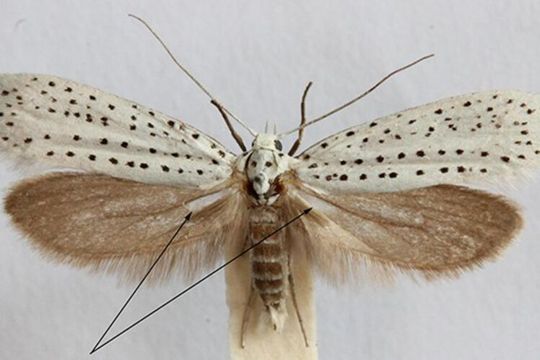
An ermine moth (Yponomeuta evonymella). The arrows indicate the tymbals.
(Source: David Agassiz, Natural History Museum)
Bristol/UK – Scientists have recently discovered that moths of the genus Yponomeuta (so-called ermine moths) have evolved a very special acoustic defence mechanism against their echolocating predators—bats.
Ermine moths produce ultrasonic clicking sounds twice per wingbeat cycle using a minute corrugated membrane in their hindwing. Strikingly, these moths lack hearing organs and are therefore not aware of their unique defence mechanism, nor do they have the capability to control it using muscular action.
In the study, published recently in Proceedings of the National Academy of Sciences, an interdisciplinary team of engineers and biologists from Bristol show how individual ridges of a corrugated patch in the hindwings of ermine moths snap-through because of in-flight wing folding. The sudden snap-through of these features vibrates an adjacent membrane, significantly amplifying the strength and direction of the produced sound. Owing to its passive in-flight actuation, this sound-producing organ is known as an ‘aeroelastic tymbal’.
Marc Holderied, Professor of Sensory Biology at the School of Biological Sciences, explained: “Our goal in this research was to understand how the corrugations in these tymbals can buckle and snap through in a choreographed way to produce a chain of broadband clicks. With this study, we unfolded the biomechanics that triggers the buckling sequence and shed light on how the clicking sounds are emitted through tymbal resonance.”
The study’s first author, Hernaldo Mendoza Nava, who investigated the mechanics of the aeroelastic tymbal as a PhD student at the EPSRC Centre for Doctoral Training in Advanced Composites for Innovation and Science of the Bristol Composites Institute (BCI), said: "Sound production and radiation is linked to mechanical vibration, for example in the skin of a drum or a loudspeaker.
“In ermine moths, the snap-through buckling events act like drumbeats at the edge of a tymbal drum, exciting a much larger portion of the wing to vibrate and radiate sound. As a result, these millimetre-sized tymbals can produce ultrasounds at the equivalent level of a lively human conversation."
To uncover the mechanics of the aeroelastic tymbal, Hernando combined state-of-the-art techniques from biology and engineering mechanics. The biological
characterization of the wing’s morphology and material properties ultimately led to detailed computer simulations of the snap-through response and sound production that match recorded moth signals in frequency, structure, amplitude, and direction.
Rainer Groh, Senior Lecturer in Digital Engineering of Structures at the BCI added: “The integration of various methods across the sciences with a consistent information flow across discipline boundaries in the spirit of ‘team science’ is what made this study unique and a success. In addition, without the amazing modern capabilities in imaging, data analysis and computation, uncovering the mechanics of this complex biological phenomenon would not have been possible."
The discovery will help researchers understand many other insect species with similar sound production mechanisms, filling a page of anti-bat acoustic defenses in the book on the age-old arms race between echolocating bats and their insect prey.
Structural buckling and sound production are rarely studied together, despite being reciprocal phenomena. In addition, buckling occurs as a sudden large deformation which can be attractive as a shape-changing mechanism in the field of morphing structures, such as in the aerospace industry, where engineers are looking to optimize the aerodynamic performance of wings.
Alberto Pirrera, Professor of Nonlinear Structural Mechanics at the BCI, concluded: “In the realm of engineering design, nonlinear elastic responses, such as buckling and snap-through instabilities, have traditionally been perceived as failure modes to be avoided. In our research, we have been advocating a paradigm shift and have demonstrated that buckling events can be strategically leveraged to imbue structures with smart functionality or enhanced mass-efficiency. Yponomeuta’s aeroelastic tymbal embodies the concept of beneficial nonlinearity.
Date: 08.12.2025
Naturally, we always handle your personal data responsibly. Any personal data we receive from you is processed in accordance with applicable data protection legislation. For detailed information please see our privacy policy.
Consent to the use of data for promotional purposes
I hereby consent to Vogel Communications Group GmbH & Co. KG, Max-Planck-Str. 7-9, 97082 Würzburg including any affiliated companies according to §§ 15 et seq. AktG (hereafter: Vogel Communications Group) using my e-mail address to send editorial newsletters. A list of all affiliated companies can be found here
Newsletter content may include all products and services of any companies mentioned above, including for example specialist journals and books, events and fairs as well as event-related products and services, print and digital media offers and services such as additional (editorial) newsletters, raffles, lead campaigns, market research both online and offline, specialist webportals and e-learning offers. In case my personal telephone number has also been collected, it may be used for offers of aforementioned products, for services of the companies mentioned above, and market research purposes.
Additionally, my consent also includes the processing of my email address and telephone number for data matching for marketing purposes with select advertising partners such as LinkedIn, Google, and Meta. For this, Vogel Communications Group may transmit said data in hashed form to the advertising partners who then use said data to determine whether I am also a member of the mentioned advertising partner portals. Vogel Communications Group uses this feature for the purposes of re-targeting (up-selling, cross-selling, and customer loyalty), generating so-called look-alike audiences for acquisition of new customers, and as basis for exclusion for on-going advertising campaigns. Further information can be found in section “data matching for marketing purposes”.
In case I access protected data on Internet portals of Vogel Communications Group including any affiliated companies according to §§ 15 et seq. AktG, I need to provide further data in order to register for the access to such content. In return for this free access to editorial content, my data may be used in accordance with this consent for the purposes stated here. This does not apply to data matching for marketing purposes.
Right of revocation
I understand that I can revoke my consent at will. My revocation does not change the lawfulness of data processing that was conducted based on my consent leading up to my revocation. One option to declare my revocation is to use the contact form found at https://contact.vogel.de. In case I no longer wish to receive certain newsletters, I have subscribed to, I can also click on the unsubscribe link included at the end of a newsletter. Further information regarding my right of revocation and the implementation of it as well as the consequences of my revocation can be found in the data protection declaration, section editorial newsletter.
“The natural world, once again, serves as a source of inspiration.” The research team anticipates that through bioinspiration, aeroelastic tymbals will encourage novel developments in the context of morphing structures, acoustic structural monitoring and soft robotics.
Paper: ‘Buckling-induced sound production in the aeroelastic tymbals of Yponomeuta’ by Hernaldo Mendoza Nava, Marc Holderied, Alberto Pirrera and Rainer Groh in Proceedings of the National Academy of Sciences of the USA.




:quality(80)/p7i.vogel.de/wcms/fd/73/fd73fcb3ceda89d1419de1083fcab7b4/0130081520v2.jpeg "The fingers at the heart of this technology were inspired by the fin-ray effect — a design principle derived from the natural structure of fish fins. (Source: University of Texas at Austin )")
:quality(80)/p7i.vogel.de/wcms/fe/64/fe649767c802d53ac63ee2c2a40b7e0d/0130060830v2.jpeg "Sample tube with light-active substance (Source: Elvira Eberhardt / Ulm University)")
:quality(80)/p7i.vogel.de/wcms/db/e2/dbe2ae4e02f702b30153a882ef705089/0129978032v1.jpeg "Each of the isolated indium atoms (in gold color) can catalyse the synthesis of methanol (top right). (Source: Constance Ko/ ETH Zurich)")
:quality(80)/p7i.vogel.de/wcms/c1/e6/c1e6ac26eb18993236c100e7f01a78f2/0129937639v1.jpeg "Dogs evolved from highly social ancestors and have been shaped by thousands of years of interacting with humans. (Source: free licensed)")
:quality(80)/p7i.vogel.de/wcms/8f/b9/8fb98a958e4afe679865fbe52a473680/0129940982v2.jpeg "pH measurement in various nanoparticles using the Nine-Focus meter ensures precise stability and performance control. (Source: Mettler Toledo)")
:quality(80)/p7i.vogel.de/wcms/11/74/1174e5d4c8b07a64637dced8c9506b40/0129787561v2.jpeg "The Multicell Plus high-pressure reactor sets a new benchmark for operator safety, all-round accessibility and ease-of-use. (Source: Asynt)")
:quality(80)/p7i.vogel.de/wcms/ef/6e/ef6e96191183411973b77041fb6b1e16/0129785957v2.jpeg "Manufactured from high-quality crystal polystyrene - these new automation-ready plates are available in a choice of ANSI / SLAS standard (96-well and breakable 8-well strip) formats. (Source: Porvair Sciences)")
:quality(80)/p7i.vogel.de/wcms/ad/ca/adcaa20ef5ccaf7e3b325788b1e349c4/0129784872v2.jpeg "The high performance Degasi Flat Film in-line degasser. (Source: Biotech Fluidics)")
:quality(80)/p7i.vogel.de/wcms/2d/45/2d45aba62f5042baa00f7fd4fa629839/0130036533v2.jpeg "The population of Pune, India, is expected to reach 11 million by 2050. (Source: free licensed)")
:quality(80)/p7i.vogel.de/wcms/52/f8/52f8d5521fdab07ed0a865ec0d8919fd/0130009438v2.jpeg "Drylands support around half of global livestock production and sustain the livelihoods of close to a billion people, while also underpinning soil stability and carbon storage. (Source: Kaust )")
:quality(80)/p7i.vogel.de/wcms/fe/49/fe494ada322615b6e6f6ff0f5bb7c5cf/0129926008v2.jpeg "A mandrill eating fruit. (Source: University of Bristol )")
:quality(80)/p7i.vogel.de/wcms/af/4e/af4ea968647ee9cae82b39800c611819/0129865630v2.jpeg "Map of a simulated risk of water stress in 2050 where hydrogen is used in transport and industry. Baseline risk (regardless of hydrogen use) is represented by the background color in each area. Dashed areas show water use exceeding available resources due to hydrogen production. Blue dots show areas where the risk of water stress increases by more than 50 percent in the simulation. (Source: Chalmers University of Technology / Joel Löfving)")
:quality(80)/p7i.vogel.de/wcms/6f/ba/6fba92196d0cbb1467334f8a2ecc520a/0130203021v2.jpeg "Low to moderate wine consumption shows lower risk compared with spirits, beer and cider (Source: free licensed)")
:quality(80)/p7i.vogel.de/wcms/a9/37/a9376f1d9a893570023d9aa97c085bc5/0129927485v2.jpeg "Examples of foods high in PUFAs include fatty fish and soybeans, while MUFAs include olive oil and avocadoes. (Source: free licensed)")
:quality(80)/p7i.vogel.de/wcms/ea/88/ea88ef8810e21cdd9bb852c70f385ba1/0129797385v2.jpeg "A team of NUS food scientists consisting of Assoc Prof Liu Shao Quan (centre), Dr Lu Yuyun (right) and Ms Geng Chenhan (left) pioneered a co-fermentation method that improves both the nutrient and flavor profile of kombu. (Source: NUS)")
:quality(80)/p7i.vogel.de/wcms/84/2c/842c7c1678ceeec7147ea3a36e238e75/0129356324v2.jpeg "Kaust and Nadec have signed a MOU that establishes a framework for long-term cooperation across agricultural research, technology development, and professional training. (Source: Kaust )")
:quality(80)/p7i.vogel.de/wcms/ed/c0/edc0c1a86229b11efd17c5e3f94d14da/0130081211v2.jpeg "A new study finds that virtual visits did not make it easier for psychiatrists, psychologists and therapists to reach significantly more people in areas where access to care has long been limited. (Source: Pixabay)")
:quality(80)/p7i.vogel.de/wcms/9c/52/9c52318bc94be17e6662dfceffa4a0c0/0130060546v2.jpeg "Domestic cat ‘Lanni’ from co-author of the study, Latasha Ludwig, Assistant Clinical Professor at Cornell University, USA. (Source: © Latasha Ludwig)")
:quality(80)/p7i.vogel.de/wcms/4b/f4/4bf4cc9e28e65e11a27dd41da2d1a7f5/0130038185v2.jpeg "The biomarker p-tau217 could help identify women at elevated dementia risk decades before clinical symptoms begin. (Source: free licensed)")
:quality(80)/p7i.vogel.de/wcms/4f/29/4f292f402b157e2ab8c57e9f2a3e3199/0130036120v2.jpeg "The chemistry is powered by an LED lamp that triggers a self-sustaining chain reaction, forging new carbon–carbon bonds under mild conditions without toxic or expensive chemicals. (Source: Nordin Ćatić/ St John’s College, Cambridge)")
:quality(80)/images.vogel.de/vogelonline/bdb/1710600/1710675/original.jpg "Discover how to set yourself up for success when performing balance-based density determination of solids such as jewelry and precious metals. (Mettler Toledo)")
:quality(80)/images.vogel.de/vogelonline/bdb/1682500/1682579/original.jpg "The new XPR Analytical balance redesigned to meet the needs of laboratory technicians of working fast and lean. (Mettler Toledo)")
:quality(80)/images.vogel.de/vogelonline/bdb/1677000/1677080/original.jpg "Enhance your weighing accuracy, comfort and productivity with the redesigned XPR Analytical balance. (Mettler Toledo)")
:quality(80)/p7i.vogel.de/wcms/39/8c/398c7434164c8697b1faf55495e729d4/0125560720v1.jpeg "A buff-tailed bumblebee (Bombus terrestris) buzz-pollinating a flower of the tomato family. (Source: Mario Vallejo-Marin)")
:quality(80)/p7i.vogel.de/wcms/e2/50/e25060efc5d415df36685fce9e64f047/0128496870v2.jpeg "SFG microscopy image of boron nitride monolayer flakes. (Source: FHI)")