Researchers have developed a new sponge that has the capacity to remove toxic heavy metals from contaminated water, thus leaving safe drinking water behind. The innovative sponge can also be reused multiple times.
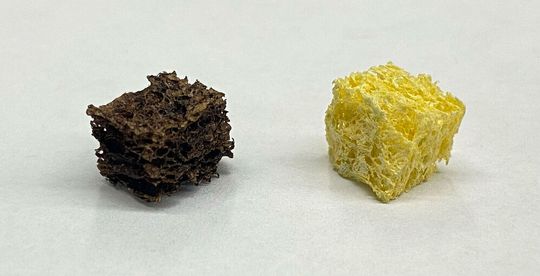
Sponge coated with nanoparticles (left) next to an uncoated cellulose sponge.
(Source: Northwestern University)
Evanston/USA – Northwestern University engineers have developed a new sponge that can remove metals — including toxic heavy metals like lead and critical metals like cobalt — from contaminated water, leaving safe, drinkable water behind. In proof-of-concept experiments, the researchers tested their new sponge on a highly contaminated sample of tap water, containing more than 1 part per million of lead. With one use, the sponge filtered lead to below detectable levels.
After using the sponge, researchers also were able to successfully recover metals and reuse the sponge for multiple cycles. The new sponge shows promise for future use as an inexpensive, easy-to-use tool in home water filters or large-scale environmental remediation efforts. The study published recently in the journal ACS ES&T Water. The paper outlines the new research and sets design rules for optimizing similar platforms for removing — and recovering — other heavy-metal toxins, including cadmium, arsenic, cobalt and chromium.
“The presence of heavy metals in the water supply is an enormous public health challenge for the entire globe,” said Northwestern’s Vinayak Dravid, senior author of the study. “It is a gigaton problem that requires solutions that can be deployed easily, effectively and inexpensively. That’s where our sponge comes in. It can remove the pollution and then be used again and again.”
Dravid is the Abraham Harris Professor of Materials Science and Engineering at Northwestern’s McCormick School of Engineering and director of global initiatives at the International Institute for Nanotechnology.
Sopping up spills
The project builds on Dravid’s previous work to develop highly porous sponges for various aspects of environmental remediation. In May 2020, his team unveiled a new sponge designed to clean up oil spills. The nanoparticle-coated sponge, which is now being commercialized by Northwestern spinoff MFNS Tech, offers a more efficient, economic, ecofriendly and reusable alternative to current approaches to oil spills. But Dravid knew it wasn’t enough.
“When there is an oil spill, you can remove the oil,” he said. “But there also are toxic heavy metals — like mercury, cadmium, sulfur and lead — in those spills. So, even when you remove the oil, some of the other toxins might remain.
Rinse and repeat
To tackle this aspect of the issue, Dravid’s team, again, turned to sponges coated with an ultrathin layer of nanoparticles. After testing many different types of nanoparticles, the team found that a manganese-doped goethite coating worked best. Not only are manganese-doped goethite nanoparticles inexpensive to make, easily available and nontoxic to human, they also have the properties necessary to selectively remediate heavy metals.
“You want a material with a high surface area, so there’s more room for the lead ions to stick to it,” said Benjamin Shindel, a Ph.D. student in Dravid’s lab and the paper’s first author. “These nanoparticles have high-surface areas and abundant reactive surface sites for adsorption and are stable, so they can be reused many times.”
The team synthesized slurries of manganese-doped goethite nanoparticles, as well as several other compositions of nanoparticles, and coated commercially available cellulose sponges with these slurries. Then, they rinsed the coated sponges with water in order to wash away any loose particles. The final coatings measured just tens of nanometers in thickness.
When submerged into contaminated water, the nanoparticle-coated sponge effectively sequested lead ions. The U.S. Food and Drug Administration requires that bottled drinking water is below 5 parts per billion of lead. In filtration trials, the sponge lowered the amount of lead to approximately 2 parts per billion, making it safe to drink.
“We’re really happy with that,” Shindel said. “Of course, this performance can vary based on several factors. For instance, if you have a large sponge in a tiny volume of water, it will perform better than a tiny sponge in a huge lake.”
Recovery bypasses mining
From there, the team rinsed the sponge with mildly acidified water, which Shindel likened to “having the same acidity of lemonade.” The acidic solution caused the sponge to release the lead ions and be ready for another use. Although the sponge’s performance declined after the first use, it still recovered more than 90 % of the ions during subsequent use cycles.
Date: 08.12.2025
Naturally, we always handle your personal data responsibly. Any personal data we receive from you is processed in accordance with applicable data protection legislation. For detailed information please see our privacy policy.
Consent to the use of data for promotional purposes
I hereby consent to Vogel Communications Group GmbH & Co. KG, Max-Planck-Str. 7-9, 97082 Würzburg including any affiliated companies according to §§ 15 et seq. AktG (hereafter: Vogel Communications Group) using my e-mail address to send editorial newsletters. A list of all affiliated companies can be found here
Newsletter content may include all products and services of any companies mentioned above, including for example specialist journals and books, events and fairs as well as event-related products and services, print and digital media offers and services such as additional (editorial) newsletters, raffles, lead campaigns, market research both online and offline, specialist webportals and e-learning offers. In case my personal telephone number has also been collected, it may be used for offers of aforementioned products, for services of the companies mentioned above, and market research purposes.
Additionally, my consent also includes the processing of my email address and telephone number for data matching for marketing purposes with select advertising partners such as LinkedIn, Google, and Meta. For this, Vogel Communications Group may transmit said data in hashed form to the advertising partners who then use said data to determine whether I am also a member of the mentioned advertising partner portals. Vogel Communications Group uses this feature for the purposes of re-targeting (up-selling, cross-selling, and customer loyalty), generating so-called look-alike audiences for acquisition of new customers, and as basis for exclusion for on-going advertising campaigns. Further information can be found in section “data matching for marketing purposes”.
In case I access protected data on Internet portals of Vogel Communications Group including any affiliated companies according to §§ 15 et seq. AktG, I need to provide further data in order to register for the access to such content. In return for this free access to editorial content, my data may be used in accordance with this consent for the purposes stated here. This does not apply to data matching for marketing purposes.
Right of revocation
I understand that I can revoke my consent at will. My revocation does not change the lawfulness of data processing that was conducted based on my consent leading up to my revocation. One option to declare my revocation is to use the contact form found at https://contact.vogel.de. In case I no longer wish to receive certain newsletters, I have subscribed to, I can also click on the unsubscribe link included at the end of a newsletter. Further information regarding my right of revocation and the implementation of it as well as the consequences of my revocation can be found in the data protection declaration, section editorial newsletter.
This ability to gather and then recover heavy metals is particularly valuable for removing rare, critical metals, such as cobalt, from water sources. A common ingredient in lithium-ion batteries, cobalt is energetically expensive to mine and accompanied by a laundry list of environmental and human costs.
If researchers could develop a sponge that selectively removes rare metals, including cobalt, from water, then those metals could be recycled into products like batteries.
“For renewable energy technologies, like batteries and fuel cells, there is a need for metal recovery,” Dravid said. “Otherwise, there is not enough cobalt in the world for the growing number of batteries. We must find ways to recover metals from very dilute solutions. Otherwise, it becomes poisonous and toxic, just sitting there in the water. We might as well make something valuable with it.”
Standardized scale
As a part of the study, Dravid and his team set new design rules to help others develop tools to target particular metals, including cobalt. Specifically, they pinpointed which low-cost and nontoxic nanoparticles also have high-surface areas and affinities for sticking to metal ions. They studied the performance of coatings of manganese, iron, aluminum and zinc oxides on lead adsorption. Then, they established relationships between the structures of these nanoparticles and their adsorptive properties.
Called Nanomaterial Sponge Coatings for Heavy Metals (or Nano-Scheme), the environmental remediation platform can help other researchers differentiate which nanomaterials are best suited for particular applications.“I’ve read a lot of literature that compares different coatings and adsorbents,” said Caroline Harms, an undergraduate student in Dravid’s lab and paper co-author.
“There really is a lack of standardization in the field. By analyzing different types of nanoparticles, we developed a comparative scale that actually works for all of them. It could have a lot of implications in moving the field forward.” Dravid and his team imagine that their sponge could be used in commercial water filters, for environmental clean-up or as an added step in water reclamation and treatment facilities.
“This work may be pertinent to water quality issues both locally and globally,” Shindel said. “We want to see this out in the world, where it can make a real impact.”
The study, “Nano-Scheme: Nanomaterial Sponge Coatings for Heavy Metals, an environmental remediation platform,” was supported by the National Science Foundation and U.S. Department of Energy.




:quality(80)/p7i.vogel.de/wcms/66/7c/667c242f45cc06eb5bee090c7723ba0b/0130384415v2.jpeg "Inspired by arm-wrestling, the NUS team built a self-training platform (left) where two rings of muscle tissues continuously and autonomously pull against each other. Ostrabot (right), made from a single trained ring of muscle and two flexible tails, swims 3 times faster than counterparts with conventionally cultured muscle. (Source: National University of Singapore)")
:quality(80)/p7i.vogel.de/wcms/92/ad/92adbafb37924cea35ea3cf05b7a23e5/0130206318v2.jpeg "The world’s first fully functioning proof-of-concept quantum battery
(Source: Csiro)")
:quality(80)/p7i.vogel.de/wcms/9f/8b/9f8bc2b8491d7a514ca154e9588a07b7/0130205846v1.jpeg "The researchers’ new material, based on mineralised sawdust, is an excellent fire retardant. (Source: Dan Vivas Glaser / from Kürsteiner R et al. Chem Circularity 2026)")
:quality(80)/p7i.vogel.de/wcms/fd/73/fd73fcb3ceda89d1419de1083fcab7b4/0130081520v2.jpeg "The fingers at the heart of this technology were inspired by the fin-ray effect — a design principle derived from the natural structure of fish fins. (Source: University of Texas at Austin )")
:quality(80)/p7i.vogel.de/wcms/8f/b9/8fb98a958e4afe679865fbe52a473680/0129940982v2.jpeg "pH measurement in various nanoparticles using the Nine-Focus meter ensures precise stability and performance control. (Source: Mettler Toledo)")
:quality(80)/p7i.vogel.de/wcms/11/74/1174e5d4c8b07a64637dced8c9506b40/0129787561v2.jpeg "The Multicell Plus high-pressure reactor sets a new benchmark for operator safety, all-round accessibility and ease-of-use. (Source: Asynt)")
:quality(80)/p7i.vogel.de/wcms/ef/6e/ef6e96191183411973b77041fb6b1e16/0129785957v2.jpeg "Manufactured from high-quality crystal polystyrene - these new automation-ready plates are available in a choice of ANSI / SLAS standard (96-well and breakable 8-well strip) formats. (Source: Porvair Sciences)")
:quality(80)/p7i.vogel.de/wcms/ad/ca/adcaa20ef5ccaf7e3b325788b1e349c4/0129784872v2.jpeg "The high performance Degasi Flat Film in-line degasser. (Source: Biotech Fluidics)")
:quality(80)/p7i.vogel.de/wcms/21/9b/219b000051ab1ea14ab5f92e4fd0f9bb/0130384937v2.jpeg "Deforestation in the Appalachian mountains. (Source: Alex Diaz on Unsplash)")
:quality(80)/p7i.vogel.de/wcms/e9/9c/e99cb19231197af70c489cb4acc2ead0/0130293444v2.jpeg "A new global study, led by researchers at Kaust in Saudi Arabia, shows that forests are most effective for climate regulation when conserved or restored in their natural or native locations. (Source: Kaust )")
:quality(80)/p7i.vogel.de/wcms/af/40/af40b535eb65c287fbd22ed5483d1d0e/0130206243v2.jpeg "The researchers dug soil pits in order to measure the carbon storage in soil
(Source: Johanna Asch)")
:quality(80)/p7i.vogel.de/wcms/2d/45/2d45aba62f5042baa00f7fd4fa629839/0130036533v2.jpeg "The population of Pune, India, is expected to reach 11 million by 2050. (Source: free licensed)")
:quality(80)/p7i.vogel.de/wcms/6f/ba/6fba92196d0cbb1467334f8a2ecc520a/0130203021v2.jpeg "Low to moderate wine consumption shows lower risk compared with spirits, beer and cider (Source: free licensed)")
:quality(80)/p7i.vogel.de/wcms/a9/37/a9376f1d9a893570023d9aa97c085bc5/0129927485v2.jpeg "Examples of foods high in PUFAs include fatty fish and soybeans, while MUFAs include olive oil and avocadoes. (Source: free licensed)")
:quality(80)/p7i.vogel.de/wcms/ea/88/ea88ef8810e21cdd9bb852c70f385ba1/0129797385v2.jpeg "A team of NUS food scientists consisting of Assoc Prof Liu Shao Quan (centre), Dr Lu Yuyun (right) and Ms Geng Chenhan (left) pioneered a co-fermentation method that improves both the nutrient and flavor profile of kombu. (Source: NUS)")
:quality(80)/p7i.vogel.de/wcms/84/2c/842c7c1678ceeec7147ea3a36e238e75/0129356324v2.jpeg "Kaust and Nadec have signed a MOU that establishes a framework for long-term cooperation across agricultural research, technology development, and professional training. (Source: Kaust )")
:quality(80)/p7i.vogel.de/wcms/30/2e/302e195d532fc9aced73406b07642b57/0130384900v2.jpeg "Sleeping for 11 minutes more, doing an additional 4.5 minutes of moderate-to-vigorous physical activity, and eating additional quarter of a cup of vegetables were associated with a 10 % reduction in major cardiovascular events. (Source: Pixabay)")
:quality(80)/p7i.vogel.de/wcms/47/41/4741ee3c589369a09ab0e3a26b7143f0/0130384858v2.jpeg "A female, Aedes aegypti mosquito, after taking her blood meal. (Source: Lauren Bishop CDC)")
:quality(80)/p7i.vogel.de/wcms/66/a6/66a64c9dd7dbe84d2d7ea95a5e691bb1/0130361609v2.jpeg "Dr. Priya Freaney speaking to a patient at Bluhm Cardiovascular Institute at Northwestern Memorial Hospital in Chicago. (Source: Northwestern Medicine)")
:quality(80)/p7i.vogel.de/wcms/6e/d4/6ed479ad990b9ddc0f2eeadccccf62c7/0130359257v2.jpeg "Routine early measurement of neurofilament light chain could help improve prediction of cognitive impairment after out-of-hospital cardiac arrest, according to a study presented recently at ESC Acute Cardiovascular Care 2026. (Source: Pixabay)")
:quality(80)/images.vogel.de/vogelonline/bdb/1710600/1710675/original.jpg "Discover how to set yourself up for success when performing balance-based density determination of solids such as jewelry and precious metals. (Mettler Toledo)")
:quality(80)/images.vogel.de/vogelonline/bdb/1682500/1682579/original.jpg "The new XPR Analytical balance redesigned to meet the needs of laboratory technicians of working fast and lean. (Mettler Toledo)")
:quality(80)/images.vogel.de/vogelonline/bdb/1677000/1677080/original.jpg "Enhance your weighing accuracy, comfort and productivity with the redesigned XPR Analytical balance. (Mettler Toledo)")
:fill(fff,0)/p7i.vogel.de/companies/5f/3f/5f3f63ceedc78/knf-logo.jpg "KNF_Logo.jpg (www.knf.com)")
:quality(80)/p7i.vogel.de/wcms/d4/29/d429a973c6f14ced3d2eb44931669a78/0129348927v1.jpeg "Cage-like ulva biochar confined synthesis of Fe₃O₄/ZnO heterojunction nanoparticles for synergistic adsorption and photocatalytic degradation of PFOA
(Source: Hua Jing et. al.)")
:quality(80)/p7i.vogel.de/wcms/37/58/3758d7aa160a60ce24245e763f6721cb/0125840273v1.jpeg "Ling Zang, left, and Rana Dalapati, seated, modified another chemical-capturing molecule to increase its binding ability. (Source: University of Utah College of Engineering)")