MethanogensEvidence for New Groups of Methane-Producing Organisms Discovered
Source:
Montana State University
4 min Reading Time
A team of scientists from Montana State University has provided the first experimental evidence that two new groups of microbes thriving in thermal features in Yellowstone National Park produce methane — a discovery that could one day contribute to the development of methods to mitigate climate change and provide insight into potential life elsewhere in our solar system.
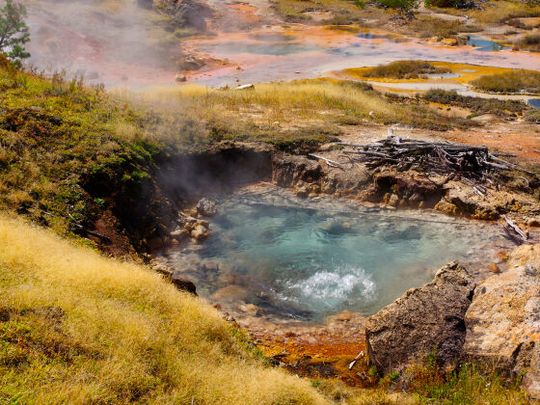
Montana State University scientists have found evidence that tiny organisms living in Yellowstone National Park's hydrothermal area produce methane.
(Source: Roland Hatzenpichler)
The journal Nature this week published findings from the laboratory of Roland Hatzenpichler, associate professor in MSU’s Department of Chemistry and Biochemistry in the College of Letters and Science and associate director of the university’s Thermal Biology Institute. The two scientific papers describe the MSU researchers’ verification of the first known examples of single-celled organisms that produce methane to exist outside the lineage Euryarchaeota, which is part of the larger branch of the tree of life called Archaea.
The methane-producing single-celled organisms are called methanogens. While humans and other animals eat food, breathe oxygen and exhale carbon dioxide to survive, methanogens eat small molecules like carbon dioxide or methanol and exhale methane. Most methanogens are strict anaerobes, meaning they cannot survive in the presence of oxygen.
Scientists have known since the 1930s that many anaerobic organisms within the archaea are methanogens, and for decades they believed that all methanogens were in a single phylum: the Euryarchaeota. But about ten years ago, microbes with genes for methanogenesis began to be discovered in other phyla, including one called Thermoproteota. That phylum contains two microbial groups called Methanomethylicia and Methanodesulfokora.
“All we knew about these organisms was their DNA,” Hatzenpichler said. “No one had ever seen a cell of these supposed methanogens; no one knew if they actually used their methanogenesis genes or if they were growing by some other means.”
Hatzenpichler and his researchers set out to test whether the organisms were living by methanogenesis, basing their work on the results of a study published last year by one of his former graduate students at MSU, Mackenzie Lynes. Samples were harvested from sediments in Yellowstone National Park hot springs ranging in temperature from 141 to 161 degrees Fahrenheit (61–72°C).
Through what Hatzenpichler described as “painstaking work,” MSU doctoral student Anthony Kohtz and postdoctoral researcher Viola Krukenberg grew the Yellowstone microbes in the lab. The microbes not only survived but thrived — and they produced methane. The team then worked to characterize the biology of the new microbes, involving staff scientist Zackary Jay and others at ETH Zurich.
At the same time, a research group led by Lei Cheng from China’s Biogas Institute of the Ministry of Agriculture and Rural Affairs and Diana Sousa from Wageningen University in the Netherlands successfully grew another one of these novel methanogens, a project they had worked on for six years.
“Until our studies, no experimental work had been done on these microbes, aside from DNA sequencing,” said Hatzenpichler. He said Cheng and Sousa offered to submit the studies together for publication, and Cheng’s paperreporting the isolation of another member of Methanomethylicia was published jointly with the two Hatzenpichler lab studies.
While one of the newly identified group of methanogens, Methanodesulfokora, seems to be confined to hot springs and deep-sea hydrothermal vents, Methanomethylicia, are widespread, Hatzenpichler said. They are sometimes found in wastewater treatment plants and the digestive tracts of ruminant animals, and in marine sediments, soils and wetlands. Hatzenpichler said that’s significant because methanogens produce 70 % of the world’s methane, a gas 28 times more potent than carbon dioxide in trapping heat in the atmosphere, according to the U.S. Environmental Protection Agency.
“Methane levels are increasing at a much higher rate than carbon dioxide, and humans are pumping methane at a higher rate into the atmosphere than ever before,” he said. Hatzenpichler said that while the experiments answered an important question, they generated many more that will fuel future work. For example, scientists don’t yet know whether Methanomethylicia that live in non-extreme environments rely on methanogenesis to grow or if they grow by other means. “My best bet is that they sometimes grow by making methane, and sometimes they do something else entirely, but we don’t know when they grow, or how, or why.” Hatzenpichler said. “We now need to find out when they contribute to methane cycling and when not.”
Date: 08.12.2025
Naturally, we always handle your personal data responsibly. Any personal data we receive from you is processed in accordance with applicable data protection legislation. For detailed information please see our privacy policy.
Consent to the use of data for promotional purposes
I hereby consent to Vogel Communications Group GmbH & Co. KG, Max-Planck-Str. 7-9, 97082 Würzburg including any affiliated companies according to §§ 15 et seq. AktG (hereafter: Vogel Communications Group) using my e-mail address to send editorial newsletters. A list of all affiliated companies can be found here
Newsletter content may include all products and services of any companies mentioned above, including for example specialist journals and books, events and fairs as well as event-related products and services, print and digital media offers and services such as additional (editorial) newsletters, raffles, lead campaigns, market research both online and offline, specialist webportals and e-learning offers. In case my personal telephone number has also been collected, it may be used for offers of aforementioned products, for services of the companies mentioned above, and market research purposes.
Additionally, my consent also includes the processing of my email address and telephone number for data matching for marketing purposes with select advertising partners such as LinkedIn, Google, and Meta. For this, Vogel Communications Group may transmit said data in hashed form to the advertising partners who then use said data to determine whether I am also a member of the mentioned advertising partner portals. Vogel Communications Group uses this feature for the purposes of re-targeting (up-selling, cross-selling, and customer loyalty), generating so-called look-alike audiences for acquisition of new customers, and as basis for exclusion for on-going advertising campaigns. Further information can be found in section “data matching for marketing purposes”.
In case I access protected data on Internet portals of Vogel Communications Group including any affiliated companies according to §§ 15 et seq. AktG, I need to provide further data in order to register for the access to such content. In return for this free access to editorial content, my data may be used in accordance with this consent for the purposes stated here. This does not apply to data matching for marketing purposes.
Right of revocation
I understand that I can revoke my consent at will. My revocation does not change the lawfulness of data processing that was conducted based on my consent leading up to my revocation. One option to declare my revocation is to use the contact form found at https://contact.vogel.de. In case I no longer wish to receive certain newsletters, I have subscribed to, I can also click on the unsubscribe link included at the end of a newsletter. Further information regarding my right of revocation and the implementation of it as well as the consequences of my revocation can be found in the data protection declaration, section editorial newsletter.
Whereas most methanogens within the Euryarchaeota use CO2 or acetate to make methane, Methanomethylicia and Methanodesulfokora use compounds such as methanol. This property could help scientists learn how to alter conditions in the different environments where they are found so that less methane is emitted into the atmosphere, Hatzenpichler said.
His lab will begin collaborating this fall with MSU’s Bozeman Agricultural Research and Teaching Farm, which will provide samples for further research into the methanogens found in cattle. In addition, new graduate students joining Hatzenpichler’s lab in the fall will determine whether the newly found archaea produce methane in wastewater, soils and wetlands.
Methanomethylicia also have a fascinating cell architecture, Hatzenpichler said. He collaborated with two scientists at ETH Zurich, Martin Pilhofer and graduate student Nickolai Petrosian, to show that the microbe forms previously unknown cell-to-cell tubes that connect two or three cells with each other.
“We have no idea why they are forming them. Structures like these have rarely been seen in microbes. Maybe they exchange DNA; maybe they exchange chemicals. We don't know yet,” said Hatzenpichler.
The newly published research was funded by Nasa’s exobiology program. NASA is interested in methanogens because they may give insights into life on Earth more than 3 billion years ago and the potential for life on other planets and moons where methane has been detected, he said.
Original Article: Cultivation and visualization of a methanogen of the phylum Thermoproteota; Nature; DOI:10.1038/s41586-024-07631-6




:quality(80)/p7i.vogel.de/wcms/92/ad/92adbafb37924cea35ea3cf05b7a23e5/0130206318v2.jpeg "The world’s first fully functioning proof-of-concept quantum battery
(Source: Csiro)")
:quality(80)/p7i.vogel.de/wcms/9f/8b/9f8bc2b8491d7a514ca154e9588a07b7/0130205846v1.jpeg "The researchers’ new material, based on mineralised sawdust, is an excellent fire retardant. (Source: Dan Vivas Glaser / from Kürsteiner R et al. Chem Circularity 2026)")
:quality(80)/p7i.vogel.de/wcms/fd/73/fd73fcb3ceda89d1419de1083fcab7b4/0130081520v2.jpeg "The fingers at the heart of this technology were inspired by the fin-ray effect — a design principle derived from the natural structure of fish fins. (Source: University of Texas at Austin )")
:quality(80)/p7i.vogel.de/wcms/fe/64/fe649767c802d53ac63ee2c2a40b7e0d/0130060830v2.jpeg "Sample tube with light-active substance (Source: Elvira Eberhardt / Ulm University)")
:quality(80)/p7i.vogel.de/wcms/8f/b9/8fb98a958e4afe679865fbe52a473680/0129940982v2.jpeg "pH measurement in various nanoparticles using the Nine-Focus meter ensures precise stability and performance control. (Source: Mettler Toledo)")
:quality(80)/p7i.vogel.de/wcms/11/74/1174e5d4c8b07a64637dced8c9506b40/0129787561v2.jpeg "The Multicell Plus high-pressure reactor sets a new benchmark for operator safety, all-round accessibility and ease-of-use. (Source: Asynt)")
:quality(80)/p7i.vogel.de/wcms/ef/6e/ef6e96191183411973b77041fb6b1e16/0129785957v2.jpeg "Manufactured from high-quality crystal polystyrene - these new automation-ready plates are available in a choice of ANSI / SLAS standard (96-well and breakable 8-well strip) formats. (Source: Porvair Sciences)")
:quality(80)/p7i.vogel.de/wcms/ad/ca/adcaa20ef5ccaf7e3b325788b1e349c4/0129784872v2.jpeg "The high performance Degasi Flat Film in-line degasser. (Source: Biotech Fluidics)")
:quality(80)/p7i.vogel.de/wcms/af/40/af40b535eb65c287fbd22ed5483d1d0e/0130206243v2.jpeg "The researchers dug soil pits in order to measure the carbon storage in soil
(Source: Johanna Asch)")
:quality(80)/p7i.vogel.de/wcms/2d/45/2d45aba62f5042baa00f7fd4fa629839/0130036533v2.jpeg "The population of Pune, India, is expected to reach 11 million by 2050. (Source: free licensed)")
:quality(80)/p7i.vogel.de/wcms/52/f8/52f8d5521fdab07ed0a865ec0d8919fd/0130009438v2.jpeg "Drylands support around half of global livestock production and sustain the livelihoods of close to a billion people, while also underpinning soil stability and carbon storage. (Source: Kaust )")
:quality(80)/p7i.vogel.de/wcms/fe/49/fe494ada322615b6e6f6ff0f5bb7c5cf/0129926008v2.jpeg "A mandrill eating fruit. (Source: University of Bristol )")
:quality(80)/p7i.vogel.de/wcms/6f/ba/6fba92196d0cbb1467334f8a2ecc520a/0130203021v2.jpeg "Low to moderate wine consumption shows lower risk compared with spirits, beer and cider (Source: free licensed)")
:quality(80)/p7i.vogel.de/wcms/a9/37/a9376f1d9a893570023d9aa97c085bc5/0129927485v2.jpeg "Examples of foods high in PUFAs include fatty fish and soybeans, while MUFAs include olive oil and avocadoes. (Source: free licensed)")
:quality(80)/p7i.vogel.de/wcms/ea/88/ea88ef8810e21cdd9bb852c70f385ba1/0129797385v2.jpeg "A team of NUS food scientists consisting of Assoc Prof Liu Shao Quan (centre), Dr Lu Yuyun (right) and Ms Geng Chenhan (left) pioneered a co-fermentation method that improves both the nutrient and flavor profile of kombu. (Source: NUS)")
:quality(80)/p7i.vogel.de/wcms/84/2c/842c7c1678ceeec7147ea3a36e238e75/0129356324v2.jpeg "Kaust and Nadec have signed a MOU that establishes a framework for long-term cooperation across agricultural research, technology development, and professional training. (Source: Kaust )")
:quality(80)/p7i.vogel.de/wcms/e9/73/e9732473361377610267347df55071a1/0130205830v2.jpeg "Sleep EEG signals may reveal whether the brain is aging faster than the body — and help identify elevated dementia risk earlier. (Source: free licensed)")
:quality(80)/p7i.vogel.de/wcms/ed/c0/edc0c1a86229b11efd17c5e3f94d14da/0130081211v2.jpeg "A new study finds that virtual visits did not make it easier for psychiatrists, psychologists and therapists to reach significantly more people in areas where access to care has long been limited. (Source: Pixabay)")
:quality(80)/p7i.vogel.de/wcms/9c/52/9c52318bc94be17e6662dfceffa4a0c0/0130060546v2.jpeg "Domestic cat ‘Lanni’ from co-author of the study, Latasha Ludwig, Assistant Clinical Professor at Cornell University, USA. (Source: © Latasha Ludwig)")
:quality(80)/p7i.vogel.de/wcms/4b/f4/4bf4cc9e28e65e11a27dd41da2d1a7f5/0130038185v2.jpeg "The biomarker p-tau217 could help identify women at elevated dementia risk decades before clinical symptoms begin. (Source: free licensed)")
:quality(80)/images.vogel.de/vogelonline/bdb/1710600/1710675/original.jpg "Discover how to set yourself up for success when performing balance-based density determination of solids such as jewelry and precious metals. (Mettler Toledo)")
:quality(80)/images.vogel.de/vogelonline/bdb/1682500/1682579/original.jpg "The new XPR Analytical balance redesigned to meet the needs of laboratory technicians of working fast and lean. (Mettler Toledo)")
:quality(80)/images.vogel.de/vogelonline/bdb/1677000/1677080/original.jpg "Enhance your weighing accuracy, comfort and productivity with the redesigned XPR Analytical balance. (Mettler Toledo)")
:quality(80)/p7i.vogel.de/wcms/e0/66/e06637b9831085801321da6d4e25b263/0125182902v1.jpeg "A little-known microbe makes methane in your gut — and may help you get more calories from food, according to an ASU-led study. (Source: free licensed)")
:quality(80)/p7i.vogel.de/wcms/1a/1a/1a1a36ec37a41fed33b0047060d2419e/0126190841v2.jpeg "The salt-loving Halalkalibacterium halodurans, growing on a petri dish in the Warnecke lab, is killed by proteins secreted by the archaeon Halogranum salarium. (Source: Aida Sanchez-Ricol )")