A new Gen AI system is all set to transform radiology like never before. The technology has the capacity to enhance productivity, identify life-threatening conditions in milliseconds and also solves the global radiologist shortage problem.
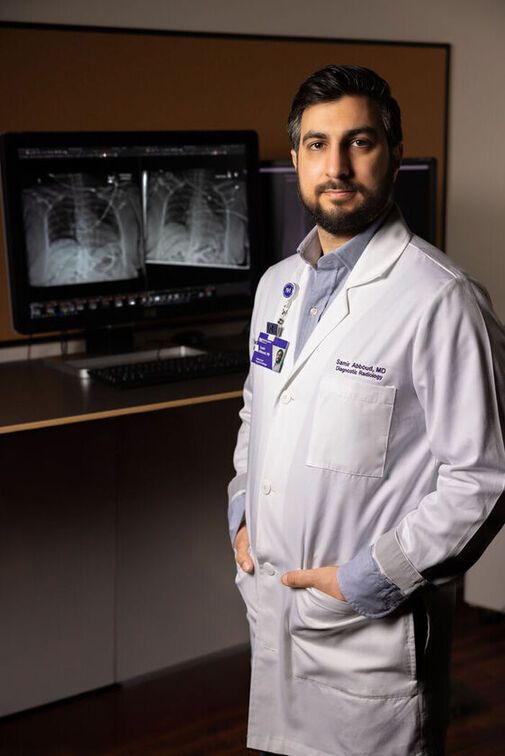
Dr. Abboud in the radiology reading room.
(Source: José M. Osorio/Northwestern Medicine)
Chicago/USA – A first-of-its-kind generative AI system, developed in-house at Northwestern Medicine, is revolutionizing radiology — boosting productivity, identifying life-threatening conditions in milliseconds and offering a breakthrough solution to the global radiologist shortage, a large new study finds.
The study was published on June 5 in Jama Network Open.
“This is, to my knowledge, the first use of AI that demonstrably improves productivity, especially in health care. Even in other fields, I haven’t seen anything close to a 40 % boost,” said senior author Dr. Mozziyar Etemadi, an assistant professor of anesthesiology at Northwestern University Feinberg School of Medicine and of biomedical engineering at Northwestern’s McCormick School of Engineering.
For the study, the AI system was deployed in real-time across the 11-hospital Northwestern Medicine network, where nearly 24,000 radiology reports were analyzed over a five-month period in 2024. Etemadi’s team then compared radiograph report creation times and clinical accuracy with and without the AI tool.
The results: an average 15.5 % boost in radiograph report completion efficiency — with some radiologists achieving gains as high as 40 % — without compromising accuracy. Follow-on work, still unpublished, shows up to 80 % efficiency gains and enables the tool for CT scans. The time saved allowed radiologists to return diagnoses much faster, particularly in critical cases in which every second counts.
According to the study authors, this is the first generative AI radiology tool in the world to be integrated into a clinical workflow. It also is the first time a generative AI model has demonstrated both high accuracy and increased efficiency across all types of X-rays, from skulls to toes.
‘It doubled our efficiency’
Unlike other narrow AI tools currently on the market that focus on detecting a single condition, Northwestern’s holistic model analyzes the entire X-ray or CT scan. It then automatically generates a report that is 95 % complete and personalized to each patient, in the radiologists’ own reporting style, which the radiologist can choose to use, review and finalize. These reports summarize key findings and offer a template to augment the radiologists’ diagnosis and treatment.
“For me and my colleagues, it’s not an exaggeration to say that it doubled our efficiency. It’s such a tremendous advantage and force multiplier,” said co-author Dr. Samir Abboud, chief of emergency radiology at Northwestern Medicine and clinical assistant professor of radiology at Feinberg.
Flagging life-threatening conditions
In addition to improving efficiency, the AI system flags life-threatening conditions like pneumothorax (collapsed lung) in real time — before a radiologist even looks at the X-rays. As the AI model drafts reports for every image, an automated tool monitors those reports for critical findings and cross-checks them with patient records. If the system identifies a new condition that needs urgent intervention, it could immediately alert radiologists.
“On any given day in the ER, we might have 100 images to review, and we don’t know which one holds a diagnosis that could save a life,” Abboud said. “This technology helps us triage faster — so we catch the most urgent cases sooner and get patients to treatment quicker.”
The Northwestern team also is adapting the AI model to detect potentially missed or delayed diagnoses, such as early-stage lung cancer.
“Having a draft report available, even before it is viewed by the radiologist, offers a simple, actionable datapoint that can be quickly and efficiently acted upon. This is completely different than traditional triage systems, which need to meticulously be trained one by one on each and every diagnosis,” said Etemadi, who also is the clinical director of advanced technologies at Northwestern Medicine’s Information Services department, where his hospital-based engineering team conducted much of the study.
‘No need to rely on tech giants’
Rather than adapting large, internet-trained models like ChatGPT, the Northwestern engineers built their own system from scratch using clinical data from within the Northwestern Medicine network. That allowed the team to create a lightweight, nimble AI model designed specifically for radiology at Northwestern — faster, more accurate and requiring far less computing power.
Date: 08.12.2025
Naturally, we always handle your personal data responsibly. Any personal data we receive from you is processed in accordance with applicable data protection legislation. For detailed information please see our privacy policy.
Consent to the use of data for promotional purposes
I hereby consent to Vogel Communications Group GmbH & Co. KG, Max-Planck-Str. 7-9, 97082 Würzburg including any affiliated companies according to §§ 15 et seq. AktG (hereafter: Vogel Communications Group) using my e-mail address to send editorial newsletters. A list of all affiliated companies can be found here
Newsletter content may include all products and services of any companies mentioned above, including for example specialist journals and books, events and fairs as well as event-related products and services, print and digital media offers and services such as additional (editorial) newsletters, raffles, lead campaigns, market research both online and offline, specialist webportals and e-learning offers. In case my personal telephone number has also been collected, it may be used for offers of aforementioned products, for services of the companies mentioned above, and market research purposes.
Additionally, my consent also includes the processing of my email address and telephone number for data matching for marketing purposes with select advertising partners such as LinkedIn, Google, and Meta. For this, Vogel Communications Group may transmit said data in hashed form to the advertising partners who then use said data to determine whether I am also a member of the mentioned advertising partner portals. Vogel Communications Group uses this feature for the purposes of re-targeting (up-selling, cross-selling, and customer loyalty), generating so-called look-alike audiences for acquisition of new customers, and as basis for exclusion for on-going advertising campaigns. Further information can be found in section “data matching for marketing purposes”.
In case I access protected data on Internet portals of Vogel Communications Group including any affiliated companies according to §§ 15 et seq. AktG, I need to provide further data in order to register for the access to such content. In return for this free access to editorial content, my data may be used in accordance with this consent for the purposes stated here. This does not apply to data matching for marketing purposes.
Right of revocation
I understand that I can revoke my consent at will. My revocation does not change the lawfulness of data processing that was conducted based on my consent leading up to my revocation. One option to declare my revocation is to use the contact form found at https://contact.vogel.de. In case I no longer wish to receive certain newsletters, I have subscribed to, I can also click on the unsubscribe link included at the end of a newsletter. Further information regarding my right of revocation and the implementation of it as well as the consequences of my revocation can be found in the data protection declaration, section editorial newsletter.
“There is no need for health systems to rely on tech giants,” said first author Dr. Jonathan Huang, a third-year medical student at Feinberg who holds a Ph.D. in biomedical engineering from McCormick.
“Our study shows that building custom AI models is well within reach of a typical health system, without reliance on expensive and opaque third-party tools like ChatGPT. We believe that this democratization of access to AI is the key to drive adoption worldwide,” Etemadi added.
Etemadi leads a Bell Labs-style engineering team embedded within the hospital system, which has attracted top talent from big tech and finance.
“My proudest achievement is building such a strong interdisciplinary team that can execute on the health system’s highest priorities,” Etemadi said. “We’re not just pushing health care AI forward — we’re advancing the fundamentals of AI at a fraction of the cost of the big AI labs. This is the start of the DeepSeek moment for health care AI.”
Solving a global shortage
Radiology is becoming one of health care’s biggest bottlenecks. By 2033, the U.S. is expected to experience a shortage of up to 42,000 radiologists, as imaging volumes rise by up to 5 % annually while radiology residency positions increase by just 2 %.
Northwestern’s AI system offers a solution, helping radiologists clear backlogs and deliver results in hours instead of days. And while the technology is powerful, it won’t replace humans.
“You still need a radiologist as the gold standard,” Abboud said. “Medicine changes constantly — new drugs, new devices, new diagnoses — and we have to make sure the AI keeps up. Our role becomes ensuring every interpretation is right for the patient.”
Two patents have been approved for the Northwestern Medicine technology and others are in various stages of the approval process. The tool is in the early stages of commercialization.
The study is titled “Efficiency and Quality of Generative AI–Assisted Radiograph Reporting.”




:quality(80)/p7i.vogel.de/wcms/6b/9a/6b9a2f9d820c458d6518f7d3c0cc990e/0131057985v2.jpeg "The collaboration marks a major step forward in how Dupont scales digital lab workflows, expands access to high-quality experimental data and turns insights into faster, more efficient innovation across its R&D organization. (Source: Dupont )")
:quality(80)/p7i.vogel.de/wcms/ed/07/ed0756a2495cf3591db2f3c23bedd39c/0131055520v2.jpeg "E. coli cultures and other experimental materials used in the study, shown with a 3D-printed model of the engineered phage (extreme left). (Source: National University of Singapore )")
:quality(80)/p7i.vogel.de/wcms/f1/87/f187c86e791dfcf8ecccf615a6a3d054/0131055400v2.jpeg "The new center brings together advanced bioproduction capabilities and hands-on collaboration to help customers accelerate process development and bring transformative therapies to patients faster. (Source: Thermo Fisher Scientific)")
:quality(80)/p7i.vogel.de/wcms/cb/39/cb3902f5777a11e07655ba29d00a0394/0131003637v1.jpeg "Lighting along riverbanks or streams at night disrupts the exchange of energy and nutrients between bodies of water and their adjacent riparian habitats. This can have far-reaching ecological consequences. (Source: RPTU)")
:quality(80)/p7i.vogel.de/wcms/52/2e/522e60883334ab2d806e6038a11e9204/0131030069v3.jpeg "“With Cellcelector, your team moves from single cell → validated clone → production ready line through one tightly integrated, automation driven workflow.” – Dr. Darius Wilson, Head of Product Management, Cell Selection & Retrieval, Sartorius Lab Product & Services (Source: Sartorius)")
:quality(80)/p7i.vogel.de/wcms/06/0e/060e08234d208d1faca16ad0cf582ff3/0131026470v2.jpeg "For enzymatic shearing from fixed cells or tissue – both these detergent-based buffers are ideal for effective fragmentation of nuclear material. (Source: © Kateryna_Kon - stock.adobe.com)")
:quality(80)/p7i.vogel.de/wcms/21/6a/216a1b69d48ac4ef7fe694d4c7791531/0131025888v2.jpeg "Biotech Fluidics has announced the Degasi Integration HFIP – a high-performance online system designed to efficiently degas even the toughest solvents. (Source: Biotech Fluidics )")
:quality(80)/p7i.vogel.de/wcms/4a/8d/4a8d7b8aa03d413a2bbcf34fdf463306/0131025869v2.jpeg "Suitable for reaction temperatures up to 200°C, the Drysyn Vortex is the perfect process development tool to efficiently, and safely, drive three stirrer shafts with one overhead stirrer. (Source: Drysyn Vortex)")
:quality(80)/p7i.vogel.de/wcms/2b/5e/2b5e4798cb0d86b0f29ba4de833c1412/0131003303v1.jpeg "33-month-old acacias in Manaus: ADEs result from the decomposition of organic matter and the use of fire by pre-Columbian populations and continue to be created by present-day peoples
(Source: Tsai Siu Mui/ Cena-USP)")
:quality(80)/p7i.vogel.de/wcms/54/50/5450b302b2cfe1f29c6f3d5c300123ce/0131004604v2.jpeg "Dr. Iván Hernández-Almeida, Science Officer, Past Global Changes, University of Bern
(Source: © Courtesy of Iván Hernández-Almeida)")
:quality(80)/p7i.vogel.de/wcms/f1/71/f1711b934d493949c55d6e9b9ddcffe9/0131003077v1.jpeg "Plastics – rich in carbon and hydrogen – can be converted into a clean energy source, using sunlight. (Source: Adelaide University)")
:quality(80)/p7i.vogel.de/wcms/60/54/6054287023c79b93d166c8b7802f9ad4/0130972957v2.jpeg "Scientists have discovered extensive, ancient and modern deep-sea coral reefs within the Galápagos Marine Reserve – the first of their kind ever to be documented inside the marine protected area since it was established in 1998. (Source: WHOI/NSF)")
:quality(80)/p7i.vogel.de/wcms/f6/a8/f6a8a2ac333baa08d168cc68ac2192c0/0131001826v2.jpeg "University of Oregon researchers find a way to measure the flavor profile of coffee. (Source: free licensed)")
:quality(80)/p7i.vogel.de/wcms/34/ff/34ff3de563d63ac821f789f8ca397070/0130971132v2.jpeg "Mixed nuts on a wooden platter. (Source: Piviso from Pixabay)")
:quality(80)/p7i.vogel.de/wcms/e7/08/e708baaa36f8929e985dfe5baea8bc68/0130734917v2.jpeg "A simple cafeteria menu change can make a measurable difference: replacing one meat-based lunch with a vegetarian option increased vegetarian meal choices by 41 percent in six English workplace canteens, while also reducing calories and greenhouse-gas emissions without hurting sales. (Source: free licensed)")
:quality(80)/p7i.vogel.de/wcms/ea/5a/ea5a5ed15b2c98730c7111bb56b1a7aa/0130612537v1.jpeg "A healthful plant-based diet prioritizes whole grains, fruits, vegetables, vegetable oils, nuts, legumes, tea and coffee. (Source: free licensed)")
:quality(80)/p7i.vogel.de/wcms/33/50/3350efd72f2c620af7c2133ce55c901f/0131086519v2.jpeg "A new Northwestern study examined all 130,267 babies born in Georgia in 2017 and tracked whether their fathers died at any point during the following five years, through 2022. (Source: Unsplash )")
:quality(80)/p7i.vogel.de/wcms/ca/fa/cafafb635ff66815b96824c2f099968a/0131058329v2.jpeg "Clinical trial participant Matthew Husar lived for roughly two years after starting the trial. (Source: Madeline Husar)")
:quality(80)/p7i.vogel.de/wcms/56/d7/56d73ff8d8ffc3ce50e3ff2188b7aada/0131004724v2.jpeg "Among Black players, major cardiac conditions occurred most commonly in those of West African origin (1.6 %), followed by Caribbean origin (0.7 %). (Source: Pixabay)")
:quality(80)/p7i.vogel.de/wcms/87/d5/87d5890059d61e8107148c2039ff9bd8/0131004713v2.jpeg "Using radio waves from a portable device, a reader, the movements of the tags could be recorded and displayed as graphs on a monitor. (Source: Chalmers University of Technology | Mia Halleröd Palmgren)")
:quality(80)/images.vogel.de/vogelonline/bdb/1710600/1710675/original.jpg "Discover how to set yourself up for success when performing balance-based density determination of solids such as jewelry and precious metals. (Mettler Toledo)")
:quality(80)/images.vogel.de/vogelonline/bdb/1682500/1682579/original.jpg "The new XPR Analytical balance redesigned to meet the needs of laboratory technicians of working fast and lean. (Mettler Toledo)")
:quality(80)/images.vogel.de/vogelonline/bdb/1677000/1677080/original.jpg "Enhance your weighing accuracy, comfort and productivity with the redesigned XPR Analytical balance. (Mettler Toledo)")
:fill(fff,0)/p7i.vogel.de/companies/69/b7/69b7f63f311d9/logo-bimos-tif--2-.jpeg "logo-bimos-tif--2- (https://www.bimos.com/de-de/)")
:quality(80)/p7i.vogel.de/wcms/d5/14/d5144a87f3c04019e3338c738a9c02ed/0126611086v1.jpeg "Detectors are created from cutting and polishing specific sizes from the boules. (Source: Mercouri Kanatzidis/Northwestern University)")
:quality(80)/p7i.vogel.de/wcms/7e/d5/7ed5f9a1c0fcecd005e8b614bd453eb2/0130963808v2.jpeg "Study senior author Dr. Mohamed Abazeed demonstrates a prototype AI tool that summarizes cancer pathology reports, shown here in a radiation oncology setting. The tool, developed at Northwestern Medicine, is not yet in clinical use and is undergoing further testing. (Source: Northwestern University)")