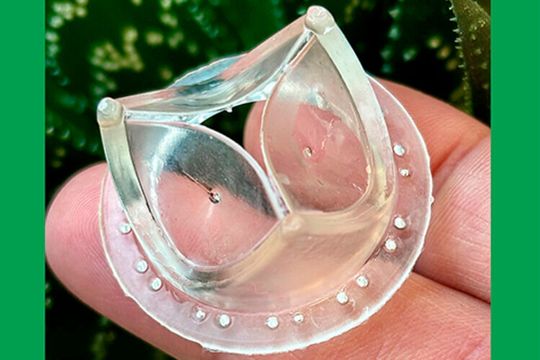
Researchers have claimed that a new artificial heart valve made from the plastic material SEBS is safe to use after they successfully tested the innovative solution for safety for a period of six months.
SEBS polymer artificial heart valve prototype.
(Source: Professor Raimondo Ascione, University of Bristol)
Bristol/UK – The next generation of an artificial heart valve made from a new plastic material could be a step closer to bedside. The research, led by the Universities of Bristol and Cambridge, demonstrated that the polymer material used to make the new artificial heart valve is safe following implant in an animal model for six months.
The study, funded by the British Heart Foundation (BHF) has recently been published in the European Journal of Cardio-Thoracic Surgery.
Currently, patients who need heart valve replacements face trade-offs. Mechanical heart valves are durable but require lifelong blood thinners, while biological (animal tissue) heart valves are more natural but tend to wear out more quickly.
The new kind of artificial heart valve made from a special plastic called SEBS might offer the best of both worlds — but the safety of this new material must be confirmed before they can be tested in humans.
In this new study, researchers tested a research-grade prototype of a new heart valve made entirely from SEBS polymers in a preclinical cardiac surgery model that mimicked how these valves might perform in humans. The team implanted the prototype polymeric artificial heart valve in seven sheep, which was carried out by an independent preclinical facility in Paris, France.
The animals, and their wellbeing, were then monitored over six months, to examine potential long-term safety issues associated with the plastic material such as mineral build up (calcification), material dissolving, blood clots, damage of the heart tissue in contact with the material, cancer, cell death, liver or kidney failure, nutrition and weight and other issues as determined by the regulator.
The research found after six months there was no evidence of harmful calcification (mineral buildup) or material deterioration; blood clotting or signs of cell toxicity. Animal health, wellbeing, blood test results and weight gain overtime were all stable and normal, and the prototype heart valve functioned well throughout the testing period, with no need for blood thinners.
Raimondo Ascione, NHS Adult Cardiac Surgeon, Professor of Cardiac Surgery and Translational Research and Director of the Translational Biomedical Research Centre (TBRC) at the University of Bristol, clinical lead on the project and corresponding author, said: “Currently 1.5 million patients around the world require heart valve replacements every year. More than 35 million patients’ heart valves are permanently damaged by rheumatic fever and with an ageing population this figure is predicted to increase four to five times by 2050.
“Our findings could mark the beginning of a new era in artificial heart valve being made from the new plastic material — one that may offer safer, more durable and more patient-friendly options for patients of all ages, with fewer compromises.”
Geoff Moggridge, Professor of Chemical Engineering Science at the university of Cambridge and biomaterial lead on the project said: “We are pleased that the new plastic material has been shown to be safe after 6 months of testing in-vivo.
“Confirming the safety of the material has been an essential and reassuring step for us, and a green light to progress the new heart valve replacement toward bedside testing.”
The researchers early bench results suggest that their artificial heart valves made from SEBS could feature excellent durability and hemo-compatible i.e. without the need for lifelong blood thinners.
While this is still early-stage research and limitations of the small sample size, the findings are a major hurdle toward future human testing. The next step will be to develop a clinical-grade version of the SEBS polymer heart valve and test it in a larger preclinical trial before seeking approval for a pilot human clinical trial.
Paper: ‘Material safety of styrene-block-ethylene/butylene-block-styrene copolymers used for cardiac valves: 6-month in-vivo results from a juvenile sheep model’ by Raimondo Ascione, Joanna R Stasiak, Daniel Baz-Lopez, Marta Serrani, Geoff Moggridge in the European Journal of Cardio-Thoracic Surgery.
Date: 08.12.2025
Naturally, we always handle your personal data responsibly. Any personal data we receive from you is processed in accordance with applicable data protection legislation. For detailed information please see our privacy policy.
Consent to the use of data for promotional purposes
I hereby consent to Vogel Communications Group GmbH & Co. KG, Max-Planck-Str. 7-9, 97082 Würzburg including any affiliated companies according to §§ 15 et seq. AktG (hereafter: Vogel Communications Group) using my e-mail address to send editorial newsletters. A list of all affiliated companies can be found here
Newsletter content may include all products and services of any companies mentioned above, including for example specialist journals and books, events and fairs as well as event-related products and services, print and digital media offers and services such as additional (editorial) newsletters, raffles, lead campaigns, market research both online and offline, specialist webportals and e-learning offers. In case my personal telephone number has also been collected, it may be used for offers of aforementioned products, for services of the companies mentioned above, and market research purposes.
Additionally, my consent also includes the processing of my email address and telephone number for data matching for marketing purposes with select advertising partners such as LinkedIn, Google, and Meta. For this, Vogel Communications Group may transmit said data in hashed form to the advertising partners who then use said data to determine whether I am also a member of the mentioned advertising partner portals. Vogel Communications Group uses this feature for the purposes of re-targeting (up-selling, cross-selling, and customer loyalty), generating so-called look-alike audiences for acquisition of new customers, and as basis for exclusion for on-going advertising campaigns. Further information can be found in section “data matching for marketing purposes”.
In case I access protected data on Internet portals of Vogel Communications Group including any affiliated companies according to §§ 15 et seq. AktG, I need to provide further data in order to register for the access to such content. In return for this free access to editorial content, my data may be used in accordance with this consent for the purposes stated here. This does not apply to data matching for marketing purposes.
Right of revocation
I understand that I can revoke my consent at will. My revocation does not change the lawfulness of data processing that was conducted based on my consent leading up to my revocation. One option to declare my revocation is to use the contact form found at https://contact.vogel.de. In case I no longer wish to receive certain newsletters, I have subscribed to, I can also click on the unsubscribe link included at the end of a newsletter. Further information regarding my right of revocation and the implementation of it as well as the consequences of my revocation can be found in the data protection declaration, section editorial newsletter.




:quality(80)/p7i.vogel.de/wcms/65/88/658810e8f70ddd88a4dc014f211630a6/0132611511v2.jpeg "In regulated cleanrooms, control is important, but being able to demonstrate control is equally important. (Source: Vaisala)")
:quality(80)/p7i.vogel.de/wcms/87/99/87991d857ac02b67176f4c88015a4d57/0132611186v2.jpeg "Supercritical fluid extraction is an area of growing interest and CO2 is the most common supercritical fluid used in SFE procedures as a replacement for traditional hexane use. (Source: Scimed)")
:quality(80)/p7i.vogel.de/wcms/7a/1c/7a1cac56bca0dde5268e4ede1c762741/0132539982v2.jpeg "The flexible material can be customized to act like different kinds of tissue. (Source: University of Texas at Austin)")
:quality(80)/p7i.vogel.de/wcms/ed/ff/edff58efa9930f672f2e50a63e65562f/0132477775v1.jpeg "Contemporary languages and endangerment status. Made with a Natural Earth base map using data from Glottolog 5.3 and information adapted from Glottoscope. (Source: Claire Bowern)")
:quality(80)/p7i.vogel.de/wcms/13/d3/13d35105f74a1c2e22b9c7a270e8e9b3/0132611155v2.jpeg "Circulating cell free DNA. (Source: Amsbio)")
:quality(80)/p7i.vogel.de/wcms/bc/ed/bced6850297a04dbea471a66cb6bb6fe/0132611405v2.jpeg "The latest addition to the range is a peristaltic tubing stop adapter that eliminates the need for fixed stoppers and allows custom cut lengths of peristaltic tubing to be installed on any pump head size. (Source: Biotech Fluidics )")
:quality(80)/p7i.vogel.de/wcms/c2/34/c234a6626d4f6360382ca7f1f440bebb/0132611196v2.jpeg "Testa Analytical's Trinity – a powerful new triple detector for Gel Permeation Chromatography / Size Exclusion Chromatography. (Source: Testa Analytical)")
:quality(80)/p7i.vogel.de/wcms/5b/3f/5b3fc0d5fb08c1f9727125bd926b1481/0132555049v1.jpeg "On 1 and 2 December 2026, the T3 – Transform The Tomorrow conference will explore strategies that help companies future-proof their operations. (Bild: © Vogel Corporate Solutions / AdobeStock 1280236166, Oksana)")
:quality(80)/p7i.vogel.de/wcms/06/1a/061a5d3a4e85383454d9450761a67de7/0132611653v2.jpeg "Shihong Lin, associate professor of civil and environmental engineering at Rice. (Source: Alex Becker/ Rice University)")
:quality(80)/p7i.vogel.de/wcms/c4/f5/c4f55f42fdf878aec3f850e5569b84ce/0132594173v2.jpeg "The latest research sheds some light on an issue that deserves more attention, that of climate-related suicide. (Source: Unsplash)")
:quality(80)/p7i.vogel.de/wcms/22/b8/22b8fa1a4146bc06c4c15d63992ebb88/0132589504v2.jpeg "Hepa filters are known to improve air quality and clean the air of microbes in laboratory settings, but this is the largest ‘real-world’ study to date to test if they reduce infections in care homes. (Source: Unsplash)")
:quality(80)/p7i.vogel.de/wcms/31/c1/31c1b666641702292624a4e8ca799a09/0132480890v1.jpeg "Decades of PFAS-laced sewage sludge, once spread on farms as fertilizer, have left millions of acres of American cropland contaminated with “forever chemicals”. (Source: frei lizenziert)")
:quality(80)/p7i.vogel.de/wcms/28/b6/28b6114fc9915c5dadee94d5c89bd129/0132593216v2.jpeg "Eating foods that contain common preservative food additives may increase the risks of high blood pressure and cardiovascular disease. (Source: Unsplash)")
:quality(80)/p7i.vogel.de/wcms/01/bc/01bcb16a3381a1d46533861eedbbae71/0132371290v1.jpeg "Adding spice may help people eat less by slowing them down. (Source: free licensed)")
:quality(80)/p7i.vogel.de/wcms/b3/16/b316ac585e067d024da89a5156c950a9/0132370983v1.jpeg "Laboratory tests suggest that some low-calorie sweeteners can alter the growth of gut bacteria, with particularly strong effects observed when isosteviol was combined with the antidepressant duloxetine. (Source: free licensed)")
:quality(80)/p7i.vogel.de/wcms/22/50/2250f9358ba65ad3c4de05ff5ea9f74e/0132117868v1.jpeg "Japanese researchers have developed a naturally bred yeast that produces nine times more ornithine while retaining normal brewing performance, opening a route to craft beer with added fermentation value. (Source: free licensed)")
:quality(80)/p7i.vogel.de/wcms/bb/f9/bbf9cc2b059213fd10c280304a51b143/0132611525v2.jpeg "Nanoact colored cellulose nanobeads were developed by Asahi Kasei by utilizing its core technology of cellulose processing. (Source: Asahi Kasei)")
:quality(80)/p7i.vogel.de/wcms/fc/90/fc9085d5ad403446c67cd4d586f4a0d6/0132611789v2.jpeg "Metastatic BAP1-deficient melanoma is the most common intraocular malignancy in adults, but it remains rare and extremely difficult to treat once it spreads. (Source: Turun yliopisto/University of Turku)")
:quality(80)/p7i.vogel.de/wcms/32/97/32977422ebe164ada6f807d16e410900/0132611708v2.jpeg "Ground sloths, which could reach the size of small elephants, originated in South America and spread into North America via the Panamanian land bridge. (Source: Natural History Museum of Los Angeles County)")
:quality(80)/p7i.vogel.de/wcms/96/6f/966f8a0a2b0c36f08622a4c5c3abb54f/0132611669v1.jpeg "A larkspur specimen in bloom at Beal Botanical Garden. Known for their toxicity, injurious plants such as larkspur and wolfsbane have been leveraged by humans for millennia for their medicinal potential. (Source: Finn Gomez/ Paul Henderson)")
:quality(80)/images.vogel.de/vogelonline/bdb/1710600/1710675/original.jpg "Discover how to set yourself up for success when performing balance-based density determination of solids such as jewelry and precious metals. (Mettler Toledo)")
:quality(80)/images.vogel.de/vogelonline/bdb/1682500/1682579/original.jpg "The new XPR Analytical balance redesigned to meet the needs of laboratory technicians of working fast and lean. (Mettler Toledo)")
:quality(80)/images.vogel.de/vogelonline/bdb/1677000/1677080/original.jpg "Enhance your weighing accuracy, comfort and productivity with the redesigned XPR Analytical balance. (Mettler Toledo)")
:fill(fff,0)/p7i.vogel.de/companies/69/b7/69b7f63f311d9/logo-bimos-tif--2-.jpeg "logo-bimos-tif--2- (https://www.bimos.com/de-de/)")
:quality(80)/p7i.vogel.de/wcms/f1/d0/f1d0dcef2c9b6ea00f163b55375593ec/0131588075v2.jpeg "The Cardiocare Consortium is focusing on a previously neglected and vulnerable group of patients – women over 65 with breast cancer at risk of cardiotoxicity from cancer treatment. (Source: Benjamin Brunner on Unsplash)")
:quality(80)/p7i.vogel.de/wcms/67/8b/678b79535fb1770795dc7cbb3b241b08/0128057804v2.jpeg "Biotech Fluidics valving solutions offer low swept volume and eliminate reagent carryover concerns. (Source: Biotech Fluidics)")