A controlled study shows that exposure to natural daylight — without changing diet, sleep or activity — helps people with type 2 diabetes stabilise blood glucose levels, highlighting light as a powerful and overlooked factor in metabolic health.
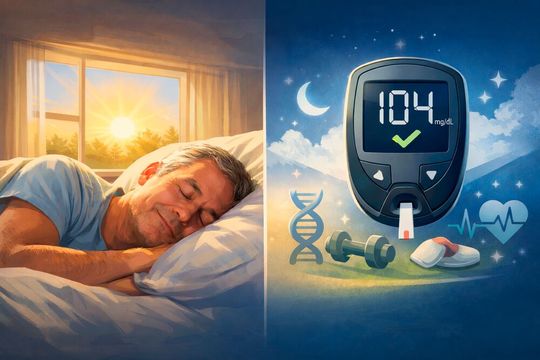
Exposure to daylight helps synchronise the body clock during sleep — and may improve blood glucose control and metabolic health in people with type 2 diabetes.
(Source: AI-generated (OpenAI / DALL·E))
Metabolic diseases have reached epidemic proportions in our society, driven by a sedentary lifestyle coupled with circadian misalignment — a desynchrony between our intrinsic biological clocks and environmental signals. Furthermore, we spend almost 90 % of our time indoors, with a very limited exposure to natural daylight. To investigate the specific role of daylight in human metabolism, particularly in glycaemic control, researchers from the University of Geneva (Unige), the University Hospitals of Geneva (HUG), Maastricht University, and the German Diabetes Center (DDZ) conducted a controlled study with thirteen volunteers with type 2 diabetes. When exposed to natural light, participants exhibited more stable blood glucose levels and an overall improvement in their metabolic profile. These results, published in the journal Cell Metabolism, provide the first evidence of the beneficial impact of natural light on people with type 2 diabetes.
As in all living beings, human physiological processes are subject to the influence of the circadian rhythm governed by the alternation of day and night. This is controlled by a central clock in the brain, which synchronises the clocks in peripheral organs such as the liver and skeletal muscles.
“It has been known for several years that the disruption of circadian rhythms plays a major role in the development of metabolic disorders that affect an increasing proportion of the Western population,” notes Charna Dibner, associate professor at the Unige Faculty of Medicine and at HUG, who co-directed this work with Joris Hoeks, associate professor at Maastricht University, and Patrick Schrauwen, professor at the DDZ.
“We largely spend our days under artificial lighting, which has a lower light intensity and a narrower wavelength spectrum than natural light. Natural light is also more effective in synchronizing the biological clock with the environment. Could the lack of natural light be to blame for metabolic diseases such as type 2 diabetes?” adds Joris Hoeks.
Key Results
Better glucose control: Participants exposed to natural daylight spent more hours per day within a normal blood-glucose range and showed lower glucose variability than under artificial light.
Rapid metabolic effects: Measurable improvements in metabolism were observed after just 4.5 days of daylight exposure.
Improved circadian alignment: Natural light more effectively synchronised the body’s central clock with peripheral clocks in organs such as skeletal muscle.
Hormonal and metabolic benefits: Daylight exposure led to slightly higher evening melatonin levels and enhanced fat oxidative metabolism.
Light as the key factor: All other lifestyle parameters (meals, sleep, activity, screen time) were kept identical, isolating light exposure as the driver of the effects.
First human evidence in diabetes: The controlled cross-over study provides the first direct evidence that natural daylight can improve metabolic health in people with type 2 diabetes.
A Look Into Body Clocks
The research team recruited 13 volunteers aged 65 and over, all with type 2 diabetes. They spent 4.5 days in specially designed living spaces at Maastricht University, lit either with natural light through large windows or with artificial light. After a break of at least four weeks, they returned for a second session, this time in the other light environment.
“This experimental model allows us to examine the same people under both conditions, which limits the individual variability in our results,” explains Joris Hoeks. “Apart from the light source, all the other lifestyle parameters — meals, sleep, physical activity, screen time, etc. — were kept strictly identical.”
Surprisingly, even over the short duration of the experiment, a significant impact was noted: in people exposed to natural light, blood glucose levels were in the normal range for more hours per day, with less variability. “Two important elements that indicate that our volunteers with diabetes managed to control their sugar levels better,” says Patrick Schrauwen from DDZ. “In addition, their melatonin level was a little higher in the evening, and fat oxidative metabolism was also improved.”
To better understand the observed positive changes in the body’s metabolism, the scientists took blood and muscle samples from the volunteers before, during, and after each light treatment. “We analysed the regulation of molecular clocks in cultured skeletal muscle cells together with lipids, metabolites, and gene transcripts in the blood. Together, the results clearly show that the internal clock and metabolism are influenced by natural light. This could be the reason for the improved blood sugar regulation and the improved coordination between the central clock in the brain and the clocks in the organs,” explains Charna Dibner.
Date: 08.12.2025
Naturally, we always handle your personal data responsibly. Any personal data we receive from you is processed in accordance with applicable data protection legislation. For detailed information please see our privacy policy.
Consent to the use of data for promotional purposes
I hereby consent to Vogel Communications Group GmbH & Co. KG, Max-Planck-Str. 7-9, 97082 Würzburg including any affiliated companies according to §§ 15 et seq. AktG (hereafter: Vogel Communications Group) using my e-mail address to send editorial newsletters. A list of all affiliated companies can be found here
Newsletter content may include all products and services of any companies mentioned above, including for example specialist journals and books, events and fairs as well as event-related products and services, print and digital media offers and services such as additional (editorial) newsletters, raffles, lead campaigns, market research both online and offline, specialist webportals and e-learning offers. In case my personal telephone number has also been collected, it may be used for offers of aforementioned products, for services of the companies mentioned above, and market research purposes.
Additionally, my consent also includes the processing of my email address and telephone number for data matching for marketing purposes with select advertising partners such as LinkedIn, Google, and Meta. For this, Vogel Communications Group may transmit said data in hashed form to the advertising partners who then use said data to determine whether I am also a member of the mentioned advertising partner portals. Vogel Communications Group uses this feature for the purposes of re-targeting (up-selling, cross-selling, and customer loyalty), generating so-called look-alike audiences for acquisition of new customers, and as basis for exclusion for on-going advertising campaigns. Further information can be found in section “data matching for marketing purposes”.
In case I access protected data on Internet portals of Vogel Communications Group including any affiliated companies according to §§ 15 et seq. AktG, I need to provide further data in order to register for the access to such content. In return for this free access to editorial content, my data may be used in accordance with this consent for the purposes stated here. This does not apply to data matching for marketing purposes.
Right of revocation
I understand that I can revoke my consent at will. My revocation does not change the lawfulness of data processing that was conducted based on my consent leading up to my revocation. One option to declare my revocation is to use the contact form found at https://contact.vogel.de. In case I no longer wish to receive certain newsletters, I have subscribed to, I can also click on the unsubscribe link included at the end of a newsletter. Further information regarding my right of revocation and the implementation of it as well as the consequences of my revocation can be found in the data protection declaration, section editorial newsletter.
Results Should Be Confirmed in Real-Life Conditions
This study — a world first controlled cross-over study — only involved a small cohort of older people with type 2 diabetes over a short period of time. Nevertheless, it is the first evidence of the beneficial effect of natural daylight on metabolic health as compared to artificial light to which we tend to be exposed most of the time. “The next step will be to study the interactions between exposure to natural light and metabolic health in real-life conditions, by equipping volunteers with light detectors and glucose measurement tools for several weeks,” say Jan-Frieder Harmsen, lead author of the study, former PhD fellow in Hoeks’ research group and currently a post-doctoral researcher at RWTH Aachen University, Germany. "This study also highlights the often-overlooked impact of building architecture on our health.”
Original Article: Natural daylight during office hours improves glucose control and whole-body substrate metabolism; Cell Metabolism; DOI:10.1016/j.cmet.2025.11.006




:quality(80)/p7i.vogel.de/wcms/aa/39/aa398d3e6667bdb43ad57abf38dc394c/0129347450v2.jpeg "An illustration shows a strand of engineered DNA passing through a nanoscale sensor, where its physical structure can be decoded as digital information. DNA nanostructures could one day serve as ultra-dense carriers of digital information and advance the field of data encryption. (Source: Jason Drees/ ASU)")
:quality(80)/p7i.vogel.de/wcms/06/a1/06a11f1d752afb35854aa9e1afb62e98/0129209625v2.jpeg "“Unsinkable\" metal tube made from chemically-etched aluminum floats in distilled water at the lab of University of Rochester professor Chunlei Guo. (Source: J. Adam Fenster / University of Rochester)")
:quality(80)/p7i.vogel.de/wcms/6d/df/6ddf023361ec7f8fbfb6c56521577960/0129056554v2.jpeg "The evolution of carburization (depicted by the spheres) under kinetic control (illustrated by the surface contours). The molecular beams represent gas evolution under synthesis conditions while the fiery sphere highlights the formation of the pure tungsten semi-carbide phase with additional molecular beams at the top to illustrate its catalytic performance. (Source: Sinhara M. H. D. Perera)")
:quality(80)/p7i.vogel.de/wcms/26/3d/263d97f8f2797267ecf2781b56882758/0129056451v1.jpeg "A study by the Complexity Science Hub finds that AI systems are already involved in nearly one-third of newly written software code, with rapid adoption in the United States and Europe and measurable productivity gains mainly for experienced developers. (Source: free licensed)")
:quality(80)/p7i.vogel.de/wcms/83/90/839049b296905df2a07deb4e867ff2cb/0129594701v2.jpeg "The full device next to a quarter for scale. (Source: John A. Rogers/Northwestern University)")
:quality(80)/p7i.vogel.de/wcms/21/03/21030cc2541c455da0769decca8d1f82/0129146048v2.jpeg "Vyon porous plastics from Porvair Sciences are the perfect material for filtration applications in the healthcare and medical device market. (Source: Porvair Sciences)")
:quality(80)/p7i.vogel.de/wcms/bd/aa/bdaae5b9d381e2471ab37f479ad43d79/0129143884v2.jpeg "The Solvent Line Monitor from Testa Analytical is a true plug-and-play addition to any HPLC system designed to detect when one or more of its pump solvent reservoirs are empty and automatically shut-off the system. (Source: Testa Analytical)")
:quality(80)/p7i.vogel.de/wcms/8f/66/8f66b8acbb3037ca8e6b320bcad1c817/0129118043v2.jpeg "The Plasmaquant 9200 series is ideal for applications in research, trace analysis and quality control. (Source: Analytik Jena )")
:quality(80)/p7i.vogel.de/wcms/c7/29/c7290f13d2a2defd81b8c0410057e157/0129647027v1.jpeg "Air pollution contributes to Alzheimer’s disease mostly through direct pathways rather than through other chronic health conditions, the study found. (Source: free licensed)")
:quality(80)/p7i.vogel.de/wcms/e4/90/e490504339150fd28bdffc2c062df8a9/0129646170v2.jpeg "“Note the clear nunatak at the mid-right of the glacier,” said Convey. “This is named 'Manhaul Rock' and, when I was first on Signy in 1989-91, it was literally a small rock poking through the ice surface that you could walk/ski/drive a skidoo up to.” (Source: Prof Peter Convey)")
:quality(80)/p7i.vogel.de/wcms/c8/ad/c8ada88a48bc380a87b17fb820ca4721/0129504248v2.jpeg "A young star surrounded by a disk of gas and dust. New planets can form from this material. Whether they have the chemical conditions necessary for life depends on the correct oxygen content during core formation. (Source: Nasa-JPL)")
:quality(80)/p7i.vogel.de/wcms/1a/4f/1a4fe7f8b5541716ba908251738beca1/0129349759v2.jpeg "Krict’s Syngas-to-Sustainable Aviation Fuel (SAF) Conversion Facility (Source: Korea Research Institute of Chemical Technology (Krict))")
:quality(80)/p7i.vogel.de/wcms/84/2c/842c7c1678ceeec7147ea3a36e238e75/0129356324v2.jpeg "Kaust and Nadec have signed a MOU that establishes a framework for long-term cooperation across agricultural research, technology development, and professional training. (Source: Kaust )")
:quality(80)/p7i.vogel.de/wcms/d1/3c/d13c2ad34af600dbd360c0bb0990b922/0129045715v2.jpeg "Replacing animal products with plant-based foods helps reduce the risk of heart disease and type 2 diabetes, finds a new review by the Physicians Committee for Responsible Medicine. (Source: Pixabay)")
:quality(80)/p7i.vogel.de/wcms/e1/b3/e1b3e26d03101ba93b76b304da150c9a/0129025388v2.jpeg "The research reanalyzed data from a seminal clinical trial, led by US National Institutes of Health veteran Dr Kevin Hall, which first exposed how eating exclusively UPFs results in excessive calorie consumption and weight gain. (Source: Pixabay)")
:quality(80)/p7i.vogel.de/wcms/75/db/75db8afe45607bee750df705e22b60e9/0128938816v1.jpeg "A new academic review suggests that bamboo shoots could offer significant health benefits, including improved blood sugar control, gut health and antioxidant activity. (Source: free licensed)")
:quality(80)/p7i.vogel.de/wcms/5c/58/5c58f24c61b1227b6c98fcf475ea1e03/0129749456v2.jpeg "A new study provides evidence for the first time that skin temperature plays a central role in controlling brain states. (Source: Pixabay)")
:quality(80)/p7i.vogel.de/wcms/67/c6/67c6b723fbf11c00c61817beab67bf88/0129690126v2.jpeg "An increase in the number of percutaneous coronary interventions does not appear to have resulted in reduced mortality rates, according to results presented at the EAPCI Summit 2026. (Source: Pixabay)")
:quality(80)/p7i.vogel.de/wcms/0b/57/0b5755d34e4fe9ab2a8bdc624986c23c/0129647454v1.jpeg "Each bee has its own preferred route and flies it very precisely. (Source: free licensed)")
:quality(80)/p7i.vogel.de/wcms/29/68/2968df8f28e01313b209d7988dd340cd/0129647462v2.jpeg "Stronger muscle strength in women over 60 was linked to significantly lower mortality over eight years, according to a large study published in JAMA Network Open. (Source: free licensed)")
:quality(80)/images.vogel.de/vogelonline/bdb/1710600/1710675/original.jpg "Discover how to set yourself up for success when performing balance-based density determination of solids such as jewelry and precious metals. (Mettler Toledo)")
:quality(80)/images.vogel.de/vogelonline/bdb/1682500/1682579/original.jpg "The new XPR Analytical balance redesigned to meet the needs of laboratory technicians of working fast and lean. (Mettler Toledo)")
:quality(80)/images.vogel.de/vogelonline/bdb/1677000/1677080/original.jpg "Enhance your weighing accuracy, comfort and productivity with the redesigned XPR Analytical balance. (Mettler Toledo)")
:quality(80)/p7i.vogel.de/wcms/2a/4d/2a4d0738b3687176a46424d0fa696a7c/0123156465v2.jpeg "The study found that adolescents whose weight was classified as overweight or obese consumed more calories later in the day compared to participants with healthy weights. (Source: Pixabay)")
:quality(80)/p7i.vogel.de/wcms/2a/0f/2a0fad9f59ea5aa4e9cac4c0a9969dee/0123635628v2.jpeg "The body’s internal clock doesn’t just dictate when we sleep — it also determines how quickly our muscles heal. (Source: Pixabay)")
:quality(80)/p7i.vogel.de/wcms/0c/47/0c47be32d4cdf24632d421f268124a63/0129534877v2.jpeg "Given the nearly 90 % adherence rate in the study, the study’s novel approach of leveraging the sleep period as an anchor for the timing of time-restricted eating may be a more accessible non-pharmacological strategy for improving cardiometabolic health. (Source: Pixabay)")