Scientists have unveiled a groundbreaking nanopore-based tool capable of diagnosing diseases faster and more precisely than ever before — using signals from individual molecules. This revolutionary device could detect infections within 48 hours and distinguish subtle differences in proteins, paving the way for earlier interventions, personalized medicine, and advances in molecular research.
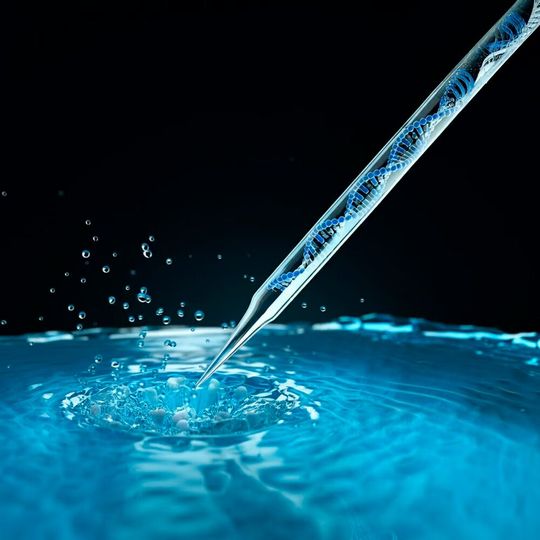
The sensor, a glass tube that is melted at the tip to form a sharp needle-like structure, is dipped into a fluid containing molecules.
(Source: Kevin Freedman/ Image FX/ UCR)
UC Riverside scientists have developed a nanopore-based tool that could help diagnose illnesses much faster and with greater precision than current tests allow, by capturing signals from individual molecules. Since the molecules scientists want to detect — generally certain DNA or protein molecules — are roughly one-billionth of a meter wide, the electrical signals they produce are very small and require specialized detection instruments.
“Right now, you need millions of molecules to detect diseases. We’re showing that it’s possible to get useful data from just a single molecule,” said Kevin Freedman, assistant professor of bioengineering at UCR and lead author of a paper about the tool in Nature Nanotechnology. “This level of sensitivity could make a real difference in disease diagnostics.”
Freedman’s lab aims to build electronic detectors that behave like neurons in the brain and can retain memories: specifically, memories of which molecules previously passed through the sensor. To do this, the UCR scientists developed a new circuit model that accounts for small changes to the sensor’s behavior.
At the core of their circuit is a nanopore — a tiny opening through which molecules pass one at a time. Biological samples are loaded into the circuit along with salts, which dissociate into ions.
If protein or DNA molecules from the sample pass through the pore, this reduces the flow of ions that can pass. “Our detector measures the reduction in flow caused by a protein or bit of DNA passing through and blocking the passage of ions,” Freedman said.
To analyze the electrical signals generated by the ions, Freedman suggests, the system needs to account for the likelihood that some molecules may not be detected as they pass through the nanopore.
What distinguishes this discovery is that the nanopore is not just a sensor but itself acts as a filter, reducing background noise from other molecules in a sample that could obscure critical signals.
Traditional sensors require external filters to remove unwanted signals, and these filters can accidentally remove valuable information from the samples. Freedman’s approach ensures that each molecule’s signal is preserved, boosting accuracy for diagnostic applications.
Freedman envisions the device being used to develop a small, portable diagnostic kit — no larger than a USB drive — that could detect infections in the earliest stages. While today’s tests may not register infections for several days after exposure, nanopore sensors could detect infections within 24 to 48 hours. This capability would provide a significant advantage for fast-spreading diseases, enabling earlier intervention and treatment.
“Nanopores offer a way to catch infections sooner — before symptoms appear and before the disease spreads,” Freedman said. “This kind of tool could make early diagnosis much more practical for both viral infections and chronic conditions.”
In addition to diagnostics, the device holds promise for advancing protein research. Proteins perform essential roles in cells, and even slight changes in their structure can affect health. Current diagnostic tools struggle to tell the difference between healthy and disease-causing proteins because of their similarities. The nanopore device, however, can measure subtle differences between individual proteins, which could help doctors design more personalized treatments.
The research also brings scientists closer to achieving single molecule protein sequencing, a long-sought goal in biology. While DNA sequencing reveals genetic instructions, protein sequencing provides insight into how those instructions are expressed and modified in real time. This deeper understanding could lead to earlier detection of diseases and more precise therapies tailored to each patient.
“There’s a lot of momentum toward developing protein sequencing because it will give us insights we can’t get from DNA alone,” Freedman said. “Nanopores allow us to study proteins in ways that weren’t possible before.”
Nanopores are the focus of a funded research grant that Freedman was awarded by the National Human Genome Research Institute in which his team will attempt to sequence single proteins. This work builds on Freedman’s previous research on refining the use of nanopores for sensing molecules, viruses, and other nanoscale entities. He sees these advances as a sign of how molecular diagnostics and biological research may shift in the future.
Date: 08.12.2025
Naturally, we always handle your personal data responsibly. Any personal data we receive from you is processed in accordance with applicable data protection legislation. For detailed information please see our privacy policy.
Consent to the use of data for promotional purposes
I hereby consent to Vogel Communications Group GmbH & Co. KG, Max-Planck-Str. 7-9, 97082 Würzburg including any affiliated companies according to §§ 15 et seq. AktG (hereafter: Vogel Communications Group) using my e-mail address to send editorial newsletters. A list of all affiliated companies can be found here
Newsletter content may include all products and services of any companies mentioned above, including for example specialist journals and books, events and fairs as well as event-related products and services, print and digital media offers and services such as additional (editorial) newsletters, raffles, lead campaigns, market research both online and offline, specialist webportals and e-learning offers. In case my personal telephone number has also been collected, it may be used for offers of aforementioned products, for services of the companies mentioned above, and market research purposes.
Additionally, my consent also includes the processing of my email address and telephone number for data matching for marketing purposes with select advertising partners such as LinkedIn, Google, and Meta. For this, Vogel Communications Group may transmit said data in hashed form to the advertising partners who then use said data to determine whether I am also a member of the mentioned advertising partner portals. Vogel Communications Group uses this feature for the purposes of re-targeting (up-selling, cross-selling, and customer loyalty), generating so-called look-alike audiences for acquisition of new customers, and as basis for exclusion for on-going advertising campaigns. Further information can be found in section “data matching for marketing purposes”.
In case I access protected data on Internet portals of Vogel Communications Group including any affiliated companies according to §§ 15 et seq. AktG, I need to provide further data in order to register for the access to such content. In return for this free access to editorial content, my data may be used in accordance with this consent for the purposes stated here. This does not apply to data matching for marketing purposes.
Right of revocation
I understand that I can revoke my consent at will. My revocation does not change the lawfulness of data processing that was conducted based on my consent leading up to my revocation. One option to declare my revocation is to use the contact form found at https://contact.vogel.de. In case I no longer wish to receive certain newsletters, I have subscribed to, I can also click on the unsubscribe link included at the end of a newsletter. Further information regarding my right of revocation and the implementation of it as well as the consequences of my revocation can be found in the data protection declaration, section editorial newsletter.
“There’s still a lot to learn about the molecules driving health and disease,” Freedman said. “This tool moves us one step closer to personalized medicine.”
Freedman expects that nanopore technology will soon become a standard feature in both research and healthcare tools. As the devices become more affordable and accessible, they could find a place in everyday diagnostic kits used at home or in clinics.
“I’m confident that nanopores will become part of everyday life,” Freedman said. “This discovery could change how we’ll use them moving forward.”
Original Article: Negative memory capacitance and ionic filtering effects in asymmetric nanopores; Nature Nanotechnology; DOI:10.1038/s41565-024-01829-5




:quality(80)/p7i.vogel.de/wcms/fd/73/fd73fcb3ceda89d1419de1083fcab7b4/0130081520v2.jpeg "The fingers at the heart of this technology were inspired by the fin-ray effect — a design principle derived from the natural structure of fish fins. (Source: University of Texas at Austin )")
:quality(80)/p7i.vogel.de/wcms/fe/64/fe649767c802d53ac63ee2c2a40b7e0d/0130060830v2.jpeg "Sample tube with light-active substance (Source: Elvira Eberhardt / Ulm University)")
:quality(80)/p7i.vogel.de/wcms/db/e2/dbe2ae4e02f702b30153a882ef705089/0129978032v1.jpeg "Each of the isolated indium atoms (in gold color) can catalyse the synthesis of methanol (top right). (Source: Constance Ko/ ETH Zurich)")
:quality(80)/p7i.vogel.de/wcms/c1/e6/c1e6ac26eb18993236c100e7f01a78f2/0129937639v1.jpeg "Dogs evolved from highly social ancestors and have been shaped by thousands of years of interacting with humans. (Source: free licensed)")
:quality(80)/p7i.vogel.de/wcms/8f/b9/8fb98a958e4afe679865fbe52a473680/0129940982v2.jpeg "pH measurement in various nanoparticles using the Nine-Focus meter ensures precise stability and performance control. (Source: Mettler Toledo)")
:quality(80)/p7i.vogel.de/wcms/11/74/1174e5d4c8b07a64637dced8c9506b40/0129787561v2.jpeg "The Multicell Plus high-pressure reactor sets a new benchmark for operator safety, all-round accessibility and ease-of-use. (Source: Asynt)")
:quality(80)/p7i.vogel.de/wcms/ef/6e/ef6e96191183411973b77041fb6b1e16/0129785957v2.jpeg "Manufactured from high-quality crystal polystyrene - these new automation-ready plates are available in a choice of ANSI / SLAS standard (96-well and breakable 8-well strip) formats. (Source: Porvair Sciences)")
:quality(80)/p7i.vogel.de/wcms/ad/ca/adcaa20ef5ccaf7e3b325788b1e349c4/0129784872v2.jpeg "The high performance Degasi Flat Film in-line degasser. (Source: Biotech Fluidics)")
:quality(80)/p7i.vogel.de/wcms/2d/45/2d45aba62f5042baa00f7fd4fa629839/0130036533v2.jpeg "The population of Pune, India, is expected to reach 11 million by 2050. (Source: free licensed)")
:quality(80)/p7i.vogel.de/wcms/52/f8/52f8d5521fdab07ed0a865ec0d8919fd/0130009438v2.jpeg "Drylands support around half of global livestock production and sustain the livelihoods of close to a billion people, while also underpinning soil stability and carbon storage. (Source: Kaust )")
:quality(80)/p7i.vogel.de/wcms/fe/49/fe494ada322615b6e6f6ff0f5bb7c5cf/0129926008v2.jpeg "A mandrill eating fruit. (Source: University of Bristol )")
:quality(80)/p7i.vogel.de/wcms/af/4e/af4ea968647ee9cae82b39800c611819/0129865630v2.jpeg "Map of a simulated risk of water stress in 2050 where hydrogen is used in transport and industry. Baseline risk (regardless of hydrogen use) is represented by the background color in each area. Dashed areas show water use exceeding available resources due to hydrogen production. Blue dots show areas where the risk of water stress increases by more than 50 percent in the simulation. (Source: Chalmers University of Technology / Joel Löfving)")
:quality(80)/p7i.vogel.de/wcms/6f/ba/6fba92196d0cbb1467334f8a2ecc520a/0130203021v2.jpeg "Low to moderate wine consumption shows lower risk compared with spirits, beer and cider (Source: free licensed)")
:quality(80)/p7i.vogel.de/wcms/a9/37/a9376f1d9a893570023d9aa97c085bc5/0129927485v2.jpeg "Examples of foods high in PUFAs include fatty fish and soybeans, while MUFAs include olive oil and avocadoes. (Source: free licensed)")
:quality(80)/p7i.vogel.de/wcms/ea/88/ea88ef8810e21cdd9bb852c70f385ba1/0129797385v2.jpeg "A team of NUS food scientists consisting of Assoc Prof Liu Shao Quan (centre), Dr Lu Yuyun (right) and Ms Geng Chenhan (left) pioneered a co-fermentation method that improves both the nutrient and flavor profile of kombu. (Source: NUS)")
:quality(80)/p7i.vogel.de/wcms/84/2c/842c7c1678ceeec7147ea3a36e238e75/0129356324v2.jpeg "Kaust and Nadec have signed a MOU that establishes a framework for long-term cooperation across agricultural research, technology development, and professional training. (Source: Kaust )")
:quality(80)/p7i.vogel.de/wcms/ed/c0/edc0c1a86229b11efd17c5e3f94d14da/0130081211v2.jpeg "A new study finds that virtual visits did not make it easier for psychiatrists, psychologists and therapists to reach significantly more people in areas where access to care has long been limited. (Source: Pixabay)")
:quality(80)/p7i.vogel.de/wcms/9c/52/9c52318bc94be17e6662dfceffa4a0c0/0130060546v2.jpeg "Domestic cat ‘Lanni’ from co-author of the study, Latasha Ludwig, Assistant Clinical Professor at Cornell University, USA. (Source: © Latasha Ludwig)")
:quality(80)/p7i.vogel.de/wcms/4b/f4/4bf4cc9e28e65e11a27dd41da2d1a7f5/0130038185v2.jpeg "The biomarker p-tau217 could help identify women at elevated dementia risk decades before clinical symptoms begin. (Source: free licensed)")
:quality(80)/p7i.vogel.de/wcms/4f/29/4f292f402b157e2ab8c57e9f2a3e3199/0130036120v2.jpeg "The chemistry is powered by an LED lamp that triggers a self-sustaining chain reaction, forging new carbon–carbon bonds under mild conditions without toxic or expensive chemicals. (Source: Nordin Ćatić/ St John’s College, Cambridge)")
:quality(80)/images.vogel.de/vogelonline/bdb/1710600/1710675/original.jpg "Discover how to set yourself up for success when performing balance-based density determination of solids such as jewelry and precious metals. (Mettler Toledo)")
:quality(80)/images.vogel.de/vogelonline/bdb/1682500/1682579/original.jpg "The new XPR Analytical balance redesigned to meet the needs of laboratory technicians of working fast and lean. (Mettler Toledo)")
:quality(80)/images.vogel.de/vogelonline/bdb/1677000/1677080/original.jpg "Enhance your weighing accuracy, comfort and productivity with the redesigned XPR Analytical balance. (Mettler Toledo)")
:quality(80)/p7i.vogel.de/wcms/02/f3/02f31267bc5fc3d06e7c55bd7ee874e5/0121899814v2.jpeg "The cover image of 10/2024 issue of Bioconjugate Chemistry, displaying a tunable ligand-protected gold nanocluster as a drug delivery system with high affinity to integrin αvβ3, a key regulator of adhesion and signaling in various biological processes that plays a critical role in cancer progression.´ (Source: María Francisca Matus from University of Jyväskyl)")
:quality(80)/p7i.vogel.de/wcms/f1/83/f183ade032b9f60cf9e5cb5159692fa1/0124793603v2.jpeg "The researchers measure how ion channels respond to electrical signals. (Source: Charlotte Perhammar)")
:quality(80)/p7i.vogel.de/wcms/a4/12/a412474313fc7d83bc51a4b99ef0af73/0129189645v2.jpeg "Around age 35, men’s risk for cardiovascular risk began to rise faster and stayed higher through midlife. (Source: Pixabay)")