Could your smartphone analyse the coronavirus on surfaces? European researchers are developing a new generation of optical microscopes for mobile phones where LEDs and tiny detectors in the camera can detect very small structures.
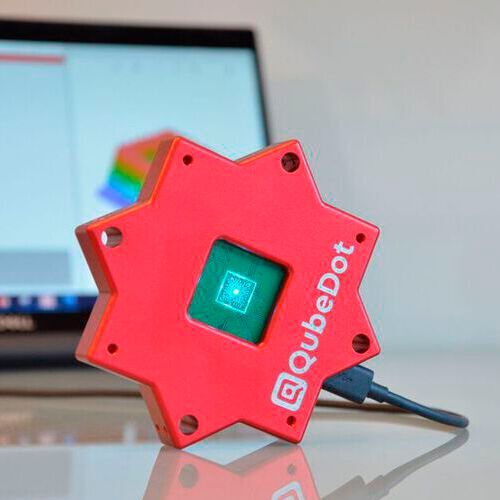
Prototype of a holographic microscope for observing cells.
(Source: Chipscope)
Optical microscopy is entering a new world. Future microscopes will be chipsised and have super-resolution capabilities. This means they will be available in everyday life, not just in specialist laboratories. And it might become possible to detect SARS-CoV-2 and other viruses using a smartphone.
“This use of chip integrated nano LEDs will revolutionise the way science and applications related to optical microscopy will be done in the future,” says Angel Dieguez, professor at the University of Barcelona, Spain. “It can be used to investigate extremely small structures such as viruses, DNA or living cells, almost anywhere and in real time.”
The resolution of conventional light microscopes, still standard equipment in laboratories, is limited by diffraction: they can’t resolve structural features smaller than about 200 nanometres. Until now, all technologies for going beyond this limit rely on complex setups, with bulky components and advanced laboratory infrastructure. They are not suitable for mobile research devices used in field or in remote areas.
The University of Barcelona is a partner in Chipscope, a project supported by the EU-programme FET (Future and Emerging Technologies) (now part of EIC Pathfinder) which is developing an array of nano light emitting diodes (nano LEDs) with individual pixel operation. LEDs which are smaller than the diffraction limit will be used as light sources for microscopes and will also be integrated on a chip. “This will lead to extreme miniaturisation and simplicity for super-resolution microscopy,” Dieguez remarks.
The project’s members are universities and research centres as well as small and medium sized enterprises (SME). They intend to integrate the nano LEDs into a real-time imaging device. The European industry leaders in imaging and microscopy are represented on an advisory board.
Dieguez explains: “In conventional optical microscopy, the area that needs to be analysed is illuminated simultaneously, collecting the light which is scattered from each point of the sample with the human eye or the sensor of a camera as a sensitive detector. Our idea, however, is based on a structured light source with tiny, individually addressable elements. The sample is put on top of this light source. Whenever single emitters are activated, the light propagation depends on the spatial structure of the sample.”
“This is very similar to shadow imaging in the macroscopic world. To obtain an image, the overall amount of light which is transmitted through the sample region is sensed by a detector, activating one light element at a time and thereby scanning across the sample space.”
The nano LEDs, which are the first with individually addressable pixels in the sub-micrometre range to become available on a commercial scale, are being developed at the Braunschweig University of Technology, Germany. “They are based on gallium nitride, a semiconductor commonly used for blue and white LEDs.”
Dieguez’ own team in Barcelona constructed the light detectors: “We now have a prototype device to conduct further experiments. Other projects will be tasked with making a marketable microscope. I don’t have a time scale in mind, but I’m convinced that this will revolutionise the microscope market and the ways to do field research. With chips instead of lenses, the devices will be very mobile and extremely cheap. They also can be integrated into existing tabletop systems.”
That is not all. Joan Daniel Prades is also a professor at the University of Barcelona and coordinates Smile (Scalable Structured Micro-Illumination Light Engines), which is using the outcomes of Chipscope. The researchers are developing micro LED devices that can bring innovation in microscopy and other research fields such as DNA chip fabrication and optogenetics.
Particularly for optical microscopy, the researchers see possibilities to study the properties of large quantities of substances. “We try to combine holography and chip-based technology with microscopy to allow transparent cells to be visualised with classic cell culture plates. Today, we have a prototype that allows a resolution of 256 pixels per inch, which is available through our start-up partner Qubedot (Braunschweig, Germany). The project’s goal is to obtain 2,000 pixels.”
Date: 08.12.2025
Naturally, we always handle your personal data responsibly. Any personal data we receive from you is processed in accordance with applicable data protection legislation. For detailed information please see our privacy policy.
Consent to the use of data for promotional purposes
I hereby consent to Vogel Communications Group GmbH & Co. KG, Max-Planck-Str. 7-9, 97082 Würzburg including any affiliated companies according to §§ 15 et seq. AktG (hereafter: Vogel Communications Group) using my e-mail address to send editorial newsletters. A list of all affiliated companies can be found here
Newsletter content may include all products and services of any companies mentioned above, including for example specialist journals and books, events and fairs as well as event-related products and services, print and digital media offers and services such as additional (editorial) newsletters, raffles, lead campaigns, market research both online and offline, specialist webportals and e-learning offers. In case my personal telephone number has also been collected, it may be used for offers of aforementioned products, for services of the companies mentioned above, and market research purposes.
Additionally, my consent also includes the processing of my email address and telephone number for data matching for marketing purposes with select advertising partners such as LinkedIn, Google, and Meta. For this, Vogel Communications Group may transmit said data in hashed form to the advertising partners who then use said data to determine whether I am also a member of the mentioned advertising partner portals. Vogel Communications Group uses this feature for the purposes of re-targeting (up-selling, cross-selling, and customer loyalty), generating so-called look-alike audiences for acquisition of new customers, and as basis for exclusion for on-going advertising campaigns. Further information can be found in section “data matching for marketing purposes”.
In case I access protected data on Internet portals of Vogel Communications Group including any affiliated companies according to §§ 15 et seq. AktG, I need to provide further data in order to register for the access to such content. In return for this free access to editorial content, my data may be used in accordance with this consent for the purposes stated here. This does not apply to data matching for marketing purposes.
Right of revocation
I understand that I can revoke my consent at will. My revocation does not change the lawfulness of data processing that was conducted based on my consent leading up to my revocation. One option to declare my revocation is to use the contact form found at https://contact.vogel.de. In case I no longer wish to receive certain newsletters, I have subscribed to, I can also click on the unsubscribe link included at the end of a newsletter. Further information regarding my right of revocation and the implementation of it as well as the consequences of my revocation can be found in the data protection declaration, section editorial newsletter.
Another application is the fabrication of DNA biochips. Prades explains: “DNA chips or DNA microarrays are an important tool for gene expression analysis. These chips consist of a solid surface with a collection of single-stranded DNA fragments [which is the known sequence, ed. Note]. The DNA samples that need to be analysed [the unknown sequence, ed. Note] are fluorescently labelled and fixed onto the chip.” The complementary binding between the known and the unknown sequences is then analysed.
Thanks to the microarray technology, the researchers can get information on thousands of genes simultaneously with just a single DNA chip. “A similar application already exists with lasers. However, these produce DNA samples point by point, whereas DNA chips will perform this task by blocks, which means they work much faster,” Prades continues.
The project also aims at bringing innovation into optogenetics, which is a biological technique that uses light to activate or deactivate individual neurons or neuronal networks in the brain of living animals by shining light on them. Up to now, complex fibre optics systems are used to do this.
“The time to generate a pixel and switch to the next one will be less than ten nanoseconds, at a full framerate of 1 MHz. So, the planned systems will encompass relevant existing restrictions regarding the maximal frequency of activation, minimum spot size and maximal power output. In addition, conventional microscopy systems are very costly and not readily available, leading to restrictions in the number of experiments to be performed per time, which limits scientific progress.”
Photolithography is another field of application: “Manipulation technologies enabled by large computing capacity allow high replication throughputs as demanded for industrial micro-patterning.”
The project is one of the EIC Transition to Innovation Activities, which aim at bringing innovative FET technologies to a level of development for business creation. “An end-user board, with experts from various branches – multinationals, SMEs and interdisciplinary research institutes – will perform tests and validations for quickly increasing markets with the prototypes we are going to make available in five pilot applications,” Prades concludes.




:quality(80)/p7i.vogel.de/wcms/92/ad/92adbafb37924cea35ea3cf05b7a23e5/0130206318v2.jpeg "The world’s first fully functioning proof-of-concept quantum battery
(Source: Csiro)")
:quality(80)/p7i.vogel.de/wcms/9f/8b/9f8bc2b8491d7a514ca154e9588a07b7/0130205846v1.jpeg "The researchers’ new material, based on mineralised sawdust, is an excellent fire retardant. (Source: Dan Vivas Glaser / from Kürsteiner R et al. Chem Circularity 2026)")
:quality(80)/p7i.vogel.de/wcms/fd/73/fd73fcb3ceda89d1419de1083fcab7b4/0130081520v2.jpeg "The fingers at the heart of this technology were inspired by the fin-ray effect — a design principle derived from the natural structure of fish fins. (Source: University of Texas at Austin )")
:quality(80)/p7i.vogel.de/wcms/fe/64/fe649767c802d53ac63ee2c2a40b7e0d/0130060830v2.jpeg "Sample tube with light-active substance (Source: Elvira Eberhardt / Ulm University)")
:quality(80)/p7i.vogel.de/wcms/8f/b9/8fb98a958e4afe679865fbe52a473680/0129940982v2.jpeg "pH measurement in various nanoparticles using the Nine-Focus meter ensures precise stability and performance control. (Source: Mettler Toledo)")
:quality(80)/p7i.vogel.de/wcms/11/74/1174e5d4c8b07a64637dced8c9506b40/0129787561v2.jpeg "The Multicell Plus high-pressure reactor sets a new benchmark for operator safety, all-round accessibility and ease-of-use. (Source: Asynt)")
:quality(80)/p7i.vogel.de/wcms/ef/6e/ef6e96191183411973b77041fb6b1e16/0129785957v2.jpeg "Manufactured from high-quality crystal polystyrene - these new automation-ready plates are available in a choice of ANSI / SLAS standard (96-well and breakable 8-well strip) formats. (Source: Porvair Sciences)")
:quality(80)/p7i.vogel.de/wcms/ad/ca/adcaa20ef5ccaf7e3b325788b1e349c4/0129784872v2.jpeg "The high performance Degasi Flat Film in-line degasser. (Source: Biotech Fluidics)")
:quality(80)/p7i.vogel.de/wcms/e9/9c/e99cb19231197af70c489cb4acc2ead0/0130293444v2.jpeg "A new global study, led by researchers at Kaust in Saudi Arabia, shows that forests are most effective for climate regulation when conserved or restored in their natural or native locations. (Source: Kaust )")
:quality(80)/p7i.vogel.de/wcms/af/40/af40b535eb65c287fbd22ed5483d1d0e/0130206243v2.jpeg "The researchers dug soil pits in order to measure the carbon storage in soil
(Source: Johanna Asch)")
:quality(80)/p7i.vogel.de/wcms/2d/45/2d45aba62f5042baa00f7fd4fa629839/0130036533v2.jpeg "The population of Pune, India, is expected to reach 11 million by 2050. (Source: free licensed)")
:quality(80)/p7i.vogel.de/wcms/52/f8/52f8d5521fdab07ed0a865ec0d8919fd/0130009438v2.jpeg "Drylands support around half of global livestock production and sustain the livelihoods of close to a billion people, while also underpinning soil stability and carbon storage. (Source: Kaust )")
:quality(80)/p7i.vogel.de/wcms/6f/ba/6fba92196d0cbb1467334f8a2ecc520a/0130203021v2.jpeg "Low to moderate wine consumption shows lower risk compared with spirits, beer and cider (Source: free licensed)")
:quality(80)/p7i.vogel.de/wcms/a9/37/a9376f1d9a893570023d9aa97c085bc5/0129927485v2.jpeg "Examples of foods high in PUFAs include fatty fish and soybeans, while MUFAs include olive oil and avocadoes. (Source: free licensed)")
:quality(80)/p7i.vogel.de/wcms/ea/88/ea88ef8810e21cdd9bb852c70f385ba1/0129797385v2.jpeg "A team of NUS food scientists consisting of Assoc Prof Liu Shao Quan (centre), Dr Lu Yuyun (right) and Ms Geng Chenhan (left) pioneered a co-fermentation method that improves both the nutrient and flavor profile of kombu. (Source: NUS)")
:quality(80)/p7i.vogel.de/wcms/84/2c/842c7c1678ceeec7147ea3a36e238e75/0129356324v2.jpeg "Kaust and Nadec have signed a MOU that establishes a framework for long-term cooperation across agricultural research, technology development, and professional training. (Source: Kaust )")
:quality(80)/p7i.vogel.de/wcms/66/a6/66a64c9dd7dbe84d2d7ea95a5e691bb1/0130361609v2.jpeg "Dr. Priya Freaney speaking to a patient at Bluhm Cardiovascular Institute at Northwestern Memorial Hospital in Chicago. (Source: Northwestern Medicine)")
:quality(80)/p7i.vogel.de/wcms/6e/d4/6ed479ad990b9ddc0f2eeadccccf62c7/0130359257v2.jpeg "Routine early measurement of neurofilament light chain could help improve prediction of cognitive impairment after out-of-hospital cardiac arrest, according to a study presented recently at ESC Acute Cardiovascular Care 2026. (Source: Pixabay)")
:quality(80)/p7i.vogel.de/wcms/6e/b9/6eb95805568aa78dc2ed57f829cf33d4/0130300421v2.jpeg "A 10-minute digital program co-developed by a University of Texas psychologist significantly reduced symptoms of depression four weeks after use, according to results from one of the largest randomized controlled trials of single-session mental health interventions. (Source: University of Texas at Austin )")
:quality(80)/p7i.vogel.de/wcms/6f/e9/6fe9d920eca2c0b3bdeb55cbe9f01908/0130299237v2.jpeg "Study authors Jason Miska and Leah Billingham reading out enzymatic activity of microglia in cell cultures. (Source: Northwestern University.)")
:quality(80)/images.vogel.de/vogelonline/bdb/1710600/1710675/original.jpg "Discover how to set yourself up for success when performing balance-based density determination of solids such as jewelry and precious metals. (Mettler Toledo)")
:quality(80)/images.vogel.de/vogelonline/bdb/1682500/1682579/original.jpg "The new XPR Analytical balance redesigned to meet the needs of laboratory technicians of working fast and lean. (Mettler Toledo)")
:quality(80)/images.vogel.de/vogelonline/bdb/1677000/1677080/original.jpg "Enhance your weighing accuracy, comfort and productivity with the redesigned XPR Analytical balance. (Mettler Toledo)")
:quality(80)/p7i.vogel.de/wcms/d5/14/d5144a87f3c04019e3338c738a9c02ed/0126611086v1.jpeg "Detectors are created from cutting and polishing specific sizes from the boules. (Source: Mercouri Kanatzidis/Northwestern University)")
:quality(80)/p7i.vogel.de/wcms/63/df/63df78cb67fa64ba76eaa5cf36524064/0127857157v2.jpeg "The pixels reproduce colors using nanoparticles whose dimensions and arrangement control how light is scattered, and whose optical properties can be electrically tuned. (Source: Chalmers University of Technology, Mia Halleröd Palmgren)")