Scientists have developed a new implantable device that can monitor fluctuating levels of proteins within the body in real time. In an animal study, device accurately tracked biomarkers of inflammation. Device also could track protein markers for other illnesses, including heart failure.
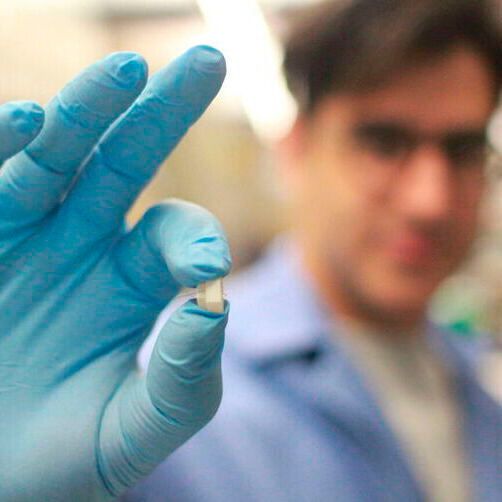
The tiny implantable microdevice comprises the electrode and sensors inside a thin microneedle, the width of just three human hairs.
Illinois/USA – Northwestern University scientists have designed a new implantable device that can monitor fluctuating levels of proteins within the body in real time. Inspired by fruit shaking off the branches of a tree, the device comprises strands of DNA that stick to proteins, shake them off and then grab more proteins. This creative strategy enables the device to sample various proteins over time to measure changes in inflammatory markers.
In proof-of-concept experiments, the sensors accurately and sensitively measured protein biomarkers of inflammation in diabetic rats. The work lays the foundation for the real-time management and prevention of acute and chronic conditions through the tracking of critical proteins, such as cytokines in inflammation, protein biomarkers in heart failure and many others.
The study has been published in the journal Science.
“The device’s design is analogous to a continuous glucose monitor that sits on your arm and measures levels right beneath your skin,” said Northwestern’s Shana O. Kelley, who led the study. “You can see that your glucose levels are increasing in real time. But then maybe you take your insulin, and your glucose goes back down. You need to be able to measure trends in the wrong direction and trends in the right direction. It’s the same with proteins in inflammation. We need to track fluctuations in order to get a full picture of what’s happening in the body. This is a completely new capability — to be able to watch inflammation in real time. There are a huge number of applications that we are now beginning to explore.”
Kelley is the Neena B. Schwartz Professor of Chemistry and Biomedical Engineering at Northwestern, where she has appointments in the Weinberg College of Arts and Sciences, Mc Cormick School of Engineering and Feinberg School of Medicine. She also is president of the Chan Zuckerberg Biohub Chicago, one of the four institutes in the Chan Zuckerberg Biohub Network.
Quaking with inspiration
While numerous sensors exist to continuously detect small molecules, such as glucose or electrolytes, sensors for proteins — which are larger and more complex than small molecules — are more challenging to design. To detect proteins in biological fluids, scientists typically use DNA receptors that bind to proteins and pull them out of biofluids.
The problem with these receptions is they work too well. Even with passive regeneration, these Velcro-like attachments are so strong that they hold onto proteins for more than 20 hours, making it impossible to measure real-time fluctuations in the blood. After trying several solutions to “reset” the sensors, Hossein Zargartalebi, the study’s first author, received inspiration from an unexpected place: nature.
“I thought about how shaking an apple tree, whether by hand or with a gust of wind, makes ripe apples detach and fall,” said Zargartalebi, a postdoctoral fellow in Kelley’s laboratory. “This simple observation sparked an idea. What if we could ‘shake’ the DNA receptors on our sensors to release the captured proteins in a similar way? I applied an alternating potential electrode, which caused the DNA strands to oscillate, and it worked. The proteins detached and the sensor was reset.”
The nanoscale sensors look like rows of bulbous pendulums, each comprising a double-stranded cord of DNA. One end of the DNA strand is attached to an electrode, and the other end is attached to another bit of DNA that binds to a desired protein. When the researchers apply an alternating electric field, the pendulum-like sensors swing back and forth — flinging off proteins within a mere minute and catching others.
“Hossein was thinking very creatively and came up with a non-obvious idea,” Kelley said. “He went into the lab, tried it once and it worked. Then, he did it again, and it worked. It’s such a simple and elegant solution.”
Date: 08.12.2025
Naturally, we always handle your personal data responsibly. Any personal data we receive from you is processed in accordance with applicable data protection legislation. For detailed information please see our privacy policy.
Consent to the use of data for promotional purposes
I hereby consent to Vogel Communications Group GmbH & Co. KG, Max-Planck-Str. 7-9, 97082 Würzburg including any affiliated companies according to §§ 15 et seq. AktG (hereafter: Vogel Communications Group) using my e-mail address to send editorial newsletters. A list of all affiliated companies can be found here
Newsletter content may include all products and services of any companies mentioned above, including for example specialist journals and books, events and fairs as well as event-related products and services, print and digital media offers and services such as additional (editorial) newsletters, raffles, lead campaigns, market research both online and offline, specialist webportals and e-learning offers. In case my personal telephone number has also been collected, it may be used for offers of aforementioned products, for services of the companies mentioned above, and market research purposes.
Additionally, my consent also includes the processing of my email address and telephone number for data matching for marketing purposes with select advertising partners such as LinkedIn, Google, and Meta. For this, Vogel Communications Group may transmit said data in hashed form to the advertising partners who then use said data to determine whether I am also a member of the mentioned advertising partner portals. Vogel Communications Group uses this feature for the purposes of re-targeting (up-selling, cross-selling, and customer loyalty), generating so-called look-alike audiences for acquisition of new customers, and as basis for exclusion for on-going advertising campaigns. Further information can be found in section “data matching for marketing purposes”.
In case I access protected data on Internet portals of Vogel Communications Group including any affiliated companies according to §§ 15 et seq. AktG, I need to provide further data in order to register for the access to such content. In return for this free access to editorial content, my data may be used in accordance with this consent for the purposes stated here. This does not apply to data matching for marketing purposes.
Right of revocation
I understand that I can revoke my consent at will. My revocation does not change the lawfulness of data processing that was conducted based on my consent leading up to my revocation. One option to declare my revocation is to use the contact form found at https://contact.vogel.de. In case I no longer wish to receive certain newsletters, I have subscribed to, I can also click on the unsubscribe link included at the end of a newsletter. Further information regarding my right of revocation and the implementation of it as well as the consequences of my revocation can be found in the data protection declaration, section editorial newsletter.
“I was exhilarated, knowing that this natural insight had led to a major breakthrough,” Zargartalebi said. “Now, just as trees repeatedly grow and release their fruit, our DNA sensors can ‘release’ their proteins after each measurement cycle, enabling continuous, real-time monitoring inside the body. This experience reminded me that, just as Newton’s encounter with the apple hinted at gravity, nature still holds powerful lessons for those who pay close attention.”
Getting under the skin
After watching the device work in the lab, the team next wanted to see if the sensors worked in living animals. The researchers built an implantable microdevice with the electrode and sensors inside a thin microneedle, the width of just three human hairs. Resembling a continuous glucose monitor, the device sits on the skin outside the body while the microneedle pricks the skin to sample fluids.
The researchers designed sensors to bind to two protein cytokines, which are key markers of inflammation. Then they attached the device into the skin of rats with diabetes. Because diabetes and inflammation are tightly linked, many complications associated with diabetes are caused by inflammation.
The sensors successfully measured concentration changes of both proteins within fluid. When the rats fasted or received insulin, the sensors tracked cytokine levels as they drifted down. Conversely, when researchers injected the rats with a substance that agitates the immune system, the inflammatory cytokine levels rapidly shot up.
The sensors were so sensitive, in fact, that each time a rat received a shot of insulin, the device detected a small spike in inflammation where the needle pierced the skin. Measurements from the sensors also matched gold-standard laboratory methods to detect proteins in bodily fluids — validating the device’s success.
The ‘ultimate preventative measure’
Although the new device works well for measuring inflammation, Kelley envisions using it to track many other protein markers. She specifically cites heart failure, which is associated with a protein called B-type natriuretic peptide (BNP). Clinicians measure BNP to diagnose and monitor heart failure, but, currently, there is no way to continuously track this marker in real time.
“If you have heart failure, you might go to the doctor every three months,” Kelley said. “But, as with most illnesses, symptoms occur between doctor’s visits. If a patient isn’t feeling well, it’s not immediately obvious that it’s due to heart failure. With a continuous monitor, when the patient doesn’t feel well, the doctor could pull up their data and check their BNP levels. Then, medications could be fine-tuned before symptoms worsen. We hope one day this technology will benefit many people, along the lines of what has happened with the positive impact of continuous glucose monitoring today. It could be the ultimate preventative measure.”
The study, “Active-reset protein sensors enable continuous in vivo monitoring of inflammation,” was supported by the National Institutes of Health, Canadian Institutes of Health Research, Ontario Genomics, National Institutes of Health Heart Failure, Chan Zuckerberg Biohub Chicago and the Natural Sciences and Engineering Research of Canada.




:quality(80)/p7i.vogel.de/wcms/92/ad/92adbafb37924cea35ea3cf05b7a23e5/0130206318v2.jpeg "The world’s first fully functioning proof-of-concept quantum battery
(Source: Csiro)")
:quality(80)/p7i.vogel.de/wcms/9f/8b/9f8bc2b8491d7a514ca154e9588a07b7/0130205846v1.jpeg "The researchers’ new material, based on mineralised sawdust, is an excellent fire retardant. (Source: Dan Vivas Glaser / from Kürsteiner R et al. Chem Circularity 2026)")
:quality(80)/p7i.vogel.de/wcms/fd/73/fd73fcb3ceda89d1419de1083fcab7b4/0130081520v2.jpeg "The fingers at the heart of this technology were inspired by the fin-ray effect — a design principle derived from the natural structure of fish fins. (Source: University of Texas at Austin )")
:quality(80)/p7i.vogel.de/wcms/fe/64/fe649767c802d53ac63ee2c2a40b7e0d/0130060830v2.jpeg "Sample tube with light-active substance (Source: Elvira Eberhardt / Ulm University)")
:quality(80)/p7i.vogel.de/wcms/8f/b9/8fb98a958e4afe679865fbe52a473680/0129940982v2.jpeg "pH measurement in various nanoparticles using the Nine-Focus meter ensures precise stability and performance control. (Source: Mettler Toledo)")
:quality(80)/p7i.vogel.de/wcms/11/74/1174e5d4c8b07a64637dced8c9506b40/0129787561v2.jpeg "The Multicell Plus high-pressure reactor sets a new benchmark for operator safety, all-round accessibility and ease-of-use. (Source: Asynt)")
:quality(80)/p7i.vogel.de/wcms/ef/6e/ef6e96191183411973b77041fb6b1e16/0129785957v2.jpeg "Manufactured from high-quality crystal polystyrene - these new automation-ready plates are available in a choice of ANSI / SLAS standard (96-well and breakable 8-well strip) formats. (Source: Porvair Sciences)")
:quality(80)/p7i.vogel.de/wcms/ad/ca/adcaa20ef5ccaf7e3b325788b1e349c4/0129784872v2.jpeg "The high performance Degasi Flat Film in-line degasser. (Source: Biotech Fluidics)")
:quality(80)/p7i.vogel.de/wcms/af/40/af40b535eb65c287fbd22ed5483d1d0e/0130206243v2.jpeg "The researchers dug soil pits in order to measure the carbon storage in soil
(Source: Johanna Asch)")
:quality(80)/p7i.vogel.de/wcms/2d/45/2d45aba62f5042baa00f7fd4fa629839/0130036533v2.jpeg "The population of Pune, India, is expected to reach 11 million by 2050. (Source: free licensed)")
:quality(80)/p7i.vogel.de/wcms/52/f8/52f8d5521fdab07ed0a865ec0d8919fd/0130009438v2.jpeg "Drylands support around half of global livestock production and sustain the livelihoods of close to a billion people, while also underpinning soil stability and carbon storage. (Source: Kaust )")
:quality(80)/p7i.vogel.de/wcms/fe/49/fe494ada322615b6e6f6ff0f5bb7c5cf/0129926008v2.jpeg "A mandrill eating fruit. (Source: University of Bristol )")
:quality(80)/p7i.vogel.de/wcms/6f/ba/6fba92196d0cbb1467334f8a2ecc520a/0130203021v2.jpeg "Low to moderate wine consumption shows lower risk compared with spirits, beer and cider (Source: free licensed)")
:quality(80)/p7i.vogel.de/wcms/a9/37/a9376f1d9a893570023d9aa97c085bc5/0129927485v2.jpeg "Examples of foods high in PUFAs include fatty fish and soybeans, while MUFAs include olive oil and avocadoes. (Source: free licensed)")
:quality(80)/p7i.vogel.de/wcms/ea/88/ea88ef8810e21cdd9bb852c70f385ba1/0129797385v2.jpeg "A team of NUS food scientists consisting of Assoc Prof Liu Shao Quan (centre), Dr Lu Yuyun (right) and Ms Geng Chenhan (left) pioneered a co-fermentation method that improves both the nutrient and flavor profile of kombu. (Source: NUS)")
:quality(80)/p7i.vogel.de/wcms/84/2c/842c7c1678ceeec7147ea3a36e238e75/0129356324v2.jpeg "Kaust and Nadec have signed a MOU that establishes a framework for long-term cooperation across agricultural research, technology development, and professional training. (Source: Kaust )")
:quality(80)/p7i.vogel.de/wcms/e9/73/e9732473361377610267347df55071a1/0130205830v2.jpeg "Sleep EEG signals may reveal whether the brain is aging faster than the body — and help identify elevated dementia risk earlier. (Source: free licensed)")
:quality(80)/p7i.vogel.de/wcms/ed/c0/edc0c1a86229b11efd17c5e3f94d14da/0130081211v2.jpeg "A new study finds that virtual visits did not make it easier for psychiatrists, psychologists and therapists to reach significantly more people in areas where access to care has long been limited. (Source: Pixabay)")
:quality(80)/p7i.vogel.de/wcms/9c/52/9c52318bc94be17e6662dfceffa4a0c0/0130060546v2.jpeg "Domestic cat ‘Lanni’ from co-author of the study, Latasha Ludwig, Assistant Clinical Professor at Cornell University, USA. (Source: © Latasha Ludwig)")
:quality(80)/p7i.vogel.de/wcms/4b/f4/4bf4cc9e28e65e11a27dd41da2d1a7f5/0130038185v2.jpeg "The biomarker p-tau217 could help identify women at elevated dementia risk decades before clinical symptoms begin. (Source: free licensed)")
:quality(80)/images.vogel.de/vogelonline/bdb/1710600/1710675/original.jpg "Discover how to set yourself up for success when performing balance-based density determination of solids such as jewelry and precious metals. (Mettler Toledo)")
:quality(80)/images.vogel.de/vogelonline/bdb/1682500/1682579/original.jpg "The new XPR Analytical balance redesigned to meet the needs of laboratory technicians of working fast and lean. (Mettler Toledo)")
:quality(80)/images.vogel.de/vogelonline/bdb/1677000/1677080/original.jpg "Enhance your weighing accuracy, comfort and productivity with the redesigned XPR Analytical balance. (Mettler Toledo)")
:quality(80)/p7i.vogel.de/wcms/71/0b/710b65311648262eb99c8690377b73dd/0124237452v2.jpeg "Northwestern University researchers have developed the first wearable device for measuring gases emitted from and absorbed by the skin. (Source: John A. Rogers/Northwestern University)")
:quality(80)/p7i.vogel.de/wcms/6f/8a/6f8ad39c13a8ea5a09af36d222ffdd9b/0125682235v2.jpeg "Researchers have developed a new wearable sensor which can continuously measure a person’s hydration levels. (Source: University of Texas at Austin)")