“Practice makes perfect” is no mere cliché, according to a new study from researchers at The Rockefeller University and Ucla. Instead, it’s the recipe for mastering a task, because repeating an activity over and over solidifies neural pathways in your brain.
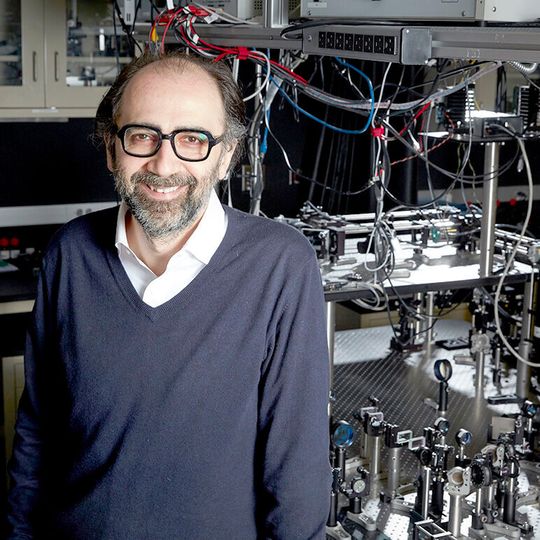
lipasha Vaziri with the light-beads microscopy (LBM) imaging technology he developed. LBM has already enabled several key discoveries that would have been impossible to make with previously existing imaging tools.
(Source: Matthew Septimus)
Scientists at The Rockefeller University and Ucla used a cutting-edge technology developed by Rockefeller’s Alipasha Vaziri to simultaneously observe 73,000 cortical neurons in mice as the animals learned and repeated a given task over two weeks. The study revealed that memory representations transform from unstable to solid in working memory circuits, giving insights into why performance becomes more accurate and automatic following repetitive practice.
“In this work we show how working memory — the brain’s ability to hold and process information — improves through practice,” says Vaziri, head of Rockefeller’s Laboratory of Neurology and Biophysics. “We expect that these insights will not only advance our understanding of learning and memory but also have implications for addressing memory-related disorders.”
Working memory is essential to a variety of cognitive functions, and yet the mechanisms underlying memory formation, retention, and recall — which enable us to perform a task we’ve done before without having to learn it anew — remain unclear over long timescales.
For the current study, the researchers wanted to observe the stability of working memory representations over time, and what role these representations played in the ability to skillfully perform the task on cue. To do so, they sought to record neuronal populations repeatedly in mice over a relatively long period while the animals learned and became experts in a given task.
But they faced a daunting challenge: technical limitations have hampered the ability to image the activity of large population of neurons across the brain in real time, over longer periods, and at any tissue depth in the cortex.
The UCLA researchers turned to Vaziri, who has developed brain imaging techniques that are among the only tools capable of capturing the majority of the mouse cortex in real time at a high resolution and speed.
Vaziri suggested they use light-beads microscopy (LBM), a high-speed volumetric imaging technology he developed that allows for cellular resolution in vivo recording of activity of neuronal populations up to 1 million neurons — a 100-fold increase in the number of neurons that can be simultaneously recorded.
Neural Transformations
In the current study, the researchers used LBM to image the cellular activity of 73,000 neurons in mice simultaneously throughout various depths of the cortex and tracked the activity of the same neurons over two weeks as the animals identified, recalled, and repeated a sequence of odors.
They found that the working memory circuits transformed as the mice mastered the proper sequences. Initially, the circuits were unstable, but as the mice practiced the task repeatedly, the circuits began to stabilize and solidify. “This is what we refer to as ‘crystallization,’” Vaziri says.
The findings essentially illustrate that repetitive training not only enhances skill proficiency but also leads to profound changes in the brain’s memory circuits, making performance more accurate and automatic.
Alipasha Vaziri; Head of Rockefeller’s Laboratory of Neurology and Biophysics
“If one imagines that each neuron in the brain is sounding a different note, the melody that the brain is generating when it is doing the task was changing from day to day, but then became more and more refined and similar as animals kept practicing the task,” adds corresponding author and UCLA Health neurologist Peyman Golshani.
Crucially, some aspects of these discoveries were uniquely enabled by the large-scale and deep tissue imaging capabilities of LBM. Initially, the researchers used standard two-photon imaging of smaller neuronal populations in upper cortical layers, but they failed to find evidence for memory stabilization. But once they employed LBM to record from over 70,000 neurons in deeper cortical regions, they were able to observe the crystallization of working memory representations that accompanied the mice’s increasing mastery of the task.
“In the future, we may tackle the role of different neuronal cell types involved in mediating this mechanism, and in particular the interaction of different types of interneurons with excitatory cells,” Vaziri says. “We’re also interested in understanding how learning is implemented and could be transferred into a new context — that is, how the brain could generalize from a learned task to some new unknown problems.”
Date: 08.12.2025
Naturally, we always handle your personal data responsibly. Any personal data we receive from you is processed in accordance with applicable data protection legislation. For detailed information please see our privacy policy.
Consent to the use of data for promotional purposes
I hereby consent to Vogel Communications Group GmbH & Co. KG, Max-Planck-Str. 7-9, 97082 Würzburg including any affiliated companies according to §§ 15 et seq. AktG (hereafter: Vogel Communications Group) using my e-mail address to send editorial newsletters. A list of all affiliated companies can be found here
Newsletter content may include all products and services of any companies mentioned above, including for example specialist journals and books, events and fairs as well as event-related products and services, print and digital media offers and services such as additional (editorial) newsletters, raffles, lead campaigns, market research both online and offline, specialist webportals and e-learning offers. In case my personal telephone number has also been collected, it may be used for offers of aforementioned products, for services of the companies mentioned above, and market research purposes.
Additionally, my consent also includes the processing of my email address and telephone number for data matching for marketing purposes with select advertising partners such as LinkedIn, Google, and Meta. For this, Vogel Communications Group may transmit said data in hashed form to the advertising partners who then use said data to determine whether I am also a member of the mentioned advertising partner portals. Vogel Communications Group uses this feature for the purposes of re-targeting (up-selling, cross-selling, and customer loyalty), generating so-called look-alike audiences for acquisition of new customers, and as basis for exclusion for on-going advertising campaigns. Further information can be found in section “data matching for marketing purposes”.
In case I access protected data on Internet portals of Vogel Communications Group including any affiliated companies according to §§ 15 et seq. AktG, I need to provide further data in order to register for the access to such content. In return for this free access to editorial content, my data may be used in accordance with this consent for the purposes stated here. This does not apply to data matching for marketing purposes.
Right of revocation
I understand that I can revoke my consent at will. My revocation does not change the lawfulness of data processing that was conducted based on my consent leading up to my revocation. One option to declare my revocation is to use the contact form found at https://contact.vogel.de. In case I no longer wish to receive certain newsletters, I have subscribed to, I can also click on the unsubscribe link included at the end of a newsletter. Further information regarding my right of revocation and the implementation of it as well as the consequences of my revocation can be found in the data protection declaration, section editorial newsletter.
Original Article: Volatile working memory representations crystallize with practice; Arash Bellafard, Ghazal Namvar, Jonathan C. Kao, Alipasha Vaziri, Peyman Golshani; Nature; DOI:10.1038/s41586-024-07425-w




:quality(80)/p7i.vogel.de/wcms/92/ad/92adbafb37924cea35ea3cf05b7a23e5/0130206318v2.jpeg "The world’s first fully functioning proof-of-concept quantum battery
(Source: Csiro)")
:quality(80)/p7i.vogel.de/wcms/9f/8b/9f8bc2b8491d7a514ca154e9588a07b7/0130205846v1.jpeg "The researchers’ new material, based on mineralised sawdust, is an excellent fire retardant. (Source: Dan Vivas Glaser / from Kürsteiner R et al. Chem Circularity 2026)")
:quality(80)/p7i.vogel.de/wcms/fd/73/fd73fcb3ceda89d1419de1083fcab7b4/0130081520v2.jpeg "The fingers at the heart of this technology were inspired by the fin-ray effect — a design principle derived from the natural structure of fish fins. (Source: University of Texas at Austin )")
:quality(80)/p7i.vogel.de/wcms/fe/64/fe649767c802d53ac63ee2c2a40b7e0d/0130060830v2.jpeg "Sample tube with light-active substance (Source: Elvira Eberhardt / Ulm University)")
:quality(80)/p7i.vogel.de/wcms/8f/b9/8fb98a958e4afe679865fbe52a473680/0129940982v2.jpeg "pH measurement in various nanoparticles using the Nine-Focus meter ensures precise stability and performance control. (Source: Mettler Toledo)")
:quality(80)/p7i.vogel.de/wcms/11/74/1174e5d4c8b07a64637dced8c9506b40/0129787561v2.jpeg "The Multicell Plus high-pressure reactor sets a new benchmark for operator safety, all-round accessibility and ease-of-use. (Source: Asynt)")
:quality(80)/p7i.vogel.de/wcms/ef/6e/ef6e96191183411973b77041fb6b1e16/0129785957v2.jpeg "Manufactured from high-quality crystal polystyrene - these new automation-ready plates are available in a choice of ANSI / SLAS standard (96-well and breakable 8-well strip) formats. (Source: Porvair Sciences)")
:quality(80)/p7i.vogel.de/wcms/ad/ca/adcaa20ef5ccaf7e3b325788b1e349c4/0129784872v2.jpeg "The high performance Degasi Flat Film in-line degasser. (Source: Biotech Fluidics)")
:quality(80)/p7i.vogel.de/wcms/af/40/af40b535eb65c287fbd22ed5483d1d0e/0130206243v2.jpeg "The researchers dug soil pits in order to measure the carbon storage in soil
(Source: Johanna Asch)")
:quality(80)/p7i.vogel.de/wcms/2d/45/2d45aba62f5042baa00f7fd4fa629839/0130036533v2.jpeg "The population of Pune, India, is expected to reach 11 million by 2050. (Source: free licensed)")
:quality(80)/p7i.vogel.de/wcms/52/f8/52f8d5521fdab07ed0a865ec0d8919fd/0130009438v2.jpeg "Drylands support around half of global livestock production and sustain the livelihoods of close to a billion people, while also underpinning soil stability and carbon storage. (Source: Kaust )")
:quality(80)/p7i.vogel.de/wcms/fe/49/fe494ada322615b6e6f6ff0f5bb7c5cf/0129926008v2.jpeg "A mandrill eating fruit. (Source: University of Bristol )")
:quality(80)/p7i.vogel.de/wcms/6f/ba/6fba92196d0cbb1467334f8a2ecc520a/0130203021v2.jpeg "Low to moderate wine consumption shows lower risk compared with spirits, beer and cider (Source: free licensed)")
:quality(80)/p7i.vogel.de/wcms/a9/37/a9376f1d9a893570023d9aa97c085bc5/0129927485v2.jpeg "Examples of foods high in PUFAs include fatty fish and soybeans, while MUFAs include olive oil and avocadoes. (Source: free licensed)")
:quality(80)/p7i.vogel.de/wcms/ea/88/ea88ef8810e21cdd9bb852c70f385ba1/0129797385v2.jpeg "A team of NUS food scientists consisting of Assoc Prof Liu Shao Quan (centre), Dr Lu Yuyun (right) and Ms Geng Chenhan (left) pioneered a co-fermentation method that improves both the nutrient and flavor profile of kombu. (Source: NUS)")
:quality(80)/p7i.vogel.de/wcms/84/2c/842c7c1678ceeec7147ea3a36e238e75/0129356324v2.jpeg "Kaust and Nadec have signed a MOU that establishes a framework for long-term cooperation across agricultural research, technology development, and professional training. (Source: Kaust )")
:quality(80)/p7i.vogel.de/wcms/e9/73/e9732473361377610267347df55071a1/0130205830v2.jpeg "Sleep EEG signals may reveal whether the brain is aging faster than the body — and help identify elevated dementia risk earlier. (Source: free licensed)")
:quality(80)/p7i.vogel.de/wcms/ed/c0/edc0c1a86229b11efd17c5e3f94d14da/0130081211v2.jpeg "A new study finds that virtual visits did not make it easier for psychiatrists, psychologists and therapists to reach significantly more people in areas where access to care has long been limited. (Source: Pixabay)")
:quality(80)/p7i.vogel.de/wcms/9c/52/9c52318bc94be17e6662dfceffa4a0c0/0130060546v2.jpeg "Domestic cat ‘Lanni’ from co-author of the study, Latasha Ludwig, Assistant Clinical Professor at Cornell University, USA. (Source: © Latasha Ludwig)")
:quality(80)/p7i.vogel.de/wcms/4b/f4/4bf4cc9e28e65e11a27dd41da2d1a7f5/0130038185v2.jpeg "The biomarker p-tau217 could help identify women at elevated dementia risk decades before clinical symptoms begin. (Source: free licensed)")
:quality(80)/images.vogel.de/vogelonline/bdb/1710600/1710675/original.jpg "Discover how to set yourself up for success when performing balance-based density determination of solids such as jewelry and precious metals. (Mettler Toledo)")
:quality(80)/images.vogel.de/vogelonline/bdb/1682500/1682579/original.jpg "The new XPR Analytical balance redesigned to meet the needs of laboratory technicians of working fast and lean. (Mettler Toledo)")
:quality(80)/images.vogel.de/vogelonline/bdb/1677000/1677080/original.jpg "Enhance your weighing accuracy, comfort and productivity with the redesigned XPR Analytical balance. (Mettler Toledo)")
:quality(80)/p7i.vogel.de/wcms/5a/86/5a8642196d701a7a631c87404a9b1ec5/0128407231v2.jpeg "Northwestern University scientists have developed a wireless device that uses light to send information directly to the brain — bypassing the body’s natural sensory pathways. (Source: Mingzheng Wu/Rogers Research Group)")
:quality(80)/p7i.vogel.de/wcms/2f/47/2f47a513851f800e27a9a8229a5956c2/0123795801v2.jpeg "New research from Ohio State University reveals how the brain links memories formed close in time. (Source: free licensed)")