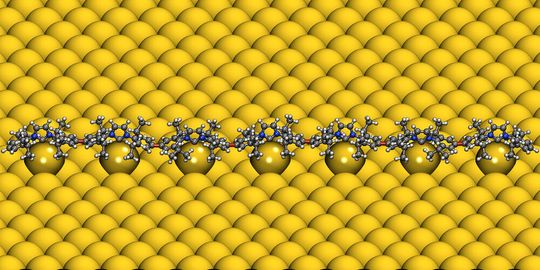
Using Ballbot molecules that slide on a surface, physicists and chemists from Münster, Germany, have produced long-chain mobile polymers on metal surfaces for the first time in cooperation with Chinese researchers. Ballbot polymers are extremely promising with regard to new applications in the fields of nanoelectronics, surface functionalisation and catalysis.
Lateral view of a structure of a Ballbot molecular chain optimised with quantum mechanical density functional theory.
(Source: WWU – AG Doltsinis)
N-heterocyclic carbenes (NHCs) are small, reactive ring molecules which bond well with metallic surfaces and which, over the past few years, have attracted a great deal of interest in the field of the stable chemical modification of metallic surfaces. One property — discovered at the University of Münster a few years ago — is the ability which certain NHC derivatives have, not only to anchor themselves to individual metal atoms, but also to completely extract an individual atom from the surface. Having bonded with these so-called adatoms, the NHCs glide freely over the surface — like a ballbot, i.e. a robot which moves on a sphere. Using such “ballbot molecules”, and working together with Chinese researchers, the Münster physicists and chemists now succeeded for the first time in making the halogenated NHCs produce long-chain mobile polymers — i.e. chains of molecules — on metallic surfaces.
The mobility of the ballbot-type NHCs opens up new possibilities, for example self-assembly into highly ordered domains from this type of molecule, up to cooperative, swarm-type behaviour on the part of the NHCs in autonomously converting certain metallic surfaces into a different highly-ordered structure without any external influence such as light or electrons. “Over and above the self-organisation, these ballbot polymers hold great promise for new applications in nanoelectronics, surface functionalisation and catalysis,” says Prof. Harald Fuchs, Senior Professor at Münster University’s Institute of Physics and Scientific Director of the Center for NanoTechnology (Centech) at Münster.
NHCs can be be easily modified in the nitrogen (N) groups of the five-fold heterocyclic body of the molecules. As a result, this makes it possible not only to influence the electronic interaction between the carbenes and the atoms of a metallic surface — for example, gold — but also to control the alignment of the carbenes vertically or parallel to a surface. One special feature of the halogenated NHCs used — which were developed at the Institute of Organic Chemistry at the University of Münster — is their ability to spontaneously form adatoms on noble metals and the mobility which arises as a result. This is a prerequisite for their coming together and for the reaction with other reactive systems on the surface.
“A decisive factor in the success of the experiments was the balance between the chemical reactivity of the monomeric structural units and their mobility,” says lead author Prof. Jindong Ren, formerly a postdoctoral researcher in Prof. Harald Fuchs’ group and now a principal investigator (PI) and group leader at the National Center for Nanoscience and Technology (NCNST) of China. On the one hand, the monomers can move easily on the surface due to their ballbot property; on the other hand, the contact time which the parties to the reaction have needs to be of a sufficient length to make the reaction happen. This occurs above all through the molecular structure and a suitable temperature setting during the experiment.
Controlling the chemical reactions, and providing evidence for the desired reaction products in the field of precision chemistry for surfaces, require highly specialised preparative and analytical experiments which allow for molecular interactions on surfaces and individual reaction steps at a submolecular scale to be observed. For this purpose, the researchers at Centech, NCNST and at Beijing National Center for Condensed Matter Physics and Institute of Physics employed scanning probe microscopy methods (STM and nc-AFM), as well as photoemission spectroscopy, to clarify the chemical bonding taking place and to provide evidence of the ballbot structures.The experimental results were complemented by elaborate computer simulations at the Institute of Solid State Theory at Münster University, based on quantum mechanics approaches and reactive force fields. In this way they confirmed the experimental results and quantified the electronic and structural properties of the ballbot polymers.
What Is Precision Chemistry
Precision chemistry on surfaces has now evolved into a separate area of chemistry. Unlike in traditional chemistry in a test tube or the gas phase, this particular branch of chemistry requires ultra-high vacuum conditions and, often, temperatures as low as minus 268°C in order to avoid any unintentional contamination, as well as to enable the observation of chemical (intermediary) steps at the molecular level. Solid surfaces — usually crystalline — serve as the platform (substrate) for the reaction and they can also support the reaction catalytically. Nano-structured surfaces, such as those which were used in the work described above, make it possible to control not only the alignment, but also a selective geometric arrangement of the reaction products or of the resultant polymers.
Date: 08.12.2025
Naturally, we always handle your personal data responsibly. Any personal data we receive from you is processed in accordance with applicable data protection legislation. For detailed information please see our privacy policy.
Consent to the use of data for promotional purposes
I hereby consent to Vogel Communications Group GmbH & Co. KG, Max-Planck-Str. 7-9, 97082 Würzburg including any affiliated companies according to §§ 15 et seq. AktG (hereafter: Vogel Communications Group) using my e-mail address to send editorial newsletters. A list of all affiliated companies can be found here
Newsletter content may include all products and services of any companies mentioned above, including for example specialist journals and books, events and fairs as well as event-related products and services, print and digital media offers and services such as additional (editorial) newsletters, raffles, lead campaigns, market research both online and offline, specialist webportals and e-learning offers. In case my personal telephone number has also been collected, it may be used for offers of aforementioned products, for services of the companies mentioned above, and market research purposes.
Additionally, my consent also includes the processing of my email address and telephone number for data matching for marketing purposes with select advertising partners such as LinkedIn, Google, and Meta. For this, Vogel Communications Group may transmit said data in hashed form to the advertising partners who then use said data to determine whether I am also a member of the mentioned advertising partner portals. Vogel Communications Group uses this feature for the purposes of re-targeting (up-selling, cross-selling, and customer loyalty), generating so-called look-alike audiences for acquisition of new customers, and as basis for exclusion for on-going advertising campaigns. Further information can be found in section “data matching for marketing purposes”.
In case I access protected data on Internet portals of Vogel Communications Group including any affiliated companies according to §§ 15 et seq. AktG, I need to provide further data in order to register for the access to such content. In return for this free access to editorial content, my data may be used in accordance with this consent for the purposes stated here. This does not apply to data matching for marketing purposes.
Right of revocation
I understand that I can revoke my consent at will. My revocation does not change the lawfulness of data processing that was conducted based on my consent leading up to my revocation. One option to declare my revocation is to use the contact form found at https://contact.vogel.de. In case I no longer wish to receive certain newsletters, I have subscribed to, I can also click on the unsubscribe link included at the end of a newsletter. Further information regarding my right of revocation and the implementation of it as well as the consequences of my revocation can be found in the data protection declaration, section editorial newsletter.
Original Publication: Jindong Ren, Maximilian Koy, Helena Osthues, Bertram Schulze Lammers, Christian Gutheil, Marvin Nyenhuis, Qi Zheng, Yao Xiao, Li Huang, Arne Nalop, Qing Dai, Hong-Jun Gao, Harry Mönig , Nikos L. Doltsinis, Harald Fuchs, Frank Glorius (2023): On-surface synthesis of ballbot-type N-heterocyclic carbene polymers. Nature Chemistry; DOI: https://doi.org/10.1038/s41557-023-01310-1




:quality(80)/p7i.vogel.de/wcms/92/ad/92adbafb37924cea35ea3cf05b7a23e5/0130206318v2.jpeg "The world’s first fully functioning proof-of-concept quantum battery
(Source: Csiro)")
:quality(80)/p7i.vogel.de/wcms/9f/8b/9f8bc2b8491d7a514ca154e9588a07b7/0130205846v1.jpeg "The researchers’ new material, based on mineralised sawdust, is an excellent fire retardant. (Source: Dan Vivas Glaser / from Kürsteiner R et al. Chem Circularity 2026)")
:quality(80)/p7i.vogel.de/wcms/fd/73/fd73fcb3ceda89d1419de1083fcab7b4/0130081520v2.jpeg "The fingers at the heart of this technology were inspired by the fin-ray effect — a design principle derived from the natural structure of fish fins. (Source: University of Texas at Austin )")
:quality(80)/p7i.vogel.de/wcms/fe/64/fe649767c802d53ac63ee2c2a40b7e0d/0130060830v2.jpeg "Sample tube with light-active substance (Source: Elvira Eberhardt / Ulm University)")
:quality(80)/p7i.vogel.de/wcms/8f/b9/8fb98a958e4afe679865fbe52a473680/0129940982v2.jpeg "pH measurement in various nanoparticles using the Nine-Focus meter ensures precise stability and performance control. (Source: Mettler Toledo)")
:quality(80)/p7i.vogel.de/wcms/11/74/1174e5d4c8b07a64637dced8c9506b40/0129787561v2.jpeg "The Multicell Plus high-pressure reactor sets a new benchmark for operator safety, all-round accessibility and ease-of-use. (Source: Asynt)")
:quality(80)/p7i.vogel.de/wcms/ef/6e/ef6e96191183411973b77041fb6b1e16/0129785957v2.jpeg "Manufactured from high-quality crystal polystyrene - these new automation-ready plates are available in a choice of ANSI / SLAS standard (96-well and breakable 8-well strip) formats. (Source: Porvair Sciences)")
:quality(80)/p7i.vogel.de/wcms/ad/ca/adcaa20ef5ccaf7e3b325788b1e349c4/0129784872v2.jpeg "The high performance Degasi Flat Film in-line degasser. (Source: Biotech Fluidics)")
:quality(80)/p7i.vogel.de/wcms/e9/9c/e99cb19231197af70c489cb4acc2ead0/0130293444v2.jpeg "A new global study, led by researchers at Kaust in Saudi Arabia, shows that forests are most effective for climate regulation when conserved or restored in their natural or native locations. (Source: Kaust )")
:quality(80)/p7i.vogel.de/wcms/af/40/af40b535eb65c287fbd22ed5483d1d0e/0130206243v2.jpeg "The researchers dug soil pits in order to measure the carbon storage in soil
(Source: Johanna Asch)")
:quality(80)/p7i.vogel.de/wcms/2d/45/2d45aba62f5042baa00f7fd4fa629839/0130036533v2.jpeg "The population of Pune, India, is expected to reach 11 million by 2050. (Source: free licensed)")
:quality(80)/p7i.vogel.de/wcms/52/f8/52f8d5521fdab07ed0a865ec0d8919fd/0130009438v2.jpeg "Drylands support around half of global livestock production and sustain the livelihoods of close to a billion people, while also underpinning soil stability and carbon storage. (Source: Kaust )")
:quality(80)/p7i.vogel.de/wcms/6f/ba/6fba92196d0cbb1467334f8a2ecc520a/0130203021v2.jpeg "Low to moderate wine consumption shows lower risk compared with spirits, beer and cider (Source: free licensed)")
:quality(80)/p7i.vogel.de/wcms/a9/37/a9376f1d9a893570023d9aa97c085bc5/0129927485v2.jpeg "Examples of foods high in PUFAs include fatty fish and soybeans, while MUFAs include olive oil and avocadoes. (Source: free licensed)")
:quality(80)/p7i.vogel.de/wcms/ea/88/ea88ef8810e21cdd9bb852c70f385ba1/0129797385v2.jpeg "A team of NUS food scientists consisting of Assoc Prof Liu Shao Quan (centre), Dr Lu Yuyun (right) and Ms Geng Chenhan (left) pioneered a co-fermentation method that improves both the nutrient and flavor profile of kombu. (Source: NUS)")
:quality(80)/p7i.vogel.de/wcms/84/2c/842c7c1678ceeec7147ea3a36e238e75/0129356324v2.jpeg "Kaust and Nadec have signed a MOU that establishes a framework for long-term cooperation across agricultural research, technology development, and professional training. (Source: Kaust )")
:quality(80)/p7i.vogel.de/wcms/6e/b9/6eb95805568aa78dc2ed57f829cf33d4/0130300421v2.jpeg "A 10-minute digital program co-developed by a University of Texas psychologist significantly reduced symptoms of depression four weeks after use, according to results from one of the largest randomized controlled trials of single-session mental health interventions. (Source: University of Texas at Austin )")
:quality(80)/p7i.vogel.de/wcms/6f/e9/6fe9d920eca2c0b3bdeb55cbe9f01908/0130299237v2.jpeg "Study authors Jason Miska and Leah Billingham reading out enzymatic activity of microglia in cell cultures. (Source: Northwestern University.)")
:quality(80)/p7i.vogel.de/wcms/c4/54/c454661a9dd459cf7c5b632f79829358/0130284530v2.jpeg "The study shows that AI can be used to assess the build-up of calcium deposits in the arteries of the breast from the standard X-ray mammography scans that are currently used in routine breast cancer screening. (Source: ESC)")
:quality(80)/p7i.vogel.de/wcms/67/9b/679b140c164dbd7c4fe9eda4da91329b/0130281406v3.jpeg "This is the highest resolution molecular structure ever constructed of a key protein complex on the surface of the Andes virus, called the Gn-Gc tetramer, that enables it to infect cells. (Source: University of Texas at Austin)")
:quality(80)/images.vogel.de/vogelonline/bdb/1710600/1710675/original.jpg "Discover how to set yourself up for success when performing balance-based density determination of solids such as jewelry and precious metals. (Mettler Toledo)")
:quality(80)/images.vogel.de/vogelonline/bdb/1682500/1682579/original.jpg "The new XPR Analytical balance redesigned to meet the needs of laboratory technicians of working fast and lean. (Mettler Toledo)")
:quality(80)/images.vogel.de/vogelonline/bdb/1677000/1677080/original.jpg "Enhance your weighing accuracy, comfort and productivity with the redesigned XPR Analytical balance. (Mettler Toledo)")
:fill(fff,0)/p7i.vogel.de/companies/5f/3f/5f3f63ceedc78/knf-logo.jpg "KNF_Logo.jpg (www.knf.com)")
:quality(80)/p7i.vogel.de/wcms/90/47/9047742e9406fb236953b5da0f67f688/0125742082v2.jpeg "A new iron-catalysed method developed at Ohio State University simplifies the creation of reactive carbenes. (Source: free licensed)")
:quality(80)/p7i.vogel.de/wcms/9c/2b/9c2bc6ebdfce4f2921fac89ad9d5b515/0124132787v2.jpeg "Breakthrough in sustinable coupling processes for synthesizing organic chemicals. (Source: Ritsumeikan University)")