A research team at Julius-Maximilians-Universität Würzburg has achieved a world first in space technology: successfully testing an AI-based attitude controller for satellites directly in orbit.
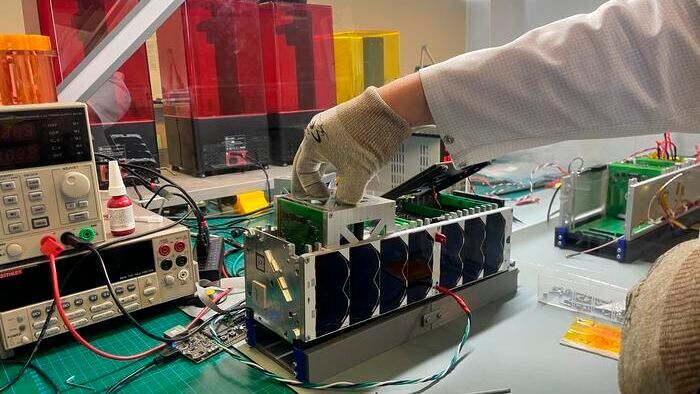
ADCS box (Attitude Determination and Control System) being installed in the qualification model of the Innocube satellite.
(Source: Tom Baumann/ Uni Würzburg)
A true milestone on the path to autonomous space systems: a research team at Julius-Maximilians-Universität Würzburg (JMU) has successfully tested an AI-based attitude controller for satellites directly in orbit — a world first! The test was carried out aboard the 3U nanosatellite Innocube.
During the satellite pass between 11:40 and 11:49 a.m. CET on 30 October 2025, the AI agent developed at JMU performed a complete attitude maneuver in orbit, controlled entirely by artificial intelligence. Using reaction wheels, the AI brought the satellite from its current initial attitude to a specified target attitude. The AI then had several further chances to prove its abilities: in subsequent tests, it also successfully and safely controlled the satellite to the desired attitude.
The Lelar research team — Dr. Kirill Djebko, Tom Baumann, Erik Dilger, Professor Frank Puppe and Professor Sergio Montenegro — has thus taken a decisive step towards space autonomy.
The Lelar Project
The “In-Orbit Demonstrator for Learning Attitude Control” (Lelar; German: In-Orbit Demonstrator Lernende Lageregelung) project aims to develop the next generation of autonomous attitude control systems. Its central focus was the design, training and in-orbit testing of an AI-based attitude controller aboard the Innocub nanosatellite.
Attitude controllers stabilise satellites in orbit and prevent them from tumbling. They are also used to point the spacecraft in a desired direction. For example, to align cameras, sensors or antennas with a specific target.
What makes this work special is that the Würzburg controller was not built using traditional, fixed algorithms. Instead, the researchers applied a Deep Reinforcement Learning (DRL) approach — a branch of machine learning in which a neural network autonomously learns the optimal control strategy in a simulated environment.
Fast and Adaptive
The key advantage of the DRL approach lies in its speed and flexibility compared to classical control development. Traditional attitude controllers often require lengthy manual tuning of parameters by engineers — sometimes taking months or even years.
The DRL method automates this process. Moreover, it offers the potential to create controllers that automatically adapt to differences between expected and actual conditions, eliminating the need for time-consuming manual recalibration.
Before deployment, the AI controller was trained on Earth in a high-fidelity simulation and then uploaded to the satellite’s flight model in orbit. One of the greatest challenges was bridging the so-called Sim2Real gap — ensuring that a controller trained in simulation is also operational on the real satellite in space.
“A truly decisive success,” emphasises Kirill Djebko of JMU. “We have achieved the world’s first practical proof that a satellite attitude controller trained using Deep Reinforcement Learning can operate successfully in orbit,” he adds.
Tom Baumann explains: “This successful test marks a major step forward in the development of future satellite control systems. It shows that AI can not only perform in simulation but also execute precise, autonomous maneuvers under real conditions.”
Acceptance and Trust in AI for Space Applications
By successfully demonstrating an AI-based controller in orbit, the Würzburg team has shown that artificial intelligence can be reliably applied in safety-critical space missions.
Frank Puppe is convinced: “This will significantly increase the acceptance of AI methods in aeronautics and space research,” pointing out the important role of the simulation model.
Growing trust in such technology is a crucial step towards future autonomous missions. For instance, interplanetary or deep-space missions, where human intervention is impossible due to vast distances or communication delays. The AI-based approach could therefore become vital for spacecraft survival.
With this experiment, the Würzburg team has reached a major goal in the Lelar project, which has been funded since July 2024 by the Federal Ministry for Economic Affairs and Energy (BMWE) with around 430,000 euros. The project is managed by the German Space Agency at DLR.
“This success motivates us to extend the technology to new scenarios,” says Erik Dilger. The test was conducted aboard Innocube, a satellite developed in cooperation with Technische Universität Berlin (TU Berlin). Innocube serves as a platform for innovative space technologies, giving researchers the opportunity to test new concepts directly in orbit.
Date: 08.12.2025
Naturally, we always handle your personal data responsibly. Any personal data we receive from you is processed in accordance with applicable data protection legislation. For detailed information please see our privacy policy.
Consent to the use of data for promotional purposes
I hereby consent to Vogel Communications Group GmbH & Co. KG, Max-Planck-Str. 7-9, 97082 Würzburg including any affiliated companies according to §§ 15 et seq. AktG (hereafter: Vogel Communications Group) using my e-mail address to send editorial newsletters. A list of all affiliated companies can be found here
Newsletter content may include all products and services of any companies mentioned above, including for example specialist journals and books, events and fairs as well as event-related products and services, print and digital media offers and services such as additional (editorial) newsletters, raffles, lead campaigns, market research both online and offline, specialist webportals and e-learning offers. In case my personal telephone number has also been collected, it may be used for offers of aforementioned products, for services of the companies mentioned above, and market research purposes.
Additionally, my consent also includes the processing of my email address and telephone number for data matching for marketing purposes with select advertising partners such as LinkedIn, Google, and Meta. For this, Vogel Communications Group may transmit said data in hashed form to the advertising partners who then use said data to determine whether I am also a member of the mentioned advertising partner portals. Vogel Communications Group uses this feature for the purposes of re-targeting (up-selling, cross-selling, and customer loyalty), generating so-called look-alike audiences for acquisition of new customers, and as basis for exclusion for on-going advertising campaigns. Further information can be found in section “data matching for marketing purposes”.
In case I access protected data on Internet portals of Vogel Communications Group including any affiliated companies according to §§ 15 et seq. AktG, I need to provide further data in order to register for the access to such content. In return for this free access to editorial content, my data may be used in accordance with this consent for the purposes stated here. This does not apply to data matching for marketing purposes.
Right of revocation
I understand that I can revoke my consent at will. My revocation does not change the lawfulness of data processing that was conducted based on my consent leading up to my revocation. One option to declare my revocation is to use the contact form found at https://contact.vogel.de. In case I no longer wish to receive certain newsletters, I have subscribed to, I can also click on the unsubscribe link included at the end of a newsletter. Further information regarding my right of revocation and the implementation of it as well as the consequences of my revocation can be found in the data protection declaration, section editorial newsletter.
One such innovation is the wireless satellite bus SKITH (Skip The Harness), which replaces conventional cabling with wireless data transmission. This not only saves mass but also reduces potential sources of failure.
Outlook: The Next Stage of Space Autonomy
This successful in-orbit test establishes the University of Würzburg as a pioneer in AI-driven space systems. The demonstrated AI-based controller represents an important building block for future deep-space exploration. The Lelar project’s results may enable faster and more cost-effective development of new, complex AI-based controllers for a wide range of satellite platforms.
“The next goal is to build on this head start,” says Kirill Djebko. “It’s a major step towards full autonomy in space,” adds Sergio Montenegro. “We are at the beginning of a new class of satellite control systems: intelligent, adaptive and self-learning.”




:quality(80)/p7i.vogel.de/wcms/92/ad/92adbafb37924cea35ea3cf05b7a23e5/0130206318v2.jpeg "The world’s first fully functioning proof-of-concept quantum battery
(Source: Csiro)")
:quality(80)/p7i.vogel.de/wcms/9f/8b/9f8bc2b8491d7a514ca154e9588a07b7/0130205846v1.jpeg "The researchers’ new material, based on mineralised sawdust, is an excellent fire retardant. (Source: Dan Vivas Glaser / from Kürsteiner R et al. Chem Circularity 2026)")
:quality(80)/p7i.vogel.de/wcms/fd/73/fd73fcb3ceda89d1419de1083fcab7b4/0130081520v2.jpeg "The fingers at the heart of this technology were inspired by the fin-ray effect — a design principle derived from the natural structure of fish fins. (Source: University of Texas at Austin )")
:quality(80)/p7i.vogel.de/wcms/fe/64/fe649767c802d53ac63ee2c2a40b7e0d/0130060830v2.jpeg "Sample tube with light-active substance (Source: Elvira Eberhardt / Ulm University)")
:quality(80)/p7i.vogel.de/wcms/8f/b9/8fb98a958e4afe679865fbe52a473680/0129940982v2.jpeg "pH measurement in various nanoparticles using the Nine-Focus meter ensures precise stability and performance control. (Source: Mettler Toledo)")
:quality(80)/p7i.vogel.de/wcms/11/74/1174e5d4c8b07a64637dced8c9506b40/0129787561v2.jpeg "The Multicell Plus high-pressure reactor sets a new benchmark for operator safety, all-round accessibility and ease-of-use. (Source: Asynt)")
:quality(80)/p7i.vogel.de/wcms/ef/6e/ef6e96191183411973b77041fb6b1e16/0129785957v2.jpeg "Manufactured from high-quality crystal polystyrene - these new automation-ready plates are available in a choice of ANSI / SLAS standard (96-well and breakable 8-well strip) formats. (Source: Porvair Sciences)")
:quality(80)/p7i.vogel.de/wcms/ad/ca/adcaa20ef5ccaf7e3b325788b1e349c4/0129784872v2.jpeg "The high performance Degasi Flat Film in-line degasser. (Source: Biotech Fluidics)")
:quality(80)/p7i.vogel.de/wcms/e9/9c/e99cb19231197af70c489cb4acc2ead0/0130293444v2.jpeg "A new global study, led by researchers at Kaust in Saudi Arabia, shows that forests are most effective for climate regulation when conserved or restored in their natural or native locations. (Source: Kaust )")
:quality(80)/p7i.vogel.de/wcms/af/40/af40b535eb65c287fbd22ed5483d1d0e/0130206243v2.jpeg "The researchers dug soil pits in order to measure the carbon storage in soil
(Source: Johanna Asch)")
:quality(80)/p7i.vogel.de/wcms/2d/45/2d45aba62f5042baa00f7fd4fa629839/0130036533v2.jpeg "The population of Pune, India, is expected to reach 11 million by 2050. (Source: free licensed)")
:quality(80)/p7i.vogel.de/wcms/52/f8/52f8d5521fdab07ed0a865ec0d8919fd/0130009438v2.jpeg "Drylands support around half of global livestock production and sustain the livelihoods of close to a billion people, while also underpinning soil stability and carbon storage. (Source: Kaust )")
:quality(80)/p7i.vogel.de/wcms/6f/ba/6fba92196d0cbb1467334f8a2ecc520a/0130203021v2.jpeg "Low to moderate wine consumption shows lower risk compared with spirits, beer and cider (Source: free licensed)")
:quality(80)/p7i.vogel.de/wcms/a9/37/a9376f1d9a893570023d9aa97c085bc5/0129927485v2.jpeg "Examples of foods high in PUFAs include fatty fish and soybeans, while MUFAs include olive oil and avocadoes. (Source: free licensed)")
:quality(80)/p7i.vogel.de/wcms/ea/88/ea88ef8810e21cdd9bb852c70f385ba1/0129797385v2.jpeg "A team of NUS food scientists consisting of Assoc Prof Liu Shao Quan (centre), Dr Lu Yuyun (right) and Ms Geng Chenhan (left) pioneered a co-fermentation method that improves both the nutrient and flavor profile of kombu. (Source: NUS)")
:quality(80)/p7i.vogel.de/wcms/84/2c/842c7c1678ceeec7147ea3a36e238e75/0129356324v2.jpeg "Kaust and Nadec have signed a MOU that establishes a framework for long-term cooperation across agricultural research, technology development, and professional training. (Source: Kaust )")
:quality(80)/p7i.vogel.de/wcms/6e/b9/6eb95805568aa78dc2ed57f829cf33d4/0130300421v2.jpeg "A 10-minute digital program co-developed by a University of Texas psychologist significantly reduced symptoms of depression four weeks after use, according to results from one of the largest randomized controlled trials of single-session mental health interventions. (Source: University of Texas at Austin )")
:quality(80)/p7i.vogel.de/wcms/6f/e9/6fe9d920eca2c0b3bdeb55cbe9f01908/0130299237v2.jpeg "Study authors Jason Miska and Leah Billingham reading out enzymatic activity of microglia in cell cultures. (Source: Northwestern University.)")
:quality(80)/p7i.vogel.de/wcms/c4/54/c454661a9dd459cf7c5b632f79829358/0130284530v2.jpeg "The study shows that AI can be used to assess the build-up of calcium deposits in the arteries of the breast from the standard X-ray mammography scans that are currently used in routine breast cancer screening. (Source: ESC)")
:quality(80)/p7i.vogel.de/wcms/67/9b/679b140c164dbd7c4fe9eda4da91329b/0130281406v3.jpeg "This is the highest resolution molecular structure ever constructed of a key protein complex on the surface of the Andes virus, called the Gn-Gc tetramer, that enables it to infect cells. (Source: University of Texas at Austin)")
:quality(80)/images.vogel.de/vogelonline/bdb/1710600/1710675/original.jpg "Discover how to set yourself up for success when performing balance-based density determination of solids such as jewelry and precious metals. (Mettler Toledo)")
:quality(80)/images.vogel.de/vogelonline/bdb/1682500/1682579/original.jpg "The new XPR Analytical balance redesigned to meet the needs of laboratory technicians of working fast and lean. (Mettler Toledo)")
:quality(80)/images.vogel.de/vogelonline/bdb/1677000/1677080/original.jpg "Enhance your weighing accuracy, comfort and productivity with the redesigned XPR Analytical balance. (Mettler Toledo)")
:fill(fff,0)/p7i.vogel.de/companies/5f/3f/5f3f63ceedc78/knf-logo.jpg "KNF_Logo.jpg (www.knf.com)")
:quality(80)/p7i.vogel.de/wcms/f1/e2/f1e2ba78465466e8adaab76b65a0cce3/0126190802v1.jpeg "Stem cells from mice cryopreserved on the International Space Station for six months have produced healthy offspring.
(Source: KyotoU/ Shinohara lab)")
:quality(80)/p7i.vogel.de/wcms/95/95/95953cd19f23c7c212553ebb39e8fb3d/0128065661v2.jpeg "Wearable technology uses everyday gestures to reliably control robotic devices even under excessive motion noise, such as when the user is running, riding in a vehicle or in environments with turbulence. (Source: David Baillot/ UC San Diego Jacobs School of Engineering)")