Researchers at the Department of Energy’s Oak Ridge National Laboratory have developed an upcycling approach that adds value to discarded plastics for reuse in additive manufacturing, or 3D printing.
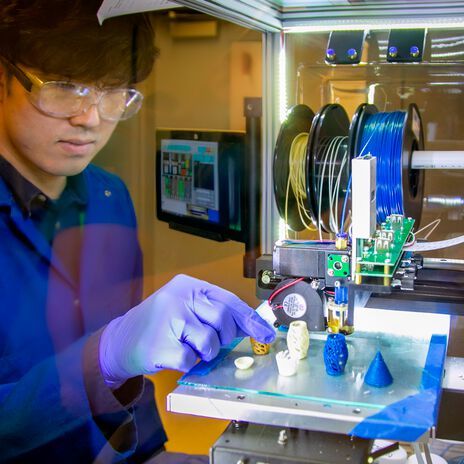
An Oak Ridge National Laboratory strategy for upcycled plastic waste offers printable, high-performance materials to advance additive manufacturing.
(Source: Genevieve Martin/ORNL, U.S. Dept. of Energy)
Oak Ridge/USA — A readily adoptable, scalable method introduces a closed-loop strategy that could globally reduce plastic waste and cut carbon emissions tied to plastic production. The team at Oak Ridge National Library upgraded acrylonitrile butadiene styrene, or ABS, a popular thermoplastic found in everyday objects ranging from auto parts to tennis balls to LEGO blocks. ABS is a popular feedstock for fused filament fabrication, or FFF, one of the most widely used 3D-printing methods. The upcycled version boasts enhanced strength, toughness and chemical resistance, making it attractive for FFF to meet new and higher performance applications not achievable with standard ABS.
Polymer upcycling plays an important role in addressing the growing challenge of global plastic waste accumulation. Approximately 400 million tons of plastic waste is generated each year, largely as single-use items that end up in landfills or the environment. Globally, less than ten percent of plastic waste is recycled.
“We will need fundamental discoveries to overcome the challenges of increased costs and deteriorating material properties associated with recycling,” said lead author Tomonori Saito of ORNL’s Chemical Sciences Division. “Our goal was to develop an easily adoptable strategy that reuses plastic waste to create a more valuable material instead of generating fresh plastic.”
The team targeted additive manufacturing, which is more resource efficient than conventional manufacturing and can achieve useful and complex 3D structures that would be difficult to produce by molding or casting. FFF makes up the largest share of this industry at nearly 70 percent of the global market.
Recovered upcycled ABS can be reused again and again for FFF with minimal loss of properties. It can also be combined with mixed and standard ABS, and directly printed as a blend.
Sungjin Kim
“Developing new, recyclable materials with superior properties for FFF creates opportunities to make a big impact on plastic production and expand additive manufacturing capabilities that have the potential to reduce our carbon footprint,” said ORNL’s Sungjin Kim.
FFF printing requires materials that can be extruded, or pushed, through a heated nozzle to form the threads of 3D structures, built layer by layer, like coiling a rope. As a thermoplastic material that responds to heat, ABS works well for the process because it can flow easily and harden quickly into strong, rigid structures. However, there are inherent weaknesses in the way the threads stack up and bind together. Developing new feedstocks with superior properties could advance high performance applications for FFF, but these have been difficult to design.
The team applied “click” chemistry to convert the chemical makeup of ABS into a vitrimer, a type of polymer that combines the processability and recyclability of thermoplastics with the superior mechanochemical properties of thermosets, such as epoxy, which are typically not compatible with FFF. The synthesis uses widely available medical compounds that are mixed in a single step under mild conditions, followed by curing with heat.
Results show upcycled ABS achieved approximately double the toughness and strength of standard ABS, with enhanced solvent resistance.
Multi-Pathway Approach
The team dissolved mixed plastic waste in various solvents, and in each experiment upcycled ABS maintained its structure, while all other plastics including ABS completely dissolved. “The approach is extremely versatile,” said Kim.
The multi-pathway approach enables both recycling and upcycling of mixed ABS waste containing any combination of standard, upcycled, or blended ABS. All are compatible with FFF and do not need to be separated prior to reprinting, but separation can easily be performed to offer a selection of useful materials for broad manufacturing applications.
“This effort demonstrates a closed-loop for manufacturing plastic items, potentially with higher value and performance, using only existing plastic waste in one of the most accessible areas of additive manufacturing,” said Saito.
Original Publication: Closed-loop additive manufacturing of upcycled commodity plastic through dynamic cross-linking; Science Advances; DOI:10.1126/sciadv.abn6006
Date: 08.12.2025
Naturally, we always handle your personal data responsibly. Any personal data we receive from you is processed in accordance with applicable data protection legislation. For detailed information please see our privacy policy.
Consent to the use of data for promotional purposes
I hereby consent to Vogel Communications Group GmbH & Co. KG, Max-Planck-Str. 7-9, 97082 Würzburg including any affiliated companies according to §§ 15 et seq. AktG (hereafter: Vogel Communications Group) using my e-mail address to send editorial newsletters. A list of all affiliated companies can be found here
Newsletter content may include all products and services of any companies mentioned above, including for example specialist journals and books, events and fairs as well as event-related products and services, print and digital media offers and services such as additional (editorial) newsletters, raffles, lead campaigns, market research both online and offline, specialist webportals and e-learning offers. In case my personal telephone number has also been collected, it may be used for offers of aforementioned products, for services of the companies mentioned above, and market research purposes.
Additionally, my consent also includes the processing of my email address and telephone number for data matching for marketing purposes with select advertising partners such as LinkedIn, Google, and Meta. For this, Vogel Communications Group may transmit said data in hashed form to the advertising partners who then use said data to determine whether I am also a member of the mentioned advertising partner portals. Vogel Communications Group uses this feature for the purposes of re-targeting (up-selling, cross-selling, and customer loyalty), generating so-called look-alike audiences for acquisition of new customers, and as basis for exclusion for on-going advertising campaigns. Further information can be found in section “data matching for marketing purposes”.
In case I access protected data on Internet portals of Vogel Communications Group including any affiliated companies according to §§ 15 et seq. AktG, I need to provide further data in order to register for the access to such content. In return for this free access to editorial content, my data may be used in accordance with this consent for the purposes stated here. This does not apply to data matching for marketing purposes.
Right of revocation
I understand that I can revoke my consent at will. My revocation does not change the lawfulness of data processing that was conducted based on my consent leading up to my revocation. One option to declare my revocation is to use the contact form found at https://contact.vogel.de. In case I no longer wish to receive certain newsletters, I have subscribed to, I can also click on the unsubscribe link included at the end of a newsletter. Further information regarding my right of revocation and the implementation of it as well as the consequences of my revocation can be found in the data protection declaration, section editorial newsletter.




:quality(80)/p7i.vogel.de/wcms/66/7c/667c242f45cc06eb5bee090c7723ba0b/0130384415v2.jpeg "Inspired by arm-wrestling, the NUS team built a self-training platform (left) where two rings of muscle tissues continuously and autonomously pull against each other. Ostrabot (right), made from a single trained ring of muscle and two flexible tails, swims 3 times faster than counterparts with conventionally cultured muscle. (Source: National University of Singapore)")
:quality(80)/p7i.vogel.de/wcms/92/ad/92adbafb37924cea35ea3cf05b7a23e5/0130206318v2.jpeg "The world’s first fully functioning proof-of-concept quantum battery
(Source: Csiro)")
:quality(80)/p7i.vogel.de/wcms/9f/8b/9f8bc2b8491d7a514ca154e9588a07b7/0130205846v1.jpeg "The researchers’ new material, based on mineralised sawdust, is an excellent fire retardant. (Source: Dan Vivas Glaser / from Kürsteiner R et al. Chem Circularity 2026)")
:quality(80)/p7i.vogel.de/wcms/fd/73/fd73fcb3ceda89d1419de1083fcab7b4/0130081520v2.jpeg "The fingers at the heart of this technology were inspired by the fin-ray effect — a design principle derived from the natural structure of fish fins. (Source: University of Texas at Austin )")
:quality(80)/p7i.vogel.de/wcms/8f/b9/8fb98a958e4afe679865fbe52a473680/0129940982v2.jpeg "pH measurement in various nanoparticles using the Nine-Focus meter ensures precise stability and performance control. (Source: Mettler Toledo)")
:quality(80)/p7i.vogel.de/wcms/11/74/1174e5d4c8b07a64637dced8c9506b40/0129787561v2.jpeg "The Multicell Plus high-pressure reactor sets a new benchmark for operator safety, all-round accessibility and ease-of-use. (Source: Asynt)")
:quality(80)/p7i.vogel.de/wcms/ef/6e/ef6e96191183411973b77041fb6b1e16/0129785957v2.jpeg "Manufactured from high-quality crystal polystyrene - these new automation-ready plates are available in a choice of ANSI / SLAS standard (96-well and breakable 8-well strip) formats. (Source: Porvair Sciences)")
:quality(80)/p7i.vogel.de/wcms/ad/ca/adcaa20ef5ccaf7e3b325788b1e349c4/0129784872v2.jpeg "The high performance Degasi Flat Film in-line degasser. (Source: Biotech Fluidics)")
:quality(80)/p7i.vogel.de/wcms/21/9b/219b000051ab1ea14ab5f92e4fd0f9bb/0130384937v2.jpeg "Deforestation in the Appalachian mountains. (Source: Alex Diaz on Unsplash)")
:quality(80)/p7i.vogel.de/wcms/e9/9c/e99cb19231197af70c489cb4acc2ead0/0130293444v2.jpeg "A new global study, led by researchers at Kaust in Saudi Arabia, shows that forests are most effective for climate regulation when conserved or restored in their natural or native locations. (Source: Kaust )")
:quality(80)/p7i.vogel.de/wcms/af/40/af40b535eb65c287fbd22ed5483d1d0e/0130206243v2.jpeg "The researchers dug soil pits in order to measure the carbon storage in soil
(Source: Johanna Asch)")
:quality(80)/p7i.vogel.de/wcms/2d/45/2d45aba62f5042baa00f7fd4fa629839/0130036533v2.jpeg "The population of Pune, India, is expected to reach 11 million by 2050. (Source: free licensed)")
:quality(80)/p7i.vogel.de/wcms/6f/ba/6fba92196d0cbb1467334f8a2ecc520a/0130203021v2.jpeg "Low to moderate wine consumption shows lower risk compared with spirits, beer and cider (Source: free licensed)")
:quality(80)/p7i.vogel.de/wcms/a9/37/a9376f1d9a893570023d9aa97c085bc5/0129927485v2.jpeg "Examples of foods high in PUFAs include fatty fish and soybeans, while MUFAs include olive oil and avocadoes. (Source: free licensed)")
:quality(80)/p7i.vogel.de/wcms/ea/88/ea88ef8810e21cdd9bb852c70f385ba1/0129797385v2.jpeg "A team of NUS food scientists consisting of Assoc Prof Liu Shao Quan (centre), Dr Lu Yuyun (right) and Ms Geng Chenhan (left) pioneered a co-fermentation method that improves both the nutrient and flavor profile of kombu. (Source: NUS)")
:quality(80)/p7i.vogel.de/wcms/84/2c/842c7c1678ceeec7147ea3a36e238e75/0129356324v2.jpeg "Kaust and Nadec have signed a MOU that establishes a framework for long-term cooperation across agricultural research, technology development, and professional training. (Source: Kaust )")
:quality(80)/p7i.vogel.de/wcms/30/2e/302e195d532fc9aced73406b07642b57/0130384900v2.jpeg "Sleeping for 11 minutes more, doing an additional 4.5 minutes of moderate-to-vigorous physical activity, and eating additional quarter of a cup of vegetables were associated with a 10 % reduction in major cardiovascular events. (Source: Pixabay)")
:quality(80)/p7i.vogel.de/wcms/47/41/4741ee3c589369a09ab0e3a26b7143f0/0130384858v2.jpeg "A female, Aedes aegypti mosquito, after taking her blood meal. (Source: Lauren Bishop CDC)")
:quality(80)/p7i.vogel.de/wcms/66/a6/66a64c9dd7dbe84d2d7ea95a5e691bb1/0130361609v2.jpeg "Dr. Priya Freaney speaking to a patient at Bluhm Cardiovascular Institute at Northwestern Memorial Hospital in Chicago. (Source: Northwestern Medicine)")
:quality(80)/p7i.vogel.de/wcms/6e/d4/6ed479ad990b9ddc0f2eeadccccf62c7/0130359257v2.jpeg "Routine early measurement of neurofilament light chain could help improve prediction of cognitive impairment after out-of-hospital cardiac arrest, according to a study presented recently at ESC Acute Cardiovascular Care 2026. (Source: Pixabay)")
:quality(80)/images.vogel.de/vogelonline/bdb/1710600/1710675/original.jpg "Discover how to set yourself up for success when performing balance-based density determination of solids such as jewelry and precious metals. (Mettler Toledo)")
:quality(80)/images.vogel.de/vogelonline/bdb/1682500/1682579/original.jpg "The new XPR Analytical balance redesigned to meet the needs of laboratory technicians of working fast and lean. (Mettler Toledo)")
:quality(80)/images.vogel.de/vogelonline/bdb/1677000/1677080/original.jpg "Enhance your weighing accuracy, comfort and productivity with the redesigned XPR Analytical balance. (Mettler Toledo)")
:quality(80)/p7i.vogel.de/wcms/c1/54/c154ed55b14917ef5ac45fe2517c3852/0126965477v2.jpeg "It’s moldable, biocompatible and glitters like gold. Plastic that can conduct an electric charge is a material that can be used for everything from sensors that can monitor our health to self-cooling clothing or electronic adhesive plasters that can be applied to the skin and send data directly to a mobile phone. (Source: Chalmers University of Technology, Henrik Sandsjö)")
:quality(80)/p7i.vogel.de/wcms/d8/42/d842014a015e22475805914990ad2fd6/0127562647v1.jpeg "Researchers at the University of Washington created a recyclable composite material made of tiny droplets of liquid metal infused into a stretchy polymer. The droplets, pictured in this microscope image, can be connected easily together to form an electrical circuit. (Source: Y. Han/ Advanced Functional Materials)")