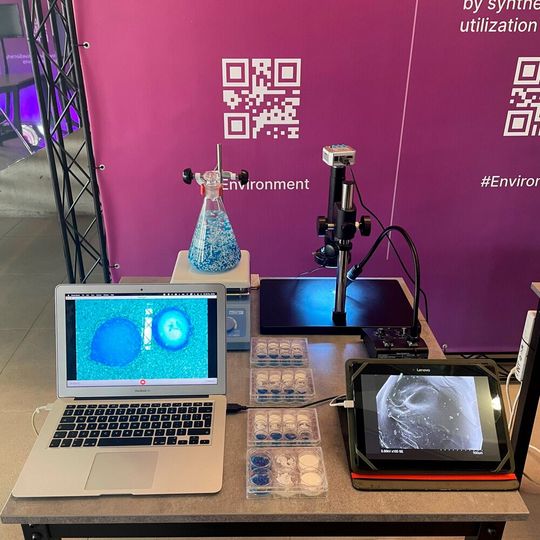
A team of researchers from Kaunas University of Technology (KTU), Lithuania, developed an innovative method for cleaning contaminated water. Hydrogel granules made from polyvinyl alcohol (PVA) function as a biological carrier for microorganism cultures, which decompose pollutants in wastewater.
Inside the pores of the granules, cultures of microorganisms that decompose pollutants in wastewater can live.
(Source: KTU)
The availability of clean water is of utmost importance for everyone. In addition to household effluent and human waste, urban-based hospitals and industries such as small-scale mining and motor garages, often dump highly toxic chemicals and medical waste into the wastewater system. Pollutants released into the environment pose a significant threat not only to human health but to the ecosystem as a whole.
The European Commission report reveals that 95 percent of wastewater in the EU is collected and 88 percent is biologically treated. However, over six percent is not sufficiently well treated to meet secondary biological treatment standards. According to Judita Švaikauskaitė, a young researcher at KTU, the increasing number of micropollutants in waste and surface water poses challenges to wastewater treatment plants’ engineers around the world.
“Water quality in the European Union is being closely monitored and analysed. The wastewater treatment companies need to update their methods with up-to-date technologies. Ozonation and other oxidation methods, biological treatment, and membrane filtration are the advanced technologies used to remove pollutants from water. Also, to improve the efficiency of biological treatment various biological carriers are used,” says Švaikauskaitė.
The winner of the Technorama’22 prize emphasises that advanced water treatment technologies that help improve water quality faster, more efficiently and without major changes to the existing plats’ infrastructure are in high demand.
Award-Winning Innovation
Hydrogel granules, designed by a team of environmental scientists from the KTU Faculty of Chemical Technology, are made from polyvinyl alcohol (PVA). Sized 3-4 mm in diameter, a granule has a porous structure made of macropores of up to 20 microns — an appropriate size to immobilise microorganisms — therefore can serve as a biological carrier. The use of PVA hydrogel granules in biological wastewater treatment technologies can increase the removal efficiency of pollutants up to five times compared to conventional activated sludge treatment.
“Inside the pores of the granules, cultures of microorganisms that decompose pollutants in wastewater can live. The network of pores in the PVA hydrogel granules, ensures a constant supply of oxygen and nutrients to the bacteria inside the granules, thus creating a highly durable and efficient biological wastewater treatment system,” says Švaikauskaitė.
PVA hydrogel granules are mechanically stable and therefore suitable for long-term use. The bacteria play a significant role in this process — they use ammonia, phosphate, organic compounds, and other dangerous chemical substances as nutrient and energy sources. A wide spectrum of bacteria can be immobilised inside a gel granule. PVA hydrogel granules demonstrate great absorption capacities for organic micropollutants and pharmaceuticals.
“PVA hydrogel granules not only increase the efficiency of the biological wastewater treatment system but also have excellent sorption properties in removing residues of pharmaceutical substances and other micro-pollutants from wastewater,” says Švaikauskaitė.
The environmentally friendly solution was created by Švaikauskaitė together with KTU Department of Environmental Technology researchers Inga Urniežaite and Vytautas Abromaitis. Their invention stood out among more than 70 teams who presented ideas for new technologies and scientific innovations in the Technorama’22 exhibition. Food, health, the environment, defence, digital solutions, mobility, engineering, and an inclusive society were among the fields represented in the innovation fair.
“I am very pleased that the work of our team has been noticed and appreciated. Winning the prize crowns a long, not always easy, but very interesting journey and gives confidence in pursuing a scientific career,” says Švaikauskaitė.
Even before her Industrial Biotechnology bachelor’s studies, Judita was interested in environmental protection.
Date: 08.12.2025
Naturally, we always handle your personal data responsibly. Any personal data we receive from you is processed in accordance with applicable data protection legislation. For detailed information please see our privacy policy.
Consent to the use of data for promotional purposes
I hereby consent to Vogel Communications Group GmbH & Co. KG, Max-Planck-Str. 7-9, 97082 Würzburg including any affiliated companies according to §§ 15 et seq. AktG (hereafter: Vogel Communications Group) using my e-mail address to send editorial newsletters. A list of all affiliated companies can be found here
Newsletter content may include all products and services of any companies mentioned above, including for example specialist journals and books, events and fairs as well as event-related products and services, print and digital media offers and services such as additional (editorial) newsletters, raffles, lead campaigns, market research both online and offline, specialist webportals and e-learning offers. In case my personal telephone number has also been collected, it may be used for offers of aforementioned products, for services of the companies mentioned above, and market research purposes.
Additionally, my consent also includes the processing of my email address and telephone number for data matching for marketing purposes with select advertising partners such as LinkedIn, Google, and Meta. For this, Vogel Communications Group may transmit said data in hashed form to the advertising partners who then use said data to determine whether I am also a member of the mentioned advertising partner portals. Vogel Communications Group uses this feature for the purposes of re-targeting (up-selling, cross-selling, and customer loyalty), generating so-called look-alike audiences for acquisition of new customers, and as basis for exclusion for on-going advertising campaigns. Further information can be found in section “data matching for marketing purposes”.
In case I access protected data on Internet portals of Vogel Communications Group including any affiliated companies according to §§ 15 et seq. AktG, I need to provide further data in order to register for the access to such content. In return for this free access to editorial content, my data may be used in accordance with this consent for the purposes stated here. This does not apply to data matching for marketing purposes.
Right of revocation
I understand that I can revoke my consent at will. My revocation does not change the lawfulness of data processing that was conducted based on my consent leading up to my revocation. One option to declare my revocation is to use the contact form found at https://contact.vogel.de. In case I no longer wish to receive certain newsletters, I have subscribed to, I can also click on the unsubscribe link included at the end of a newsletter. Further information regarding my right of revocation and the implementation of it as well as the consequences of my revocation can be found in the data protection declaration, section editorial newsletter.
“Later, during my final bachelor’s project, when I was designing a domestic wastewater treatment plant for a small town, I became more interested in biological treatment of polluted water, which is based on biotechnological processes,” says Švaikauskaitė.
Today, the young scientist, who has just graduated with a master’s degree in Environment Engineering is preparing for her doctoral studies where she expects to continue creating solutions for a cleaner environment. The 1.5 thousand euros Technorama’22 prize served as an additional incentive to choose a path as a scientist.




:quality(80)/p7i.vogel.de/wcms/45/87/458714daead8bb6b83d5305ff764e8c1/0130386255v1.jpeg "Examples of drawings from each category, with the scores they received from humans, independent AI and the human-guided AI. (Source: Advanced Science)")
:quality(80)/p7i.vogel.de/wcms/66/7c/667c242f45cc06eb5bee090c7723ba0b/0130384415v2.jpeg "Inspired by arm-wrestling, the NUS team built a self-training platform (left) where two rings of muscle tissues continuously and autonomously pull against each other. Ostrabot (right), made from a single trained ring of muscle and two flexible tails, swims 3 times faster than counterparts with conventionally cultured muscle. (Source: National University of Singapore)")
:quality(80)/p7i.vogel.de/wcms/92/ad/92adbafb37924cea35ea3cf05b7a23e5/0130206318v2.jpeg "The world’s first fully functioning proof-of-concept quantum battery
(Source: Csiro)")
:quality(80)/p7i.vogel.de/wcms/9f/8b/9f8bc2b8491d7a514ca154e9588a07b7/0130205846v1.jpeg "The researchers’ new material, based on mineralised sawdust, is an excellent fire retardant. (Source: Dan Vivas Glaser / from Kürsteiner R et al. Chem Circularity 2026)")
:quality(80)/p7i.vogel.de/wcms/8f/b9/8fb98a958e4afe679865fbe52a473680/0129940982v2.jpeg "pH measurement in various nanoparticles using the Nine-Focus meter ensures precise stability and performance control. (Source: Mettler Toledo)")
:quality(80)/p7i.vogel.de/wcms/11/74/1174e5d4c8b07a64637dced8c9506b40/0129787561v2.jpeg "The Multicell Plus high-pressure reactor sets a new benchmark for operator safety, all-round accessibility and ease-of-use. (Source: Asynt)")
:quality(80)/p7i.vogel.de/wcms/ef/6e/ef6e96191183411973b77041fb6b1e16/0129785957v2.jpeg "Manufactured from high-quality crystal polystyrene - these new automation-ready plates are available in a choice of ANSI / SLAS standard (96-well and breakable 8-well strip) formats. (Source: Porvair Sciences)")
:quality(80)/p7i.vogel.de/wcms/ad/ca/adcaa20ef5ccaf7e3b325788b1e349c4/0129784872v2.jpeg "The high performance Degasi Flat Film in-line degasser. (Source: Biotech Fluidics)")
:quality(80)/p7i.vogel.de/wcms/5d/bb/5dbb962b09bae1c078a8ff996666bc8e/0130386229v2.jpeg "This image created using Gemini Pro, depicts an activated carbon fiber functionalized with amine groups (–NH2) at adjacent positions. This arrangement improves the energy efficacy of key interactions, enabling the desorption of captured carbon dioxide at lower temperatures. (Source: Gemini / Yasuhiro Yamada/ Chiba University / KI-generiert)")
:quality(80)/p7i.vogel.de/wcms/21/9b/219b000051ab1ea14ab5f92e4fd0f9bb/0130384937v2.jpeg "Deforestation in the Appalachian mountains. (Source: Alex Diaz on Unsplash)")
:quality(80)/p7i.vogel.de/wcms/e9/9c/e99cb19231197af70c489cb4acc2ead0/0130293444v2.jpeg "A new global study, led by researchers at Kaust in Saudi Arabia, shows that forests are most effective for climate regulation when conserved or restored in their natural or native locations. (Source: Kaust )")
:quality(80)/p7i.vogel.de/wcms/af/40/af40b535eb65c287fbd22ed5483d1d0e/0130206243v2.jpeg "The researchers dug soil pits in order to measure the carbon storage in soil
(Source: Johanna Asch)")
:quality(80)/p7i.vogel.de/wcms/2a/07/2a0737995810d504b318f8a0f9ac2c3d/0130386209v1.jpeg "Simple, repeatable eating habits may help people stick to diets, see better results, study says (Source: free licensed)")
:quality(80)/p7i.vogel.de/wcms/6f/ba/6fba92196d0cbb1467334f8a2ecc520a/0130203021v2.jpeg "Low to moderate wine consumption shows lower risk compared with spirits, beer and cider (Source: free licensed)")
:quality(80)/p7i.vogel.de/wcms/a9/37/a9376f1d9a893570023d9aa97c085bc5/0129927485v2.jpeg "Examples of foods high in PUFAs include fatty fish and soybeans, while MUFAs include olive oil and avocadoes. (Source: free licensed)")
:quality(80)/p7i.vogel.de/wcms/ea/88/ea88ef8810e21cdd9bb852c70f385ba1/0129797385v2.jpeg "A team of NUS food scientists consisting of Assoc Prof Liu Shao Quan (centre), Dr Lu Yuyun (right) and Ms Geng Chenhan (left) pioneered a co-fermentation method that improves both the nutrient and flavor profile of kombu. (Source: NUS)")
:quality(80)/p7i.vogel.de/wcms/40/c0/40c0c09c2bad7b925a069edbbac90621/0130385557v1.jpeg "When a stroke damages brain tissue (red) along an important movement pathway (yellow), the injured side of the brain may show faster aging (red), while parts of the opposite side may appear relatively “younger” (blue) as the brain tries to compensate. This pattern is linked to more severe movement problems and less recovery.
(Bild: Stevens INI)")
:quality(80)/p7i.vogel.de/wcms/32/14/3214c28a03f71ad067c5f27e5bd6772b/0130386218v1.jpeg "Antimicrobial-resistant Salmonella poses severe challenges to global food safety and public health. (Source: free licensed)")
:quality(80)/p7i.vogel.de/wcms/30/2e/302e195d532fc9aced73406b07642b57/0130384900v2.jpeg "Sleeping for 11 minutes more, doing an additional 4.5 minutes of moderate-to-vigorous physical activity, and eating additional quarter of a cup of vegetables were associated with a 10 % reduction in major cardiovascular events. (Source: Pixabay)")
:quality(80)/p7i.vogel.de/wcms/47/41/4741ee3c589369a09ab0e3a26b7143f0/0130384858v2.jpeg "A female, Aedes aegypti mosquito, after taking her blood meal. (Source: Lauren Bishop CDC)")
:quality(80)/images.vogel.de/vogelonline/bdb/1710600/1710675/original.jpg "Discover how to set yourself up for success when performing balance-based density determination of solids such as jewelry and precious metals. (Mettler Toledo)")
:quality(80)/images.vogel.de/vogelonline/bdb/1682500/1682579/original.jpg "The new XPR Analytical balance redesigned to meet the needs of laboratory technicians of working fast and lean. (Mettler Toledo)")
:quality(80)/images.vogel.de/vogelonline/bdb/1677000/1677080/original.jpg "Enhance your weighing accuracy, comfort and productivity with the redesigned XPR Analytical balance. (Mettler Toledo)")
:fill(fff,0)/p7i.vogel.de/companies/5f/3f/5f3f63ceedc78/knf-logo.jpg "KNF_Logo.jpg (www.knf.com)")
:quality(80)/p7i.vogel.de/wcms/be/df/bedfe90cb7688f6f1c6c4a9793ec9bbf/0105443075.jpeg "0105443075 (Bild: ©luigi giordano - stock.adobe.com)")
:quality(80)/p7i.vogel.de/wcms/03/95/0395e673e26fd81beeea1055d0269707/0125270300v2.jpeg "3D-printed “pineapple” with cyanobacteria growing inside after a development period of 60 days. The green colour comes from the chlorophyll of the photosynthetic bacteria. (Source: Yifan Cui / ETH Zurich)")
:quality(80)/p7i.vogel.de/wcms/60/51/605177e7b4cff1ce0fc717b897dfa6e1/0125184006v2.jpeg "Young-Shin Jun’s lab developed a novel composite nanotechnology that removes and recovers nutrients from wastewater, subsequently upcycling them as agricultural fertilizers or as biorefinery feedstocks while simultaneously mitigating the occurrence of harmful algal blooms. (Source: Young-Shin Jun)")