Circular CircuitsNew Recyclable PCBs Could Drastically Reduce Global Electronic Waste
Source:
University of Washington
4 min Reading Time
PCBs, integral for housing and connecting electronic components, have traditionally been non-recyclable composites of glass fiber and plastic, often ending up in landfills or incinerated to recover valuable metals. In response, University of Washington researchers have pioneered a recyclable PCB using vitrimers, innovative polymers that can be dissolved, reformed, and reused with minimal material loss.
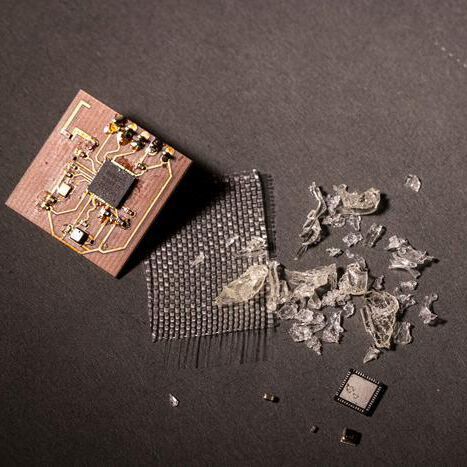
A team led by researchers at the University of Washington developed a new PCB that performs on par with traditional materials and can be recycled repeatedly with negligible material loss.
(Source: Mark Stone/ University of Washington)
A recent United Nations report found that the world generated 137 billion pounds of electronic waste in 2022, an 82 % increase from 2010. Yet less than a quarter of 2022’s e-waste was recycled. While many things impede a sustainable afterlife for electronics, one is that we don’t have systems at scale to recycle the printed circuit boards (PCBs) found in nearly all electronic devices.
PCBs — which house and interconnect chips, transistors and other components — typically consist of layers of thin glass fiber sheets coated in hard plastic and laminated together with copper. That plastic can’t easily be separated from the glass, so PCBs often pile up in landfills, where their chemicals can seep into the environment. Or they’re burned to extract their electronics’ valuable metals like gold and copper. This burning, often undertaken in developing nations, is wasteful and can be toxic — especially for those doing the work without proper protections.
A team led by researchers at the University of Washington developed a new PCB that performs on par with traditional materials and can be recycled repeatedly with negligible material loss. Researchers used a solvent that transforms a type of vitrimer — a cutting-edge class of sustainable polymers — to a jelly-like substance without damaging it, allowing the solid components to be plucked out for reuse or recycling.
The vitrimer jelly can then be repeatedly used to make new, high-quality PCBs, unlike conventional plastics that degrade significantly with each recycling. With these “vPCBs” (vitrimer printed circuit boards), researchers recovered 98 % of the vitrimer and 100 % of the glass fiber, as well as 91 % of the solvent used for recycling.
“PCBs make up a pretty large fraction of the mass and volume of electronic waste,” said co-senior author Vikram Iyer, a UW assistant professor in the Paul G. Allen School of Computer Science & Engineering. “They’re constructed to be fireproof and chemical-proof, which is great in terms of making them very robust. But that also makes them basically impossible to recycle. Here, we created a new material formulation that has the electrical properties comparable to conventional PCBs as well as a process to recycle them repeatedly.”
Vitrimers are a class of polymers first developed in 2015. When exposed to certain conditions, such as heat above a specific temperature, their molecules can rearrange and form new bonds. This makes them both “healable” (a bent PCB could be straightened, for instance) and highly recyclable.
“On a molecular level, polymers are kind of like spaghetti noodles, which wrap and get compacted,” said co-senior author Aniruddh Vashisth, a UW assistant professor in the mechanical engineering department. “But vitrimers are distinct because the molecules that make up each noodle can unlink and relink. It’s almost like each piece of spaghetti is made of small Legos.”
The team’s process to create the vPCB deviated only slightly from those used for PCBs. Conventionally, semi-cured PCB layers are held in cool, dry conditions where they have a limited shelf life before they’re laminated in a heat press. Because vitrimers can form new bonds, researchers laminated fully cured vPCB layers. The researchers found that to recycle the vPCBs they could immerse the material in an organic solvent that has a relatively low boiling point. This swelled the vPCB’s plastic without damaging the glass sheets and electronic components, letting the researchers extract these for reuse.
This process allows for several paths to more sustainable, circular PCB lifecycles. Damaged circuit boards, such those with cracks or warping, can in some cases be repaired. If they aren’t repaired, they can be separated from their electronic components. Those components can then be recycled or reused, while the vitrimer and glass fibers can get recycled into new vPCBs.
The team tested its vPCB for strength and electrical properties, and found that it performed comparable to the most common PCB material (FR-4). Vashisth and co-author Bichlien H. Nguyen, a principal researcher at Microsoft Research and an affiliate assistant professor in the Allen School, are now using artificial intelligence to explore new vitrimer formulations for different uses.
Date: 08.12.2025
Naturally, we always handle your personal data responsibly. Any personal data we receive from you is processed in accordance with applicable data protection legislation. For detailed information please see our privacy policy.
Consent to the use of data for promotional purposes
I hereby consent to Vogel Communications Group GmbH & Co. KG, Max-Planck-Str. 7-9, 97082 Würzburg including any affiliated companies according to §§ 15 et seq. AktG (hereafter: Vogel Communications Group) using my e-mail address to send editorial newsletters. A list of all affiliated companies can be found here
Newsletter content may include all products and services of any companies mentioned above, including for example specialist journals and books, events and fairs as well as event-related products and services, print and digital media offers and services such as additional (editorial) newsletters, raffles, lead campaigns, market research both online and offline, specialist webportals and e-learning offers. In case my personal telephone number has also been collected, it may be used for offers of aforementioned products, for services of the companies mentioned above, and market research purposes.
Additionally, my consent also includes the processing of my email address and telephone number for data matching for marketing purposes with select advertising partners such as LinkedIn, Google, and Meta. For this, Vogel Communications Group may transmit said data in hashed form to the advertising partners who then use said data to determine whether I am also a member of the mentioned advertising partner portals. Vogel Communications Group uses this feature for the purposes of re-targeting (up-selling, cross-selling, and customer loyalty), generating so-called look-alike audiences for acquisition of new customers, and as basis for exclusion for on-going advertising campaigns. Further information can be found in section “data matching for marketing purposes”.
In case I access protected data on Internet portals of Vogel Communications Group including any affiliated companies according to §§ 15 et seq. AktG, I need to provide further data in order to register for the access to such content. In return for this free access to editorial content, my data may be used in accordance with this consent for the purposes stated here. This does not apply to data matching for marketing purposes.
Right of revocation
I understand that I can revoke my consent at will. My revocation does not change the lawfulness of data processing that was conducted based on my consent leading up to my revocation. One option to declare my revocation is to use the contact form found at https://contact.vogel.de. In case I no longer wish to receive certain newsletters, I have subscribed to, I can also click on the unsubscribe link included at the end of a newsletter. Further information regarding my right of revocation and the implementation of it as well as the consequences of my revocation can be found in the data protection declaration, section editorial newsletter.
Producing vPCBs wouldn’t entail major changes to manufacturing processes.
“The nice thing is that a lot of industries — such as aerospace, automotive and even electronics — already have processing set up for the sorts of two-part epoxies that we use here,” said lead author Zhihan Zhang, a UW doctoral student in the Allen School.
The team analyzed the environmental impact and found recycled vPCBs could entail a 48 % reduction in global warming potential and an 81 % reduction in carcinogenic emissions compared to traditional PCBs. While this work presents a technology solution, the team notes that a significant hurdle to recycling vPCBs at scale would be creating systems and incentives to gather e-waste so it can be recycled.
“For real implementation of these systems, there needs to be cost parity and strong governmental regulations in place,” said Nguyen. “Moving forward, we need to design and optimize materials with sustainability metrics as a first principle.”
Original Article: Recyclable vitrimer-based printed circuit boards for sustainable electronics; Nature Sustainability; DOI:10.1038/s41893-024-01333-7




:quality(80)/p7i.vogel.de/wcms/92/ad/92adbafb37924cea35ea3cf05b7a23e5/0130206318v2.jpeg "The world’s first fully functioning proof-of-concept quantum battery
(Source: Csiro)")
:quality(80)/p7i.vogel.de/wcms/9f/8b/9f8bc2b8491d7a514ca154e9588a07b7/0130205846v1.jpeg "The researchers’ new material, based on mineralised sawdust, is an excellent fire retardant. (Source: Dan Vivas Glaser / from Kürsteiner R et al. Chem Circularity 2026)")
:quality(80)/p7i.vogel.de/wcms/fd/73/fd73fcb3ceda89d1419de1083fcab7b4/0130081520v2.jpeg "The fingers at the heart of this technology were inspired by the fin-ray effect — a design principle derived from the natural structure of fish fins. (Source: University of Texas at Austin )")
:quality(80)/p7i.vogel.de/wcms/fe/64/fe649767c802d53ac63ee2c2a40b7e0d/0130060830v2.jpeg "Sample tube with light-active substance (Source: Elvira Eberhardt / Ulm University)")
:quality(80)/p7i.vogel.de/wcms/8f/b9/8fb98a958e4afe679865fbe52a473680/0129940982v2.jpeg "pH measurement in various nanoparticles using the Nine-Focus meter ensures precise stability and performance control. (Source: Mettler Toledo)")
:quality(80)/p7i.vogel.de/wcms/11/74/1174e5d4c8b07a64637dced8c9506b40/0129787561v2.jpeg "The Multicell Plus high-pressure reactor sets a new benchmark for operator safety, all-round accessibility and ease-of-use. (Source: Asynt)")
:quality(80)/p7i.vogel.de/wcms/ef/6e/ef6e96191183411973b77041fb6b1e16/0129785957v2.jpeg "Manufactured from high-quality crystal polystyrene - these new automation-ready plates are available in a choice of ANSI / SLAS standard (96-well and breakable 8-well strip) formats. (Source: Porvair Sciences)")
:quality(80)/p7i.vogel.de/wcms/ad/ca/adcaa20ef5ccaf7e3b325788b1e349c4/0129784872v2.jpeg "The high performance Degasi Flat Film in-line degasser. (Source: Biotech Fluidics)")
:quality(80)/p7i.vogel.de/wcms/af/40/af40b535eb65c287fbd22ed5483d1d0e/0130206243v2.jpeg "The researchers dug soil pits in order to measure the carbon storage in soil
(Source: Johanna Asch)")
:quality(80)/p7i.vogel.de/wcms/2d/45/2d45aba62f5042baa00f7fd4fa629839/0130036533v2.jpeg "The population of Pune, India, is expected to reach 11 million by 2050. (Source: free licensed)")
:quality(80)/p7i.vogel.de/wcms/52/f8/52f8d5521fdab07ed0a865ec0d8919fd/0130009438v2.jpeg "Drylands support around half of global livestock production and sustain the livelihoods of close to a billion people, while also underpinning soil stability and carbon storage. (Source: Kaust )")
:quality(80)/p7i.vogel.de/wcms/fe/49/fe494ada322615b6e6f6ff0f5bb7c5cf/0129926008v2.jpeg "A mandrill eating fruit. (Source: University of Bristol )")
:quality(80)/p7i.vogel.de/wcms/6f/ba/6fba92196d0cbb1467334f8a2ecc520a/0130203021v2.jpeg "Low to moderate wine consumption shows lower risk compared with spirits, beer and cider (Source: free licensed)")
:quality(80)/p7i.vogel.de/wcms/a9/37/a9376f1d9a893570023d9aa97c085bc5/0129927485v2.jpeg "Examples of foods high in PUFAs include fatty fish and soybeans, while MUFAs include olive oil and avocadoes. (Source: free licensed)")
:quality(80)/p7i.vogel.de/wcms/ea/88/ea88ef8810e21cdd9bb852c70f385ba1/0129797385v2.jpeg "A team of NUS food scientists consisting of Assoc Prof Liu Shao Quan (centre), Dr Lu Yuyun (right) and Ms Geng Chenhan (left) pioneered a co-fermentation method that improves both the nutrient and flavor profile of kombu. (Source: NUS)")
:quality(80)/p7i.vogel.de/wcms/84/2c/842c7c1678ceeec7147ea3a36e238e75/0129356324v2.jpeg "Kaust and Nadec have signed a MOU that establishes a framework for long-term cooperation across agricultural research, technology development, and professional training. (Source: Kaust )")
:quality(80)/p7i.vogel.de/wcms/e9/73/e9732473361377610267347df55071a1/0130205830v2.jpeg "Sleep EEG signals may reveal whether the brain is aging faster than the body — and help identify elevated dementia risk earlier. (Source: free licensed)")
:quality(80)/p7i.vogel.de/wcms/ed/c0/edc0c1a86229b11efd17c5e3f94d14da/0130081211v2.jpeg "A new study finds that virtual visits did not make it easier for psychiatrists, psychologists and therapists to reach significantly more people in areas where access to care has long been limited. (Source: Pixabay)")
:quality(80)/p7i.vogel.de/wcms/9c/52/9c52318bc94be17e6662dfceffa4a0c0/0130060546v2.jpeg "Domestic cat ‘Lanni’ from co-author of the study, Latasha Ludwig, Assistant Clinical Professor at Cornell University, USA. (Source: © Latasha Ludwig)")
:quality(80)/p7i.vogel.de/wcms/4b/f4/4bf4cc9e28e65e11a27dd41da2d1a7f5/0130038185v2.jpeg "The biomarker p-tau217 could help identify women at elevated dementia risk decades before clinical symptoms begin. (Source: free licensed)")
:quality(80)/images.vogel.de/vogelonline/bdb/1710600/1710675/original.jpg "Discover how to set yourself up for success when performing balance-based density determination of solids such as jewelry and precious metals. (Mettler Toledo)")
:quality(80)/images.vogel.de/vogelonline/bdb/1682500/1682579/original.jpg "The new XPR Analytical balance redesigned to meet the needs of laboratory technicians of working fast and lean. (Mettler Toledo)")
:quality(80)/images.vogel.de/vogelonline/bdb/1677000/1677080/original.jpg "Enhance your weighing accuracy, comfort and productivity with the redesigned XPR Analytical balance. (Mettler Toledo)")
:quality(80)/p7i.vogel.de/wcms/a6/03/a603fe75a035788da7a75d25d24d6475/0115221416.jpeg "Plastic recycling facilities are located all over the world. But the plastic that is extracted contains hundreds of chemicals, many of which are dangerous to people and the environment. (Source: Greenpeace)")
:quality(80)/p7i.vogel.de/wcms/d8/42/d842014a015e22475805914990ad2fd6/0127562647v1.jpeg "Researchers at the University of Washington created a recyclable composite material made of tiny droplets of liquid metal infused into a stretchy polymer. The droplets, pictured in this microscope image, can be connected easily together to form an electrical circuit. (Source: Y. Han/ Advanced Functional Materials)")
:quality(80)/p7i.vogel.de/wcms/32/ae/32ae11ef4154e0a95f766875fd10ad47/0124884486v2.jpeg "An intercrystal formed by overlaying twisted graphene on hexagonal boron nitride. (Source: Andrei Lab/ Rutgers University)")