From Pathogen to TreatmentBasic Research on Listeria Bacteria Leads to Unique Cancer Therapy
Source:
University of California - Berkeley
4 min Reading Time
Decades of basic research on the foodborne pathogen Listeria monocytogenes have culminated in an unexpected medical application: a novel cancer therapy designed to activate the body’s innate immune system.
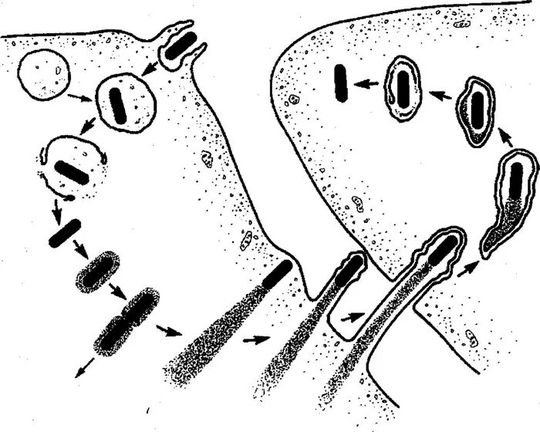
The Listeria lifecycle after it infects a mammalian host. Counterclockwise from upper left, the bacteria are quickly ingested by an immune system cell called a macrophage, where they end up in an organ called the phagosome for digestion. But they escape the phagosome and enlist a protein called actin to build a needle-like protrusion and push it through the cell wall into a neighboring cell, starting the cycle over again. The Listeria strain used for cancer therapy is unable to co-opt actin and thus cannot infect other cells to cause illness.
(Source: American Society for Cell Biology)
After nearly 40 years of research on how Listeria bacteria manipulate our cells and battle our immune system to cause listeriosis, Daniel Portnoy and his colleagues have discovered a way to turn the bacteria into a potent booster of the immune system — and a potential weapon against cancer.
Three years ago, Portnoy cofounded a startup, Laguna Biotherapeutics, that worked with scientists in his University of California, Berkeley lab to eliminate the bacteria’s ability to cause disease while retaining its ability to rev up production of a type of immune system cell associated with increased survival in cancer patients. These so-called gamma delta T cells are general-purpose killers of cancer cells or any cell infected by a pathogen — bacteria, virus or fungus.
Laguna Bio will soon ask the FDA for clearance to evaluate the therapy in children with leukemia who have received unmatched bone marrow transplants. Stanford University Medical Center doctors hope that the engineered Listeria will boost gamma delta T cells in pediatric patients and help them stave off graft-versus-host disease, fight potentially deadly infections that take advantage of a transplant patient’s compromised immune system and prevent the cancer from returning.
Portnoy and his colleagues foresee a broader application of this Listeria therapy, which is unique among cancer therapies in stimulating the body’s innate immune system to eliminate essentially any cell that puts out a distress signal indicating it’s been compromised. Today’s immunotherapies for cancer typically activate the “adaptive” immune system, boosting cells that recognize and kill cancer cells.
“The issue is that tumors are a suppressive environment, and so the immune system isn't really even working,” said Portnoy, a UC Berkeley professor of molecular and cell biology and of plant and microbial biology. “There are lots of attempts to try to reawaken the immune system, such as using checkpoint inhibitors, which were originally developed at UC Berkeley. The idea is somewhat similar with Listeria: Listeria itself is seen as foreign and induces an innate immune response, which allows the body to overcome the suppression.”
Late last year, Portnoy and his Berkeley and Laguna Bio collaborators published details of the successful use of the attenuated Listeria therapy in mice in the journal mBio, a publication of the American Society for Microbiology. In another study posted last year on the Biorxiv preprint server, they reported that Listeria can also be engineered to boost another type of innate immune cell — mucosal-associated invariant T cell, or MAIT— that helps defend against infections and possibly cancer.
“What we’re doing is based on decades of literature, chief among them Dr. Portnoy’s work, showing that Listeria generates a really unique immune response,” said Laguna Bio CEO Jonathan Kotula. “We believe that if you want to generate a comprehensive immune response, you need to carefully orchestrate the entire immune system. And attenuated Listeria seems to be doing that.”
Escape from the Phagosome
Listeria monocytogenes is a foodborne pathogen that causes gastrointestinal disease and fever in some people but occasionally spreads from the intestines to cause deadly sepsis or meningitis. Researchers have documented how, after infection, the bacteria are engulfed by scavenger cells called phagocytes, where they are captured by an organelle called a phagosome that digests invaders. But Portnoy showed nearly 40 years ago that before that can happen, the bacteria escape the phagosome and set up shop in the cell interior, hiding out from the host’s immune system until they reproduce and spread to infect new cells.
Despite this immune evasion, Listeria triggers cytotoxic CD8 T cells. In the 2000s, Daniel Portnoy and Aduro Biotech used genetically weakened Listeria engineered with cancer antigens to stimulate anti-tumor immunity. To make the bacterium safer, two genes required for cell-to-cell spread were deleted, producing a strain that still entered cells and activated immunity but was far less virulent.
“We found that a strain that was unable to nucleate actin will still get into the cytosol of cells, still grow and induce a potent immune response, but since it doesn't spread, it's a thousandfold less virulent,” Portnoy said.
The resulting LADD strain was tested in nearly 1,000 patients but proved less effective in humans than in mice, leading Aduro to halt the trials in 2020. However, the studies revealed that Listeria also activates gamma delta T cells of the innate immune system, which can attack cancer cells and stimulate broader immune responses.
Date: 08.12.2025
Naturally, we always handle your personal data responsibly. Any personal data we receive from you is processed in accordance with applicable data protection legislation. For detailed information please see our privacy policy.
Consent to the use of data for promotional purposes
I hereby consent to Vogel Communications Group GmbH & Co. KG, Max-Planck-Str. 7-9, 97082 Würzburg including any affiliated companies according to §§ 15 et seq. AktG (hereafter: Vogel Communications Group) using my e-mail address to send editorial newsletters. A list of all affiliated companies can be found here
Newsletter content may include all products and services of any companies mentioned above, including for example specialist journals and books, events and fairs as well as event-related products and services, print and digital media offers and services such as additional (editorial) newsletters, raffles, lead campaigns, market research both online and offline, specialist webportals and e-learning offers. In case my personal telephone number has also been collected, it may be used for offers of aforementioned products, for services of the companies mentioned above, and market research purposes.
Additionally, my consent also includes the processing of my email address and telephone number for data matching for marketing purposes with select advertising partners such as LinkedIn, Google, and Meta. For this, Vogel Communications Group may transmit said data in hashed form to the advertising partners who then use said data to determine whether I am also a member of the mentioned advertising partner portals. Vogel Communications Group uses this feature for the purposes of re-targeting (up-selling, cross-selling, and customer loyalty), generating so-called look-alike audiences for acquisition of new customers, and as basis for exclusion for on-going advertising campaigns. Further information can be found in section “data matching for marketing purposes”.
In case I access protected data on Internet portals of Vogel Communications Group including any affiliated companies according to §§ 15 et seq. AktG, I need to provide further data in order to register for the access to such content. In return for this free access to editorial content, my data may be used in accordance with this consent for the purposes stated here. This does not apply to data matching for marketing purposes.
Right of revocation
I understand that I can revoke my consent at will. My revocation does not change the lawfulness of data processing that was conducted based on my consent leading up to my revocation. One option to declare my revocation is to use the contact form found at https://contact.vogel.de. In case I no longer wish to receive certain newsletters, I have subscribed to, I can also click on the unsubscribe link included at the end of a newsletter. Further information regarding my right of revocation and the implementation of it as well as the consequences of my revocation can be found in the data protection declaration, section editorial newsletter.
Building on this insight, Portnoy’s team developed an even safer strain, QUAIL, by deleting two additional genes needed to synthesize riboflavin-derived cofactors. The bacterium can now grow only inside cells, not in blood or other extracellular sites.
“We said, 'Oh my gosh, this strain fits the criteria that we were looking for' — a mutant of Listeria that could grow inside of cells but not outside of cells,” Portnoy said. “We have a strain that can't grow in blood, it can’t grow in the intestine, it doesn't grow in the gallbladder — these are all extracellular sites for growth — but it grows inside of cells. So that's the new safer strain, QUAIL. We're very excited about that.”
A new study shows QUAIL is safe in mice and as potent as LADD, while avoiding risks such as growth on medical implants. Drawing on prior human data, researchers now plan early trials in pediatric leukemia to harness gamma delta T cells.
“Taking all that body of data that existed before from Aduro allowed us to go forward with this plan that I think is really unique in that it's informed by robust human data,” Kotula said.
If successful, the approach could extend to other cancers and even infectious diseases.
Original Article: Reprogramming Listeria monocytogenes flavin metabolism to improve its therapeutic safety profile and broaden innate T-cell activation; mBi; DOI:10.1128/mbio.03652-25




:quality(80)/p7i.vogel.de/wcms/aa/39/aa398d3e6667bdb43ad57abf38dc394c/0129347450v2.jpeg "An illustration shows a strand of engineered DNA passing through a nanoscale sensor, where its physical structure can be decoded as digital information. DNA nanostructures could one day serve as ultra-dense carriers of digital information and advance the field of data encryption. (Source: Jason Drees/ ASU)")
:quality(80)/p7i.vogel.de/wcms/06/a1/06a11f1d752afb35854aa9e1afb62e98/0129209625v2.jpeg "“Unsinkable\" metal tube made from chemically-etched aluminum floats in distilled water at the lab of University of Rochester professor Chunlei Guo. (Source: J. Adam Fenster / University of Rochester)")
:quality(80)/p7i.vogel.de/wcms/6d/df/6ddf023361ec7f8fbfb6c56521577960/0129056554v2.jpeg "The evolution of carburization (depicted by the spheres) under kinetic control (illustrated by the surface contours). The molecular beams represent gas evolution under synthesis conditions while the fiery sphere highlights the formation of the pure tungsten semi-carbide phase with additional molecular beams at the top to illustrate its catalytic performance. (Source: Sinhara M. H. D. Perera)")
:quality(80)/p7i.vogel.de/wcms/26/3d/263d97f8f2797267ecf2781b56882758/0129056451v1.jpeg "A study by the Complexity Science Hub finds that AI systems are already involved in nearly one-third of newly written software code, with rapid adoption in the United States and Europe and measurable productivity gains mainly for experienced developers. (Source: free licensed)")
:quality(80)/p7i.vogel.de/wcms/21/03/21030cc2541c455da0769decca8d1f82/0129146048v2.jpeg "Vyon porous plastics from Porvair Sciences are the perfect material for filtration applications in the healthcare and medical device market. (Source: Porvair Sciences)")
:quality(80)/p7i.vogel.de/wcms/bd/aa/bdaae5b9d381e2471ab37f479ad43d79/0129143884v2.jpeg "The Solvent Line Monitor from Testa Analytical is a true plug-and-play addition to any HPLC system designed to detect when one or more of its pump solvent reservoirs are empty and automatically shut-off the system. (Source: Testa Analytical)")
:quality(80)/p7i.vogel.de/wcms/8f/66/8f66b8acbb3037ca8e6b320bcad1c817/0129118043v2.jpeg "The Plasmaquant 9200 series is ideal for applications in research, trace analysis and quality control. (Source: Analytik Jena )")
:quality(80)/p7i.vogel.de/wcms/66/82/66825163ab842baded640db1a484e729/0129117548v2.jpeg "Biotech Fluidics has announced the Smartsaver solvent recycling unit which is designed to recover up to 90 % of your mobile phase by redirection of the pure solvent to the solvent reservoir during isocratic HPLC. (Source: Biotech Fluidics )")
:quality(80)/p7i.vogel.de/wcms/c8/ad/c8ada88a48bc380a87b17fb820ca4721/0129504248v2.jpeg "A young star surrounded by a disk of gas and dust. New planets can form from this material. Whether they have the chemical conditions necessary for life depends on the correct oxygen content during core formation. (Source: Nasa-JPL)")
:quality(80)/p7i.vogel.de/wcms/1a/4f/1a4fe7f8b5541716ba908251738beca1/0129349759v2.jpeg "Krict’s Syngas-to-Sustainable Aviation Fuel (SAF) Conversion Facility (Source: Korea Research Institute of Chemical Technology (Krict))")
:quality(80)/p7i.vogel.de/wcms/d4/29/d429a973c6f14ced3d2eb44931669a78/0129348927v1.jpeg "Cage-like ulva biochar confined synthesis of Fe₃O₄/ZnO heterojunction nanoparticles for synergistic adsorption and photocatalytic degradation of PFOA
(Source: Hua Jing et. al.)")
:quality(80)/p7i.vogel.de/wcms/86/90/8690b8154a552da13b37f289349b1db4/0129283446v2.jpeg "Lina Pérez-Ángel holds two sediment samples whose ages are separated by about a million years. (Source: Ellen Jorgensen)")
:quality(80)/p7i.vogel.de/wcms/84/2c/842c7c1678ceeec7147ea3a36e238e75/0129356324v2.jpeg "Kaust and Nadec have signed a MOU that establishes a framework for long-term cooperation across agricultural research, technology development, and professional training. (Source: Kaust )")
:quality(80)/p7i.vogel.de/wcms/d1/3c/d13c2ad34af600dbd360c0bb0990b922/0129045715v2.jpeg "Replacing animal products with plant-based foods helps reduce the risk of heart disease and type 2 diabetes, finds a new review by the Physicians Committee for Responsible Medicine. (Source: Pixabay)")
:quality(80)/p7i.vogel.de/wcms/e1/b3/e1b3e26d03101ba93b76b304da150c9a/0129025388v2.jpeg "The research reanalyzed data from a seminal clinical trial, led by US National Institutes of Health veteran Dr Kevin Hall, which first exposed how eating exclusively UPFs results in excessive calorie consumption and weight gain. (Source: Pixabay)")
:quality(80)/p7i.vogel.de/wcms/75/db/75db8afe45607bee750df705e22b60e9/0128938816v1.jpeg "A new academic review suggests that bamboo shoots could offer significant health benefits, including improved blood sugar control, gut health and antioxidant activity. (Source: free licensed)")
:quality(80)/p7i.vogel.de/wcms/4f/b3/4fb3b146c4aedd40397a148c8322867f/0129504680v1.jpeg "Aerobic exercise, such as running, swimming, and dancing, may be most effective for relieving the symptoms of depression and anxiety. (Source: free licensed)")
:quality(80)/p7i.vogel.de/wcms/18/e6/18e6f3c86e5006f24237775af2a6124b/0129504632v1.jpeg "The Listeria lifecycle after it infects a mammalian host. Counterclockwise from upper left, the bacteria are quickly ingested by an immune system cell called a macrophage, where they end up in an organ called the phagosome for digestion. But they escape the phagosome and enlist a protein called actin to build a needle-like protrusion and push it through the cell wall into a neighboring cell, starting the cycle over again. The Listeria strain used for cancer therapy is unable to co-opt actin and thus cannot infect other cells to cause illness. (Source: American Society for Cell Biology)")
:quality(80)/p7i.vogel.de/wcms/bc/49/bc49ddee3b9194ee0589427d13610f11/0129504608v1.jpeg "The figure depicts associations between genetic variants and 921 different bacterial species in the Swedish cohorts (n = 16,017). Each point represents a genetic variant, and the higher the point, the stronger the association. Genetic regions that have not previously been identified in similar genetic studies are shown in purple. (Source: Tove Fall/ Uppsala University)")
:quality(80)/p7i.vogel.de/wcms/45/47/4547a006853506f31157fb435ce1449f/0129504589v1.jpeg "Elephant trunk whiskers shine (Source: MPI-IS/A. Posada)")
:quality(80)/images.vogel.de/vogelonline/bdb/1710600/1710675/original.jpg "Discover how to set yourself up for success when performing balance-based density determination of solids such as jewelry and precious metals. (Mettler Toledo)")
:quality(80)/images.vogel.de/vogelonline/bdb/1682500/1682579/original.jpg "The new XPR Analytical balance redesigned to meet the needs of laboratory technicians of working fast and lean. (Mettler Toledo)")
:quality(80)/images.vogel.de/vogelonline/bdb/1677000/1677080/original.jpg "Enhance your weighing accuracy, comfort and productivity with the redesigned XPR Analytical balance. (Mettler Toledo)")
:quality(80)/p7i.vogel.de/wcms/74/24/74240e173bab6975e14499ec0d72dc0b/0119162060v1.jpeg "The researchers created a chip with four distinct regions, capable of rapidly testing for the presence of multiple pathogens simultaneously. (Source: Feng et al.)")
:quality(80)/p7i.vogel.de/wcms/27/db/27db283a838c7e0a56f0439c8d752849/0122005107v2.jpeg "The clear test at left indicates a negative result, while the red color in the test at right indiates a positive result. (Source: Georgia Kirkos/ McMaster University)")
:quality(80)/p7i.vogel.de/wcms/4d/1f/4d1f7401aa9c168bb9822e714da370c1/0125011802v2.jpeg "Developed by NUS researchers, the Next platform works by interfacing cells with a dense forest of nanostraws. When a mild electrical signal is applied, the nanostraws open temporary pores in the cell membrane, allowing biomolecules such as mRNA or CRISPR/Cas9 complexes to enter the cell cytoplasm directly. (Source: NUS)")
:quality(80)/p7i.vogel.de/wcms/c9/f9/c9f90a352f8676b188f434fa02da7649/0125476575v1.jpeg "Prof. Dr. Stephanie Ganal-Vonarburg is a research group leader at the Department of Biomedical Research (DBMR), University of Bern, and University Clinic for Visceral Surgery and Medicine, Inselspital, University Hospital Bern. (Source: ZVG)")