Researchers have developed a metahydrogel platform integrated with AI-driven signal processing which enables clinical-grade tracking of heart signals and blood pressure during daily activities, paving the way for uninterrupted monitoring of mental-health states.
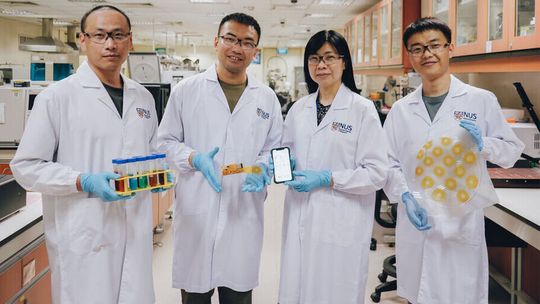
Prof Ho Ghim Wei (third from left) and her team - (from left) Dr Pan Xinglong, Dr Tian Guo, and Dr Li Zhiwei - have developed a hydrogel sensor system that delivers seamless, real-time monitoring of mental wellbeing.
(Source: NUS)
Queenstown/Singapore – About one in three employees in Singapore report feeling burnt out — one of the highest rates globally. Burnout and chronic fatigue carry a substantial economic cost and pose serious risks in professions where alertness is critical. Yet diagnosing fatigue and related mental health conditions today relies largely on self-reported questionnaires, which tend to be subjective, intermittent and poorly suited to real-time evaluation.
Wearable devices could fill the gap by continuously tracking cardiovascular markers linked to the autonomic nervous system, but their readings degrade sharply during everyday movement. Motion artefacts from muscle activity, body movement and physiological interference overwhelm the faint heart and blood pressure signals these devices are trying to capture, and current mitigation strategies typically address only one type of noise or a narrow frequency band.
A research team led by Professor Ho Ghim Wei from the Department of Electrical and Computer Engineering under the College of Design and Engineering at the National University of Singapore, with Research Fellow Dr Tian Guo as first author, has developed a metahydrogel platform integrated with AI-driven signal processing that suppresses multiple sources of motion noise simultaneously. The system delivers an electrocardiograph (ECG) signal-to-noise ratio (SNR) of 37.36 dB and blood pressure deviation as low as 3 mmHg during movement — accuracy that meets ISO clinical-grade standards and outperforms commercial trackers currently available in the market. Combined with machine learning, the platform classifies fatigue levels with 92 per cent accuracy, pointing towards objective, continuous mental health monitoring in real-world settings.
The findings were published in Nature Sensors on 24 March 2026.
Filtering noise at the source
Rather than relying solely on software to clean up noisy data, the team tackled the problem at the sensor-body interface itself. The metahydrogel artefact-mitigating platform (Map) combines two filtering mechanisms in a single material. Nanoparticles self-assembled into periodic bands within the hydrogel scatter and absorb mechanical vibrations, much like how a soundproofing panel traps sound energy, blocking movement noise within targeted frequency ranges. At the same time, a biocompatible glycerol-water electrolyte controls how quickly ions travel through the gel, letting low-frequency heart signals (below 30 Hz) pass through, while suppressing higher-frequency muscle electrical noise. A machine-learning denoising algorithm then removes any remaining unstructured noise while preserving critical physiological features.
The platform is soft enough to match the mechanical properties of biological tissue, breathable with a water vapor transmission rate exceeding that of human skin and durable under repeated stretching. By combining improved hardware with smart algorithms, the system made the ECG signal much cleaner, boosting signal quality from 5.19 dB to 37.36 dB. This clearer signal helps it detect key ECG peaks more reliably, raising peak-detection accuracy from 52 per cent to 93 per cent and making it easier to tell fatigue-related patterns from normal heart rhythms.
“Compared with current commercial devices, our metahydrogel platform demonstrates superior performance, particularly under motion conditions where artefact suppression is critical. Current smartwatches typically achieve ECG signal-to-noise ratios of 10-20 dB, which can decrease by approximately 40 per cent under motion due to artefacts and unstable contact. Our system achieves around 37 dB during daily activities,” said Dr Tian.
From stable signals to mental-state decoding
Because fatigue disrupts the autonomic nervous system, it leaves measurable traces in heart rate variability, blood pressure patterns and ECG waveform features — but only if those signals can be captured cleanly during everyday activity. The team built a fully integrated, flexible wearable Map system with wireless transmission and used it to monitor participants over multiple days, including simulated driving tasks designed to induce fatigue. Using high-quality cardiovascular data collected from the hydrogel sensor, a deep-learning system identified fatigue levels with 92 per cent accuracy, versus 64 per cent when trained on data collected without Map. The team also showed that the system meets the ISO 81060-2 gold-standard requirements for blood pressure monitoring.
Date: 08.12.2025
Naturally, we always handle your personal data responsibly. Any personal data we receive from you is processed in accordance with applicable data protection legislation. For detailed information please see our privacy policy.
Consent to the use of data for promotional purposes
I hereby consent to Vogel Communications Group GmbH & Co. KG, Max-Planck-Str. 7-9, 97082 Würzburg including any affiliated companies according to §§ 15 et seq. AktG (hereafter: Vogel Communications Group) using my e-mail address to send editorial newsletters. A list of all affiliated companies can be found here
Newsletter content may include all products and services of any companies mentioned above, including for example specialist journals and books, events and fairs as well as event-related products and services, print and digital media offers and services such as additional (editorial) newsletters, raffles, lead campaigns, market research both online and offline, specialist webportals and e-learning offers. In case my personal telephone number has also been collected, it may be used for offers of aforementioned products, for services of the companies mentioned above, and market research purposes.
Additionally, my consent also includes the processing of my email address and telephone number for data matching for marketing purposes with select advertising partners such as LinkedIn, Google, and Meta. For this, Vogel Communications Group may transmit said data in hashed form to the advertising partners who then use said data to determine whether I am also a member of the mentioned advertising partner portals. Vogel Communications Group uses this feature for the purposes of re-targeting (up-selling, cross-selling, and customer loyalty), generating so-called look-alike audiences for acquisition of new customers, and as basis for exclusion for on-going advertising campaigns. Further information can be found in section “data matching for marketing purposes”.
In case I access protected data on Internet portals of Vogel Communications Group including any affiliated companies according to §§ 15 et seq. AktG, I need to provide further data in order to register for the access to such content. In return for this free access to editorial content, my data may be used in accordance with this consent for the purposes stated here. This does not apply to data matching for marketing purposes.
Right of revocation
I understand that I can revoke my consent at will. My revocation does not change the lawfulness of data processing that was conducted based on my consent leading up to my revocation. One option to declare my revocation is to use the contact form found at https://contact.vogel.de. In case I no longer wish to receive certain newsletters, I have subscribed to, I can also click on the unsubscribe link included at the end of a newsletter. Further information regarding my right of revocation and the implementation of it as well as the consequences of my revocation can be found in the data protection declaration, section editorial newsletter.
Beyond fatigue tracking, Map suppressed artefact across diverse biosignal types, including heart sounds, respiratory sounds, voice, brain-wave and eye-movement recordings, highlighting its potential for broader neurophysiological and mental health monitoring.
Towards real-world mental-health monitoring
The team spent about four years developing the underlying sensing technologies before arriving at the metahydrogel concept about two and a half years ago. Designing and fabricating the platform took about a year, during which the researchers built a library of metahydrogels with different material systems to target noise across different frequency ranges. A further year of system integration and application validation followed, including exploration of its potential for mental-health monitoring.
“We hope to work closely with mental-health physicians to better understand what types of physiological data are most relevant in real-world settings, as well as the level of accuracy required to meet clinical needs. Clinicians can provide valuable insights to help us establish meaningful links between the data and pathological conditions,” said Prof Ho.
On the industry side, the team is seeking partners to improve device consistency and scalability. “Our current material synthesis and system fabrication are still largely based on laboratory processes. We aim to collaborate with industrial partners to optimize manufacturing strategies and advance the platform toward practical, product-level implementation,” she added.




:quality(80)/p7i.vogel.de/wcms/5e/ae/5eae9dcbba6d172fac2b07b7aef05d3f/0130484643v2.jpeg "The chemical processes occurring when the light interacts with the plastic when it is dissolved causes the reaction to glow blue. (Source: University of Bath)")
:quality(80)/p7i.vogel.de/wcms/e5/9c/e59c5dd9fe4308acae7d5c6de8038c88/0130484607v1.jpeg "A close-up of a laser-directed energy deposition (LDED) system fabricating the novel AI-designed ultra-high strength steel, which achieves a rare balance of strength and ductility, excellent corrosion resistance, and requires only 6 hours of single-step heat treatment at low cost. (Source: Yating Luo et. al.)")
:quality(80)/p7i.vogel.de/wcms/5b/b6/5bb6c39a72c5852361fa904e2e9d8a49/0130484591v1.jpeg "Vehicle-to-grid (V2G) technology — software that allows charging stations to communicate with the grid — bridges both challenges, allowing EVs to both draw power and send it back when needed. (Source: free licensed)")
:quality(80)/p7i.vogel.de/wcms/6e/a8/6ea8f1ae8dd3d2bf84a941bae68e9a16/0130484528v1.jpeg "Highly porous biochar from spent coffee ground for fully green thermal insulating composites with thermal conductivity of 0.04 W m−1 K−1 (Source: Sung Jin Kim/ Seong Yun Kim)")
:quality(80)/p7i.vogel.de/wcms/6e/7c/6e7c762e933c938a92431a785df4690f/0130440213v2.jpeg "Biotech Fluidics' valving solutions offer low swept volume and eliminate reagent carryover concerns. (Source: Biotech Fluidics)")
:quality(80)/p7i.vogel.de/wcms/b0/0b/b00b237311ce4ceb03b2ba1136b6b074/0130440144v2.jpeg "Azenta Life Sciences offers a range of low binding consumables that deliver consistent performance from sensitive applications that require low DNA input such as Next Generation Sequencing and Molecular Biology. (Source: Azenta)")
:quality(80)/p7i.vogel.de/wcms/6c/ef/6cef060860810f12200fbd6d56884e9d/0130440127v2.jpeg "The Automated Plate Seal Remover from Azenta Life Sciences is a compact system for removing seals from a wide range of microplates at the single touch of a button, without damaging the plate or seal. (Source: Azenta )")
:quality(80)/p7i.vogel.de/wcms/14/ca/14ca189a5a6a5ac4c434039fc35af36c/0130440109v2.jpeg "Afys3G has launched the Information Marking System Lambda768. (Source: Afys3G)")
:quality(80)/p7i.vogel.de/wcms/f6/3d/f63d5aa4c99a79e3cfe9e1bf8c1595f3/0130484550v1.jpeg "A robot designed to assist with precision irrigation in action, in a citrus orchard. (Source: Elia Scudiero/ UCR)")
:quality(80)/p7i.vogel.de/wcms/5d/bb/5dbb962b09bae1c078a8ff996666bc8e/0130386229v2.jpeg "This image created using Gemini Pro, depicts an activated carbon fiber functionalized with amine groups (–NH2) at adjacent positions. This arrangement improves the energy efficacy of key interactions, enabling the desorption of captured carbon dioxide at lower temperatures. (Source: Gemini / Yasuhiro Yamada/ Chiba University / KI-generiert)")
:quality(80)/p7i.vogel.de/wcms/21/9b/219b000051ab1ea14ab5f92e4fd0f9bb/0130384937v2.jpeg "Deforestation in the Appalachian mountains. (Source: Alex Diaz on Unsplash)")
:quality(80)/p7i.vogel.de/wcms/e9/9c/e99cb19231197af70c489cb4acc2ead0/0130293444v2.jpeg "A new global study, led by researchers at Kaust in Saudi Arabia, shows that forests are most effective for climate regulation when conserved or restored in their natural or native locations. (Source: Kaust )")
:quality(80)/p7i.vogel.de/wcms/4c/df/4cdf172835be728c9ecb68ec309acca1/0130465673v2.jpeg "Peaches are climacteric fruits, which means they continue to ripen after being picked. The recommended storage temperature is 0°C, otherwise there is a risk of cold damage. (Source: Dall-e)")
:quality(80)/p7i.vogel.de/wcms/2a/07/2a0737995810d504b318f8a0f9ac2c3d/0130386209v1.jpeg "Simple, repeatable eating habits may help people stick to diets, see better results, study says (Source: free licensed)")
:quality(80)/p7i.vogel.de/wcms/6f/ba/6fba92196d0cbb1467334f8a2ecc520a/0130203021v2.jpeg "Low to moderate wine consumption shows lower risk compared with spirits, beer and cider (Source: free licensed)")
:quality(80)/p7i.vogel.de/wcms/a9/37/a9376f1d9a893570023d9aa97c085bc5/0129927485v2.jpeg "Examples of foods high in PUFAs include fatty fish and soybeans, while MUFAs include olive oil and avocadoes. (Source: free licensed)")
:quality(80)/p7i.vogel.de/wcms/58/c9/58c99ae20ee71ab55c2bb16253d65297/0130486531v2.jpeg "Prof Ho Ghim Wei (third from left) and her team - (from left) Dr Pan Xinglong, Dr Tian Guo, and Dr Li Zhiwei - have developed a hydrogel sensor system that delivers seamless, real-time monitoring of mental wellbeing. (Source: NUS)")
:quality(80)/p7i.vogel.de/wcms/40/c0/40c0c09c2bad7b925a069edbbac90621/0130385557v1.jpeg "When a stroke damages brain tissue (red) along an important movement pathway (yellow), the injured side of the brain may show faster aging (red), while parts of the opposite side may appear relatively “younger” (blue) as the brain tries to compensate. This pattern is linked to more severe movement problems and less recovery.
(Bild: Stevens INI)")
:quality(80)/p7i.vogel.de/wcms/32/14/3214c28a03f71ad067c5f27e5bd6772b/0130386218v1.jpeg "Antimicrobial-resistant Salmonella poses severe challenges to global food safety and public health. (Source: free licensed)")
:quality(80)/p7i.vogel.de/wcms/30/2e/302e195d532fc9aced73406b07642b57/0130384900v2.jpeg "Sleeping for 11 minutes more, doing an additional 4.5 minutes of moderate-to-vigorous physical activity, and eating additional quarter of a cup of vegetables were associated with a 10 % reduction in major cardiovascular events. (Source: Pixabay)")
:quality(80)/images.vogel.de/vogelonline/bdb/1710600/1710675/original.jpg "Discover how to set yourself up for success when performing balance-based density determination of solids such as jewelry and precious metals. (Mettler Toledo)")
:quality(80)/images.vogel.de/vogelonline/bdb/1682500/1682579/original.jpg "The new XPR Analytical balance redesigned to meet the needs of laboratory technicians of working fast and lean. (Mettler Toledo)")
:quality(80)/images.vogel.de/vogelonline/bdb/1677000/1677080/original.jpg "Enhance your weighing accuracy, comfort and productivity with the redesigned XPR Analytical balance. (Mettler Toledo)")
:fill(fff,0)/p7i.vogel.de/companies/69/b7/69b7f63f311d9/logo-bimos-tif--2-.jpeg "logo-bimos-tif--2- (https://www.bimos.com/de-de/)")
:quality(80)/p7i.vogel.de/wcms/01/f1/01f10bca54dfd43e15fe2068461651c4/0129775941v2.jpeg "Lead researcher Deji Akinwande sits at a workstation in a biomedical engineering lab at the University of Texas at Austin. (Source: University of Texas at Austin )")
:quality(80)/p7i.vogel.de/wcms/95/95/95953cd19f23c7c212553ebb39e8fb3d/0128065661v2.jpeg "Wearable technology uses everyday gestures to reliably control robotic devices even under excessive motion noise, such as when the user is running, riding in a vehicle or in environments with turbulence. (Source: David Baillot/ UC San Diego Jacobs School of Engineering)")