A new research has revealed that extreme heat will be the reason behind the mass extinction of humans and mammals on earth in the future. With the sun emitting more energy and warming the Earth, tectonic processes will also occur in the Earth’s crust that would lead to more frequent volcanic eruptions, thus warming the planet even further.
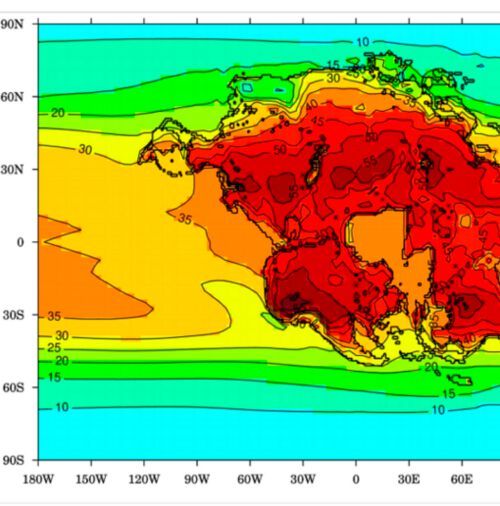
Image shows the warmest month average temperature (degrees Celsius) for Earth and the projected supercontinent (Pangea Ultima) in 250 million years, when it would be difficult for almost any mammals to survive.
(Source: University of Bristol)
Bristol/UK – The research, published recently in Nature Geoscience and led by the University of Bristol, presents the first-ever supercomputer climate models of the distant future and demonstrates how climate extremes will dramatically intensify when the world’s continents eventually merge to form one hot, dry and largely uninhabitable supercontinent.
The findings project how these high temperatures are set to further increase, as the sun becomes brighter, emitting more energy and warming the Earth. Tectonic processes, occurring in the Earth’s crust and resulting in supercontinent formation would also lead to more frequent volcanic eruptions which produce huge releases of carbon dioxide into the atmosphere, further warming the planet.
Mammals, including humans, have survived historically thanks to their ability to adjust to weather extremes, especially through adaptations such as fur and hibernating in the cold, as well as short spells of warm weather hibernation.
While mammals have evolved to lower their cold temperature survivable limit, their upper temperature tolerance has generally remained constant. This makes exposure to prolonged excessive heat much harder to overcome and the climate simulations, if realized, would ultimately prove unsurvivable.
Lead author Dr Alexander Farnsworth, Senior Research Associate at the University of Bristol, said: “The newly-emerged supercontinent would effectively create a triple whammy, comprising the continentality effect, hotter sun and more CO2 in the atmosphere, of increasing heat for much of the planet. The result is a mostly hostile environment devoid of food and water sources for mammals.
“Widespread temperatures of between 40 to 50 degrees Celsius, and even greater daily extremes, compounded by high levels of humidity would ultimately seal our fate. Humans – along with many other species – would expire due to their inability to shed this heat through sweat, cooling their bodies.”
Although human-induced climate change and global warming is likely to be a growing cause of heat stress and mortality in some regions, research suggests the planet should largely remain habitable until this seismic landmass change in the deep future. But when the supercontinent forms, findings indicate only somewhere between 8 % and 16 % of land would be habitable for mammals.
Co-author Dr Eunice Lo, Research Fellow in Climate Change and Health at the University of Bristol said: “It is vitally important not to lose sight of our current Climate Crisis, which is a result of human emissions of greenhouse gases. While we are predicting an uninhabitable planet in 250 million years, today we are already experiencing extreme heat that is detrimental to human health. This is why it is crucial to reach net-zero emissions as soon as possible.”
The international team of scientists applied climate models, simulating temperature, wind, rain, and humidity trends for the next supercontinent – called Pangea Ultima – expected to form in the next 250 million years. To estimate the future level of CO2, the team used models of tectonic plate movement, ocean chemistry and biology to map out inputs and outputs of CO2.
The future CO2 calculations were led by Professor Benjamin Mills at the University of Leeds, who said: “We think CO2 could rise from around 400 parts per million (ppm) today to more than 600 ppm many millions of years in the future. Of course, this assumes that humans will stop burning fossil fuels, otherwise we will see those numbers much, much sooner.”
Dr. Farnsworth, also a visiting Professor at the Tibetan Plateau Earth System, Environment and Resources (TPESER), at the Chinese Academy of Sciences Institute of Tibetan Plateau Research said: “The outlook in the distant future appears very bleak. Carbon dioxide levels could be double current levels. With the Sun also anticipated to emit about 2.5 % more radiation and the supercontinent being located primarily in the hot, humid tropics, much of the planet could be facing temperatures of between 40 to 70 °C.
“This work also highlights that a world within the so-called ‘habitable zone’ of a solar system may not be the most hospitable for humans depending on whether the continents are dispersed, as we have today, or in one large supercontinent.”
In addition, the research illustrates the importance of tectonics and continental layouts when conducting research into planets beyond our solar system, called exoplanets. Although the Earth will still be within the habitable zone in 250 million years’ time, for mammals the formation of a supercontinent with elevated carbon dioxide will make most of the world uninhabitable. The findings suggest the landmass layout for a distant world could be a key factor when determining how liveable it is for humans.
Date: 08.12.2025
Naturally, we always handle your personal data responsibly. Any personal data we receive from you is processed in accordance with applicable data protection legislation. For detailed information please see our privacy policy.
Consent to the use of data for promotional purposes
I hereby consent to Vogel Communications Group GmbH & Co. KG, Max-Planck-Str. 7-9, 97082 Würzburg including any affiliated companies according to §§ 15 et seq. AktG (hereafter: Vogel Communications Group) using my e-mail address to send editorial newsletters. A list of all affiliated companies can be found here
Newsletter content may include all products and services of any companies mentioned above, including for example specialist journals and books, events and fairs as well as event-related products and services, print and digital media offers and services such as additional (editorial) newsletters, raffles, lead campaigns, market research both online and offline, specialist webportals and e-learning offers. In case my personal telephone number has also been collected, it may be used for offers of aforementioned products, for services of the companies mentioned above, and market research purposes.
Additionally, my consent also includes the processing of my email address and telephone number for data matching for marketing purposes with select advertising partners such as LinkedIn, Google, and Meta. For this, Vogel Communications Group may transmit said data in hashed form to the advertising partners who then use said data to determine whether I am also a member of the mentioned advertising partner portals. Vogel Communications Group uses this feature for the purposes of re-targeting (up-selling, cross-selling, and customer loyalty), generating so-called look-alike audiences for acquisition of new customers, and as basis for exclusion for on-going advertising campaigns. Further information can be found in section “data matching for marketing purposes”.
In case I access protected data on Internet portals of Vogel Communications Group including any affiliated companies according to §§ 15 et seq. AktG, I need to provide further data in order to register for the access to such content. In return for this free access to editorial content, my data may be used in accordance with this consent for the purposes stated here. This does not apply to data matching for marketing purposes.
Right of revocation
I understand that I can revoke my consent at will. My revocation does not change the lawfulness of data processing that was conducted based on my consent leading up to my revocation. One option to declare my revocation is to use the contact form found at https://contact.vogel.de. In case I no longer wish to receive certain newsletters, I have subscribed to, I can also click on the unsubscribe link included at the end of a newsletter. Further information regarding my right of revocation and the implementation of it as well as the consequences of my revocation can be found in the data protection declaration, section editorial newsletter.
The research formed part of a funded project, funded by the UK Research and Innovation Natural Environment Research Council (UKRI NERC) looking at the climates of supercontinents and mass extinctions.
Paper: ‘Climate extremes likely to drive land mammal extinction during next supercontinent assembly’ by Alexander Farnsworth et al. in Nature Geoscience.




:quality(80)/p7i.vogel.de/wcms/aa/39/aa398d3e6667bdb43ad57abf38dc394c/0129347450v2.jpeg "An illustration shows a strand of engineered DNA passing through a nanoscale sensor, where its physical structure can be decoded as digital information. DNA nanostructures could one day serve as ultra-dense carriers of digital information and advance the field of data encryption. (Source: Jason Drees/ ASU)")
:quality(80)/p7i.vogel.de/wcms/06/a1/06a11f1d752afb35854aa9e1afb62e98/0129209625v2.jpeg "“Unsinkable\" metal tube made from chemically-etched aluminum floats in distilled water at the lab of University of Rochester professor Chunlei Guo. (Source: J. Adam Fenster / University of Rochester)")
:quality(80)/p7i.vogel.de/wcms/6d/df/6ddf023361ec7f8fbfb6c56521577960/0129056554v2.jpeg "The evolution of carburization (depicted by the spheres) under kinetic control (illustrated by the surface contours). The molecular beams represent gas evolution under synthesis conditions while the fiery sphere highlights the formation of the pure tungsten semi-carbide phase with additional molecular beams at the top to illustrate its catalytic performance. (Source: Sinhara M. H. D. Perera)")
:quality(80)/p7i.vogel.de/wcms/26/3d/263d97f8f2797267ecf2781b56882758/0129056451v1.jpeg "A study by the Complexity Science Hub finds that AI systems are already involved in nearly one-third of newly written software code, with rapid adoption in the United States and Europe and measurable productivity gains mainly for experienced developers. (Source: free licensed)")
:quality(80)/p7i.vogel.de/wcms/21/03/21030cc2541c455da0769decca8d1f82/0129146048v2.jpeg "Vyon porous plastics from Porvair Sciences are the perfect material for filtration applications in the healthcare and medical device market. (Source: Porvair Sciences)")
:quality(80)/p7i.vogel.de/wcms/bd/aa/bdaae5b9d381e2471ab37f479ad43d79/0129143884v2.jpeg "The Solvent Line Monitor from Testa Analytical is a true plug-and-play addition to any HPLC system designed to detect when one or more of its pump solvent reservoirs are empty and automatically shut-off the system. (Source: Testa Analytical)")
:quality(80)/p7i.vogel.de/wcms/8f/66/8f66b8acbb3037ca8e6b320bcad1c817/0129118043v2.jpeg "The Plasmaquant 9200 series is ideal for applications in research, trace analysis and quality control. (Source: Analytik Jena )")
:quality(80)/p7i.vogel.de/wcms/66/82/66825163ab842baded640db1a484e729/0129117548v2.jpeg "Biotech Fluidics has announced the Smartsaver solvent recycling unit which is designed to recover up to 90 % of your mobile phase by redirection of the pure solvent to the solvent reservoir during isocratic HPLC. (Source: Biotech Fluidics )")
:quality(80)/p7i.vogel.de/wcms/1a/4f/1a4fe7f8b5541716ba908251738beca1/0129349759v2.jpeg "Krict’s Syngas-to-Sustainable Aviation Fuel (SAF) Conversion Facility (Source: Korea Research Institute of Chemical Technology (Krict))")
:quality(80)/p7i.vogel.de/wcms/d4/29/d429a973c6f14ced3d2eb44931669a78/0129348927v1.jpeg "Cage-like ulva biochar confined synthesis of Fe₃O₄/ZnO heterojunction nanoparticles for synergistic adsorption and photocatalytic degradation of PFOA
(Source: Hua Jing et. al.)")
:quality(80)/p7i.vogel.de/wcms/86/90/8690b8154a552da13b37f289349b1db4/0129283446v2.jpeg "Lina Pérez-Ángel holds two sediment samples whose ages are separated by about a million years. (Source: Ellen Jorgensen)")
:quality(80)/p7i.vogel.de/wcms/90/f8/90f8c3152a59205a7cac1cc182eb186b/0129209634v2.jpeg "Nitrate in drinking water linked to increased dementia risk while nitrate from vegetables is linked to a lower risk, researchers find . (Source: free licensed)")
:quality(80)/p7i.vogel.de/wcms/84/2c/842c7c1678ceeec7147ea3a36e238e75/0129356324v2.jpeg "Kaust and Nadec have signed a MOU that establishes a framework for long-term cooperation across agricultural research, technology development, and professional training. (Source: Kaust )")
:quality(80)/p7i.vogel.de/wcms/d1/3c/d13c2ad34af600dbd360c0bb0990b922/0129045715v2.jpeg "Replacing animal products with plant-based foods helps reduce the risk of heart disease and type 2 diabetes, finds a new review by the Physicians Committee for Responsible Medicine. (Source: Pixabay)")
:quality(80)/p7i.vogel.de/wcms/e1/b3/e1b3e26d03101ba93b76b304da150c9a/0129025388v2.jpeg "The research reanalyzed data from a seminal clinical trial, led by US National Institutes of Health veteran Dr Kevin Hall, which first exposed how eating exclusively UPFs results in excessive calorie consumption and weight gain. (Source: Pixabay)")
:quality(80)/p7i.vogel.de/wcms/75/db/75db8afe45607bee750df705e22b60e9/0128938816v1.jpeg "A new academic review suggests that bamboo shoots could offer significant health benefits, including improved blood sugar control, gut health and antioxidant activity. (Source: free licensed)")
:quality(80)/p7i.vogel.de/wcms/14/24/14247b96901bfab6c75b7a3453ecfc6e/0129390600v2.jpeg "The US study, ‘Artificial-Intelligence-Enabled Digital Stethoscope Improves Point-of-Care Screening for Moderate to Severe Valvular Heart Disease’, was recently published on Thursday 5 February, 2026 in the European Heart Journal - Digital Health. (Source: Pixabay)")
:quality(80)/p7i.vogel.de/wcms/0d/9b/0d9bcd7e41846276db862456d619edd2/0129351002v2.jpeg "A Caltech-led team has developed a way of making bubble bots with simple protein shells that can be modified by enzymes or magnetic nanoparticles for efficient drug delivery. One version the researchers has made is \"smart\" enough to direct itself to direct itself to a tumor target. (Source: Gao Lab/ Caltech)")
:quality(80)/p7i.vogel.de/wcms/1a/ee/1aee2613e1a69c73ab568ee61d354ded/0129347044v1.jpeg "The Tonks lab studied PTP1B inhibition in a mouse model of Alzheimer’s disease. When PTP1B was deleted, as shown in the bottom row, the brain’s immune cells (green) were better at engulfing harmful amyloid-β plaques (grey), as shown in the left column. (Source: Nicholas Tonks/ CSHL)")
:quality(80)/p7i.vogel.de/wcms/fe/b7/feb7e0d151036b0c2be071e958dbce3b/0129341435v2.jpeg "As youth mental health challenges have risen alongside increased social media use, researchers and policymakers have questioned whether platforms contribute to emotional distress. (Source: Pixabay)")
:quality(80)/images.vogel.de/vogelonline/bdb/1710600/1710675/original.jpg "Discover how to set yourself up for success when performing balance-based density determination of solids such as jewelry and precious metals. (Mettler Toledo)")
:quality(80)/images.vogel.de/vogelonline/bdb/1682500/1682579/original.jpg "The new XPR Analytical balance redesigned to meet the needs of laboratory technicians of working fast and lean. (Mettler Toledo)")
:quality(80)/images.vogel.de/vogelonline/bdb/1677000/1677080/original.jpg "Enhance your weighing accuracy, comfort and productivity with the redesigned XPR Analytical balance. (Mettler Toledo)")
:fill(fff,0)/p7i.vogel.de/companies/5f/3f/5f3f63ceedc78/knf-logo.jpg "KNF_Logo.jpg (www.knf.com)")
:quality(80)/p7i.vogel.de/wcms/86/90/8690b8154a552da13b37f289349b1db4/0129283446v2.jpeg "Lina Pérez-Ángel holds two sediment samples whose ages are separated by about a million years. (Source: Ellen Jorgensen)")
:quality(80)/p7i.vogel.de/wcms/b9/06/b9069c414c1bc5c667d30f8fd5bb1c5d/0124805595v2.jpeg "Remaining of a glacier iceberg in Svalbard, Norway (Source: Fabien Maussion)")