A team of researchers from the Instituto Gulbenkian de Ciência (IGC) revealed that cells of the brain can detect the presence of malaria parasites in the blood, triggering the inflammation underlying cerebral malaria. This discovery brought to light new targets for adjuvant therapies that could restrain brain damage in initial phases of the disease and avoid neurological sequelae.
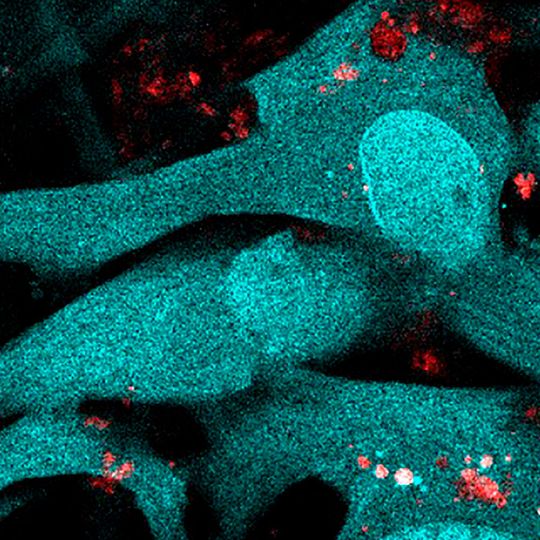
Brain vascular endothelial cells (blue) internalize particles released by erythrocytes infected with the malaria parasite (pink and red)
(Source: Teresa Pais)
Cerebral malaria is a severe complication of infection with Plasmodium falciparum, the most lethal of the parasites causing malaria. This form of the disease manifests through impaired consciousness and coma and affects mainly children under 5, being one of the main causes of death in this age group in countries of Sub-Saharan Africa. Those who survive are frequently affected by debilitating neurological sequelae, such as motor deficits, paralysis, and speech, hearing, and visual impairment.
To prevent certain molecules and cells from reaching the brain, which would disturb its normal functioning, specialized cells from the inner lining of blood vessels, the endothelial cells, are tightly kept together, forming a barrier between the blood and this organ. Cerebral malaria results from an unrestrained inflammatory response to infection which leads to significant alterations in this barrier and, consequently, neurological complications.
Over the last years, specialists in this field have turned their attention to a molecule, named interferon-β, which seems to be associated with this pathological process. So called for interfering with viral replication, this highly inflammatory molecule has two sides: it can either be protecting or cause tissue destruction. It is known, for example, that despite its antiviral role in Covid-19, at a given concentration and phase of infection, it can cause lung damage. A similar dynamic is thought to occur in cerebral malaria. However, we still don’t know what leads to the secretion of interferon-β, nor the main cells involved.
A recent study led by the IGC and published in the PNAS journal, revealed that endothelial cells in the brain play a crucial role, being able to sense the infection by the malaria parasite at an early phase. These detect the infection through an internal sensor which triggers a cascade of events, starting with the production of interferon-β. Next, they release a signaling molecule that attracts cells of the immune system to the brain, initiating the inflammatory process.
To reach these conclusions, researchers used mice that mimic several symptoms described in human malaria and a genetic manipulation system that allowed them to delete this sensor in several types of cells. When they deleted this sensor in brain endothelial cells, they concluded that the animal’s symptoms were not as severe and that they died less from the infection. That was when they realized these brain cells contributed greatly to the pathology of cerebral malaria. “We thought brain endothelial cells acted in a later phase, but we ended up realizing that they are participants from the very beginning”, explains Teresa Pais, a post-doctoral researcher at the IGC and first author of the study. “Normally we associate this initial phase of the response to infection with cells of the immune system. These are already known to respond, but cells of the brain, and maybe other organs, also have this ability to sense the infection because they have the same sensors”, she adds.
But what really surprised the researchers was the factor activating the sensor and triggering this cell response. This factor is nothing more nothing less than a byproduct of the activity of the parasite. Once in the blood, the parasite invades the host’s red blood cells, where it multiplies. Here, it digests hemoglobin, a protein that transports oxygen, to get nutrients. During this process, a molecule named heme is formed and it can be transported in tiny particles in the blood that are internalized by endothelial cells. When this happens, heme acts as an alarm for the immune system. “We weren’t expecting that heme could enter cells this way and activate this response involving interferon-β in endothelial cells”, the researcher says.
This work of about 6 years allowed the researchers to identify a molecular mechanism that is critical for the destruction of brain tissue during infection with the malaria parasite and, with that, new therapeutic targets. “The next step will be to try to inhibit the activity of this sensor inside the endothelial cells and understand if we can act on the host’s response and stop brain pathology in an initial phase”, explains Carlos Penha Gonçalves, principal investigator of the group who led the study. “If we could use inhibitors of the sensor in parallel with antiparasitic drugs maybe we could stop the loss of neuronal function and avoid sequelae which are a major problem for children surviving cerebral malaria”, he concludes.
Date: 08.12.2025
Naturally, we always handle your personal data responsibly. Any personal data we receive from you is processed in accordance with applicable data protection legislation. For detailed information please see our privacy policy.
Consent to the use of data for promotional purposes
I hereby consent to Vogel Communications Group GmbH & Co. KG, Max-Planck-Str. 7-9, 97082 Würzburg including any affiliated companies according to §§ 15 et seq. AktG (hereafter: Vogel Communications Group) using my e-mail address to send editorial newsletters. A list of all affiliated companies can be found here
Newsletter content may include all products and services of any companies mentioned above, including for example specialist journals and books, events and fairs as well as event-related products and services, print and digital media offers and services such as additional (editorial) newsletters, raffles, lead campaigns, market research both online and offline, specialist webportals and e-learning offers. In case my personal telephone number has also been collected, it may be used for offers of aforementioned products, for services of the companies mentioned above, and market research purposes.
Additionally, my consent also includes the processing of my email address and telephone number for data matching for marketing purposes with select advertising partners such as LinkedIn, Google, and Meta. For this, Vogel Communications Group may transmit said data in hashed form to the advertising partners who then use said data to determine whether I am also a member of the mentioned advertising partner portals. Vogel Communications Group uses this feature for the purposes of re-targeting (up-selling, cross-selling, and customer loyalty), generating so-called look-alike audiences for acquisition of new customers, and as basis for exclusion for on-going advertising campaigns. Further information can be found in section “data matching for marketing purposes”.
In case I access protected data on Internet portals of Vogel Communications Group including any affiliated companies according to §§ 15 et seq. AktG, I need to provide further data in order to register for the access to such content. In return for this free access to editorial content, my data may be used in accordance with this consent for the purposes stated here. This does not apply to data matching for marketing purposes.
Right of revocation
I understand that I can revoke my consent at will. My revocation does not change the lawfulness of data processing that was conducted based on my consent leading up to my revocation. One option to declare my revocation is to use the contact form found at https://contact.vogel.de. In case I no longer wish to receive certain newsletters, I have subscribed to, I can also click on the unsubscribe link included at the end of a newsletter. Further information regarding my right of revocation and the implementation of it as well as the consequences of my revocation can be found in the data protection declaration, section editorial newsletter.




:quality(80)/p7i.vogel.de/wcms/92/ad/92adbafb37924cea35ea3cf05b7a23e5/0130206318v2.jpeg "The world’s first fully functioning proof-of-concept quantum battery
(Source: Csiro)")
:quality(80)/p7i.vogel.de/wcms/9f/8b/9f8bc2b8491d7a514ca154e9588a07b7/0130205846v1.jpeg "The researchers’ new material, based on mineralised sawdust, is an excellent fire retardant. (Source: Dan Vivas Glaser / from Kürsteiner R et al. Chem Circularity 2026)")
:quality(80)/p7i.vogel.de/wcms/fd/73/fd73fcb3ceda89d1419de1083fcab7b4/0130081520v2.jpeg "The fingers at the heart of this technology were inspired by the fin-ray effect — a design principle derived from the natural structure of fish fins. (Source: University of Texas at Austin )")
:quality(80)/p7i.vogel.de/wcms/fe/64/fe649767c802d53ac63ee2c2a40b7e0d/0130060830v2.jpeg "Sample tube with light-active substance (Source: Elvira Eberhardt / Ulm University)")
:quality(80)/p7i.vogel.de/wcms/8f/b9/8fb98a958e4afe679865fbe52a473680/0129940982v2.jpeg "pH measurement in various nanoparticles using the Nine-Focus meter ensures precise stability and performance control. (Source: Mettler Toledo)")
:quality(80)/p7i.vogel.de/wcms/11/74/1174e5d4c8b07a64637dced8c9506b40/0129787561v2.jpeg "The Multicell Plus high-pressure reactor sets a new benchmark for operator safety, all-round accessibility and ease-of-use. (Source: Asynt)")
:quality(80)/p7i.vogel.de/wcms/ef/6e/ef6e96191183411973b77041fb6b1e16/0129785957v2.jpeg "Manufactured from high-quality crystal polystyrene - these new automation-ready plates are available in a choice of ANSI / SLAS standard (96-well and breakable 8-well strip) formats. (Source: Porvair Sciences)")
:quality(80)/p7i.vogel.de/wcms/ad/ca/adcaa20ef5ccaf7e3b325788b1e349c4/0129784872v2.jpeg "The high performance Degasi Flat Film in-line degasser. (Source: Biotech Fluidics)")
:quality(80)/p7i.vogel.de/wcms/af/40/af40b535eb65c287fbd22ed5483d1d0e/0130206243v2.jpeg "The researchers dug soil pits in order to measure the carbon storage in soil
(Source: Johanna Asch)")
:quality(80)/p7i.vogel.de/wcms/2d/45/2d45aba62f5042baa00f7fd4fa629839/0130036533v2.jpeg "The population of Pune, India, is expected to reach 11 million by 2050. (Source: free licensed)")
:quality(80)/p7i.vogel.de/wcms/52/f8/52f8d5521fdab07ed0a865ec0d8919fd/0130009438v2.jpeg "Drylands support around half of global livestock production and sustain the livelihoods of close to a billion people, while also underpinning soil stability and carbon storage. (Source: Kaust )")
:quality(80)/p7i.vogel.de/wcms/fe/49/fe494ada322615b6e6f6ff0f5bb7c5cf/0129926008v2.jpeg "A mandrill eating fruit. (Source: University of Bristol )")
:quality(80)/p7i.vogel.de/wcms/6f/ba/6fba92196d0cbb1467334f8a2ecc520a/0130203021v2.jpeg "Low to moderate wine consumption shows lower risk compared with spirits, beer and cider (Source: free licensed)")
:quality(80)/p7i.vogel.de/wcms/a9/37/a9376f1d9a893570023d9aa97c085bc5/0129927485v2.jpeg "Examples of foods high in PUFAs include fatty fish and soybeans, while MUFAs include olive oil and avocadoes. (Source: free licensed)")
:quality(80)/p7i.vogel.de/wcms/ea/88/ea88ef8810e21cdd9bb852c70f385ba1/0129797385v2.jpeg "A team of NUS food scientists consisting of Assoc Prof Liu Shao Quan (centre), Dr Lu Yuyun (right) and Ms Geng Chenhan (left) pioneered a co-fermentation method that improves both the nutrient and flavor profile of kombu. (Source: NUS)")
:quality(80)/p7i.vogel.de/wcms/84/2c/842c7c1678ceeec7147ea3a36e238e75/0129356324v2.jpeg "Kaust and Nadec have signed a MOU that establishes a framework for long-term cooperation across agricultural research, technology development, and professional training. (Source: Kaust )")
:quality(80)/p7i.vogel.de/wcms/e9/73/e9732473361377610267347df55071a1/0130205830v2.jpeg "Sleep EEG signals may reveal whether the brain is aging faster than the body — and help identify elevated dementia risk earlier. (Source: free licensed)")
:quality(80)/p7i.vogel.de/wcms/ed/c0/edc0c1a86229b11efd17c5e3f94d14da/0130081211v2.jpeg "A new study finds that virtual visits did not make it easier for psychiatrists, psychologists and therapists to reach significantly more people in areas where access to care has long been limited. (Source: Pixabay)")
:quality(80)/p7i.vogel.de/wcms/9c/52/9c52318bc94be17e6662dfceffa4a0c0/0130060546v2.jpeg "Domestic cat ‘Lanni’ from co-author of the study, Latasha Ludwig, Assistant Clinical Professor at Cornell University, USA. (Source: © Latasha Ludwig)")
:quality(80)/p7i.vogel.de/wcms/4b/f4/4bf4cc9e28e65e11a27dd41da2d1a7f5/0130038185v2.jpeg "The biomarker p-tau217 could help identify women at elevated dementia risk decades before clinical symptoms begin. (Source: free licensed)")
:quality(80)/images.vogel.de/vogelonline/bdb/1710600/1710675/original.jpg "Discover how to set yourself up for success when performing balance-based density determination of solids such as jewelry and precious metals. (Mettler Toledo)")
:quality(80)/images.vogel.de/vogelonline/bdb/1682500/1682579/original.jpg "The new XPR Analytical balance redesigned to meet the needs of laboratory technicians of working fast and lean. (Mettler Toledo)")
:quality(80)/images.vogel.de/vogelonline/bdb/1677000/1677080/original.jpg "Enhance your weighing accuracy, comfort and productivity with the redesigned XPR Analytical balance. (Mettler Toledo)")
:fill(fff,0)/p7i.vogel.de/companies/5f/3f/5f3f63ceedc78/knf-logo.jpg "KNF_Logo.jpg (www.knf.com)")
:quality(80)/images.vogel.de/vogelonline/bdb/1858100/1858139/original.jpg "Biontech aims to develop the first mRNA-based vaccine for Malaria prevention with the initiation of a clinical trial by end of 2022. (Public Domain)")
:quality(80)/p7i.vogel.de/wcms/fb/ab/fbabe328b0bc6299bf87e6257c185025/0126267809v2.jpeg "Researchers from Turku, Finland, observed that lymphatic endothelial cells and other stromal cells are the first cells in the lymph nodes to come into contact with vaccines. (Source: University of Turku)")
:quality(80)/p7i.vogel.de/wcms/92/3b/923ba38a0b5c46d7a51e3f0089eacfcf/0128184036v2.jpeg "New insights reveal why “feeling sick” prompts the brain to promote rest and isolation. (Source: free licensed)")