A new technology for wheels and mobile systems, necessary for overcoming various obstacles in daily life such as stairs or rocks by adjusting the stiffness of the wheel in real time, has been developed for the first time in the world. This technology is anticipated to find wide applications in various moving vehicles equipped with wheels, where overcoming terrain obstacles is essential.
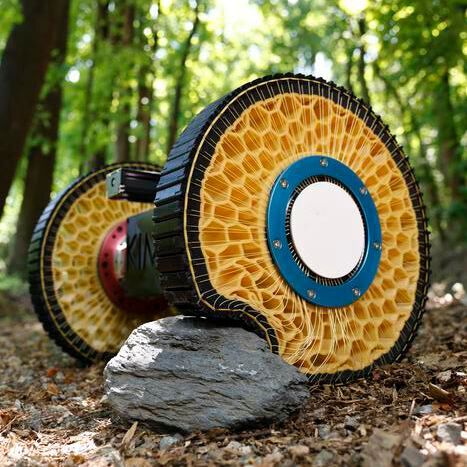
The variable-stiffness morphing wheel inspired by surface tension, developed by the Advanced Robotics Research Center of the Kimm’s Research Institute of AI Robotics, overcoming a rock.
(Source: Korea Institute of Machinery and Materials)
The Korea Institute of Machinery and Materials (Kimm) has announced a groundbreaking innovation in wheel technology: the world's first variable-stiffness morphing wheel inspired by the surface tension dynamics of a liquid droplet. This cutting-edge technology, developed by a research team led by Principal Researcher Sung-Hyuk Song and Dong Il Park, Head of the Advanced Robotics Research Center at KIMM’s Research Institute of AI Robotics, has been successfully applied to various mobile systems.
The newly developed morphing wheel and its modularization system represent a significant leap forward in mobility technology. Unlike traditional wheels that maintain a fixed structure, this innovative wheel can alter its stiffness by adjusting the surface tension applied to smart chain blocks, eliminating the need for complex machinery or sensors. The wheel can operate as a rigid, circular wheel on flat surfaces, ensuring efficient and stable driving, and can switch to a softer, deformable state to roll over obstacles of varying heights and shapes.
Overcoming the Limitations of Conventional Wheel Technologies
While flexible-structure wheel technologies, such as non-pneumatic tires, have existed, they come with limitations. These wheels often remain in a deformed state even on flat surfaces, which can reduce driving efficiency, compromise stability, and generate noise. In contrast, the variable-stiffness morphing wheel developed by Kimm can seamlessly transition between a rigid state for flat terrain and a soft, adaptable form to navigate obstacles. This dual capability enhances both the versatility and functionality of vehicles equipped with this technology.
The morphing wheel's design incorporates a smart chain block and a flexible structure. The outermost edge of the wheel consists of a smart chain block connected to a wire spoke structure, which in turn is linked to the wheel’s hub. The rotation or distance changes of the hub structure affect the tension of the wire spokes, which either tighten or loosen the smart chain blocks, thereby altering the wheel's surface tension.
The principle behind this innovation draws inspiration from liquid droplet dynamics. When the wire spokes pull the smart chain blocks inward, the traction force increases, akin to the increased surface tension in a liquid droplet that helps maintain a stable circular shape. Conversely, loosening the wire spokes reduces the wheel's rigidity, allowing it to adapt to uneven surfaces and obstacles.
Versatile Applications in Mobility Systems
KIMM's research team has also achieved a breakthrough in the modularization of this technology, making it adaptable to a wide range of mobile systems. A miniaturized, lightweight version of the variable-stiffness mechanism has been successfully integrated into the wheel's interior, enabling its application to different vehicles, such as a two-wheeled wheelchair.
The incorporation of this wheel into a two-wheeled wheelchair system demonstrates its practical advantages. The wheelchair can dynamically adjust its wheel stiffness in real time, allowing for stable movement and agile maneuvering even in confined spaces. It can also navigate over obstacles like rocks or stairs up to 18 centimeters high. Furthermore, when applied to a four-wheeled mobile system, the wheel can overcome obstacles up to 1.3 times its radius, confirming its superior adaptability and robustness.
Principal Researcher Sung-Hyuk Song of the Kimm commented: “One of the problems associated with quadrupedal and bipedal walking robots for overcoming obstacles is that movement efficiency is relatively low on flat surfaces, and that shaking inevitably occurs in the moving state.” Song added, “The newly developed morphing wheel is significantly meaningful in that it is capable of overcoming obstacles while at the same time maintaining high movement efficiency comparable to conventional wheels.”
Dong Il Park, Head of the Kimm’s Advanced Robotics Research Center, said: “This new technology for morphing wheels inspired by surface tension can help to overcome the limitations of conventional mechanical devices such as leg-type robots and wheel clusters for overcoming obstacles.” Park added, “It will likely find applications in a wide range of fields including wheelchairs, mobile robots, and personal mobility capable of overcoming obstacles.”
Original Article: Variable-stiffness–morphing wheel inspired by the surface tension of a liquid droplet; Science Robotics; DOI:10.1126/scirobotics.adl2067
Date: 08.12.2025
Naturally, we always handle your personal data responsibly. Any personal data we receive from you is processed in accordance with applicable data protection legislation. For detailed information please see our privacy policy.
Consent to the use of data for promotional purposes
I hereby consent to Vogel Communications Group GmbH & Co. KG, Max-Planck-Str. 7-9, 97082 Würzburg including any affiliated companies according to §§ 15 et seq. AktG (hereafter: Vogel Communications Group) using my e-mail address to send editorial newsletters. A list of all affiliated companies can be found here
Newsletter content may include all products and services of any companies mentioned above, including for example specialist journals and books, events and fairs as well as event-related products and services, print and digital media offers and services such as additional (editorial) newsletters, raffles, lead campaigns, market research both online and offline, specialist webportals and e-learning offers. In case my personal telephone number has also been collected, it may be used for offers of aforementioned products, for services of the companies mentioned above, and market research purposes.
Additionally, my consent also includes the processing of my email address and telephone number for data matching for marketing purposes with select advertising partners such as LinkedIn, Google, and Meta. For this, Vogel Communications Group may transmit said data in hashed form to the advertising partners who then use said data to determine whether I am also a member of the mentioned advertising partner portals. Vogel Communications Group uses this feature for the purposes of re-targeting (up-selling, cross-selling, and customer loyalty), generating so-called look-alike audiences for acquisition of new customers, and as basis for exclusion for on-going advertising campaigns. Further information can be found in section “data matching for marketing purposes”.
In case I access protected data on Internet portals of Vogel Communications Group including any affiliated companies according to §§ 15 et seq. AktG, I need to provide further data in order to register for the access to such content. In return for this free access to editorial content, my data may be used in accordance with this consent for the purposes stated here. This does not apply to data matching for marketing purposes.
Right of revocation
I understand that I can revoke my consent at will. My revocation does not change the lawfulness of data processing that was conducted based on my consent leading up to my revocation. One option to declare my revocation is to use the contact form found at https://contact.vogel.de. In case I no longer wish to receive certain newsletters, I have subscribed to, I can also click on the unsubscribe link included at the end of a newsletter. Further information regarding my right of revocation and the implementation of it as well as the consequences of my revocation can be found in the data protection declaration, section editorial newsletter.




:quality(80)/p7i.vogel.de/wcms/84/78/8478fcee08360056b226cb8d5032d50c/0130489771v2.jpeg "Saharsh Davuluri will assume the role of Chief Executive Officer and Managing Director, effective immediately, as the company moves into its next stage of CDMO growth. (Source: Neuland Laboratories)")
:quality(80)/p7i.vogel.de/wcms/5e/ae/5eae9dcbba6d172fac2b07b7aef05d3f/0130484643v2.jpeg "The chemical processes occurring when the light interacts with the plastic when it is dissolved causes the reaction to glow blue. (Source: University of Bath)")
:quality(80)/p7i.vogel.de/wcms/e5/9c/e59c5dd9fe4308acae7d5c6de8038c88/0130484607v1.jpeg "A close-up of a laser-directed energy deposition (LDED) system fabricating the novel AI-designed ultra-high strength steel, which achieves a rare balance of strength and ductility, excellent corrosion resistance, and requires only 6 hours of single-step heat treatment at low cost. (Source: Yating Luo et. al.)")
:quality(80)/p7i.vogel.de/wcms/5b/b6/5bb6c39a72c5852361fa904e2e9d8a49/0130484591v1.jpeg "Vehicle-to-grid (V2G) technology — software that allows charging stations to communicate with the grid — bridges both challenges, allowing EVs to both draw power and send it back when needed. (Source: free licensed)")
:quality(80)/p7i.vogel.de/wcms/6e/7c/6e7c762e933c938a92431a785df4690f/0130440213v2.jpeg "Biotech Fluidics' valving solutions offer low swept volume and eliminate reagent carryover concerns. (Source: Biotech Fluidics)")
:quality(80)/p7i.vogel.de/wcms/b0/0b/b00b237311ce4ceb03b2ba1136b6b074/0130440144v2.jpeg "Azenta Life Sciences offers a range of low binding consumables that deliver consistent performance from sensitive applications that require low DNA input such as Next Generation Sequencing and Molecular Biology. (Source: Azenta)")
:quality(80)/p7i.vogel.de/wcms/6c/ef/6cef060860810f12200fbd6d56884e9d/0130440127v2.jpeg "The Automated Plate Seal Remover from Azenta Life Sciences is a compact system for removing seals from a wide range of microplates at the single touch of a button, without damaging the plate or seal. (Source: Azenta )")
:quality(80)/p7i.vogel.de/wcms/14/ca/14ca189a5a6a5ac4c434039fc35af36c/0130440109v2.jpeg "Afys3G has launched the Information Marking System Lambda768. (Source: Afys3G)")
:quality(80)/p7i.vogel.de/wcms/f6/3d/f63d5aa4c99a79e3cfe9e1bf8c1595f3/0130484550v1.jpeg "A robot designed to assist with precision irrigation in action, in a citrus orchard. (Source: Elia Scudiero/ UCR)")
:quality(80)/p7i.vogel.de/wcms/5d/bb/5dbb962b09bae1c078a8ff996666bc8e/0130386229v2.jpeg "This image created using Gemini Pro, depicts an activated carbon fiber functionalized with amine groups (–NH2) at adjacent positions. This arrangement improves the energy efficacy of key interactions, enabling the desorption of captured carbon dioxide at lower temperatures. (Source: Gemini / Yasuhiro Yamada/ Chiba University / KI-generiert)")
:quality(80)/p7i.vogel.de/wcms/21/9b/219b000051ab1ea14ab5f92e4fd0f9bb/0130384937v2.jpeg "Deforestation in the Appalachian mountains. (Source: Alex Diaz on Unsplash)")
:quality(80)/p7i.vogel.de/wcms/e9/9c/e99cb19231197af70c489cb4acc2ead0/0130293444v2.jpeg "A new global study, led by researchers at Kaust in Saudi Arabia, shows that forests are most effective for climate regulation when conserved or restored in their natural or native locations. (Source: Kaust )")
:quality(80)/p7i.vogel.de/wcms/4c/df/4cdf172835be728c9ecb68ec309acca1/0130465673v2.jpeg "Peaches are climacteric fruits, which means they continue to ripen after being picked. The recommended storage temperature is 0°C, otherwise there is a risk of cold damage. (Source: Dall-e)")
:quality(80)/p7i.vogel.de/wcms/2a/07/2a0737995810d504b318f8a0f9ac2c3d/0130386209v1.jpeg "Simple, repeatable eating habits may help people stick to diets, see better results, study says (Source: free licensed)")
:quality(80)/p7i.vogel.de/wcms/6f/ba/6fba92196d0cbb1467334f8a2ecc520a/0130203021v2.jpeg "Low to moderate wine consumption shows lower risk compared with spirits, beer and cider (Source: free licensed)")
:quality(80)/p7i.vogel.de/wcms/a9/37/a9376f1d9a893570023d9aa97c085bc5/0129927485v2.jpeg "Examples of foods high in PUFAs include fatty fish and soybeans, while MUFAs include olive oil and avocadoes. (Source: free licensed)")
:quality(80)/p7i.vogel.de/wcms/58/c9/58c99ae20ee71ab55c2bb16253d65297/0130486531v2.jpeg "Prof Ho Ghim Wei (third from left) and her team - (from left) Dr Pan Xinglong, Dr Tian Guo, and Dr Li Zhiwei - have developed a hydrogel sensor system that delivers seamless, real-time monitoring of mental wellbeing. (Source: NUS)")
:quality(80)/p7i.vogel.de/wcms/40/c0/40c0c09c2bad7b925a069edbbac90621/0130385557v1.jpeg "When a stroke damages brain tissue (red) along an important movement pathway (yellow), the injured side of the brain may show faster aging (red), while parts of the opposite side may appear relatively “younger” (blue) as the brain tries to compensate. This pattern is linked to more severe movement problems and less recovery.
(Bild: Stevens INI)")
:quality(80)/p7i.vogel.de/wcms/32/14/3214c28a03f71ad067c5f27e5bd6772b/0130386218v1.jpeg "Antimicrobial-resistant Salmonella poses severe challenges to global food safety and public health. (Source: free licensed)")
:quality(80)/p7i.vogel.de/wcms/30/2e/302e195d532fc9aced73406b07642b57/0130384900v2.jpeg "Sleeping for 11 minutes more, doing an additional 4.5 minutes of moderate-to-vigorous physical activity, and eating additional quarter of a cup of vegetables were associated with a 10 % reduction in major cardiovascular events. (Source: Pixabay)")
:quality(80)/images.vogel.de/vogelonline/bdb/1710600/1710675/original.jpg "Discover how to set yourself up for success when performing balance-based density determination of solids such as jewelry and precious metals. (Mettler Toledo)")
:quality(80)/images.vogel.de/vogelonline/bdb/1682500/1682579/original.jpg "The new XPR Analytical balance redesigned to meet the needs of laboratory technicians of working fast and lean. (Mettler Toledo)")
:quality(80)/images.vogel.de/vogelonline/bdb/1677000/1677080/original.jpg "Enhance your weighing accuracy, comfort and productivity with the redesigned XPR Analytical balance. (Mettler Toledo)")
:fill(fff,0)/p7i.vogel.de/companies/5f/3f/5f3f63ceedc78/knf-logo.jpg "KNF_Logo.jpg (www.knf.com)")
:quality(80)/p7i.vogel.de/wcms/95/f2/95f265acecd99375327c2b0f3b312e81/0124276650v2.jpeg "Illustration of 2D mechanically interlocked polymer (Source: Dengke Shen/ Anhui University)")
:quality(80)/p7i.vogel.de/wcms/d8/42/d842014a015e22475805914990ad2fd6/0127562647v1.jpeg "Researchers at the University of Washington created a recyclable composite material made of tiny droplets of liquid metal infused into a stretchy polymer. The droplets, pictured in this microscope image, can be connected easily together to form an electrical circuit. (Source: Y. Han/ Advanced Functional Materials)")