Imagine a world where the debilitating symptoms of Parkinson’s disease, dystonia, obsessive-compulsive disorder (OCD), and Tourette’s syndrome can be significantly alleviated with precision-targeted brain stimulation. Thanks to pioneering research led by teams from Charité – Universitätsmedizin and Brigham and Women’s Hospital, this is not just a hopeful dream but an unfolding reality.
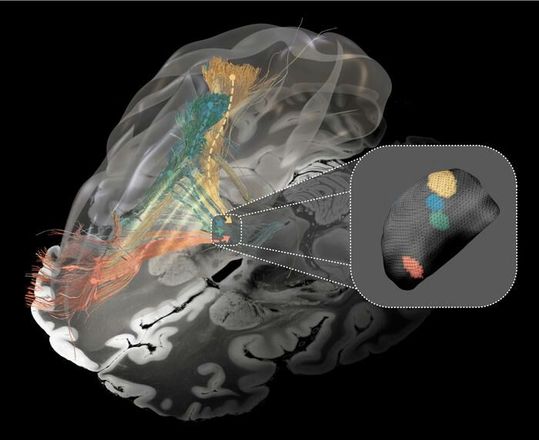
Affected brain circuits in Parkinson’s disease (green), dystonia (yellow), Tourette’s syndrome (blue), and obsessive-compulsive disorder (red). Inset: the optimal target areas for deep brain stimulation in the basal ganglia.
(Source: Charité/ Barbara Hollunder)
When certain connections in the brain do not function correctly, disorders such as Parkinson’s disease, dystonia, obsessive-compulsive disorder (OCD), and Tourette’s syndrome may result. Targeted stimulation of specific areas in the brain can help alleviate symptoms. To pinpoint the exact therapeutic target areas of the brain, a team led by researchers from Charité – Universitätsmedizin and Brigham and Women’s Hospital analyzed data from patients across the globe who had undergone implantation of tiny electrodes to stimulate the brain.
Neurological and neuropsychiatric disorders present with a broad spectrum of different symptoms, from mood and information processing disorders to motor deficits. But they do have one thing in common: They are all attributable to malfunctioning connections between specific regions of the brain. In simplified terms, when brain circuits become dysfunctional, they may act as brakes on the brain functions that the circuit usually carries out.
Deep brain stimulation (DBS) targets these kinds of malfunctional circuits and can be instrumental in alleviating symptoms in various areas. In this neurosurgical approach, small electrodes are implanted into precisely defined target brain areas. The electrodes then chronically emit weak electrical pulses to the surrounding tissue. The stimulation effects travel along neural pathways to more distant areas of the brain to unfold their full impact. But stimulation is not always successful. Even small discrepancies in electrode placement can lead to weaker effects of the treatment.
Which specific brain circuits need to be stimulated to achieve optimal outcomes when treating a range of symptoms was the question for an international team headed by neuroscientists Prof. Andreas Horn and Dr. Ningfei Li at Charité and Brigham and Women’s Hospital. “Our goal was to better understand where in the brain possible ‘brakes’ can be released through neuromodulation to normalize the symptoms of Parkinson’s disease, for example,” says Ningfei Li.
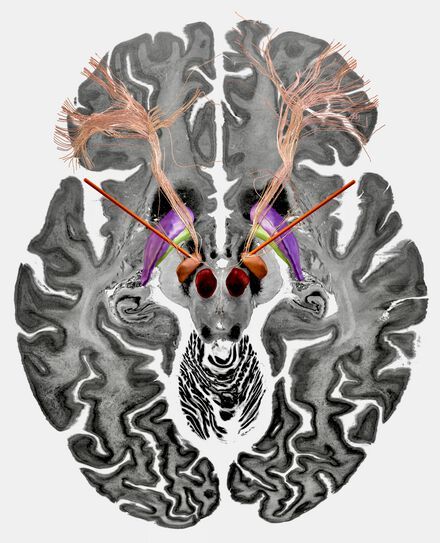
The therapeutic fibre bundle for the treatment of obsessive-compulsive disorder. Electrodes placed in the subthalamic nucleus.
(Source: Charité/ Barbara Hollunder)
Exploring a Seeming Paradox
The researchers’ work addresses a seeming paradox that has been known for a while in this field. A specific area of the basal ganglia called the subthalamic nucleus is considered an effective target for DBS to treat the symptoms of Parkinson’s disease and dystonia, which are both on the spectrum of movement disorders. Recently, the same region of the brain was also identified as a successful target for treating neuropsychiatric disorders such as OCD and tic disorders.
This raised the question of how such a small nucleus, only about one centimeter long, could be an effective target for symptoms of such different brain dysfunctions. To investigate this question, the team analyzed data from 534 DBS electrodes implanted in 261 patients across the globe. Of this cohort, 70 patients were diagnosed with dystonia, 127 with Parkinson’s disease, 50 with OCD, and 14 with Tourette’s syndrome. Using software developed by the team, the researchers reconstructed the precise location of each electrode. Computer simulations were then used to map neural tracts that were activated in patients with optimal or suboptimal treatment outcomes.
Using these results, they were able to identify specific brain circuits that had become dysfunctional in each of the four disorders. They were associated with the relevant regions of the frontal part of the brain that play an important role in motor functions, impulse control, and information processing. “The circuits we identified partially overlapped, which to us implies that the malfunctions reflected in the symptoms studied are not wholly independent from each other,” says Barbara Hollunder, a PhD fellow at the Einstein Center for Neurosciences at Charité and the first author of the study.
This means that as the first step, the researchers have succeeded in localizing the exact networks in the forebrain and midbrain that are crucial to treating Parkinson’s disease, dystonia, obsessive-compulsive disorder, and Tourette’s syndrome. Applying this same approach across disorders with different symptoms gradually yields a map that denotes how specific brain circuits are associated with certain symptoms. “By analogy to the terms ‘connectome,’ which describes a comprehensive map of all neural connections existing in the brain, and ‘genome,’ which is used for the full set of genetic information found in an organism, we have coined the term human ‘dysfunctome.’ One day, we hope the dysfunctome will describe the entirety of brain circuits that may typically become dysfunctional as a result of network disorders,” Hollunder explains.
Date: 08.12.2025
Naturally, we always handle your personal data responsibly. Any personal data we receive from you is processed in accordance with applicable data protection legislation. For detailed information please see our privacy policy.
Consent to the use of data for promotional purposes
I hereby consent to Vogel Communications Group GmbH & Co. KG, Max-Planck-Str. 7-9, 97082 Würzburg including any affiliated companies according to §§ 15 et seq. AktG (hereafter: Vogel Communications Group) using my e-mail address to send editorial newsletters. A list of all affiliated companies can be found here
Newsletter content may include all products and services of any companies mentioned above, including for example specialist journals and books, events and fairs as well as event-related products and services, print and digital media offers and services such as additional (editorial) newsletters, raffles, lead campaigns, market research both online and offline, specialist webportals and e-learning offers. In case my personal telephone number has also been collected, it may be used for offers of aforementioned products, for services of the companies mentioned above, and market research purposes.
Additionally, my consent also includes the processing of my email address and telephone number for data matching for marketing purposes with select advertising partners such as LinkedIn, Google, and Meta. For this, Vogel Communications Group may transmit said data in hashed form to the advertising partners who then use said data to determine whether I am also a member of the mentioned advertising partner portals. Vogel Communications Group uses this feature for the purposes of re-targeting (up-selling, cross-selling, and customer loyalty), generating so-called look-alike audiences for acquisition of new customers, and as basis for exclusion for on-going advertising campaigns. Further information can be found in section “data matching for marketing purposes”.
In case I access protected data on Internet portals of Vogel Communications Group including any affiliated companies according to §§ 15 et seq. AktG, I need to provide further data in order to register for the access to such content. In return for this free access to editorial content, my data may be used in accordance with this consent for the purposes stated here. This does not apply to data matching for marketing purposes.
Right of revocation
I understand that I can revoke my consent at will. My revocation does not change the lawfulness of data processing that was conducted based on my consent leading up to my revocation. One option to declare my revocation is to use the contact form found at https://contact.vogel.de. In case I no longer wish to receive certain newsletters, I have subscribed to, I can also click on the unsubscribe link included at the end of a newsletter. Further information regarding my right of revocation and the implementation of it as well as the consequences of my revocation can be found in the data protection declaration, section editorial newsletter.
Initial Success with Treatment in the Course of the Study
The researchers’ findings have already benefited the first few patients. Fine-tuning and precision electrode placement made it possible to alleviate the symptoms of severe, treatment-resistant OCD, for example. “We plan to refine this technique and zero in even more precisely on dysfunctional brain circuits for specific symptoms. For example, we could isolate the circuits involved in obsessions or compulsions in OCD, or other comorbid symptoms commonly found in these patients, like depression and anxiety disorders, to individualize treatment further,” says Ningfei Li, looking to the future.
The researchers also believe that more than one region of the brain may be responsible for improvement of a given symptom. They suspect that neural networks themselves transmit the therapeutic effects, which can be modulated from various points in the brain. This means the study provides not only valuable insights for targeted neurosurgical treatment, but may also inspire approaches for noninvasive neuromodulation such as transcranial magnetic stimulation (TMS), in which magnetic fields are used to stimulate certain areas of the brain from outside of the brain, without the need for surgery.
Original Article: Hollunder, Barbara et al. Mapping Dysfunctional Circuits in the Frontal Cortex Using Deep Brain Stimulation. Nature Neuroscience 2024. Feb 22. doi: 10.1038/s41593-024-01570-1




:quality(80)/p7i.vogel.de/wcms/62/32/62327aaae1415beeed47db6201e79661/0133375912v2.jpeg "A cotton trailer outfitted with benches and a sunshade offers farmworkers a reprieve from the sun as they take a break from picking cantaloupe melons in Firebaugh, Calif.
(Source: Joe Proudman/ Regents of the University of California)")
:quality(80)/p7i.vogel.de/wcms/e6/c8/e6c8bd554776ee1ad2f1f0723fb243a7/0133369387v1.jpeg "Roman road (Source: Queen Mary University of London)")
:quality(80)/p7i.vogel.de/wcms/51/68/51687ac4cc19f2757c138498b877de57/0133167039v2.jpeg "CMFs are foams that consist of hollow spheres – made of materials such as stainless steel, nickel, or other metals and alloys – embedded in a metallic matrix. The resulting material is both lightweight and remarkably strong at absorbing compressive forces. (Source: Jie Sun/ NC State University)")
:quality(80)/p7i.vogel.de/wcms/cd/c0/cdc09efd1e5b3b8f83224e7729d66c10/0133105276v2.jpeg "From the data presented in this report, the authors show how TF3-MALS-RI is uniquely able to separate large polyacrylate molecules and provide precise molecular weight and Rg values. (Source: Postnova Analytics)")
:quality(80)/p7i.vogel.de/wcms/86/01/86014d3d2a28cefc852f65c8d68317e4/0133104231v2.jpeg "Single-handed tube reading using a Handheld 2. (Source: Azenta Life Sciences)")
:quality(80)/p7i.vogel.de/wcms/0b/0f/0b0f8ed042dfc91f32582e10d54c2c7e/0133087444v2.jpeg "Offering advanced automation to increase your throughput, the Intellixcap provides secure sealing – eliminating the need for manual intervention, while preserving vital sample integrity. (Source: Azenta Life Sciences)")
:quality(80)/p7i.vogel.de/wcms/13/d3/13d35105f74a1c2e22b9c7a270e8e9b3/0132611155v2.jpeg "Circulating cell free DNA. (Source: Amsbio)")
:quality(80)/p7i.vogel.de/wcms/bc/ed/bced6850297a04dbea471a66cb6bb6fe/0132611405v2.jpeg "The latest addition to the range is a peristaltic tubing stop adapter that eliminates the need for fixed stoppers and allows custom cut lengths of peristaltic tubing to be installed on any pump head size. (Source: Biotech Fluidics )")
:quality(80)/p7i.vogel.de/wcms/8d/5c/8d5c6c7f897f91d6784825eee20b5584/0133321225v1.jpeg "Empa researcher Christoph Hüglin collects samples of particles that are washed out of the air by rain and snow or settle due to gravity. (Source: Empa)")
:quality(80)/p7i.vogel.de/wcms/a1/af/a1afbc7c8a067bbe94749ec680b4bafd/0133163762v2.jpeg "The study found in murkier water, fish took longer to move towards the food than those in clear water, but individuals in larger groups responded more quickly overall. (Source: Christos Ioannou)")
:quality(80)/p7i.vogel.de/wcms/32/80/3280aa3d44708962943c96fe2d466744/0133088560v2.jpeg "A bumble bee in flight at the University of Bristol Botanic Garden. (Source: Phil Savoie)")
:quality(80)/p7i.vogel.de/wcms/7b/e5/7be5c735140cbe28f3af0ec3d88274b9/0133045403v2.jpeg "After being buried in the ground for two months and broken down by soil organisms, a new pair of cotton underwear (left) shows clear signs of decomposition (right). (Source: Nicolas Zonvi)")
:quality(80)/p7i.vogel.de/wcms/ee/ad/eead38ab1e3c36f262bd889dfc8c5039/0133409909v2.jpeg "Eating a diet rich in wholegrain food is likely to prevent heart disease by reducing body weight, blood pressure and the levels of cholesterol and glucose in the blood. (Source: Unsplash)")
:quality(80)/p7i.vogel.de/wcms/ef/68/ef68375729607984e5bb0c143afdae70/0133375119v2.jpeg "Printed Rice-Lentil 3D structures
(Source: SUTD)")
:quality(80)/p7i.vogel.de/wcms/bf/d0/bfd087349a85956a7aefad57ac1204c7/0133241961v2.jpeg "The Thermo Scientific Suretect Beverage Spoilage Multiplex PCR Assay provides a fast, broad-range molecular solution for detecting key spoilage microorganisms that threaten beverage quality. (Source: © OlegDoroshin - stock.adobe.com)")
:quality(80)/p7i.vogel.de/wcms/d4/61/d461ce0bd5743897993c6475f69e7ad6/0133067478v2.jpeg "In Harris County, 50 % of households with children reported food insecurity, compared with 33 % of households without children. (Source: Rice University)")
:quality(80)/p7i.vogel.de/wcms/f5/d3/f5d3af7b7479d0573bec5c1fb9f1fd7b/0133409927v2.jpeg "The Match study looked at over 500 cancer survivors with varying types and stages of cancer and found that patients experienced less pain, fatigue, and sleep problems after participating in the interventions. (Source: Unsplash)")
:quality(80)/p7i.vogel.de/wcms/22/49/224964dd6850b62cccdbc4bde2d34693/0133372964v1.jpeg "Brain activity recorded during a video game helped researchers predict whether participants would take or avoid a risk half a second before they acted. (Source: free licensed)")
:quality(80)/p7i.vogel.de/wcms/48/a7/48a761934161543f70fef2403b44d714/0133372328v2.jpeg "The link between pollution and coughing persisted in the data, even when pollution levels were below the WHO’s recommended safe daily exposure limit. (Source: free licensed)")
:quality(80)/images.vogel.de/vogelonline/bdb/1710600/1710675/original.jpg "Discover how to set yourself up for success when performing balance-based density determination of solids such as jewelry and precious metals. (Mettler Toledo)")
:quality(80)/images.vogel.de/vogelonline/bdb/1682500/1682579/original.jpg "The new XPR Analytical balance redesigned to meet the needs of laboratory technicians of working fast and lean. (Mettler Toledo)")
:quality(80)/images.vogel.de/vogelonline/bdb/1677000/1677080/original.jpg "Enhance your weighing accuracy, comfort and productivity with the redesigned XPR Analytical balance. (Mettler Toledo)")
:fill(fff,0)/images.vogel.de/vogelonline/companyimg/107800/107832/65.jpg "logoDueperthal.jpg ()")
:fill(fff,0)/p7i.vogel.de/companies/69/b7/69b7f63f311d9/logo-bimos-tif--2-.jpeg "logo-bimos-tif--2- (https://www.bimos.com/de-de/)")
:quality(80)/p7i.vogel.de/wcms/89/36/89364139aae1ae20e74159800cf143ed/0112167953.jpeg "University of Minnesota researchers have developed a groundbreaking new diagnostic technique that will allow for faster and more accurate detection of neurodegenerative diseases. (Source: Sang-Hyun Oh Research Group, University of Minnesota)")
:quality(80)/p7i.vogel.de/wcms/22/49/224964dd6850b62cccdbc4bde2d34693/0133372964v1.jpeg "Brain activity recorded during a video game helped researchers predict whether participants would take or avoid a risk half a second before they acted. (Source: free licensed)")
:quality(80)/p7i.vogel.de/wcms/72/f9/72f951e3dddaf04188300a0391eb3d6b/0127374812v2.jpeg "An illustration showcasing how the stimulation works. (Source: Merck )")