Why don’t we see a blur every time our eyes dart around? New research reveals that the speed of our eye movements — known as saccades — sets a natural limit on how fast an object can move before it becomes invisible. The study suggests that perception and action are more closely intertwined than previously thought.
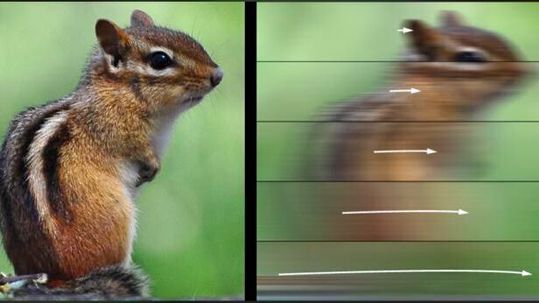
Much like chipmunks dart around in rapid bursts, our eyes swiftly dart from one place to the next. These eye movements create high-speed motion that increases with the distance they cover. The new study shows that the speed of eye movements predicts the speed limit of perception.
If you quickly move a camera from object to object, the abrupt shift between the two points causes a motion smear that might give you nausea. Our eyes, however, do movements like these two or three times per second. These rapid movements are called saccades, and although the visual stimulus during a saccade shifts abruptly across the retina, our brain seems to keep it under the hood: we never perceive the shift. New research shows that the speed of our saccades predicts the speed limit in our vision when an object becomes too fast to see. According to a study published in Nature Communications by researchers from the Cluster of Excellence Science of Intelligence (TU Berlin), visual stimuli — think a chipmunk darting around or a tennis ball hit with full force — become invisible when they move at a speed, duration, and distance similar to those of one of our saccades. This suggests that the properties of the human visual system are best understood in the context of the movements of our eyes.
When Does a Moving Stimulus Become too Fast to See?
The limits of how fast an object can be before it becomes invisible to us is directly related to the speed of our own eye movements. Beyond a certain speed, a moving stimulus becomes too fast for us to see. As a result, the speed of our eye movements across a specific distance can be used to predict at what speed a moving stimulus becomes invisible to us. And since the speed of our eye movements changes from person to person, people who make particularly rapid eye movements can also see objects moving at higher speeds than people with slower eye movements. This might mean that the best baseball batters, action video game players, or wildlife photographers are the ones with quicker eye movements.
Our Movements Shape our Perception
This result is exciting as it provides first evidence of the idea that our body movements fundamentally shape the abilities of our perceptual system. “What parts of the physical world we can sense depends fundamentally on how good our sensors are,” explains Martin Rolfs, the lead author of the study. “For example, we don't see infrared light because our eyes are not sensitive to it, and we fail to see flicker on our screens because they flicker at higher frequencies than our eyes can resolve. In this paper, however, we show that the limits of seeing are not just defined by these biophysical constraints but also by the actions and movements that impose changes on the sensory system. To show this, we used the body's fastest and most frequent motions, i.e. the saccadic eye movements that people make more than a hundred thousand times a day.”
A Motion we Don’t Perceive
Much like a camera movement causes motion in a movie, saccades create movement patterns on the retina. “But we never consciously perceive that motion,” says Rolfs. “We have shown that stimuli that follow the same (very specific) movement patterns as saccades (while people are holding their eyes still) also become invisible. So we are basically suggesting that the kinematics of our actions (here, saccades) fundamentally constrain a sensory system’s access to the physical world around us.” Rolfs explained that this is to be considered an intelligent trait of the visual system, because it remains sensitive to fast motion, but only up to speeds that result specifically from saccades, and these speeds are not seen consciously albeit available to the brain. “In simple terms,the properties of a sensory system such as the human visual system are best understood in the context of the kinematics of actions that drive its input(in this case, rapid eye movements),” said Rolfs.
A Finely Tuned Machine
“Our visual system and motor system are finely tuned to each other, but this has long been ignored,” says Martin Rolfs. “One of the issues is that the people who study motor control are not the same ones who study perception. They attend different conferences, they publish in different journals — but they should be talking!”
This study suggests that our visual system can recognize when a stimulus moves in a way that is similar to our own eye movements, and then filters out the conscious perception of this movement. This also introduces a new mechanism to explain why we do not see visual motion smear on the retina during eye movements as we would if we were using a camera.
Date: 08.12.2025
Naturally, we always handle your personal data responsibly. Any personal data we receive from you is processed in accordance with applicable data protection legislation. For detailed information please see our privacy policy.
Consent to the use of data for promotional purposes
I hereby consent to Vogel Communications Group GmbH & Co. KG, Max-Planck-Str. 7-9, 97082 Würzburg including any affiliated companies according to §§ 15 et seq. AktG (hereafter: Vogel Communications Group) using my e-mail address to send editorial newsletters. A list of all affiliated companies can be found here
Newsletter content may include all products and services of any companies mentioned above, including for example specialist journals and books, events and fairs as well as event-related products and services, print and digital media offers and services such as additional (editorial) newsletters, raffles, lead campaigns, market research both online and offline, specialist webportals and e-learning offers. In case my personal telephone number has also been collected, it may be used for offers of aforementioned products, for services of the companies mentioned above, and market research purposes.
Additionally, my consent also includes the processing of my email address and telephone number for data matching for marketing purposes with select advertising partners such as LinkedIn, Google, and Meta. For this, Vogel Communications Group may transmit said data in hashed form to the advertising partners who then use said data to determine whether I am also a member of the mentioned advertising partner portals. Vogel Communications Group uses this feature for the purposes of re-targeting (up-selling, cross-selling, and customer loyalty), generating so-called look-alike audiences for acquisition of new customers, and as basis for exclusion for on-going advertising campaigns. Further information can be found in section “data matching for marketing purposes”.
In case I access protected data on Internet portals of Vogel Communications Group including any affiliated companies according to §§ 15 et seq. AktG, I need to provide further data in order to register for the access to such content. In return for this free access to editorial content, my data may be used in accordance with this consent for the purposes stated here. This does not apply to data matching for marketing purposes.
Right of revocation
I understand that I can revoke my consent at will. My revocation does not change the lawfulness of data processing that was conducted based on my consent leading up to my revocation. One option to declare my revocation is to use the contact form found at https://contact.vogel.de. In case I no longer wish to receive certain newsletters, I have subscribed to, I can also click on the unsubscribe link included at the end of a newsletter. Further information regarding my right of revocation and the implementation of it as well as the consequences of my revocation can be found in the data protection declaration, section editorial newsletter.
Original Article: Lawful kinematics link eye movements to,the limits of high-speed perception; Nature Communications; DOI:10.1038/s41467-025-58659-9




:quality(80)/p7i.vogel.de/wcms/cb/39/cb3902f5777a11e07655ba29d00a0394/0131003637v1.jpeg "Lighting along riverbanks or streams at night disrupts the exchange of energy and nutrients between bodies of water and their adjacent riparian habitats. This can have far-reaching ecological consequences. (Source: RPTU)")
:quality(80)/p7i.vogel.de/wcms/2b/23/2b23a3cfe0768c5bfc1386dcb21f47d3/0130918783v2.jpeg "A concept illustration of the development of Synthegy. (Source: Ella Maru Studio)")
:quality(80)/p7i.vogel.de/wcms/89/ce/89ceadc7f33d88a6474ca9c3e382e67c/0130918737v1.jpeg "Snapshots of hydrogen bubble evolution immediately after water electrolysis starts. (Source: NYU Tandon School of Engineering)")
:quality(80)/p7i.vogel.de/wcms/fc/8b/fc8bff3e193f086214476440d369cc4e/0130737030v2.jpeg "A study suggests that using AI too passively at work may affect how confident people feel about their own thinking and ideas. (Source: free licensed)")
:quality(80)/p7i.vogel.de/wcms/52/2e/522e60883334ab2d806e6038a11e9204/0131030069v3.jpeg "“With Cellcelector, your team moves from single cell → validated clone → production ready line through one tightly integrated, automation driven workflow.” – Dr. Darius Wilson, Head of Product Management, Cell Selection & Retrieval, Sartorius Lab Product & Services (Source: Sartorius)")
:quality(80)/p7i.vogel.de/wcms/06/0e/060e08234d208d1faca16ad0cf582ff3/0131026470v2.jpeg "For enzymatic shearing from fixed cells or tissue – both these detergent-based buffers are ideal for effective fragmentation of nuclear material. (Source: © Kateryna_Kon - stock.adobe.com)")
:quality(80)/p7i.vogel.de/wcms/21/6a/216a1b69d48ac4ef7fe694d4c7791531/0131025888v2.jpeg "Biotech Fluidics has announced the Degasi Integration HFIP – a high-performance online system designed to efficiently degas even the toughest solvents. (Source: Biotech Fluidics )")
:quality(80)/p7i.vogel.de/wcms/4a/8d/4a8d7b8aa03d413a2bbcf34fdf463306/0131025869v2.jpeg "Suitable for reaction temperatures up to 200°C, the Drysyn Vortex is the perfect process development tool to efficiently, and safely, drive three stirrer shafts with one overhead stirrer. (Source: Drysyn Vortex)")
:quality(80)/p7i.vogel.de/wcms/2b/5e/2b5e4798cb0d86b0f29ba4de833c1412/0131003303v1.jpeg "33-month-old acacias in Manaus: ADEs result from the decomposition of organic matter and the use of fire by pre-Columbian populations and continue to be created by present-day peoples
(Source: Tsai Siu Mui/ Cena-USP)")
:quality(80)/p7i.vogel.de/wcms/54/50/5450b302b2cfe1f29c6f3d5c300123ce/0131004604v2.jpeg "Dr. Iván Hernández-Almeida, Science Officer, Past Global Changes, University of Bern
(Source: © Courtesy of Iván Hernández-Almeida)")
:quality(80)/p7i.vogel.de/wcms/f1/71/f1711b934d493949c55d6e9b9ddcffe9/0131003077v1.jpeg "Plastics – rich in carbon and hydrogen – can be converted into a clean energy source, using sunlight. (Source: Adelaide University)")
:quality(80)/p7i.vogel.de/wcms/60/54/6054287023c79b93d166c8b7802f9ad4/0130972957v2.jpeg "Scientists have discovered extensive, ancient and modern deep-sea coral reefs within the Galápagos Marine Reserve – the first of their kind ever to be documented inside the marine protected area since it was established in 1998. (Source: WHOI/NSF)")
:quality(80)/p7i.vogel.de/wcms/f6/a8/f6a8a2ac333baa08d168cc68ac2192c0/0131001826v2.jpeg "University of Oregon researchers find a way to measure the flavor profile of coffee. (Source: free licensed)")
:quality(80)/p7i.vogel.de/wcms/34/ff/34ff3de563d63ac821f789f8ca397070/0130971132v2.jpeg "Mixed nuts on a wooden platter. (Source: Piviso from Pixabay)")
:quality(80)/p7i.vogel.de/wcms/e7/08/e708baaa36f8929e985dfe5baea8bc68/0130734917v2.jpeg "A simple cafeteria menu change can make a measurable difference: replacing one meat-based lunch with a vegetarian option increased vegetarian meal choices by 41 percent in six English workplace canteens, while also reducing calories and greenhouse-gas emissions without hurting sales. (Source: free licensed)")
:quality(80)/p7i.vogel.de/wcms/ea/5a/ea5a5ed15b2c98730c7111bb56b1a7aa/0130612537v1.jpeg "A healthful plant-based diet prioritizes whole grains, fruits, vegetables, vegetable oils, nuts, legumes, tea and coffee. (Source: free licensed)")
:quality(80)/p7i.vogel.de/wcms/56/d7/56d73ff8d8ffc3ce50e3ff2188b7aada/0131004724v2.jpeg "Among Black players, major cardiac conditions occurred most commonly in those of West African origin (1.6 %), followed by Caribbean origin (0.7 %). (Source: Pixabay)")
:quality(80)/p7i.vogel.de/wcms/87/d5/87d5890059d61e8107148c2039ff9bd8/0131004713v2.jpeg "Using radio waves from a portable device, a reader, the movements of the tags could be recorded and displayed as graphs on a monitor. (Source: Chalmers University of Technology | Mia Halleröd Palmgren)")
:quality(80)/p7i.vogel.de/wcms/01/62/01621d3cb2500e9d1f537491258caf4c/0131004592v2.jpeg "Prof. Maria Luisa Balmer, M.D., SNSF Excellenza Assistant Professor, 2023 Marie Heim-Vögtlin Prize winner, and Head of the Translational Immunometabolism Lab at the Institute for Infectious Diseases (IFIK), University of Bern. (Source: © University of Bern, Image: Dres Hubacher )")
:quality(80)/p7i.vogel.de/wcms/33/b6/33b69a779b1722cdf8ce6751bf9b4ac2/0131004208v2.jpeg "(From left) Associate Professor Jonathan Lee, Professor Matthew Chang, and Dr Nikhil Aggarwal from NUS Syncti have successfully engineered a naturally occurring beneficial gut bacterium into a programmable “living medicine” to treat hepatic encephalopathy, a severe brain dysfunction linked to liver failure. (Source: NUS)")
:quality(80)/images.vogel.de/vogelonline/bdb/1710600/1710675/original.jpg "Discover how to set yourself up for success when performing balance-based density determination of solids such as jewelry and precious metals. (Mettler Toledo)")
:quality(80)/images.vogel.de/vogelonline/bdb/1682500/1682579/original.jpg "The new XPR Analytical balance redesigned to meet the needs of laboratory technicians of working fast and lean. (Mettler Toledo)")
:quality(80)/images.vogel.de/vogelonline/bdb/1677000/1677080/original.jpg "Enhance your weighing accuracy, comfort and productivity with the redesigned XPR Analytical balance. (Mettler Toledo)")
:fill(fff,0)/images.vogel.de/vogelonline/companyimg/131900/131910/65.jpg "Xylem_tag_rgb.jpg ()")
:fill(fff,0)/p7i.vogel.de/companies/69/b7/69b7f63f311d9/logo-bimos-tif--2-.jpeg "logo-bimos-tif--2- (https://www.bimos.com/de-de/)")
:quality(80)/p7i.vogel.de/wcms/d0/2d/d02dee62d9d7043405db20308a530d29/0124884497v2.jpeg "Study participant putting contacts in (Source: Yuqian Ma, Yunuo Chen, Hang Zhao)")
:quality(80)/p7i.vogel.de/wcms/c4/49/c44915c58d445a691a60f502c058433f/0125560534v1.jpeg "In this study, the participants categorised the images or sounds based on the amount of diversity they perceived in the pictures and recordings. (Source: K. Rozario / Idiv)")