Researchers at MIT have developed a rechargeable lithium-ion battery in the form of an ultra-long fiber that could be woven into fabrics. The battery could enable a wide variety of wearable electronic devices, and might even be used to make 3D-printed batteries in virtually any shape.
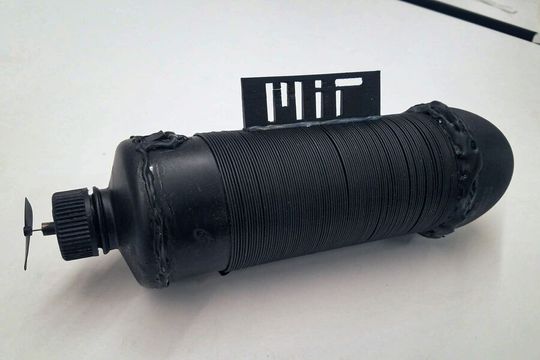
This submarine drone is powered by a 20-meter-long fiber battery that is wrapped on its surface.
(Source: Tural Khudiyev, Jung Tae Lee, Benjamin Grena, Yoel Fink et al)
Cambridge/USA — In a proof of concept, a team at Massachusetts Institute of Technology has produced the world’s longest flexible fiber battery. It is 140 meters long and demonstrates that the material can be manufactured to arbitrarily long lengths. Researchers, including members of this team, have previously demonstrated fibers that contain a wide variety of electronic components, including light emitting diodes (LEDs), photosensors, communications, and digital systems. Many of these are weavable and washable, making them practical for use in wearable products, but all have so far relied on an external power source. Now, this fiber battery, which is also weavable and washable, could enable such devices to be completely self-contained.
The new fiber battery is manufactured using novel battery gels and a standard fiber-drawing system that starts with a larger cylinder containing all the components and then heats it to just below its melting point. The material is drawn through a narrow opening to compress all the parts to a fraction of their original diameter, while maintaining all the original arrangement of parts.
While others have attempted to make batteries in fiber form, Khudiyev says, those were structured with key materials on the outside of the fiber, whereas this system embeds the lithium and other materials inside the fiber, with a protective outside coating, thus directly making this version stable and waterproof. This is the first demonstration of sub-kilometer long fiber battery which is both sufficiently long and highly durable to have practical applications, he says.
The fact that they were able to make a 140-meter fiber battery shows that “there’s no obvious upper limit to the length. We could definitely do a kilometer-scale length,” he says. A demonstration device using the new fiber battery incorporated a “Li-Fi” communications system — one in which pulses of light are used to transmit data, and included a microphone, pre-amp, transistor, and diodes to establish an optical data link between two woven fabric devices.
“When we embed the active materials inside the fiber, that means sensitive battery components already have a good sealing,” Khudiyev says, “and all the active materials are very well-integrated, so they don’t change their position” during the drawing process. In addition, the resulting fiber battery is much thinner and more flexible yielding an aspect ratio, that is the length-to-width fraction, up to a million, which is way beyond other designs, which makes it practical to use standard weaving equipment to create fabrics that incorporate the batteries as well as electronic systems.
The 140-meter fiber produced so far has an energy storage capacity of 123 milliamp-hours, which can charge smartwatches or phones, he says. The fiber device is only a few hundred microns in thickness, thinner than any previous attempts to produce batteries in fiber form.
“The beauty of our approach is that we can embed multiple devices in an individual fiber, Lee says, “unlike other approaches which need integration of multiple fiber devices.” They demonstrated integration of LED and Li-ion battery in a single fiber and he believes more than three or four devices can be combined in such a small space in the future. “When we integrate these fibers containing multi-devices, the aggregate will advance the realization of a compact fabric computer.”
In addition to individual one-dimensional fibers, which can be woven to produce two-dimensional fabrics, the material can also be used in 3D printing or custom-shape systems to create solid objects, such as casings that could provide both the structure of a device and its power source. To demonstrate this capability, a toy submarine was wrapped with the battery fiber to provide it with power. Incorporating the power source into the structure of such devices could lower the overall weight and so improve the efficiency and range they can achieve.
“This is the first 3D printing of a fiber battery device,” Khudiyev says. “If you want to make complex objects” through 3D printing that incorporate a battery device, he says, this is the first system that can achieve that. “After printing, you do not need to add anything else, because everything is already inside the fiber, all the metals, all the active materials. It’s just a one-step printing. That’s a first.” That means that now, he says, “Computational units can be put inside everyday objects, including Li-Fi.”
Date: 08.12.2025
Naturally, we always handle your personal data responsibly. Any personal data we receive from you is processed in accordance with applicable data protection legislation. For detailed information please see our privacy policy.
Consent to the use of data for promotional purposes
I hereby consent to Vogel Communications Group GmbH & Co. KG, Max-Planck-Str. 7-9, 97082 Würzburg including any affiliated companies according to §§ 15 et seq. AktG (hereafter: Vogel Communications Group) using my e-mail address to send editorial newsletters. A list of all affiliated companies can be found here
Newsletter content may include all products and services of any companies mentioned above, including for example specialist journals and books, events and fairs as well as event-related products and services, print and digital media offers and services such as additional (editorial) newsletters, raffles, lead campaigns, market research both online and offline, specialist webportals and e-learning offers. In case my personal telephone number has also been collected, it may be used for offers of aforementioned products, for services of the companies mentioned above, and market research purposes.
Additionally, my consent also includes the processing of my email address and telephone number for data matching for marketing purposes with select advertising partners such as LinkedIn, Google, and Meta. For this, Vogel Communications Group may transmit said data in hashed form to the advertising partners who then use said data to determine whether I am also a member of the mentioned advertising partner portals. Vogel Communications Group uses this feature for the purposes of re-targeting (up-selling, cross-selling, and customer loyalty), generating so-called look-alike audiences for acquisition of new customers, and as basis for exclusion for on-going advertising campaigns. Further information can be found in section “data matching for marketing purposes”.
In case I access protected data on Internet portals of Vogel Communications Group including any affiliated companies according to §§ 15 et seq. AktG, I need to provide further data in order to register for the access to such content. In return for this free access to editorial content, my data may be used in accordance with this consent for the purposes stated here. This does not apply to data matching for marketing purposes.
Right of revocation
I understand that I can revoke my consent at will. My revocation does not change the lawfulness of data processing that was conducted based on my consent leading up to my revocation. One option to declare my revocation is to use the contact form found at https://contact.vogel.de. In case I no longer wish to receive certain newsletters, I have subscribed to, I can also click on the unsubscribe link included at the end of a newsletter. Further information regarding my right of revocation and the implementation of it as well as the consequences of my revocation can be found in the data protection declaration, section editorial newsletter.
The team has already applied for a patent on the process and continues to develop further improvements in power capacity and variations on the materials used to improve efficiency. Khudiyev says such fiber batteries could be ready for use in commercial products within a few years.
The research was supported by the MIT MRSEC program of the National Science Foundation, the U.S. Army Research Laboratory through the Institute for Soldier Nanotechnologies, the National Science Foundation’s graduate research fellowship program, and the National Research Foundation of Korea. The work is described in the journal Materials Today. MIT postdoc Tural Khudiyev (now an assistant professor at National University of Singapore), former MIT postdoc Jung Tae Lee (now a professor at Kyung Hee University), and Benjamin Grena SM ’13, PhD ’17 (currently at Apple) are the lead authors on the paper. Other co-authors are MIT professors Yoel Fink, Ju Li, and John Joannopoulos, and seven others at MIT and elsewhere.




:quality(80)/p7i.vogel.de/wcms/66/7c/667c242f45cc06eb5bee090c7723ba0b/0130384415v2.jpeg "Inspired by arm-wrestling, the NUS team built a self-training platform (left) where two rings of muscle tissues continuously and autonomously pull against each other. Ostrabot (right), made from a single trained ring of muscle and two flexible tails, swims 3 times faster than counterparts with conventionally cultured muscle. (Source: National University of Singapore)")
:quality(80)/p7i.vogel.de/wcms/92/ad/92adbafb37924cea35ea3cf05b7a23e5/0130206318v2.jpeg "The world’s first fully functioning proof-of-concept quantum battery
(Source: Csiro)")
:quality(80)/p7i.vogel.de/wcms/9f/8b/9f8bc2b8491d7a514ca154e9588a07b7/0130205846v1.jpeg "The researchers’ new material, based on mineralised sawdust, is an excellent fire retardant. (Source: Dan Vivas Glaser / from Kürsteiner R et al. Chem Circularity 2026)")
:quality(80)/p7i.vogel.de/wcms/fd/73/fd73fcb3ceda89d1419de1083fcab7b4/0130081520v2.jpeg "The fingers at the heart of this technology were inspired by the fin-ray effect — a design principle derived from the natural structure of fish fins. (Source: University of Texas at Austin )")
:quality(80)/p7i.vogel.de/wcms/8f/b9/8fb98a958e4afe679865fbe52a473680/0129940982v2.jpeg "pH measurement in various nanoparticles using the Nine-Focus meter ensures precise stability and performance control. (Source: Mettler Toledo)")
:quality(80)/p7i.vogel.de/wcms/11/74/1174e5d4c8b07a64637dced8c9506b40/0129787561v2.jpeg "The Multicell Plus high-pressure reactor sets a new benchmark for operator safety, all-round accessibility and ease-of-use. (Source: Asynt)")
:quality(80)/p7i.vogel.de/wcms/ef/6e/ef6e96191183411973b77041fb6b1e16/0129785957v2.jpeg "Manufactured from high-quality crystal polystyrene - these new automation-ready plates are available in a choice of ANSI / SLAS standard (96-well and breakable 8-well strip) formats. (Source: Porvair Sciences)")
:quality(80)/p7i.vogel.de/wcms/ad/ca/adcaa20ef5ccaf7e3b325788b1e349c4/0129784872v2.jpeg "The high performance Degasi Flat Film in-line degasser. (Source: Biotech Fluidics)")
:quality(80)/p7i.vogel.de/wcms/21/9b/219b000051ab1ea14ab5f92e4fd0f9bb/0130384937v2.jpeg "Deforestation in the Appalachian mountains. (Source: Alex Diaz on Unsplash)")
:quality(80)/p7i.vogel.de/wcms/e9/9c/e99cb19231197af70c489cb4acc2ead0/0130293444v2.jpeg "A new global study, led by researchers at Kaust in Saudi Arabia, shows that forests are most effective for climate regulation when conserved or restored in their natural or native locations. (Source: Kaust )")
:quality(80)/p7i.vogel.de/wcms/af/40/af40b535eb65c287fbd22ed5483d1d0e/0130206243v2.jpeg "The researchers dug soil pits in order to measure the carbon storage in soil
(Source: Johanna Asch)")
:quality(80)/p7i.vogel.de/wcms/2d/45/2d45aba62f5042baa00f7fd4fa629839/0130036533v2.jpeg "The population of Pune, India, is expected to reach 11 million by 2050. (Source: free licensed)")
:quality(80)/p7i.vogel.de/wcms/6f/ba/6fba92196d0cbb1467334f8a2ecc520a/0130203021v2.jpeg "Low to moderate wine consumption shows lower risk compared with spirits, beer and cider (Source: free licensed)")
:quality(80)/p7i.vogel.de/wcms/a9/37/a9376f1d9a893570023d9aa97c085bc5/0129927485v2.jpeg "Examples of foods high in PUFAs include fatty fish and soybeans, while MUFAs include olive oil and avocadoes. (Source: free licensed)")
:quality(80)/p7i.vogel.de/wcms/ea/88/ea88ef8810e21cdd9bb852c70f385ba1/0129797385v2.jpeg "A team of NUS food scientists consisting of Assoc Prof Liu Shao Quan (centre), Dr Lu Yuyun (right) and Ms Geng Chenhan (left) pioneered a co-fermentation method that improves both the nutrient and flavor profile of kombu. (Source: NUS)")
:quality(80)/p7i.vogel.de/wcms/84/2c/842c7c1678ceeec7147ea3a36e238e75/0129356324v2.jpeg "Kaust and Nadec have signed a MOU that establishes a framework for long-term cooperation across agricultural research, technology development, and professional training. (Source: Kaust )")
:quality(80)/p7i.vogel.de/wcms/30/2e/302e195d532fc9aced73406b07642b57/0130384900v2.jpeg "Sleeping for 11 minutes more, doing an additional 4.5 minutes of moderate-to-vigorous physical activity, and eating additional quarter of a cup of vegetables were associated with a 10 % reduction in major cardiovascular events. (Source: Pixabay)")
:quality(80)/p7i.vogel.de/wcms/47/41/4741ee3c589369a09ab0e3a26b7143f0/0130384858v2.jpeg "A female, Aedes aegypti mosquito, after taking her blood meal. (Source: Lauren Bishop CDC)")
:quality(80)/p7i.vogel.de/wcms/66/a6/66a64c9dd7dbe84d2d7ea95a5e691bb1/0130361609v2.jpeg "Dr. Priya Freaney speaking to a patient at Bluhm Cardiovascular Institute at Northwestern Memorial Hospital in Chicago. (Source: Northwestern Medicine)")
:quality(80)/p7i.vogel.de/wcms/6e/d4/6ed479ad990b9ddc0f2eeadccccf62c7/0130359257v2.jpeg "Routine early measurement of neurofilament light chain could help improve prediction of cognitive impairment after out-of-hospital cardiac arrest, according to a study presented recently at ESC Acute Cardiovascular Care 2026. (Source: Pixabay)")
:quality(80)/images.vogel.de/vogelonline/bdb/1710600/1710675/original.jpg "Discover how to set yourself up for success when performing balance-based density determination of solids such as jewelry and precious metals. (Mettler Toledo)")
:quality(80)/images.vogel.de/vogelonline/bdb/1682500/1682579/original.jpg "The new XPR Analytical balance redesigned to meet the needs of laboratory technicians of working fast and lean. (Mettler Toledo)")
:quality(80)/images.vogel.de/vogelonline/bdb/1677000/1677080/original.jpg "Enhance your weighing accuracy, comfort and productivity with the redesigned XPR Analytical balance. (Mettler Toledo)")
:quality(80)/images.vogel.de/vogelonline/bdb/1864600/1864652/original.jpg "With a promising combination of cathode and electrolyte, the HIU researchers want to make a very high energy density possible. (Amadeus Bramsiepe, KIT)")
:quality(80)/p7i.vogel.de/wcms/15/d1/15d1ab97d1834050b8d828a4c0f9dabf/0124014294v2.jpeg "Tiny pacemaker on a fingertip, between a sesame seed and single grain of rice for scale. (Source: John A. Rogers/Northwestern University)")
:quality(80)/p7i.vogel.de/wcms/ec/c1/ecc1313beba111e5dfcce0a9c8801d63/0125849242v2.jpeg "A composite image of the robotic leg — with integrated artificial muscles — bending at the ankle and knee. (Source: Ryan Truby/Taekyoung Kim/Northwestern University)")