Mega ocean warming El Niño events were key in driving the largest extinction of life on planet Earth some 252 million years ago, according to new research. Is this a sign of the future to come?
A geological field section reveals a desiccated (extreme dryness) land surface that was common all over the world 252 million years ago — a sign of our future to come.
(Source: University of Bristol and China University of Geosciences (Wuhan))
A study, published in Science and co-led by the University of Bristol and China University of Geosciences (Wuhan), has shed new light on why the effects of rapid climate change in the Permian-Triassic warming were so devastating for all forms of life in the sea and on land. Scientists have long linked this mass extinction to vast volcanic eruptions in what is now Siberia. The resulting carbon dioxide emissions rapidly accelerated climate warming, resulting in widespread stagnation and the collapse of marine and terrestrial ecosystems. But what caused life on land, including plants and usually resilient insects, to suffer just as badly has remained a source of mystery.
Co-lead author Dr Alexander Farnsworth, Senior Research Associate at the University of Bristol, said: “Climate warming alone cannot drive such devastating extinctions because, as we are seeing today, when the tropics become too hot, species migrate to the cooler, higher latitudes. Our research has revealed that increased greenhouse gases don’t just make the majority of the planet warmer, they also increase weather and climate variability making it even more ‘wild’ and difficult for life to survive.”
The Permian-Triassic catastrophe shows the problem of global warming is not just a matter of it becoming unbearably hot, but also a case of conditions swinging wildly over decades.
“Most life failed to adapt to these conditions, but thankfully a few things survived, without which we wouldn’t be here today. It was nearly, but not quite, the end of the life on Earth,” said co-lead author Professor Yadong Sun at China University of Geosciences, Wuhan.
The scale of Permian-Triassic warming was revealed by studying oxygen isotopes in the fossilised tooth material of tiny extinct swimming organisms called conodonts. By studying the temperature record of conodonts from around the world, the researchers were able to show a remarkable collapse of temperature gradients in the low and mid latitudes.
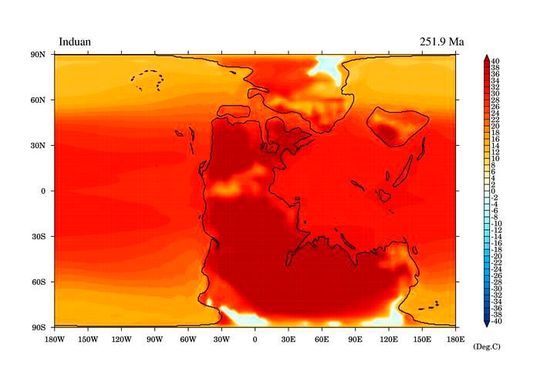
Dr Farnsworth, who used pioneering climate modelling to evaluate the findings, said: “Essentially, it got too hot everywhere. The changes responsible for the climate patterns identified were profound because there were much more intense and prolonged El Niño events than witnessed today. Species were simply not equipped to adapt or evolve quickly enough.”
Surface temperature (°C) of the warmest month during peak-warmth for the Permian-Triassic mass extinction 252 million years ago.
(Source: University of Bristol and China University of Geosciences (Wuhan))
In recent years El Niño events have caused major changes in rainfall patterns and temperature. For example, the weather extremes that caused the June 2024 North American heatwave when temperatures were around 15°C hotter than normal. 2023-2024 was also one of the hottest years on record globally due to a strong El Niño in the Pacific, which was further exacerbated by increased human-induced CO2 driving catastrophic drought and fires around the world.
“Fortunately such events so far have only lasted one to two years at a time. During the Permian-Triassic crisis, El Niño persisted for much longer resulting in a decade of widespread drought, followed by years of flooding. Basically, the climate was all over the place and that makes it very hard for any species to adapt,” co-author Paul Wignall, Professor of Palaeoenvironments at the University of Leeds. The results of the climate modelling also help explain the abundant charcoal found in rock layers of that age.
“Wildfires become very common if you have a drought-prone climate. Earth got stuck in a crisis state where the land was burning and the oceans stagnating. There was nowhere to hide,” added co-author Professor David Bond, a palaeontologist at the University of Hull.
The researchers observed that throughout Earth’s history there have been many volcanic events similar to those in Siberia, and many caused extinctions, but none led to a crisis of the scale of the Permian-Triassic event. They found Permian-Triassic extinction was so different because these Mega-El Niños created positive feedback on the climate which led to incredibly warm conditions starting in the tropics and then beyond, resulting in the dieback of vegetation. Plants are essential for removing CO2 from the atmosphere, as well as the foundation of the food web, and if they die so does one of the Earth's mechanisms to stop CO2 building up in the atmosphere as a result of continued volcanism. This also helps explain the conundrum regarding the Permian-Triassic mass extinction whereby the extinction on land occurred tens of thousands of years before extinction in the oceans.
Date: 08.12.2025
Naturally, we always handle your personal data responsibly. Any personal data we receive from you is processed in accordance with applicable data protection legislation. For detailed information please see our privacy policy.
Consent to the use of data for promotional purposes
I hereby consent to Vogel Communications Group GmbH & Co. KG, Max-Planck-Str. 7-9, 97082 Würzburg including any affiliated companies according to §§ 15 et seq. AktG (hereafter: Vogel Communications Group) using my e-mail address to send editorial newsletters. A list of all affiliated companies can be found here
Newsletter content may include all products and services of any companies mentioned above, including for example specialist journals and books, events and fairs as well as event-related products and services, print and digital media offers and services such as additional (editorial) newsletters, raffles, lead campaigns, market research both online and offline, specialist webportals and e-learning offers. In case my personal telephone number has also been collected, it may be used for offers of aforementioned products, for services of the companies mentioned above, and market research purposes.
Additionally, my consent also includes the processing of my email address and telephone number for data matching for marketing purposes with select advertising partners such as LinkedIn, Google, and Meta. For this, Vogel Communications Group may transmit said data in hashed form to the advertising partners who then use said data to determine whether I am also a member of the mentioned advertising partner portals. Vogel Communications Group uses this feature for the purposes of re-targeting (up-selling, cross-selling, and customer loyalty), generating so-called look-alike audiences for acquisition of new customers, and as basis for exclusion for on-going advertising campaigns. Further information can be found in section “data matching for marketing purposes”.
In case I access protected data on Internet portals of Vogel Communications Group including any affiliated companies according to §§ 15 et seq. AktG, I need to provide further data in order to register for the access to such content. In return for this free access to editorial content, my data may be used in accordance with this consent for the purposes stated here. This does not apply to data matching for marketing purposes.
Right of revocation
I understand that I can revoke my consent at will. My revocation does not change the lawfulness of data processing that was conducted based on my consent leading up to my revocation. One option to declare my revocation is to use the contact form found at https://contact.vogel.de. In case I no longer wish to receive certain newsletters, I have subscribed to, I can also click on the unsubscribe link included at the end of a newsletter. Further information regarding my right of revocation and the implementation of it as well as the consequences of my revocation can be found in the data protection declaration, section editorial newsletter.
“Whilst the oceans were initially shielded from the temperature rises, the mega-El Nino’s caused temperatures on land to exceed most species thermal tolerances at rates so rapid that they could not adapt in time,” explained Dr Sun. “Only species that could migrate quickly could survive, and there weren’t many plants or animals that could do that.”
Mass extinctions, although rare, are the heartbeat of the Earth’s natural system resetting life and evolution along different paths. “The Permo-Triassic mass extinction, although devastating, would ultimately see the rise of Dinosaurs becoming the dominant species thereafter as would the Cretaceous mass extinction lead to the rise of mammals, and humans,” Dr Farnsworth concluded.




:quality(80)/p7i.vogel.de/wcms/92/ad/92adbafb37924cea35ea3cf05b7a23e5/0130206318v2.jpeg "The world’s first fully functioning proof-of-concept quantum battery
(Source: Csiro)")
:quality(80)/p7i.vogel.de/wcms/9f/8b/9f8bc2b8491d7a514ca154e9588a07b7/0130205846v1.jpeg "The researchers’ new material, based on mineralised sawdust, is an excellent fire retardant. (Source: Dan Vivas Glaser / from Kürsteiner R et al. Chem Circularity 2026)")
:quality(80)/p7i.vogel.de/wcms/fd/73/fd73fcb3ceda89d1419de1083fcab7b4/0130081520v2.jpeg "The fingers at the heart of this technology were inspired by the fin-ray effect — a design principle derived from the natural structure of fish fins. (Source: University of Texas at Austin )")
:quality(80)/p7i.vogel.de/wcms/fe/64/fe649767c802d53ac63ee2c2a40b7e0d/0130060830v2.jpeg "Sample tube with light-active substance (Source: Elvira Eberhardt / Ulm University)")
:quality(80)/p7i.vogel.de/wcms/8f/b9/8fb98a958e4afe679865fbe52a473680/0129940982v2.jpeg "pH measurement in various nanoparticles using the Nine-Focus meter ensures precise stability and performance control. (Source: Mettler Toledo)")
:quality(80)/p7i.vogel.de/wcms/11/74/1174e5d4c8b07a64637dced8c9506b40/0129787561v2.jpeg "The Multicell Plus high-pressure reactor sets a new benchmark for operator safety, all-round accessibility and ease-of-use. (Source: Asynt)")
:quality(80)/p7i.vogel.de/wcms/ef/6e/ef6e96191183411973b77041fb6b1e16/0129785957v2.jpeg "Manufactured from high-quality crystal polystyrene - these new automation-ready plates are available in a choice of ANSI / SLAS standard (96-well and breakable 8-well strip) formats. (Source: Porvair Sciences)")
:quality(80)/p7i.vogel.de/wcms/ad/ca/adcaa20ef5ccaf7e3b325788b1e349c4/0129784872v2.jpeg "The high performance Degasi Flat Film in-line degasser. (Source: Biotech Fluidics)")
:quality(80)/p7i.vogel.de/wcms/af/40/af40b535eb65c287fbd22ed5483d1d0e/0130206243v2.jpeg "The researchers dug soil pits in order to measure the carbon storage in soil
(Source: Johanna Asch)")
:quality(80)/p7i.vogel.de/wcms/2d/45/2d45aba62f5042baa00f7fd4fa629839/0130036533v2.jpeg "The population of Pune, India, is expected to reach 11 million by 2050. (Source: free licensed)")
:quality(80)/p7i.vogel.de/wcms/52/f8/52f8d5521fdab07ed0a865ec0d8919fd/0130009438v2.jpeg "Drylands support around half of global livestock production and sustain the livelihoods of close to a billion people, while also underpinning soil stability and carbon storage. (Source: Kaust )")
:quality(80)/p7i.vogel.de/wcms/fe/49/fe494ada322615b6e6f6ff0f5bb7c5cf/0129926008v2.jpeg "A mandrill eating fruit. (Source: University of Bristol )")
:quality(80)/p7i.vogel.de/wcms/6f/ba/6fba92196d0cbb1467334f8a2ecc520a/0130203021v2.jpeg "Low to moderate wine consumption shows lower risk compared with spirits, beer and cider (Source: free licensed)")
:quality(80)/p7i.vogel.de/wcms/a9/37/a9376f1d9a893570023d9aa97c085bc5/0129927485v2.jpeg "Examples of foods high in PUFAs include fatty fish and soybeans, while MUFAs include olive oil and avocadoes. (Source: free licensed)")
:quality(80)/p7i.vogel.de/wcms/ea/88/ea88ef8810e21cdd9bb852c70f385ba1/0129797385v2.jpeg "A team of NUS food scientists consisting of Assoc Prof Liu Shao Quan (centre), Dr Lu Yuyun (right) and Ms Geng Chenhan (left) pioneered a co-fermentation method that improves both the nutrient and flavor profile of kombu. (Source: NUS)")
:quality(80)/p7i.vogel.de/wcms/84/2c/842c7c1678ceeec7147ea3a36e238e75/0129356324v2.jpeg "Kaust and Nadec have signed a MOU that establishes a framework for long-term cooperation across agricultural research, technology development, and professional training. (Source: Kaust )")
:quality(80)/p7i.vogel.de/wcms/e9/73/e9732473361377610267347df55071a1/0130205830v2.jpeg "Sleep EEG signals may reveal whether the brain is aging faster than the body — and help identify elevated dementia risk earlier. (Source: free licensed)")
:quality(80)/p7i.vogel.de/wcms/ed/c0/edc0c1a86229b11efd17c5e3f94d14da/0130081211v2.jpeg "A new study finds that virtual visits did not make it easier for psychiatrists, psychologists and therapists to reach significantly more people in areas where access to care has long been limited. (Source: Pixabay)")
:quality(80)/p7i.vogel.de/wcms/9c/52/9c52318bc94be17e6662dfceffa4a0c0/0130060546v2.jpeg "Domestic cat ‘Lanni’ from co-author of the study, Latasha Ludwig, Assistant Clinical Professor at Cornell University, USA. (Source: © Latasha Ludwig)")
:quality(80)/p7i.vogel.de/wcms/4b/f4/4bf4cc9e28e65e11a27dd41da2d1a7f5/0130038185v2.jpeg "The biomarker p-tau217 could help identify women at elevated dementia risk decades before clinical symptoms begin. (Source: free licensed)")
:quality(80)/images.vogel.de/vogelonline/bdb/1710600/1710675/original.jpg "Discover how to set yourself up for success when performing balance-based density determination of solids such as jewelry and precious metals. (Mettler Toledo)")
:quality(80)/images.vogel.de/vogelonline/bdb/1682500/1682579/original.jpg "The new XPR Analytical balance redesigned to meet the needs of laboratory technicians of working fast and lean. (Mettler Toledo)")
:quality(80)/images.vogel.de/vogelonline/bdb/1677000/1677080/original.jpg "Enhance your weighing accuracy, comfort and productivity with the redesigned XPR Analytical balance. (Mettler Toledo)")

:quality(80)/p7i.vogel.de/wcms/86/90/8690b8154a552da13b37f289349b1db4/0129283446v2.jpeg "Lina Pérez-Ángel holds two sediment samples whose ages are separated by about a million years. (Source: Ellen Jorgensen)")
:quality(80)/p7i.vogel.de/wcms/e4/90/e490504339150fd28bdffc2c062df8a9/0129646170v2.jpeg "“Note the clear nunatak at the mid-right of the glacier,” said Convey. “This is named 'Manhaul Rock' and, when I was first on Signy in 1989-91, it was literally a small rock poking through the ice surface that you could walk/ski/drive a skidoo up to.” (Source: Prof Peter Convey)")