Scientists at Tokyo University of Science have developed stable trivalent platforms for triple click chemistry, making it easier to synthesize complex molecules with high precision. This method allows for efficient and selective formation of highly functional triazoles, with potential applications in drug development, material science, and bioengineering.
The triple click chemistry platforms developed in this study have important implications in several fields.
Middle molecules with a molecular weight of more than 1,000 are difficult to synthesize due to multiple steps and time-consuming nature, demanding the development of a new approach that can overcome these disadvantages. Click chemistry has become an essential tool in applied chemistry due to its simplicity, efficiency, and versatility. This approach to chemical synthesis allows for quick and reliable joining of small molecules into larger, more complex structures, often with minimal side reactions and byproducts. By definition, click chemistry reactions are highly selective and efficient, making them ideal for creating specific compounds in a controlled and predictable manner.
By taking this idea two steps further, chemists have been developing molecular platforms that allow for triple click chemistry — the development of stable molecules with three different functional groups that serve as distinct, targetable reaction sites. Although these “trivalent” platforms enable the efficient synthesis of complex compounds, the selective formation of triazoles using platforms with azide and alkyne moieties remains an unsolved challenge.
Against this backdrop, a research team led by Associate Professor Suguru Yoshida from Tokyo University of Science (TUS), Japan, set out to develop novel trivalent platforms capable of producing highly functional triazoles.
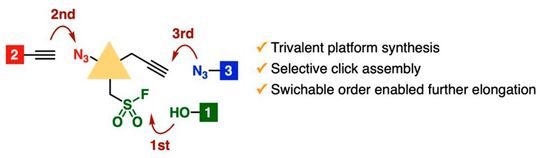
The proposed platform for triple click chemistry has three functional groups that can be independently targeted for replacement by choosing an appropriate reaction partner. This platform is compatible with sequential and versatile one-pot reactions that produce multi-triazoles.
(Source: Dr. Suguru Yoshida from Tokyo University of Science)
The researchers succeeded in creating stable trivalent platforms for triple click chemistry, thanks to a longer linker in the central scaffold. The research team demonstrated how a wide variety of molecules could be produced by sequentially targeting each functional moiety in the trivalent platform. For example, they leveraged the sulfur–fluoride exchange reaction to target the fluorosulfonyl moiety and produce different alcohols in high yields without affecting the azide and alkyne moieties. Then, they performed diverse transformations on the azide moiety, including hallmarks like copper-catalyzed azide–alkyne cycloaddition, strain-promoted azide-alkyne cycloaddition, and Bertozzi–Staudinger ligation. Finally, through a broad range of possible third transformations targeting the remaining alkyne moiety, the researchers successfully synthesized complex triazoles.
Notably, it was not strictly necessary to follow the order described above when targeting each moiety, as the researchers demonstrated triazole formations selectively in subsequent experiments. On top of this, complex triazoles could be obtained in a straightforward, one-pot reaction. “Selective click reactions with molecules that have both azide and alkyne moieties are not easy, but we were able to elucidate that each click reaction proceeds in a highly selective manner by properly choosing alkyne or azide reaction partners that react preferentially with the targeted group under the suitable conditions,” explains Yoshida.
The triple click chemistry platforms developed in this study have important implications in several applied fields. For example, functionalized multi-triazoles, which can be readily prepared in high yield, are valuable in drug development, material science, and bioengineering. They are compatible with many biological targets, such as enzymes and receptors, indicating potential pharmaceutical applications. The bio-active middle molecules synthesized via triple click chemistry can help in recovering from intractable diseases. Moreover, they are important in catalysis and materials development, serving as the basis for the design of polymers, sensors, coatings, and coordination frameworks.
“Our ultimate goal is to create new molecules that will revolutionize life sciences, and we conceived this research as a method for assembling simple component molecules all at once,” concludes Yoshida. “The proposed method enables the simple synthesis of multifunctional molecules and a wide variety of medium-sized molecules, and we expect it to be widely useful in pharmaceutical science, medicinal chemistry, chemical biology, and materials chemistry.”
The proposed approach utilizes simple initial materials rather than complex materials, promoting sustainable pharmaceutical synthesis. Additionally, the time-saving aspect of this approach can speed up the research process. Overall, the efficient trivalent platform molecules presented in this study will help accelerate progress toward more sustainable chemistry, hopefully leading to green synthesis protocols, better medical treatments, and environmental and agricultural advancements.
Date: 08.12.2025
Naturally, we always handle your personal data responsibly. Any personal data we receive from you is processed in accordance with applicable data protection legislation. For detailed information please see our privacy policy.
Consent to the use of data for promotional purposes
I hereby consent to Vogel Communications Group GmbH & Co. KG, Max-Planck-Str. 7-9, 97082 Würzburg including any affiliated companies according to §§ 15 et seq. AktG (hereafter: Vogel Communications Group) using my e-mail address to send editorial newsletters. A list of all affiliated companies can be found here
Newsletter content may include all products and services of any companies mentioned above, including for example specialist journals and books, events and fairs as well as event-related products and services, print and digital media offers and services such as additional (editorial) newsletters, raffles, lead campaigns, market research both online and offline, specialist webportals and e-learning offers. In case my personal telephone number has also been collected, it may be used for offers of aforementioned products, for services of the companies mentioned above, and market research purposes.
Additionally, my consent also includes the processing of my email address and telephone number for data matching for marketing purposes with select advertising partners such as LinkedIn, Google, and Meta. For this, Vogel Communications Group may transmit said data in hashed form to the advertising partners who then use said data to determine whether I am also a member of the mentioned advertising partner portals. Vogel Communications Group uses this feature for the purposes of re-targeting (up-selling, cross-selling, and customer loyalty), generating so-called look-alike audiences for acquisition of new customers, and as basis for exclusion for on-going advertising campaigns. Further information can be found in section “data matching for marketing purposes”.
In case I access protected data on Internet portals of Vogel Communications Group including any affiliated companies according to §§ 15 et seq. AktG, I need to provide further data in order to register for the access to such content. In return for this free access to editorial content, my data may be used in accordance with this consent for the purposes stated here. This does not apply to data matching for marketing purposes.
Right of revocation
I understand that I can revoke my consent at will. My revocation does not change the lawfulness of data processing that was conducted based on my consent leading up to my revocation. One option to declare my revocation is to use the contact form found at https://contact.vogel.de. In case I no longer wish to receive certain newsletters, I have subscribed to, I can also click on the unsubscribe link included at the end of a newsletter. Further information regarding my right of revocation and the implementation of it as well as the consequences of my revocation can be found in the data protection declaration, section editorial newsletter.
Reference: Three-step click assembly using trivalent platforms bearing azido, ethynyl, and fluorosulfonyl groups; Chemical Communications; DOI: 10.1039/D4CC06585A




:quality(80)/p7i.vogel.de/wcms/92/ad/92adbafb37924cea35ea3cf05b7a23e5/0130206318v2.jpeg "The world’s first fully functioning proof-of-concept quantum battery
(Source: Csiro)")
:quality(80)/p7i.vogel.de/wcms/9f/8b/9f8bc2b8491d7a514ca154e9588a07b7/0130205846v1.jpeg "The researchers’ new material, based on mineralised sawdust, is an excellent fire retardant. (Source: Dan Vivas Glaser / from Kürsteiner R et al. Chem Circularity 2026)")
:quality(80)/p7i.vogel.de/wcms/fd/73/fd73fcb3ceda89d1419de1083fcab7b4/0130081520v2.jpeg "The fingers at the heart of this technology were inspired by the fin-ray effect — a design principle derived from the natural structure of fish fins. (Source: University of Texas at Austin )")
:quality(80)/p7i.vogel.de/wcms/fe/64/fe649767c802d53ac63ee2c2a40b7e0d/0130060830v2.jpeg "Sample tube with light-active substance (Source: Elvira Eberhardt / Ulm University)")
:quality(80)/p7i.vogel.de/wcms/8f/b9/8fb98a958e4afe679865fbe52a473680/0129940982v2.jpeg "pH measurement in various nanoparticles using the Nine-Focus meter ensures precise stability and performance control. (Source: Mettler Toledo)")
:quality(80)/p7i.vogel.de/wcms/11/74/1174e5d4c8b07a64637dced8c9506b40/0129787561v2.jpeg "The Multicell Plus high-pressure reactor sets a new benchmark for operator safety, all-round accessibility and ease-of-use. (Source: Asynt)")
:quality(80)/p7i.vogel.de/wcms/ef/6e/ef6e96191183411973b77041fb6b1e16/0129785957v2.jpeg "Manufactured from high-quality crystal polystyrene - these new automation-ready plates are available in a choice of ANSI / SLAS standard (96-well and breakable 8-well strip) formats. (Source: Porvair Sciences)")
:quality(80)/p7i.vogel.de/wcms/ad/ca/adcaa20ef5ccaf7e3b325788b1e349c4/0129784872v2.jpeg "The high performance Degasi Flat Film in-line degasser. (Source: Biotech Fluidics)")
:quality(80)/p7i.vogel.de/wcms/af/40/af40b535eb65c287fbd22ed5483d1d0e/0130206243v2.jpeg "The researchers dug soil pits in order to measure the carbon storage in soil
(Source: Johanna Asch)")
:quality(80)/p7i.vogel.de/wcms/2d/45/2d45aba62f5042baa00f7fd4fa629839/0130036533v2.jpeg "The population of Pune, India, is expected to reach 11 million by 2050. (Source: free licensed)")
:quality(80)/p7i.vogel.de/wcms/52/f8/52f8d5521fdab07ed0a865ec0d8919fd/0130009438v2.jpeg "Drylands support around half of global livestock production and sustain the livelihoods of close to a billion people, while also underpinning soil stability and carbon storage. (Source: Kaust )")
:quality(80)/p7i.vogel.de/wcms/fe/49/fe494ada322615b6e6f6ff0f5bb7c5cf/0129926008v2.jpeg "A mandrill eating fruit. (Source: University of Bristol )")
:quality(80)/p7i.vogel.de/wcms/6f/ba/6fba92196d0cbb1467334f8a2ecc520a/0130203021v2.jpeg "Low to moderate wine consumption shows lower risk compared with spirits, beer and cider (Source: free licensed)")
:quality(80)/p7i.vogel.de/wcms/a9/37/a9376f1d9a893570023d9aa97c085bc5/0129927485v2.jpeg "Examples of foods high in PUFAs include fatty fish and soybeans, while MUFAs include olive oil and avocadoes. (Source: free licensed)")
:quality(80)/p7i.vogel.de/wcms/ea/88/ea88ef8810e21cdd9bb852c70f385ba1/0129797385v2.jpeg "A team of NUS food scientists consisting of Assoc Prof Liu Shao Quan (centre), Dr Lu Yuyun (right) and Ms Geng Chenhan (left) pioneered a co-fermentation method that improves both the nutrient and flavor profile of kombu. (Source: NUS)")
:quality(80)/p7i.vogel.de/wcms/84/2c/842c7c1678ceeec7147ea3a36e238e75/0129356324v2.jpeg "Kaust and Nadec have signed a MOU that establishes a framework for long-term cooperation across agricultural research, technology development, and professional training. (Source: Kaust )")
:quality(80)/p7i.vogel.de/wcms/e9/73/e9732473361377610267347df55071a1/0130205830v2.jpeg "Sleep EEG signals may reveal whether the brain is aging faster than the body — and help identify elevated dementia risk earlier. (Source: free licensed)")
:quality(80)/p7i.vogel.de/wcms/ed/c0/edc0c1a86229b11efd17c5e3f94d14da/0130081211v2.jpeg "A new study finds that virtual visits did not make it easier for psychiatrists, psychologists and therapists to reach significantly more people in areas where access to care has long been limited. (Source: Pixabay)")
:quality(80)/p7i.vogel.de/wcms/9c/52/9c52318bc94be17e6662dfceffa4a0c0/0130060546v2.jpeg "Domestic cat ‘Lanni’ from co-author of the study, Latasha Ludwig, Assistant Clinical Professor at Cornell University, USA. (Source: © Latasha Ludwig)")
:quality(80)/p7i.vogel.de/wcms/4b/f4/4bf4cc9e28e65e11a27dd41da2d1a7f5/0130038185v2.jpeg "The biomarker p-tau217 could help identify women at elevated dementia risk decades before clinical symptoms begin. (Source: free licensed)")
:quality(80)/images.vogel.de/vogelonline/bdb/1710600/1710675/original.jpg "Discover how to set yourself up for success when performing balance-based density determination of solids such as jewelry and precious metals. (Mettler Toledo)")
:quality(80)/images.vogel.de/vogelonline/bdb/1682500/1682579/original.jpg "The new XPR Analytical balance redesigned to meet the needs of laboratory technicians of working fast and lean. (Mettler Toledo)")
:quality(80)/images.vogel.de/vogelonline/bdb/1677000/1677080/original.jpg "Enhance your weighing accuracy, comfort and productivity with the redesigned XPR Analytical balance. (Mettler Toledo)")
:fill(fff,0)/p7i.vogel.de/companies/5f/3f/5f3f63ceedc78/knf-logo.jpg "KNF_Logo.jpg (www.knf.com)")
:quality(80)/p7i.vogel.de/wcms/9c/2b/9c2bc6ebdfce4f2921fac89ad9d5b515/0124132787v2.jpeg "Breakthrough in sustinable coupling processes for synthesizing organic chemicals. (Source: Ritsumeikan University)")
:quality(80)/p7i.vogel.de/wcms/36/15/36155593f7f025f2081b716386d9028f/0123895736v2.jpeg "Research group of the Department of Chemistry, Biochemistry and Pharmaceutical Sciences (DCBP) of the University of Bern, Dr. Andreu Tortajada (former postdoc at the DCBP), Prof. Dr. Eva Hevia (Vice Director / Research Group Leader at the DCBP), David Anderson (PhD student at the DCBP) (from left to right). (Source: © zvg)")