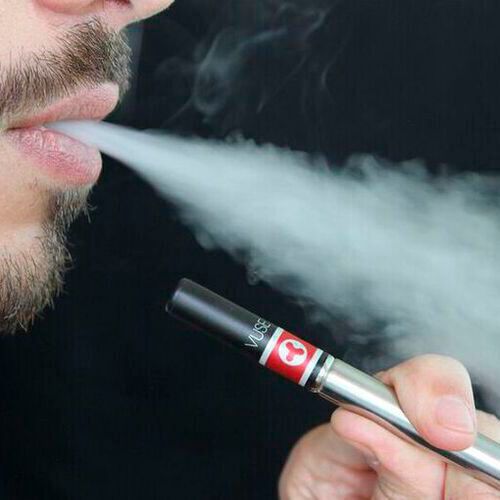
Vapes are used by cigarette addicts to get rid of their nicotine addiction but a research group has now revealed that these e-cigarettes help to stop smoking but not necessarily stop using nicotine.
The researchers see a pragmatic approach in recommending vapes to smokers instead of leaving them alone with their dependence and the health consequences of their habit.
(Source: Pixabay)
Bern/Switzerland – Vapes, also called e-cigarettes or electronic nicotine delivery systems (Ends) are electrically powered devices that emit nicotine in the form of vapor. Unlike tobacco cigarettes, they are tobacco-free and deliver significantly lower levels of toxic compounds. Vapes are used by tobacco smokers, among others, to quit smoking cigarettes. So far, however, there is insufficient data on how safe vapes are when they are used over longer periods and as part of intensive smoking cessation counseling, as offered in Switzerland. The world's largest study on this topic has now been conducted, involving researchers from the fields of family medicine, pulmonary medicine, toxicology, addiction medicine and epidemiology with five study centers in Switzerland (Bern, Geneva, Lausanne, Zurich, St. Gallen), led by the University of Bern.
The study compared the efficacy, safety and toxicology of vapes as part of intensive smoking cessation counseling compared to equally intensive smoking cessation counseling without vapes. The smoking cessation counseling in both groups included intensive behavioral support as well as recommendations to use smoking cessation medication and nicotine replacement therapy. The results, which were published in The New England Journal of Medicine, show that vapes are more effective for smoking cessation than conventional smoking cessation counseling without vapes, and they have few side effects. However, they do not help to kick the nicotine habit. "Our study confirms previous findings that vapes are effective to quit smoking tobacco. It also shows the benefits they bring in the context of intensive smoking cessation counseling, as we have in Switzerland," says Reto Auer, study leader from the Institute of Primary Health Care (Biham) at the University of Bern and from Unisanté, University Center for Primary Care and Public Health in Lausanne.
Abstinence from tobacco, but ongoing nicotine use
Over a period of six months, a total of 1,246 participants in the two groups were surveyed and clinically examined in the five study centers in German-speaking and French-speaking Switzerland. Health-related adverse events were recorded in detail. The results showed that the addition of vapes to intensive smoking cessation counseling increased abstinence from tobacco smoking by 21 %. The abstinence rate from tobacco smoking was 53 % in the group with vapes and 32 % in the group without vapes (67 % more abstinence with vapes compared to no vapes). However, many people who stopped smoking tobacco continued to use vapes and thus with nicotine. Accordingly, nicotine abstinence was lower in this group. The difference was 14 % (20 % nicotine abstinence in the group with vapes compared to 34 % in the group without vapes).
Vapes could lead to fewer tobacco-related symptoms
In terms of side effects, serious adverse events did not occur more frequently in the group with vapes than in the group without vapes. "This speaks for the safety of vapes in smoking cessation counseling in light of the study's large scope," says Auer. On the other hand, more mild side effects such as airways irritation were found. "This can be explained, among other things, by the fact that the nicotine in vapes irritates the throat more than conventional cigarettes, which contain additives to alleviate precisely these symptoms," explains Auer. Health problems such as cough and sputum production were lower in the group with vapes than in the control group (41 % less participants reporting cough compared to 34 %). "Cough and sputum production are typical symptoms of smoker's lung. A reduction in these symptoms could indicate that smokers who switch to vapes completely and stop smoking tobacco could suffer less from tobacco-related diseases in the long term, even if they continue to use vapes," explains Martin Brutsche, pulmonologist, and head of the study center in St. Gallen. However, according to the researchers, long-term studies are needed to confirm the health benefits compared to continued smoking. "Most smoking-related illnesses are caused by toxic and carcinogenic substances in tobacco and not by nicotine," continues Martin Brutsche.
"Most smokers want to stop smoking tobacco cigarettes, but many are unable to do so even with available, established, scientifically proven smoking cessation products. This is where vapes could help as part of a smoking cessation counseling," adds Isabelle Jacot-Sadowski, who was involved in the Lausanne study center.
Date: 08.12.2025
Naturally, we always handle your personal data responsibly. Any personal data we receive from you is processed in accordance with applicable data protection legislation. For detailed information please see our privacy policy.
Consent to the use of data for promotional purposes
I hereby consent to Vogel Communications Group GmbH & Co. KG, Max-Planck-Str. 7-9, 97082 Würzburg including any affiliated companies according to §§ 15 et seq. AktG (hereafter: Vogel Communications Group) using my e-mail address to send editorial newsletters. A list of all affiliated companies can be found here
Newsletter content may include all products and services of any companies mentioned above, including for example specialist journals and books, events and fairs as well as event-related products and services, print and digital media offers and services such as additional (editorial) newsletters, raffles, lead campaigns, market research both online and offline, specialist webportals and e-learning offers. In case my personal telephone number has also been collected, it may be used for offers of aforementioned products, for services of the companies mentioned above, and market research purposes.
Additionally, my consent also includes the processing of my email address and telephone number for data matching for marketing purposes with select advertising partners such as LinkedIn, Google, and Meta. For this, Vogel Communications Group may transmit said data in hashed form to the advertising partners who then use said data to determine whether I am also a member of the mentioned advertising partner portals. Vogel Communications Group uses this feature for the purposes of re-targeting (up-selling, cross-selling, and customer loyalty), generating so-called look-alike audiences for acquisition of new customers, and as basis for exclusion for on-going advertising campaigns. Further information can be found in section “data matching for marketing purposes”.
In case I access protected data on Internet portals of Vogel Communications Group including any affiliated companies according to §§ 15 et seq. AktG, I need to provide further data in order to register for the access to such content. In return for this free access to editorial content, my data may be used in accordance with this consent for the purposes stated here. This does not apply to data matching for marketing purposes.
Right of revocation
I understand that I can revoke my consent at will. My revocation does not change the lawfulness of data processing that was conducted based on my consent leading up to my revocation. One option to declare my revocation is to use the contact form found at https://contact.vogel.de. In case I no longer wish to receive certain newsletters, I have subscribed to, I can also click on the unsubscribe link included at the end of a newsletter. Further information regarding my right of revocation and the implementation of it as well as the consequences of my revocation can be found in the data protection declaration, section editorial newsletter.
Possible two-stage approach to nicotine addiction
The researchers see a pragmatic approach in recommending vapes to smokers instead of leaving them alone with their dependence and the health consequences of their habit. "By using vapes, smokers could reduce the risk of tobacco-related diseases until they later decide to stop using nicotine altogether," says Isabelle Jacot-Sadowski. Vapes therefore enable a two-stage approach: first quitting tobacco and then quitting the vapes, and thus nicotine.
No easy access to vapes recommended
Vapes are not risk-free. Even though vapes release far fewer toxic substances than tobacco cigarettes, they still release carcinogenic substances and nicotine can lead to addictive behavior, especially among young people. Accordingly, a sharp increase in vaping among young people is being observed with concern in many Western countries. "Adolescents and non-smokers should breathe in fresh air rather than vaping. It is therefore important to ensure that access to vapes is sufficiently regulated," says Auer. The researchers emphasize that the study only examined the use of vapes in people willing to quit smoking and in conjunction with smoking cessation counseling. "We therefore advocate that vapes could be suggested to smokers as part of smoking cessation counseling, but that non-smokers should not have easy access to vapes, nor to tobacco cigarettes and other nicotine-containing products," explains Auer.




:quality(80)/p7i.vogel.de/wcms/92/ad/92adbafb37924cea35ea3cf05b7a23e5/0130206318v2.jpeg "The world’s first fully functioning proof-of-concept quantum battery
(Source: Csiro)")
:quality(80)/p7i.vogel.de/wcms/9f/8b/9f8bc2b8491d7a514ca154e9588a07b7/0130205846v1.jpeg "The researchers’ new material, based on mineralised sawdust, is an excellent fire retardant. (Source: Dan Vivas Glaser / from Kürsteiner R et al. Chem Circularity 2026)")
:quality(80)/p7i.vogel.de/wcms/fd/73/fd73fcb3ceda89d1419de1083fcab7b4/0130081520v2.jpeg "The fingers at the heart of this technology were inspired by the fin-ray effect — a design principle derived from the natural structure of fish fins. (Source: University of Texas at Austin )")
:quality(80)/p7i.vogel.de/wcms/fe/64/fe649767c802d53ac63ee2c2a40b7e0d/0130060830v2.jpeg "Sample tube with light-active substance (Source: Elvira Eberhardt / Ulm University)")
:quality(80)/p7i.vogel.de/wcms/8f/b9/8fb98a958e4afe679865fbe52a473680/0129940982v2.jpeg "pH measurement in various nanoparticles using the Nine-Focus meter ensures precise stability and performance control. (Source: Mettler Toledo)")
:quality(80)/p7i.vogel.de/wcms/11/74/1174e5d4c8b07a64637dced8c9506b40/0129787561v2.jpeg "The Multicell Plus high-pressure reactor sets a new benchmark for operator safety, all-round accessibility and ease-of-use. (Source: Asynt)")
:quality(80)/p7i.vogel.de/wcms/ef/6e/ef6e96191183411973b77041fb6b1e16/0129785957v2.jpeg "Manufactured from high-quality crystal polystyrene - these new automation-ready plates are available in a choice of ANSI / SLAS standard (96-well and breakable 8-well strip) formats. (Source: Porvair Sciences)")
:quality(80)/p7i.vogel.de/wcms/ad/ca/adcaa20ef5ccaf7e3b325788b1e349c4/0129784872v2.jpeg "The high performance Degasi Flat Film in-line degasser. (Source: Biotech Fluidics)")
:quality(80)/p7i.vogel.de/wcms/af/40/af40b535eb65c287fbd22ed5483d1d0e/0130206243v2.jpeg "The researchers dug soil pits in order to measure the carbon storage in soil
(Source: Johanna Asch)")
:quality(80)/p7i.vogel.de/wcms/2d/45/2d45aba62f5042baa00f7fd4fa629839/0130036533v2.jpeg "The population of Pune, India, is expected to reach 11 million by 2050. (Source: free licensed)")
:quality(80)/p7i.vogel.de/wcms/52/f8/52f8d5521fdab07ed0a865ec0d8919fd/0130009438v2.jpeg "Drylands support around half of global livestock production and sustain the livelihoods of close to a billion people, while also underpinning soil stability and carbon storage. (Source: Kaust )")
:quality(80)/p7i.vogel.de/wcms/fe/49/fe494ada322615b6e6f6ff0f5bb7c5cf/0129926008v2.jpeg "A mandrill eating fruit. (Source: University of Bristol )")
:quality(80)/p7i.vogel.de/wcms/6f/ba/6fba92196d0cbb1467334f8a2ecc520a/0130203021v2.jpeg "Low to moderate wine consumption shows lower risk compared with spirits, beer and cider (Source: free licensed)")
:quality(80)/p7i.vogel.de/wcms/a9/37/a9376f1d9a893570023d9aa97c085bc5/0129927485v2.jpeg "Examples of foods high in PUFAs include fatty fish and soybeans, while MUFAs include olive oil and avocadoes. (Source: free licensed)")
:quality(80)/p7i.vogel.de/wcms/ea/88/ea88ef8810e21cdd9bb852c70f385ba1/0129797385v2.jpeg "A team of NUS food scientists consisting of Assoc Prof Liu Shao Quan (centre), Dr Lu Yuyun (right) and Ms Geng Chenhan (left) pioneered a co-fermentation method that improves both the nutrient and flavor profile of kombu. (Source: NUS)")
:quality(80)/p7i.vogel.de/wcms/84/2c/842c7c1678ceeec7147ea3a36e238e75/0129356324v2.jpeg "Kaust and Nadec have signed a MOU that establishes a framework for long-term cooperation across agricultural research, technology development, and professional training. (Source: Kaust )")
:quality(80)/p7i.vogel.de/wcms/e9/73/e9732473361377610267347df55071a1/0130205830v2.jpeg "Sleep EEG signals may reveal whether the brain is aging faster than the body — and help identify elevated dementia risk earlier. (Source: free licensed)")
:quality(80)/p7i.vogel.de/wcms/ed/c0/edc0c1a86229b11efd17c5e3f94d14da/0130081211v2.jpeg "A new study finds that virtual visits did not make it easier for psychiatrists, psychologists and therapists to reach significantly more people in areas where access to care has long been limited. (Source: Pixabay)")
:quality(80)/p7i.vogel.de/wcms/9c/52/9c52318bc94be17e6662dfceffa4a0c0/0130060546v2.jpeg "Domestic cat ‘Lanni’ from co-author of the study, Latasha Ludwig, Assistant Clinical Professor at Cornell University, USA. (Source: © Latasha Ludwig)")
:quality(80)/p7i.vogel.de/wcms/4b/f4/4bf4cc9e28e65e11a27dd41da2d1a7f5/0130038185v2.jpeg "The biomarker p-tau217 could help identify women at elevated dementia risk decades before clinical symptoms begin. (Source: free licensed)")
:quality(80)/images.vogel.de/vogelonline/bdb/1710600/1710675/original.jpg "Discover how to set yourself up for success when performing balance-based density determination of solids such as jewelry and precious metals. (Mettler Toledo)")
:quality(80)/images.vogel.de/vogelonline/bdb/1682500/1682579/original.jpg "The new XPR Analytical balance redesigned to meet the needs of laboratory technicians of working fast and lean. (Mettler Toledo)")
:quality(80)/images.vogel.de/vogelonline/bdb/1677000/1677080/original.jpg "Enhance your weighing accuracy, comfort and productivity with the redesigned XPR Analytical balance. (Mettler Toledo)")
:fill(fff,0)/p7i.vogel.de/companies/5f/3f/5f3f63ceedc78/knf-logo.jpg "KNF_Logo.jpg (www.knf.com)")
:quality(80)/p7i.vogel.de/wcms/7f/78/7f78a8ee6f40a309900d0afc6115faa5/0124805603v2.jpeg "New research highlights the high addiction potential of pod-style e-cigarettes, especially among young adults with no history of smoking. (Source: free licensed)")
:quality(80)/p7i.vogel.de/wcms/d9/f6/d9f6cb2991052e99729ec2f8cdd5701a/0128641463v2.jpeg "Nicotine is toxic to the heart and blood vessels, regardless of whether it is consumed via a vape, a pouch, a shisha or a cigarette, according to an expert consensus report published in the European Heart Journal recently. (Source: Pixabay)")