Biology Meets Big DataDNA Provides a Solution to Data Storage Problem
Source:
Arizona State University
5 min Reading Time
DNA may offer an answer to two of the digital age’s biggest challenges: how to store exploding volumes of data and how to keep it secure. Researchers at Arizona State University show that engineered DNA structures can encode vast amounts of information and even enable molecular-level encryption, pointing to a future beyond silicon-based storage.
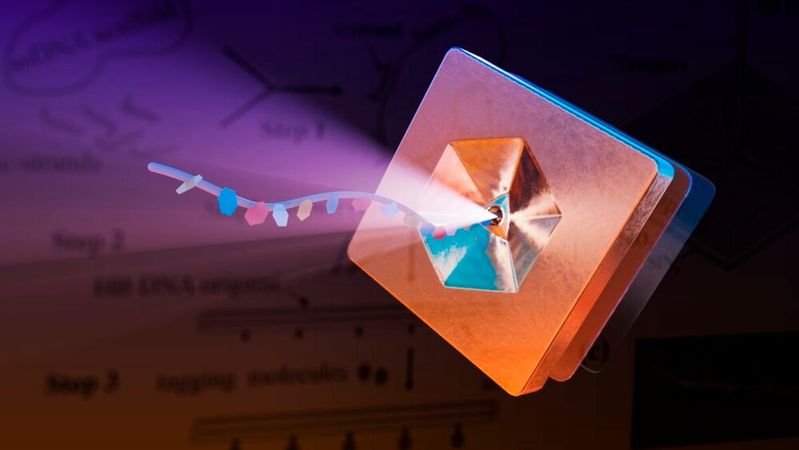
An illustration shows a strand of engineered DNA passing through a nanoscale sensor, where its physical structure can be decoded as digital information. DNA nanostructures could one day serve as ultra-dense carriers of digital information and advance the field of data encryption.
(Source: Jason Drees/ ASU)
Since the dawn of the computer age, researchers have wrestled with two persistent challenges: how to store ever-increasing reams of data and how to protect that information from unintended access. Now, researchers with Arizona State University’s Biodesign Institute and their colleagues offer a surprising answer. In a pair of new studies, they show how DNA, the molecule of life, can be harnessed to faithfully store enormous volumes of data and provide powerful encryption.
The findings, appearing in the journals Advanced Functional Materials and Nature Communications respectively, provide a nature-inspired alternative to silicon-based storage and encryption solutions. They could help reshape the design of future microelectronic and molecular information systems for a broad range of applications.
“For decades, information technology has relied almost entirely on silicon,” said Hao Yan, a Regents Professor in the School of Molecular Sciences and director of the Biodesign Center for Molecular Design and Biomimetics at Arizona State University. “What we’re showing here is that biological molecules, specifically DNA, can be engineered to store and protect information in fundamentally new ways. By treating DNA as an information platform rather than just a genetic material, we can begin to rethink how data is stored, read and secured at the nanoscale.”
Yan, along with researchers Chao Wang, associate professor in the School of Electrical, Computer and Energy Engineering, and Rizal Hariadi, associate professor in the Department of Physics, worked together to lead the projects.
Big Data, Tiny Molecule
As the world generates tremendous volumes of digital information, today’s storage technologies are struggling to keep up. The first study demonstrates a new way to store information using DNA — not by analyzing genetic letters, but by interpreting DNA’s physical shape.
DNA is appealing because it can store massive amounts of information in a tiny physical volume, and because it can remain stable for astonishingly long periods. (In 2022, researchers recovered DNA fragments from Greenland sediments dating back roughly 2 million years.)
The new research describes the design and construction of tiny DNA structures that act like physical letters in an alphabet, each carrying a piece of information. As the structures pass through a microscopic sensor, machine learning software records and analyzes subtle electrical signals. Then, the system can translate the data back into readable words and short messages with high accuracy.
The approach offers a powerful alternative to more traditional DNA data storage methods that rely on slow and expensive DNA sequencing. In contrast, the new technique is faster, cheaper and more scalable.
What we’re showing here is that biological molecules, specifically DNA, can be engineered to store and protect information in fundamentally new ways.
Hao Yan, Regents Professor, Arizona State University
The work points toward a future where DNA could serve as an ultra-dense, long-lasting and secure medium for data storage. It could be useful for archiving massive amounts of information — from scientific records to cultural data — using very little space and energy. It also demonstrates a powerful bridge between synthetic biology and semiconductor technology, opening the door to new kinds of molecular information systems that go beyond conventional electronics.
Locking Down Information at the Molecular Level
While the first study focuses on how DNA can store information efficiently, the second explores how DNA nanostructures could also help protect information through encryption.
In this work, the researchers design intricate DNA origami structures — folded arrangements of DNA strands that form precise two- and three-dimensional shapes. Instead of storing data simply as bits or letters, information is encoded in the arrangement and pattern of these nanoscale structures. This creates a kind of molecular code that is difficult to interpret without the correct tools and reference patterns.
To read the encrypted information, the team uses an advanced form of super-resolution microscopy that can visualize individual DNA structures at extremely high precision. Machine learning software then analyzes thousands of molecular images, grouping similar patterns and translating them back into the original message. Without the correct decoding framework, the patterns are essentially meaningless, adding a layer of built-in security.
Date: 08.12.2025
Naturally, we always handle your personal data responsibly. Any personal data we receive from you is processed in accordance with applicable data protection legislation. For detailed information please see our privacy policy.
Consent to the use of data for promotional purposes
I hereby consent to Vogel Communications Group GmbH & Co. KG, Max-Planck-Str. 7-9, 97082 Würzburg including any affiliated companies according to §§ 15 et seq. AktG (hereafter: Vogel Communications Group) using my e-mail address to send editorial newsletters. A list of all affiliated companies can be found here
Newsletter content may include all products and services of any companies mentioned above, including for example specialist journals and books, events and fairs as well as event-related products and services, print and digital media offers and services such as additional (editorial) newsletters, raffles, lead campaigns, market research both online and offline, specialist webportals and e-learning offers. In case my personal telephone number has also been collected, it may be used for offers of aforementioned products, for services of the companies mentioned above, and market research purposes.
Additionally, my consent also includes the processing of my email address and telephone number for data matching for marketing purposes with select advertising partners such as LinkedIn, Google, and Meta. For this, Vogel Communications Group may transmit said data in hashed form to the advertising partners who then use said data to determine whether I am also a member of the mentioned advertising partner portals. Vogel Communications Group uses this feature for the purposes of re-targeting (up-selling, cross-selling, and customer loyalty), generating so-called look-alike audiences for acquisition of new customers, and as basis for exclusion for on-going advertising campaigns. Further information can be found in section “data matching for marketing purposes”.
In case I access protected data on Internet portals of Vogel Communications Group including any affiliated companies according to §§ 15 et seq. AktG, I need to provide further data in order to register for the access to such content. In return for this free access to editorial content, my data may be used in accordance with this consent for the purposes stated here. This does not apply to data matching for marketing purposes.
Right of revocation
I understand that I can revoke my consent at will. My revocation does not change the lawfulness of data processing that was conducted based on my consent leading up to my revocation. One option to declare my revocation is to use the contact form found at https://contact.vogel.de. In case I no longer wish to receive certain newsletters, I have subscribed to, I can also click on the unsubscribe link included at the end of a newsletter. Further information regarding my right of revocation and the implementation of it as well as the consequences of my revocation can be found in the data protection declaration, section editorial newsletter.
The approach greatly increases the number of possible molecular codes that can be created, making unauthorized decoding far more difficult. It also allows information to be packed into three-dimensional DNA structures, which adds even more complexity and security to each molecular key.
“In these studies, our team brings together complementary approaches, including DNA nanotechnology, super-resolution optical imaging, high-speed electronic readout and machine learning, to interrogate DNA nanostructures across multiple spatial and temporal scales,” Wang said. "This integrated strategy helps us better understand the behavior and function of DNA nanostructures.
"This is a very good example of doing research at the intersection of semiconductor technology and biology. In this emerging field, more applications, from advanced biosensing to programmable nanodevices, remain to be explored.”
Bringing Storage and Security Together at the Molecular Scale
Together, the two studies show how DNA can function not only as a compact storage medium, but also as a platform for secure information handling at the nanoscale. One technique emphasizes fast, electronic-style readout of molecular information, while the other demonstrates how molecular patterns themselves can serve as encrypted carriers of data.
DNA-based systems could one day support ultra-dense storage for scientific data, medical records or cultural archives. Molecular encryption could provide new ways to secure sensitive information in environments where conventional electronics struggle, such as extreme temperatures, radiation or long-term preservation.
The research highlights a growing convergence between biology, materials science, computation and electronics. By treating DNA as both a biological molecule and an information platform, researchers are opening new ways to store, protect and access data at scales far smaller and potentially far more durable than today’s digital devices.
Original Article: High-speed 3D DNA PAINT and unsupervised clustering for unlocking 3D DNA origami cryptography; Nature Communications; DOI:10.1038/s41467-025-66338-y




:quality(80)/p7i.vogel.de/wcms/92/ad/92adbafb37924cea35ea3cf05b7a23e5/0130206318v2.jpeg "The world’s first fully functioning proof-of-concept quantum battery
(Source: Csiro)")
:quality(80)/p7i.vogel.de/wcms/9f/8b/9f8bc2b8491d7a514ca154e9588a07b7/0130205846v1.jpeg "The researchers’ new material, based on mineralised sawdust, is an excellent fire retardant. (Source: Dan Vivas Glaser / from Kürsteiner R et al. Chem Circularity 2026)")
:quality(80)/p7i.vogel.de/wcms/fd/73/fd73fcb3ceda89d1419de1083fcab7b4/0130081520v2.jpeg "The fingers at the heart of this technology were inspired by the fin-ray effect — a design principle derived from the natural structure of fish fins. (Source: University of Texas at Austin )")
:quality(80)/p7i.vogel.de/wcms/fe/64/fe649767c802d53ac63ee2c2a40b7e0d/0130060830v2.jpeg "Sample tube with light-active substance (Source: Elvira Eberhardt / Ulm University)")
:quality(80)/p7i.vogel.de/wcms/8f/b9/8fb98a958e4afe679865fbe52a473680/0129940982v2.jpeg "pH measurement in various nanoparticles using the Nine-Focus meter ensures precise stability and performance control. (Source: Mettler Toledo)")
:quality(80)/p7i.vogel.de/wcms/11/74/1174e5d4c8b07a64637dced8c9506b40/0129787561v2.jpeg "The Multicell Plus high-pressure reactor sets a new benchmark for operator safety, all-round accessibility and ease-of-use. (Source: Asynt)")
:quality(80)/p7i.vogel.de/wcms/ef/6e/ef6e96191183411973b77041fb6b1e16/0129785957v2.jpeg "Manufactured from high-quality crystal polystyrene - these new automation-ready plates are available in a choice of ANSI / SLAS standard (96-well and breakable 8-well strip) formats. (Source: Porvair Sciences)")
:quality(80)/p7i.vogel.de/wcms/ad/ca/adcaa20ef5ccaf7e3b325788b1e349c4/0129784872v2.jpeg "The high performance Degasi Flat Film in-line degasser. (Source: Biotech Fluidics)")
:quality(80)/p7i.vogel.de/wcms/e9/9c/e99cb19231197af70c489cb4acc2ead0/0130293444v2.jpeg "A new global study, led by researchers at Kaust in Saudi Arabia, shows that forests are most effective for climate regulation when conserved or restored in their natural or native locations. (Source: Kaust )")
:quality(80)/p7i.vogel.de/wcms/af/40/af40b535eb65c287fbd22ed5483d1d0e/0130206243v2.jpeg "The researchers dug soil pits in order to measure the carbon storage in soil
(Source: Johanna Asch)")
:quality(80)/p7i.vogel.de/wcms/2d/45/2d45aba62f5042baa00f7fd4fa629839/0130036533v2.jpeg "The population of Pune, India, is expected to reach 11 million by 2050. (Source: free licensed)")
:quality(80)/p7i.vogel.de/wcms/52/f8/52f8d5521fdab07ed0a865ec0d8919fd/0130009438v2.jpeg "Drylands support around half of global livestock production and sustain the livelihoods of close to a billion people, while also underpinning soil stability and carbon storage. (Source: Kaust )")
:quality(80)/p7i.vogel.de/wcms/6f/ba/6fba92196d0cbb1467334f8a2ecc520a/0130203021v2.jpeg "Low to moderate wine consumption shows lower risk compared with spirits, beer and cider (Source: free licensed)")
:quality(80)/p7i.vogel.de/wcms/a9/37/a9376f1d9a893570023d9aa97c085bc5/0129927485v2.jpeg "Examples of foods high in PUFAs include fatty fish and soybeans, while MUFAs include olive oil and avocadoes. (Source: free licensed)")
:quality(80)/p7i.vogel.de/wcms/ea/88/ea88ef8810e21cdd9bb852c70f385ba1/0129797385v2.jpeg "A team of NUS food scientists consisting of Assoc Prof Liu Shao Quan (centre), Dr Lu Yuyun (right) and Ms Geng Chenhan (left) pioneered a co-fermentation method that improves both the nutrient and flavor profile of kombu. (Source: NUS)")
:quality(80)/p7i.vogel.de/wcms/84/2c/842c7c1678ceeec7147ea3a36e238e75/0129356324v2.jpeg "Kaust and Nadec have signed a MOU that establishes a framework for long-term cooperation across agricultural research, technology development, and professional training. (Source: Kaust )")
:quality(80)/p7i.vogel.de/wcms/6e/b9/6eb95805568aa78dc2ed57f829cf33d4/0130300421v2.jpeg "A 10-minute digital program co-developed by a University of Texas psychologist significantly reduced symptoms of depression four weeks after use, according to results from one of the largest randomized controlled trials of single-session mental health interventions. (Source: University of Texas at Austin )")
:quality(80)/p7i.vogel.de/wcms/6f/e9/6fe9d920eca2c0b3bdeb55cbe9f01908/0130299237v2.jpeg "Study authors Jason Miska and Leah Billingham reading out enzymatic activity of microglia in cell cultures. (Source: Northwestern University.)")
:quality(80)/p7i.vogel.de/wcms/c4/54/c454661a9dd459cf7c5b632f79829358/0130284530v2.jpeg "The study shows that AI can be used to assess the build-up of calcium deposits in the arteries of the breast from the standard X-ray mammography scans that are currently used in routine breast cancer screening. (Source: ESC)")
:quality(80)/p7i.vogel.de/wcms/67/9b/679b140c164dbd7c4fe9eda4da91329b/0130281406v3.jpeg "This is the highest resolution molecular structure ever constructed of a key protein complex on the surface of the Andes virus, called the Gn-Gc tetramer, that enables it to infect cells. (Source: University of Texas at Austin)")
:quality(80)/images.vogel.de/vogelonline/bdb/1710600/1710675/original.jpg "Discover how to set yourself up for success when performing balance-based density determination of solids such as jewelry and precious metals. (Mettler Toledo)")
:quality(80)/images.vogel.de/vogelonline/bdb/1682500/1682579/original.jpg "The new XPR Analytical balance redesigned to meet the needs of laboratory technicians of working fast and lean. (Mettler Toledo)")
:quality(80)/images.vogel.de/vogelonline/bdb/1677000/1677080/original.jpg "Enhance your weighing accuracy, comfort and productivity with the redesigned XPR Analytical balance. (Mettler Toledo)")
:quality(80)/p7i.vogel.de/wcms/0e/42/0e42a661380bdddf69f951839af69c19/0125742093v1.jpeg "This low-symmetry material produces powerful spin-orbit torque (SOT) — a key mechanism for manipulating magnetism in next-generation memory and logic technologies. (Source: University of Minnesota)")
:quality(80)/p7i.vogel.de/wcms/77/06/770643406b271ac51d6738e9d5da3e4a/0126190788v1.jpeg "The low-power microchip researchers call a “microwave brain” is the first processor to compute on both ultra-fast data signals and wireless communication signals by harnessing the physics of microwaves. (Source: Charissa King-O’Brien/ Cornell Engineering)")
:quality(80)/p7i.vogel.de/wcms/33/29/3329f5df475bc9699a04dd35506e2b6a/0127659650v1.jpeg "A microscopy image that shows SNAs (in red) taken up into leukemia cells. Cell nuclei shown in blue.
(Source: Mirkin Research Group/ Northwestern University)")