The National Research Foundation has funded 36 million dollars to the National University of Singapore’s Mechanobiology Institute for developing biomedical innovations for infertility, muscle loss and cancer.
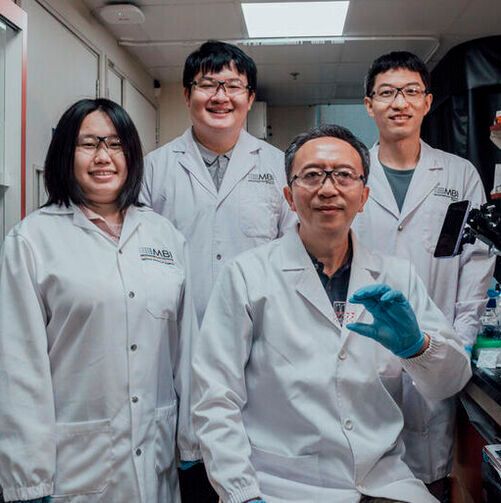
MBI researcher Professor Yan Jie (front row, right) and his team members (from left) Ms Jiang Yanqige, Dr Zhou Yu and Dr Zhao Xiaodan are developing easy-to-use diagnostic tools with high sensitivity and specificity for disease diagnosis and monitoring.
(Source: National University of Singapore)
Queenstown/Singapore – The Mechanobiology Institute (MBI) at the National University of Singapore (NUS) has recently secured 36 million dollars (49 million Singapore dollars) in funding from the National Research Foundation (NRF) to promote research aimed at advancing the field of mechanobiology and turning scientific breakthroughs into action by developing novel technologies and therapeutic targets for the treatment of age-related ailments such as infertility, chronical inflammatory diseases, muscle atrophy and cancer. The research funding will be provided over seven years, from December 2023.
Mechanobiology employs theories and techniques from various fields to facilitate the study of how physical and mechanical processes in biology could have an influence on organismal development, physiology and disease development. Discoveries in this field can have a profound impact on understanding various aspects of human health, as well as developing more effective diagnostics and therapies for diseases.
For example, during the development of gametes (eggs and sperms), mechanical signals, such as compression, stiffness and shear force, help to direct the growth and differentiation of gamete cells with high reproductive potential. Mechanobiology research on the development and ageing of these cells could lead to the discovery of new approaches to treat infertility.
Advancements in mechanobiology could also help to address age-related loss of biomechanical functions such as that associated with muscle atrophy, which occurs during ageing. During exercise, muscle cells experience and generate forces, which promote muscle growth. Understanding how cells sense and respond to changes in mechanical forces could inspire novel approaches to prevent muscle loss in older persons.
Since its establishment in 2009 with the support of NRF, Ministry of Education and NUS, MBI has made significant strides in revealing the role of mechanical signals in the development of tissues and organisms. Building on this foundation, MBI is now exploring the complexities of cellular and tissue ageing, as well as the potential
for biomedical and bioengineering solutions to combat the effects of time on the human body.
The latest NRF funding will enable MBI to make fundamental discoveries and develop novel health innovations, enhancing Singapore’s global standing as a hub of advanced biomedical research. The investment will also help attract world-class talent and investment in deep tech, aligning with Singapore’s strategic push in the biotech sector to drive improved healthcare outcomes and fuel economic growth.
MBI Director Professor Rong Li said, “Singapore, like many developed countries, is a fast-ageing society. By leveraging new knowledge generated over the course of this grant, we will develop biomedical innovations and interventions aimed at improving healthy longevity in the Singaporean population. We believe this will spur innovation and enterprise in the local biotech industry, which is fully in line with the Research, Innovation and Enterprise (RIE) 2025 plan on human health and potential.”
NUS Deputy President (Research and Technology) Professor Liu Bin said, “This new research grant from NRF reflects a significant vote of confidence in NUS’ research capabilities in biomedical sciences. MBI has established a strong reputation as a world leader in the field of mechanobiology. I am excited to see MBI raising the bar for research excellence and working closely with its research, clinical and industry partners to push the boundaries of innovation and importantly, to accelerate the translation of novel discoveries into diagnostics and therapies that will benefit patients in Singapore and beyond.”
From pioneering research to groundbreaking solutions
MBI’s research framework is streamlined into three thrusts to maximize impact.
Under Thrust 1, MBI researchers are studying how cells and tissues sense and adapt to mechanical forces — critical for treating age-related disorders and injuries. One of the key projects involves developing new imaging technologies to observe in detail how the cell interacts with its surroundings and other cells. Importantly, small changes at a nanoscopic scale in these surroundings can have profound impact on cell behavior and response to therapeutic drugs.
Date: 08.12.2025
Naturally, we always handle your personal data responsibly. Any personal data we receive from you is processed in accordance with applicable data protection legislation. For detailed information please see our privacy policy.
Consent to the use of data for promotional purposes
I hereby consent to Vogel Communications Group GmbH & Co. KG, Max-Planck-Str. 7-9, 97082 Würzburg including any affiliated companies according to §§ 15 et seq. AktG (hereafter: Vogel Communications Group) using my e-mail address to send editorial newsletters. A list of all affiliated companies can be found here
Newsletter content may include all products and services of any companies mentioned above, including for example specialist journals and books, events and fairs as well as event-related products and services, print and digital media offers and services such as additional (editorial) newsletters, raffles, lead campaigns, market research both online and offline, specialist webportals and e-learning offers. In case my personal telephone number has also been collected, it may be used for offers of aforementioned products, for services of the companies mentioned above, and market research purposes.
Additionally, my consent also includes the processing of my email address and telephone number for data matching for marketing purposes with select advertising partners such as LinkedIn, Google, and Meta. For this, Vogel Communications Group may transmit said data in hashed form to the advertising partners who then use said data to determine whether I am also a member of the mentioned advertising partner portals. Vogel Communications Group uses this feature for the purposes of re-targeting (up-selling, cross-selling, and customer loyalty), generating so-called look-alike audiences for acquisition of new customers, and as basis for exclusion for on-going advertising campaigns. Further information can be found in section “data matching for marketing purposes”.
In case I access protected data on Internet portals of Vogel Communications Group including any affiliated companies according to §§ 15 et seq. AktG, I need to provide further data in order to register for the access to such content. In return for this free access to editorial content, my data may be used in accordance with this consent for the purposes stated here. This does not apply to data matching for marketing purposes.
Right of revocation
I understand that I can revoke my consent at will. My revocation does not change the lawfulness of data processing that was conducted based on my consent leading up to my revocation. One option to declare my revocation is to use the contact form found at https://contact.vogel.de. In case I no longer wish to receive certain newsletters, I have subscribed to, I can also click on the unsubscribe link included at the end of a newsletter. Further information regarding my right of revocation and the implementation of it as well as the consequences of my revocation can be found in the data protection declaration, section editorial newsletter.
Thrust 2 explores how mechanical forces shape the development and maintenance of multicellular tissues by studying how cells interact and organize themselves. For example, MBI researchers are devising methods to cultivate and analyze ovarian follicles, cocoon-like structures in the ovary that support the growth and development of eggs. This could have profound implications for fertility treatments and the understanding of ovarian diseases.
Thrust 3 delves into the potential of mechanomedicine, characterized by the practical application of mechanical principles to diagnose and treat diseases. In one of the projects under this research thrust, MBI researchers are developing next-generation diagnostic assays that can detect disease biomarkers with supreme sensitivity and specificity, streamlining the diagnostic process for cancer and degenerative diseases such as Alzheimer’s.
Expanding research networks, boosting commercialization
To facilitate these thrusts, MBI is building a broad coalition of basic scientists, engineers and clinical researchers in Singapore, and tapping into the international mechanobiology network. MBI will also serve as a training hub for aspiring young scientists poised to tackle complex challenges in biology and medicine in the future.
MBI’s facilities include a dedicated 2,200 sqm laboratory space equipped with state-of-the-art technologies for bioimaging, microfabrication, and high-throughput genetics, supported by a team of core technical staff. The institute’s infrastructure is designed to maximize collaborative, interdisciplinary research with its clinical partners, such as the National University Health System, and academic research partners including Nanyang Technological University and the Agency for Science, Technology and Research.
MBI’s partnerships with industry leaders exemplify its efforts to translate research into real-world applications. Collaborating with Nuevocor, a Singapore-based preclinical-stage biopharmaceutical startup, MBI will identify new gene therapy targets for cardiovascular diseases such as familial dilated cardiomyopathy, one of the most common causes of heart failure. MBI also has an ongoing industrial partnership with Restem Biotech, which is based in Hong Kong and China, to develop cell-based therapies for infertility.
Beyond generating intellectual property, MBI proactively nurtures startup companies to bring laboratory breakthroughs to the marketplace. Some of MBI’s spin-off companies include Clearbridge Biomedics, Pickcell, and Prime Growth.
MBI is also partnering with NUS Enterprise – the University’s entrepreneurial arm – as well as local venture firm Paeonia Group, both with experience in commercialization of cutting-edge technologies developed in universities and research institutes.
Poised to impact human health and diseases
Over the next seven years, the NRF funding will also support MBI’s education and talent development efforts. MBI aims to train about 20 PhD students in interdisciplinary science through its dedicated MBI Graduate Programme and plans to institute a novel post-doctoral fellow training programme to identify and develop talented scientists to conduct basic and translational research across all three research thrusts.
The goals for technology transfer include identifying mechanomedicine targets, developing new technology platforms, creating diagnostic assay prototypes, filing patents for promising technologies, and building a vibrant ecosystem for discovery, innovation and commercialization.




:quality(80)/p7i.vogel.de/wcms/92/ad/92adbafb37924cea35ea3cf05b7a23e5/0130206318v2.jpeg "The world’s first fully functioning proof-of-concept quantum battery
(Source: Csiro)")
:quality(80)/p7i.vogel.de/wcms/9f/8b/9f8bc2b8491d7a514ca154e9588a07b7/0130205846v1.jpeg "The researchers’ new material, based on mineralised sawdust, is an excellent fire retardant. (Source: Dan Vivas Glaser / from Kürsteiner R et al. Chem Circularity 2026)")
:quality(80)/p7i.vogel.de/wcms/fd/73/fd73fcb3ceda89d1419de1083fcab7b4/0130081520v2.jpeg "The fingers at the heart of this technology were inspired by the fin-ray effect — a design principle derived from the natural structure of fish fins. (Source: University of Texas at Austin )")
:quality(80)/p7i.vogel.de/wcms/fe/64/fe649767c802d53ac63ee2c2a40b7e0d/0130060830v2.jpeg "Sample tube with light-active substance (Source: Elvira Eberhardt / Ulm University)")
:quality(80)/p7i.vogel.de/wcms/8f/b9/8fb98a958e4afe679865fbe52a473680/0129940982v2.jpeg "pH measurement in various nanoparticles using the Nine-Focus meter ensures precise stability and performance control. (Source: Mettler Toledo)")
:quality(80)/p7i.vogel.de/wcms/11/74/1174e5d4c8b07a64637dced8c9506b40/0129787561v2.jpeg "The Multicell Plus high-pressure reactor sets a new benchmark for operator safety, all-round accessibility and ease-of-use. (Source: Asynt)")
:quality(80)/p7i.vogel.de/wcms/ef/6e/ef6e96191183411973b77041fb6b1e16/0129785957v2.jpeg "Manufactured from high-quality crystal polystyrene - these new automation-ready plates are available in a choice of ANSI / SLAS standard (96-well and breakable 8-well strip) formats. (Source: Porvair Sciences)")
:quality(80)/p7i.vogel.de/wcms/ad/ca/adcaa20ef5ccaf7e3b325788b1e349c4/0129784872v2.jpeg "The high performance Degasi Flat Film in-line degasser. (Source: Biotech Fluidics)")
:quality(80)/p7i.vogel.de/wcms/e9/9c/e99cb19231197af70c489cb4acc2ead0/0130293444v2.jpeg "A new global study, led by researchers at Kaust in Saudi Arabia, shows that forests are most effective for climate regulation when conserved or restored in their natural or native locations. (Source: Kaust )")
:quality(80)/p7i.vogel.de/wcms/af/40/af40b535eb65c287fbd22ed5483d1d0e/0130206243v2.jpeg "The researchers dug soil pits in order to measure the carbon storage in soil
(Source: Johanna Asch)")
:quality(80)/p7i.vogel.de/wcms/2d/45/2d45aba62f5042baa00f7fd4fa629839/0130036533v2.jpeg "The population of Pune, India, is expected to reach 11 million by 2050. (Source: free licensed)")
:quality(80)/p7i.vogel.de/wcms/52/f8/52f8d5521fdab07ed0a865ec0d8919fd/0130009438v2.jpeg "Drylands support around half of global livestock production and sustain the livelihoods of close to a billion people, while also underpinning soil stability and carbon storage. (Source: Kaust )")
:quality(80)/p7i.vogel.de/wcms/6f/ba/6fba92196d0cbb1467334f8a2ecc520a/0130203021v2.jpeg "Low to moderate wine consumption shows lower risk compared with spirits, beer and cider (Source: free licensed)")
:quality(80)/p7i.vogel.de/wcms/a9/37/a9376f1d9a893570023d9aa97c085bc5/0129927485v2.jpeg "Examples of foods high in PUFAs include fatty fish and soybeans, while MUFAs include olive oil and avocadoes. (Source: free licensed)")
:quality(80)/p7i.vogel.de/wcms/ea/88/ea88ef8810e21cdd9bb852c70f385ba1/0129797385v2.jpeg "A team of NUS food scientists consisting of Assoc Prof Liu Shao Quan (centre), Dr Lu Yuyun (right) and Ms Geng Chenhan (left) pioneered a co-fermentation method that improves both the nutrient and flavor profile of kombu. (Source: NUS)")
:quality(80)/p7i.vogel.de/wcms/84/2c/842c7c1678ceeec7147ea3a36e238e75/0129356324v2.jpeg "Kaust and Nadec have signed a MOU that establishes a framework for long-term cooperation across agricultural research, technology development, and professional training. (Source: Kaust )")
:quality(80)/p7i.vogel.de/wcms/6e/b9/6eb95805568aa78dc2ed57f829cf33d4/0130300421v2.jpeg "A 10-minute digital program co-developed by a University of Texas psychologist significantly reduced symptoms of depression four weeks after use, according to results from one of the largest randomized controlled trials of single-session mental health interventions. (Source: University of Texas at Austin )")
:quality(80)/p7i.vogel.de/wcms/6f/e9/6fe9d920eca2c0b3bdeb55cbe9f01908/0130299237v2.jpeg "Study authors Jason Miska and Leah Billingham reading out enzymatic activity of microglia in cell cultures. (Source: Northwestern University.)")
:quality(80)/p7i.vogel.de/wcms/c4/54/c454661a9dd459cf7c5b632f79829358/0130284530v2.jpeg "The study shows that AI can be used to assess the build-up of calcium deposits in the arteries of the breast from the standard X-ray mammography scans that are currently used in routine breast cancer screening. (Source: ESC)")
:quality(80)/p7i.vogel.de/wcms/67/9b/679b140c164dbd7c4fe9eda4da91329b/0130281406v3.jpeg "This is the highest resolution molecular structure ever constructed of a key protein complex on the surface of the Andes virus, called the Gn-Gc tetramer, that enables it to infect cells. (Source: University of Texas at Austin)")
:quality(80)/images.vogel.de/vogelonline/bdb/1710600/1710675/original.jpg "Discover how to set yourself up for success when performing balance-based density determination of solids such as jewelry and precious metals. (Mettler Toledo)")
:quality(80)/images.vogel.de/vogelonline/bdb/1682500/1682579/original.jpg "The new XPR Analytical balance redesigned to meet the needs of laboratory technicians of working fast and lean. (Mettler Toledo)")
:quality(80)/images.vogel.de/vogelonline/bdb/1677000/1677080/original.jpg "Enhance your weighing accuracy, comfort and productivity with the redesigned XPR Analytical balance. (Mettler Toledo)")
:quality(80)/p7i.vogel.de/wcms/b0/10/b010e660caa030dc3fa5ee69439dcb9b/0125195464v2.jpeg "Asst Prof Jennifer Young (right) and PhD student Avery Rui Sun (left), who are from the College of Design and Engineering at NUS, image heart cells (orange) on Decipher scaffolds (pink) using a confocal microscope to understand how cells interact with the extracellular matrix. (Source: NUS)")
:quality(80)/p7i.vogel.de/wcms/fd/98/fd98a33070514a059a7b42694751ad00/0123969076v2.jpeg "Professor Tan Eng Chye (fifth from left), NUS President, met Dr Lidong Zhou (fourth from left), Corporate Vice President and Managing Director of MSRA, and Ms Lee Hui Li (sixth from right), Managing Director of Microsoft Singapore, in 2024. (Source: Microsoft Research Asia)")