The Alfred Wegener Institute (AWI) demonstrates that storm Boris would have produced 9 % less rain without global warming, highlighting climate change’s effect on extreme weather. AWI’s new modelling approach, “storylines,” visualizes the impact of climate change on current weather events, making complex data more understandable.
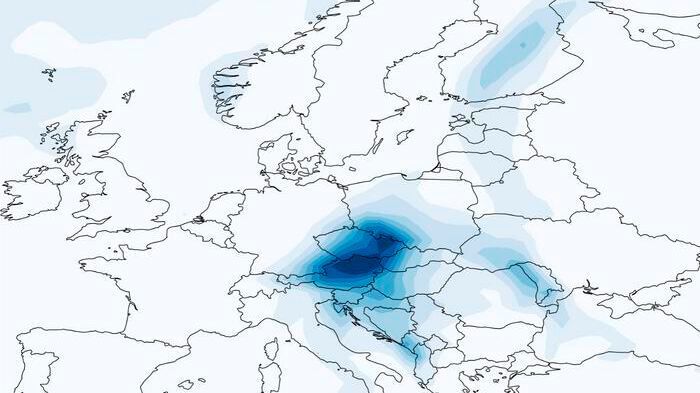
Precipitation amounts from storm "Boris" from 12 to 16 September 2024.
Only a few weeks ago, massive precipitation produced by the storm “Boris” led to chaos and flooding in Central and Eastern Europe. An analysis conducted by the Alfred Wegener Institute shows that in a world without the current level of global warming Boris would have deposited roughly nine percent less rain. Such conclusions can be drawn thanks to a new modelling approach called ‘storylines’. How it can be used in near-real-time was just presented in the Nature journal Communications Earth & Environment. At the same time, the AWI team released a freely available online tool that allows users to identify the fingerprints of climate change in current extreme weather events and create their own comparison graphics.
In mid-September, the storm “Boris” produced torrential rains and extreme flooding in Poland, the Czech Republic, Austria and Romania. In many of the affected regions, it was one of the highest amounts of precipitation ever recorded in a five-day period. There were at least 27 fatalities, while countless families were forced to leave their homes. In the meantime, the situation has improved and cleanup efforts are running round the clock. But already the next weather extremes, this time in Spain, are cause for concern. Time and time again, a central question arises in public, political, and media forums: was the catastrophe caused by global climate change?
Gallery
“For the past few years, science has been able to provide robust answers to this absolutely legitimate question,” says lead author Dr Marylou Athanase, a physicist in the Climate Dynamics Section of the Alfred Wegener Institute, Helmholtz Centre for Polar and Marine Research (AWI). “As early as one or two weeks after a given event, so-called probabilistic attribution studies can be used to draw initial conclusions on how much more probable the event was, due to climate change.”
The only problem: probabilities are often somewhat intangible, especially when they collide with concrete and exceptional, real-world events. When it comes to external communications — with the public and decision-makers — the scientific community has never had a tool that could show the influence of global climate change on the actual local weather in an impressive yet readily understandable way. “That’s why we at the AWI have worked so hard to advance a totally new way — the ‘storyline’ approach,” explains Dr Antonio Sánchez-Benítez, a fellow physicist in the Climate Dynamics Section and co-lead author of the study. “Essentially, we apply the ‘what if?’ principle. What would a given catastrophe look like in a world without climate change? And what about in a climate that was even warmer? By comparing the hypothetical scenarios with the reality, we can then very clearly identify the fingerprints of climate change — and not just for extreme weather events, but also for day-to-day weather.”
Using storm Boris as an example, the AWI experts have now demonstrated what the new approach can do in the Nature journal Communications Earth & Environment. A comparison of the scenarios shows: without global warming, Boris would have deposited roughly nine percent less rain. In reality, however, on its way from the eastern Mediterannean and the Black Sea toward Central Europe, the storm was able to gather in intensity because the water was roughly two degrees Celsius warmer than preindustrial levels — which meant a correspondingly higher percentage of water vapour in the air above the region. Nine percent might not sound like much, but when it comes to the consequences of heavy rains, it always comes down to how much water gathers on the surface and where it all goes — can a river, a dam, or a sewage system hold it, or does it spill over, doing tremendous damage in the process?
But how did the experts manage to connect climate model-based simulations, which are mainly designed for long-term trends, with the actual local weather? “One important aspect is what is known as ‘nudging’”, explains Dr Helge Gößling, a climate physicist and team lead of the storyline research at the AWI. “Climate models normally simulate a specific, quasi-random sequence of weather conditions, which is consistent with the laws of physics that their programming is based on. In order to identify differences in the climate, you need to see whether the mean values and distributions change, over a long period of time with a correspondingly large number of weather conditions. Likewise, in weather models the simulated conditions have very little to do with the reality after a few weeks; the actual weather can only be predicted to a limited extent. With the ‘nudging’, we provide the model with actually observed wind data, including phenomena like the jet stream, and we nudge the model a bit in the direction of the actually observed wind. In this way, we can accurately reproduce real weather in the real climate. Then we change the background climate of the model, for instance to a world untouched by climate change by reducing the greenhouse-gas concentrations and adjusting other aspects, and repeat the experiment.”
Date: 08.12.2025
Naturally, we always handle your personal data responsibly. Any personal data we receive from you is processed in accordance with applicable data protection legislation. For detailed information please see our privacy policy.
Consent to the use of data for promotional purposes
I hereby consent to Vogel Communications Group GmbH & Co. KG, Max-Planck-Str. 7-9, 97082 Würzburg including any affiliated companies according to §§ 15 et seq. AktG (hereafter: Vogel Communications Group) using my e-mail address to send editorial newsletters. A list of all affiliated companies can be found here
Newsletter content may include all products and services of any companies mentioned above, including for example specialist journals and books, events and fairs as well as event-related products and services, print and digital media offers and services such as additional (editorial) newsletters, raffles, lead campaigns, market research both online and offline, specialist webportals and e-learning offers. In case my personal telephone number has also been collected, it may be used for offers of aforementioned products, for services of the companies mentioned above, and market research purposes.
Additionally, my consent also includes the processing of my email address and telephone number for data matching for marketing purposes with select advertising partners such as LinkedIn, Google, and Meta. For this, Vogel Communications Group may transmit said data in hashed form to the advertising partners who then use said data to determine whether I am also a member of the mentioned advertising partner portals. Vogel Communications Group uses this feature for the purposes of re-targeting (up-selling, cross-selling, and customer loyalty), generating so-called look-alike audiences for acquisition of new customers, and as basis for exclusion for on-going advertising campaigns. Further information can be found in section “data matching for marketing purposes”.
In case I access protected data on Internet portals of Vogel Communications Group including any affiliated companies according to §§ 15 et seq. AktG, I need to provide further data in order to register for the access to such content. In return for this free access to editorial content, my data may be used in accordance with this consent for the purposes stated here. This does not apply to data matching for marketing purposes.
Right of revocation
I understand that I can revoke my consent at will. My revocation does not change the lawfulness of data processing that was conducted based on my consent leading up to my revocation. One option to declare my revocation is to use the contact form found at https://contact.vogel.de. In case I no longer wish to receive certain newsletters, I have subscribed to, I can also click on the unsubscribe link included at the end of a newsletter. Further information regarding my right of revocation and the implementation of it as well as the consequences of my revocation can be found in the data protection declaration, section editorial newsletter.
The model used is the CMIP6 version of the AWI climate model, which was also part of the base data for the IPCC’s Sixth Assessment Report. The wind data fed into the model stems from the ERA5 reanalysis produced by the European Centre for Medium-Range Weather Forecasts (ECMWF). “We have since automated the system to the point where daily analyses on the current weather are run on the supercomputer at the German Climate Computing Center (DKRZ),” says Marylou Athanase. “The data is then transferred to an online tool that runs on the AWI’s servers and is freely accessible to everyone at https://climate-storylines.awi.de. The analyses are conducted with a three-day delay on ‘real-time’, after which they’re available online. As a result, interested users can log on anytime to see the ‘Climate Change Signal of the Day’ for extremes and everyday weather, around the globe and in near-real-time, in the form of interactive maps and timelines, though for the time being, only data on the temperature and precipitation from 1 January 2024 onwards is available. Our goal is to promote a better understanding of the connections between climate change and extreme weather events, and to supply concrete and timely answers that can also be used in media coverage of these events.”
Original Publication: Marylou Athanase, Antonio Sánchez-Benítez, Eva Monfort, Thomas Jung, Helge F. Goessling (2024). How climate change intensified storm Boris’ extreme rainfall, revealed by near-real-time storylines. Nature Communications Earth & Environment; DOI: https://doi.org/10.1038/s43247-024-01847-0




:quality(80)/p7i.vogel.de/wcms/92/ad/92adbafb37924cea35ea3cf05b7a23e5/0130206318v2.jpeg "The world’s first fully functioning proof-of-concept quantum battery
(Source: Csiro)")
:quality(80)/p7i.vogel.de/wcms/9f/8b/9f8bc2b8491d7a514ca154e9588a07b7/0130205846v1.jpeg "The researchers’ new material, based on mineralised sawdust, is an excellent fire retardant. (Source: Dan Vivas Glaser / from Kürsteiner R et al. Chem Circularity 2026)")
:quality(80)/p7i.vogel.de/wcms/fd/73/fd73fcb3ceda89d1419de1083fcab7b4/0130081520v2.jpeg "The fingers at the heart of this technology were inspired by the fin-ray effect — a design principle derived from the natural structure of fish fins. (Source: University of Texas at Austin )")
:quality(80)/p7i.vogel.de/wcms/fe/64/fe649767c802d53ac63ee2c2a40b7e0d/0130060830v2.jpeg "Sample tube with light-active substance (Source: Elvira Eberhardt / Ulm University)")
:quality(80)/p7i.vogel.de/wcms/8f/b9/8fb98a958e4afe679865fbe52a473680/0129940982v2.jpeg "pH measurement in various nanoparticles using the Nine-Focus meter ensures precise stability and performance control. (Source: Mettler Toledo)")
:quality(80)/p7i.vogel.de/wcms/11/74/1174e5d4c8b07a64637dced8c9506b40/0129787561v2.jpeg "The Multicell Plus high-pressure reactor sets a new benchmark for operator safety, all-round accessibility and ease-of-use. (Source: Asynt)")
:quality(80)/p7i.vogel.de/wcms/ef/6e/ef6e96191183411973b77041fb6b1e16/0129785957v2.jpeg "Manufactured from high-quality crystal polystyrene - these new automation-ready plates are available in a choice of ANSI / SLAS standard (96-well and breakable 8-well strip) formats. (Source: Porvair Sciences)")
:quality(80)/p7i.vogel.de/wcms/ad/ca/adcaa20ef5ccaf7e3b325788b1e349c4/0129784872v2.jpeg "The high performance Degasi Flat Film in-line degasser. (Source: Biotech Fluidics)")
:quality(80)/p7i.vogel.de/wcms/e9/9c/e99cb19231197af70c489cb4acc2ead0/0130293444v2.jpeg "A new global study, led by researchers at Kaust in Saudi Arabia, shows that forests are most effective for climate regulation when conserved or restored in their natural or native locations. (Source: Kaust )")
:quality(80)/p7i.vogel.de/wcms/af/40/af40b535eb65c287fbd22ed5483d1d0e/0130206243v2.jpeg "The researchers dug soil pits in order to measure the carbon storage in soil
(Source: Johanna Asch)")
:quality(80)/p7i.vogel.de/wcms/2d/45/2d45aba62f5042baa00f7fd4fa629839/0130036533v2.jpeg "The population of Pune, India, is expected to reach 11 million by 2050. (Source: free licensed)")
:quality(80)/p7i.vogel.de/wcms/52/f8/52f8d5521fdab07ed0a865ec0d8919fd/0130009438v2.jpeg "Drylands support around half of global livestock production and sustain the livelihoods of close to a billion people, while also underpinning soil stability and carbon storage. (Source: Kaust )")
:quality(80)/p7i.vogel.de/wcms/6f/ba/6fba92196d0cbb1467334f8a2ecc520a/0130203021v2.jpeg "Low to moderate wine consumption shows lower risk compared with spirits, beer and cider (Source: free licensed)")
:quality(80)/p7i.vogel.de/wcms/a9/37/a9376f1d9a893570023d9aa97c085bc5/0129927485v2.jpeg "Examples of foods high in PUFAs include fatty fish and soybeans, while MUFAs include olive oil and avocadoes. (Source: free licensed)")
:quality(80)/p7i.vogel.de/wcms/ea/88/ea88ef8810e21cdd9bb852c70f385ba1/0129797385v2.jpeg "A team of NUS food scientists consisting of Assoc Prof Liu Shao Quan (centre), Dr Lu Yuyun (right) and Ms Geng Chenhan (left) pioneered a co-fermentation method that improves both the nutrient and flavor profile of kombu. (Source: NUS)")
:quality(80)/p7i.vogel.de/wcms/84/2c/842c7c1678ceeec7147ea3a36e238e75/0129356324v2.jpeg "Kaust and Nadec have signed a MOU that establishes a framework for long-term cooperation across agricultural research, technology development, and professional training. (Source: Kaust )")
:quality(80)/p7i.vogel.de/wcms/66/a6/66a64c9dd7dbe84d2d7ea95a5e691bb1/0130361609v2.jpeg "Dr. Priya Freaney speaking to a patient at Bluhm Cardiovascular Institute at Northwestern Memorial Hospital in Chicago. (Source: Northwestern Medicine)")
:quality(80)/p7i.vogel.de/wcms/6e/d4/6ed479ad990b9ddc0f2eeadccccf62c7/0130359257v2.jpeg "Routine early measurement of neurofilament light chain could help improve prediction of cognitive impairment after out-of-hospital cardiac arrest, according to a study presented recently at ESC Acute Cardiovascular Care 2026. (Source: Pixabay)")
:quality(80)/p7i.vogel.de/wcms/6e/b9/6eb95805568aa78dc2ed57f829cf33d4/0130300421v2.jpeg "A 10-minute digital program co-developed by a University of Texas psychologist significantly reduced symptoms of depression four weeks after use, according to results from one of the largest randomized controlled trials of single-session mental health interventions. (Source: University of Texas at Austin )")
:quality(80)/p7i.vogel.de/wcms/6f/e9/6fe9d920eca2c0b3bdeb55cbe9f01908/0130299237v2.jpeg "Study authors Jason Miska and Leah Billingham reading out enzymatic activity of microglia in cell cultures. (Source: Northwestern University.)")
:quality(80)/images.vogel.de/vogelonline/bdb/1710600/1710675/original.jpg "Discover how to set yourself up for success when performing balance-based density determination of solids such as jewelry and precious metals. (Mettler Toledo)")
:quality(80)/images.vogel.de/vogelonline/bdb/1682500/1682579/original.jpg "The new XPR Analytical balance redesigned to meet the needs of laboratory technicians of working fast and lean. (Mettler Toledo)")
:quality(80)/images.vogel.de/vogelonline/bdb/1677000/1677080/original.jpg "Enhance your weighing accuracy, comfort and productivity with the redesigned XPR Analytical balance. (Mettler Toledo)")
:quality(80)/p7i.vogel.de/wcms/3b/f2/3bf29e275e8d7e03430832385487213b/0121686806v1.jpeg "Precipitation amounts of storm \"Boris\" from 12 to 16 September 2024 in (a) observations and (b) simulation (in millimetres). The simulated change in precipitation due to climate change to date is shown in (c), the simulated further change in the course of a possible strong additional warming is shown in (d).(Source: Alfred-Wegener-Institut / Marylou Athanase)")
:quality(80)/p7i.vogel.de/wcms/67/69/6769f10ab576ba74f8fdbd7db5e69eac/0121686805v1.jpeg "Precipitation amounts from storm \"Boris\" from 12 to 16 September 2024.(Source: Alfred-Wegener-Institut / Marylou Athanase)")
:quality(80)/p7i.vogel.de/wcms/57/7a/577a28bca081eafcd6922748aafea0de/0118773927v2.jpeg "In new studies of recent events in both the UK and U.S., they assessed the impact of global warming at a local scale and found that human activity both worsened specific weather events and made them more likely to occur. (Source: Pixabay)")
:quality(80)/p7i.vogel.de/wcms/d9/f8/d9f82dbc05c3b73e34f37e9a3a4f9ad1/0126746946v2.jpeg "A supercell thunderstorm over Lake Maggiore, photographed from Locarno Monti. (Source: © Meteoswiss, Luca Panziera)")
:quality(80)/p7i.vogel.de/wcms/b8/2f/b82f6780686354bbcc429398910297fb/0126916407v2.jpeg "Stanford-led study warns wildfire smoke could cause up to 70,000 U.S. deaths annually by 2050. (Source: free licensed)")