Apparently so. Scientists have developed a new, potent injectable therapy that has the potential to protect the heart from damage after a heart attack.
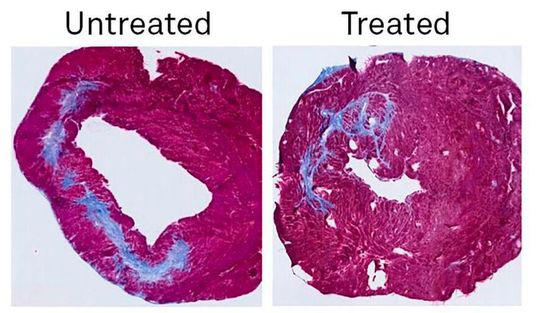
Samples of heart tissue from the study. The sample on the right, which was treated with the PLP therapy, shows decreased scarring (in blue) compared to the untreated sample on the left.
Evanston/USA – Scientists at Northwestern University and University of California San Diego have developed a new, potent injectable therapy that can protect the heart from damage after a heart attack.
The therapeutic approach comprises specially designed polymers that act like proteins. These protein-like polymers (PLPs) “grab” onto regulatory proteins, which blunt the body’s natural healing process, in heart tissue. With those proteins out of the way, the healing proteins are free to do their job — preventing stress and inflammation.
After showing success in cell culture, the scientists tested their new therapy in a rat model of heart attack. Following a single, low-dose intravenous injection, the animals experienced decreased inflammation and cell death along with improved cardiac function and increased growth of new blood vessels.
The study was published recently on April 25 in the journal Advanced Materials. The PLP platform is being commercialized by Northwestern spin-out company Grove Biopharma, which recently closed a 30-million-dollar series A financing round.
“Heart disease remains the leading cause of death worldwide, with heart attacks accounting for many of those deaths,” said Northwestern’s Nathan Gianneschi, a senior author of the study and scientific founder of Grove Biopharma. “Despite this startling regularity, there is relatively little that can be done to change the course of the subsequent progression to heart failure. Our work introduces an entirely new type of therapy capable of addressing previously ‘undruggable’ targets within the cells. It offers a promising strategy to change the course of this devastating disease.”
“Preventing heart failure after a heart attack is still a major unmet clinical need,” said UC San Diego’s Karen Christman, who co-led the study with Gianneschi. “The goal of this therapy is to intervene very soon after someone suffers a heart attack to keep them from ultimately going into heart failure.”
Gianneschi is the Jacob and Rosaline Cohn Professor of Chemistry at Northwestern's Weinberg College of Arts and Sciences, a professor of materials science and engineering and of biomedical engineering at the McCormick School of Engineering and a professor of pharmacology at Feinberg School of Medicine. He also is a member of the International Institute for Nanotechnology, the Chemistry of Life Processes Institute, the Querrey Simpson Institute for Regenerative Engineering at Northwestern University (RENU) and the Robert H. Lurie Comprehensive Cancer Center of Northwestern University. Christman is a Professor in the Shu Chien-Gene Lay Department of Bioengineering at the UC San Diego Jacobs School of Engineering.
From heart attack to heart failure
According to the U.S. Centers for Disease Control and Prevention, 6.7 million Americans over the age of 20 have heart failure, which occurs when the heart is unable to pump enough blood to the rest of the body. After developing heart failure, 52.6 % of patients die within five years. The most significant cause of heart failure is a heart attack, which affects more than 800,000 Americans each year.
When a person suffers a heart attack, their heart muscle often becomes damaged due to a lack of oxygen and increased oxidative stress. This damage can lead to inflammation and scarring, which eventually weakens the heart and causes heart failure. Although current treatments exist to restore blood flow, these methods do not fully prevent the long-term damage that leads to heart failure over time.
To address this unmet need, the research team focused on the interaction between two proteins: Keap1 and Nrf2. While Nrf2 protects heart cells from stress and inflammation, Keap1 physically binds to Nrf2, regulating its function. This prevents Nrf2 from entering the cell’s nucleus, where it can activate protective genes.
“Based on past biological studies, Nrf2 has been shown to have a positive effect on heart health following heart attack,” Gianneschi said. “We wanted to see if boosting Nrf2 could act to help the body heal itself after a heart attack.”
Freeing protective proteins
In previous studies, Gianneschi and his colleagues invented the PLP platform, in which nanoscale precision polymers mimic proteins to act like artificial antibodies. Once inside cells, they “grab” biological targets. In the new study, Gianneschi, Christman and their teams engineered a PLP with multiple “arms” that can grab onto Keap1. These “arms” mimic a part of the Nrf2 protein that typically binds to Keap1.
Date: 08.12.2025
Naturally, we always handle your personal data responsibly. Any personal data we receive from you is processed in accordance with applicable data protection legislation. For detailed information please see our privacy policy.
Consent to the use of data for promotional purposes
I hereby consent to Vogel Communications Group GmbH & Co. KG, Max-Planck-Str. 7-9, 97082 Würzburg including any affiliated companies according to §§ 15 et seq. AktG (hereafter: Vogel Communications Group) using my e-mail address to send editorial newsletters. A list of all affiliated companies can be found here
Newsletter content may include all products and services of any companies mentioned above, including for example specialist journals and books, events and fairs as well as event-related products and services, print and digital media offers and services such as additional (editorial) newsletters, raffles, lead campaigns, market research both online and offline, specialist webportals and e-learning offers. In case my personal telephone number has also been collected, it may be used for offers of aforementioned products, for services of the companies mentioned above, and market research purposes.
Additionally, my consent also includes the processing of my email address and telephone number for data matching for marketing purposes with select advertising partners such as LinkedIn, Google, and Meta. For this, Vogel Communications Group may transmit said data in hashed form to the advertising partners who then use said data to determine whether I am also a member of the mentioned advertising partner portals. Vogel Communications Group uses this feature for the purposes of re-targeting (up-selling, cross-selling, and customer loyalty), generating so-called look-alike audiences for acquisition of new customers, and as basis for exclusion for on-going advertising campaigns. Further information can be found in section “data matching for marketing purposes”.
In case I access protected data on Internet portals of Vogel Communications Group including any affiliated companies according to §§ 15 et seq. AktG, I need to provide further data in order to register for the access to such content. In return for this free access to editorial content, my data may be used in accordance with this consent for the purposes stated here. This does not apply to data matching for marketing purposes.
Right of revocation
I understand that I can revoke my consent at will. My revocation does not change the lawfulness of data processing that was conducted based on my consent leading up to my revocation. One option to declare my revocation is to use the contact form found at https://contact.vogel.de. In case I no longer wish to receive certain newsletters, I have subscribed to, I can also click on the unsubscribe link included at the end of a newsletter. Further information regarding my right of revocation and the implementation of it as well as the consequences of my revocation can be found in the data protection declaration, section editorial newsletter.
Because it has many “arms,” the PLP binds strongly to Keap1, preventing it from grabbing onto the real Nrf2. With Keap1 out of the way, Nrf2 can move into the heart cell’s nucleus to exert its protective effects.
After developing the system, the researchers conducted laboratory tests on heart muscle cells to evaluate its effectiveness. In experiments, the PLPs — even at very low concentrations — successfully protected cells from damage caused by oxidative stress. Next, the team administered a single dose of PLP intravenously in a small animal model of heart attack. Not only did the therapy improve how well the animal’s heart functioned, it also remained effective up to five weeks after the injection. Further testing showed the cells expressed more Nrf2-related genes, which promote healing.
Tackling other ‘undruggable’ targets
The researchers say this novel PLP platform represents a significant advancement in therapeutic development, offering a new tool to tackle challenging biological targets where traditional approaches have fallen short. With Grove Biopharma, researchers are developing PLPs to target protein-protein interactions in various diseases, with an initial focus on cancer and neurodegenerative diseases.
“Proteins are the molecular machines that drive all essential cellular function, and dysregulated intracellular protein-protein interactions are the cause of many human diseases,” Gianneschi said. “Existing drug modalities are either unable to penetrate cells or cannot effectively engage these large disease target domains. We are looking at these challenges through a new lens, and I am excited to continue collaborating with the Grove team to help advance this new modality to the clinic.”
The study, “Protein-like polymers targeting Keap1/Nrf2 as a therapeutic for myocardial infarction,” was supported by the National Institutes of Health National Heart, Lung, and Blood Institute (award numbers 2R01HL139001 and R00CA248715).




:quality(80)/p7i.vogel.de/wcms/92/ad/92adbafb37924cea35ea3cf05b7a23e5/0130206318v2.jpeg "The world’s first fully functioning proof-of-concept quantum battery
(Source: Csiro)")
:quality(80)/p7i.vogel.de/wcms/9f/8b/9f8bc2b8491d7a514ca154e9588a07b7/0130205846v1.jpeg "The researchers’ new material, based on mineralised sawdust, is an excellent fire retardant. (Source: Dan Vivas Glaser / from Kürsteiner R et al. Chem Circularity 2026)")
:quality(80)/p7i.vogel.de/wcms/fd/73/fd73fcb3ceda89d1419de1083fcab7b4/0130081520v2.jpeg "The fingers at the heart of this technology were inspired by the fin-ray effect — a design principle derived from the natural structure of fish fins. (Source: University of Texas at Austin )")
:quality(80)/p7i.vogel.de/wcms/fe/64/fe649767c802d53ac63ee2c2a40b7e0d/0130060830v2.jpeg "Sample tube with light-active substance (Source: Elvira Eberhardt / Ulm University)")
:quality(80)/p7i.vogel.de/wcms/8f/b9/8fb98a958e4afe679865fbe52a473680/0129940982v2.jpeg "pH measurement in various nanoparticles using the Nine-Focus meter ensures precise stability and performance control. (Source: Mettler Toledo)")
:quality(80)/p7i.vogel.de/wcms/11/74/1174e5d4c8b07a64637dced8c9506b40/0129787561v2.jpeg "The Multicell Plus high-pressure reactor sets a new benchmark for operator safety, all-round accessibility and ease-of-use. (Source: Asynt)")
:quality(80)/p7i.vogel.de/wcms/ef/6e/ef6e96191183411973b77041fb6b1e16/0129785957v2.jpeg "Manufactured from high-quality crystal polystyrene - these new automation-ready plates are available in a choice of ANSI / SLAS standard (96-well and breakable 8-well strip) formats. (Source: Porvair Sciences)")
:quality(80)/p7i.vogel.de/wcms/ad/ca/adcaa20ef5ccaf7e3b325788b1e349c4/0129784872v2.jpeg "The high performance Degasi Flat Film in-line degasser. (Source: Biotech Fluidics)")
:quality(80)/p7i.vogel.de/wcms/af/40/af40b535eb65c287fbd22ed5483d1d0e/0130206243v2.jpeg "The researchers dug soil pits in order to measure the carbon storage in soil
(Source: Johanna Asch)")
:quality(80)/p7i.vogel.de/wcms/2d/45/2d45aba62f5042baa00f7fd4fa629839/0130036533v2.jpeg "The population of Pune, India, is expected to reach 11 million by 2050. (Source: free licensed)")
:quality(80)/p7i.vogel.de/wcms/52/f8/52f8d5521fdab07ed0a865ec0d8919fd/0130009438v2.jpeg "Drylands support around half of global livestock production and sustain the livelihoods of close to a billion people, while also underpinning soil stability and carbon storage. (Source: Kaust )")
:quality(80)/p7i.vogel.de/wcms/fe/49/fe494ada322615b6e6f6ff0f5bb7c5cf/0129926008v2.jpeg "A mandrill eating fruit. (Source: University of Bristol )")
:quality(80)/p7i.vogel.de/wcms/6f/ba/6fba92196d0cbb1467334f8a2ecc520a/0130203021v2.jpeg "Low to moderate wine consumption shows lower risk compared with spirits, beer and cider (Source: free licensed)")
:quality(80)/p7i.vogel.de/wcms/a9/37/a9376f1d9a893570023d9aa97c085bc5/0129927485v2.jpeg "Examples of foods high in PUFAs include fatty fish and soybeans, while MUFAs include olive oil and avocadoes. (Source: free licensed)")
:quality(80)/p7i.vogel.de/wcms/ea/88/ea88ef8810e21cdd9bb852c70f385ba1/0129797385v2.jpeg "A team of NUS food scientists consisting of Assoc Prof Liu Shao Quan (centre), Dr Lu Yuyun (right) and Ms Geng Chenhan (left) pioneered a co-fermentation method that improves both the nutrient and flavor profile of kombu. (Source: NUS)")
:quality(80)/p7i.vogel.de/wcms/84/2c/842c7c1678ceeec7147ea3a36e238e75/0129356324v2.jpeg "Kaust and Nadec have signed a MOU that establishes a framework for long-term cooperation across agricultural research, technology development, and professional training. (Source: Kaust )")
:quality(80)/p7i.vogel.de/wcms/e9/73/e9732473361377610267347df55071a1/0130205830v2.jpeg "Sleep EEG signals may reveal whether the brain is aging faster than the body — and help identify elevated dementia risk earlier. (Source: free licensed)")
:quality(80)/p7i.vogel.de/wcms/ed/c0/edc0c1a86229b11efd17c5e3f94d14da/0130081211v2.jpeg "A new study finds that virtual visits did not make it easier for psychiatrists, psychologists and therapists to reach significantly more people in areas where access to care has long been limited. (Source: Pixabay)")
:quality(80)/p7i.vogel.de/wcms/9c/52/9c52318bc94be17e6662dfceffa4a0c0/0130060546v2.jpeg "Domestic cat ‘Lanni’ from co-author of the study, Latasha Ludwig, Assistant Clinical Professor at Cornell University, USA. (Source: © Latasha Ludwig)")
:quality(80)/p7i.vogel.de/wcms/4b/f4/4bf4cc9e28e65e11a27dd41da2d1a7f5/0130038185v2.jpeg "The biomarker p-tau217 could help identify women at elevated dementia risk decades before clinical symptoms begin. (Source: free licensed)")
:quality(80)/images.vogel.de/vogelonline/bdb/1710600/1710675/original.jpg "Discover how to set yourself up for success when performing balance-based density determination of solids such as jewelry and precious metals. (Mettler Toledo)")
:quality(80)/images.vogel.de/vogelonline/bdb/1682500/1682579/original.jpg "The new XPR Analytical balance redesigned to meet the needs of laboratory technicians of working fast and lean. (Mettler Toledo)")
:quality(80)/images.vogel.de/vogelonline/bdb/1677000/1677080/original.jpg "Enhance your weighing accuracy, comfort and productivity with the redesigned XPR Analytical balance. (Mettler Toledo)")
:quality(80)/p7i.vogel.de/wcms/6e/b4/6eb490e9ca40cb42034b3052a874e46e/0129778274v2.jpeg "The researchers tested a specific class of these PLPs, called Hydracs (Hybrid Degrading Copolymers), on two particularly problematic proteins: MYC and KRAS. (Source: Nathan Gianneschi/Northwestern University)")
:quality(80)/p7i.vogel.de/wcms/7c/ad/7cad9f6e24173d03be0ce5b66579e4d7/0129134543v2.jpeg "Northwestern University scientists have developed an injectable regenerative nanomaterial that helps protect the brain during this vulnerable window. (Source: Pixabay)")